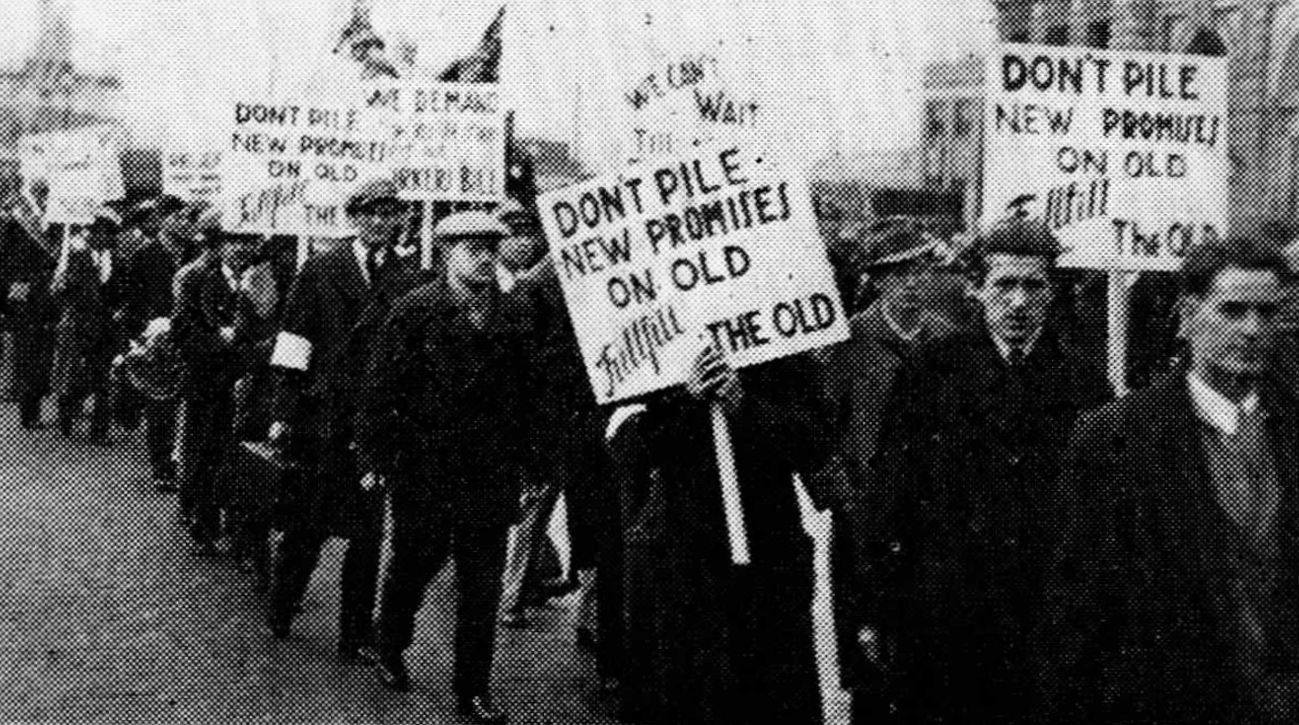
High drama as two columns of Hunger Marchers attempt to converge in Albany, New York’s capital, to demand relief during the Great Depression and are met at the Dunn Memorial Bridge by police clubs and mass arrests.
‘A Hunger Marcher’s Report’ by David Lurie from New Masses. Vol. 13 No. 7. November 13, 1934.
The Dunn Memorial Bridge appears suddenly as you turn the last corner in Rensselaer on the road to Albany. It is a big bridge, a million dollar bridge of which the Albany Chamber of Commerce is very proud. Rensselaer is a small railroad town just opposite Albany. Its police chief, who met us four miles before the bridge, was very polite: “I know you people don’t want any trouble and we don’t want any trouble. We will give you a safe escort to the bridge, but don’t make us responsible for what happens after. Don’t take it out on the people of Rensselaer on your way back—whatever happens in Albany.”
It was already late, it would soon be dark. We decided to go ahead without waiting for the up-state Hunger Marchers who were to meet us outside Rensselaer for a joint entry into Albany.
“The Rensselaer police left us at the bridge. The Albany cops were waiting, lined up on both sides of the bridge on foot and on motorcycles, shifting expectantly from foot to foot, getting a firmer grasp on their clubs. We saw them standing there. We knew what was coming, but we rolled slowly toward them. The two lines closed on us like the jaws of a trap. They opened the door of the car at the head of our line and demanded the driver’s license. As the driver reached for it, the first club smashed down on the head of the fellow next to him. The first drops of blood spattered the pavement. At that signal, the battle began. The police swarmed around all five trucks, occupants were pulled out and as each one stepped out, he was clubbed.
“We were riding peaceful and quiet,” said Bill Landers, unemployed seaman. “The truck doors were closed so we didn’t know where we were. All of a sudden the truck stops, the doors open, the tailboard drops down and about two dozen cops pile in, swinging their clubs, pulling every one out. I was hit over the head after I hit the pavement.”
The marchers fell back, the cops chasing them. Many of the cops seemed to be drunk. Marchers who sought to pick up the fallen were beaten on the shoulders. Marchers who did not run fast enough were prodded. Several received leg injuries caused by night sticks thrown at them after they had got beyond arm’s reach of the cops. On up the hill, over two railroad bridges, up Clinton Heights, the main body of the marchers was pushed, till finally two and a half miles from the bridge they reached a spot where they could camp. Here, on Onderdonck’s farm, they could stop, gather their forces, make a resting place for the wounded, set up their camp. Here was established Camp Lehman.
The Up-State contingent, made up of five “pleasure” cars and two trucks, moved slowly all day from Johnstown where they had been received by the Independent Leather Workers’ Union and the Slovak International Workers’ Order. In Amsterdam they were fed by the Transient Bureau; in Schenectady they were whisked through by the police to the city line where they turned towards Troy, following the route which would connect them with the New York contingent four miles outside Albany for a joint entrance. Informed by a scout car that the New York contingent could not be found and was undoubtedly already in Albany, they changed their route and came into Albany along the Watervliet road. They were not surprised when they saw the cops, about 150 of them, lined up to meet them. They had been met by cops at Amsterdam and Schenectady and thought that this was simply a larger escort. On orders, they swung over to the curb. Before the brakes had halted the wheels, the cops attacked.
But here the police followed a somewhat different procedure. This part of Albany is a factory and warehouse section. The built-up city stretches two miles beyond the city line. The marchers here numbered 98. After beating about half of the 98, and forcing them into a line up, where they were questioned, the leaders were separated from the rest of the marchers. Then there began a process of dividing the marchers into two categories, foreign born and Negroes into one, native born whites into the other. About forty of the obviously native born whites were herded into the two trucks and sent back across the line towards Watervliet. The rest were herded into police wagons and large Packards and taken off to the station house.
In the station house they were searched several times, all money and valuables were taken from them. These were returned. Then they were moved to another station house, where they were searched once more. This time the money was not returned, collection boxes were broken into and the contents pocketed by the police. Watches, fountain pens, blankets were “confiscated.” Here the marchers were booked, divided into groups of four or five and given to individual officers as his arrested prisoners. Here they were fingerprinted and photographed and here the beatings began all over again.
Workers were stood against the wall, hit in the eyes with bare fists. When they fell they were kicked. It was in the jails that the upstate marchers got their worst beating. Negroes were especially attacked. A Negro stood against the wall. A cop, his coat off, his eyes shining with excitement, swung hard at his head with a club. As the worker dropped, he was met with an uppercut, which jolted him upward once more. As he dropped a second time, he got a sharp kick in the groin. The shock reviving him with the sharp pain straightened him to meet once more the blows of club and fist. Others were forced to run a gauntlet, propelled by clubs, hit from cop to cop. Finally, drunk and insane with the brutality, tired with administering the blows, the cops quit. The prisoners were put in the cells. There were about 150 in various station houses and in the county jail, thirty-eight on the road to Gloversville, about eighty at Camp Lehman, Cold, hungry, many of them badly wounded, these eighty stood or sat around the fires built with wood brought by State troopers. Coffee was brought to them with the help of a farm woman and another woman who sympathized with their plight. But it was not until about 4 a.m. Wednesday morning that they received hot oatmeal and coffee brought out by the Marchers’ commissary which had gotten into Albany in the afternoon.
By morning, Joseph Tauber, sent by the I.L.D., and Arthur Harvey, of Albany, appeared in court as defense counsel. Tauber represented in court not only the jailed marchers, but the rising protest throughout the state and in the city itself. On every street corner during the early hours of Tuesday night, in every all-night restaurant and beer place, talk of the attack went on. Few were on the side of the police.
So Tauber and Harvey came into court armed with the protest of the majority of the people in the town and the support of thousands miles away. On the first day only the officer who had booked the first four defendants testified. His name was Woods; he weighed 250 pounds and was more than six feet tall, but he swore he had had to “protect himself” from the marchers and so had arrested them. He was saved from being completely tangled up in his own contradictions only through the intercession of the judge and the third assistant district attorney, a smart, well-dressed young son of a politician named McGuinness, a local boy whose whole case was that these were not really “hunger” marchers, because they had some money on their persons when arrested. Woods was uncomfortable, not quite knowing what it was all about, reflecting the bewilderment of the Albany police.
Wednesday afternoon, the marchers were brought in from Camp Lehman. Subpoenas had been issued by the defense, in order to get them in as material witnesses, and the marchers came silently into town, marching double file through the streets to the court, passing through the crowded streets conscious that there was no hostile glance except from the police.
Thursday morning the Conference opened, every delegate conscious that half their comrades were in jail. The first order of business was the election of a delegation to the Mayor to demand the release of those still in jail.
On this same morning, the arrested marchers themselves took the stand for the first time and twelve were brought from jail as the first witnesses. The District Attorney was baffled by the steadfastness of the defendants. All knew exactly why they had come to Albany, all were conscious of the meaning of their demands, all were courageous in explaining how necessary it was for them to present these demands. That day the first 24 of the prisoners were paroled, and marched to the Conference Hall, where they were greeted first with the singing of Solidarity, then with the embraces of the already arrived delegates. Though most of those released at this time were from upstate, unknown to the New York marchers present, they were received as brothers, unknown arms on their shoulders.
That night marked the first three victories, the paroling of the 24, the granting of food and shelter by the authorities, a telegram from Lehman saying that his secretary would hear the marchers’ demands and that he had asked Mayor Thacher to grant a permit for a parade.
Israel Amter, National Secretary of the Unemployed Council, and Communist candidate for Governor, arrived at the Conference Hall to greet the marchers. Instead they greeted him, cheering his every word. In a short speech he told them of the nationwide protest, told them of the bloody events at Denver. They stood resolved to stay in Albany till all the marchers were released, to carry on their conference.
The next day, preparations went on for the march. At first Mayor Thacher and Police Chief Smurl tried to refuse the permit. Finally they had to give in. That morning, Friday, all of the remaining prisoners were in court ready to be paroled. Here Phil Bard, cartoonist, member of the John Reed Club and an organizer for the Hunger March, was put on the stand. The New Masses came in for some comment when the District Attorney having asked whether The New Masses, to which Bard had testified he contributed, was not a “Communist magazine,” was given a list of internationally known contributors (but he had never heard of “Honree Barbush”). Tauber offered to pay half the fee if the District Attorney would subscribe, but he shouted that he didn’t want to join the organization. That morning all the remaining prisoners were paroled. They joined the other marchers, ready to parade.
Long before three o’clock, when the march to the Capitol was to start, the police were lined up on South Pearl Street. Inside the Conference Hall, everything was being prepared. Marshals were chosen, the committee of six to present the demands was elected. Now we were ready.
Crowds were waiting all along the street, as we filed two by two out the door, taking our place four abreast in the march. At the signal we started forward, silently, most of the men walking with their hats and caps in their hands, all of them looking straight ahead. There was no music, we needed no drum to beat time for us, as we marched forward.
All held their heads high, men, women, youth, as we marched. The crowds grew thicker as we passed. It started to snow as we turned from South Pearl Street into State Street but it stopped almost immediately. The crowds were greater as we swung along, still slowly, up the hill to the Capitol. There we took the steps, standing in long lines facing the Capitol while our representatives went inside. This was our victory. We felt, as we stood there singing, waiting for the delegation of six to return, that there would be other, stronger marches to this same Capitol building. We felt we had led the way. After the report of the delegation we turned and as slowly marched back to the headquarters. But now all were smiling, all tasted victory with every breath. We held our disciplined ranks and in silence marched back to the Hall to finish. our business.
The New Masses was the continuation of Workers Monthly which began publishing in 1924 as a merger of the ‘Liberator’, the Trade Union Educational League magazine ‘Labor Herald’, and Friends of Soviet Russia’s monthly ‘Soviet Russia Pictorial’ as an explicitly Communist Party publication, but drawing in a wide range of contributors and sympathizers. In 1927 Workers Monthly ceased and The New Masses began. A major left cultural magazine of the late 1920s to early 1940s, the early editors of The New Masses included Hugo Gellert, John F. Sloan, Max Eastman, Mike Gold, and Joseph Freeman. Writers included William Carlos Williams, Theodore Dreiser, John Dos Passos, Upton Sinclair, Richard Wright, Ralph Ellison, Dorothy Parker, Dorothy Day, John Breecher, Langston Hughes, Eugene O’Neill, Rex Stout and Ernest Hemingway, Artists included Hugo Gellert, Stuart Davis, Boardman Robinson, Wanda Gag, William Gropper and Otto Soglow. Over time, the New Masses became narrower politically and more journalistic in its tone.
PDF of full issue: https://www.marxists.org/history/usa/pubs/new-masses/1934/v13n07-nov-13-1934-NM.pdf

