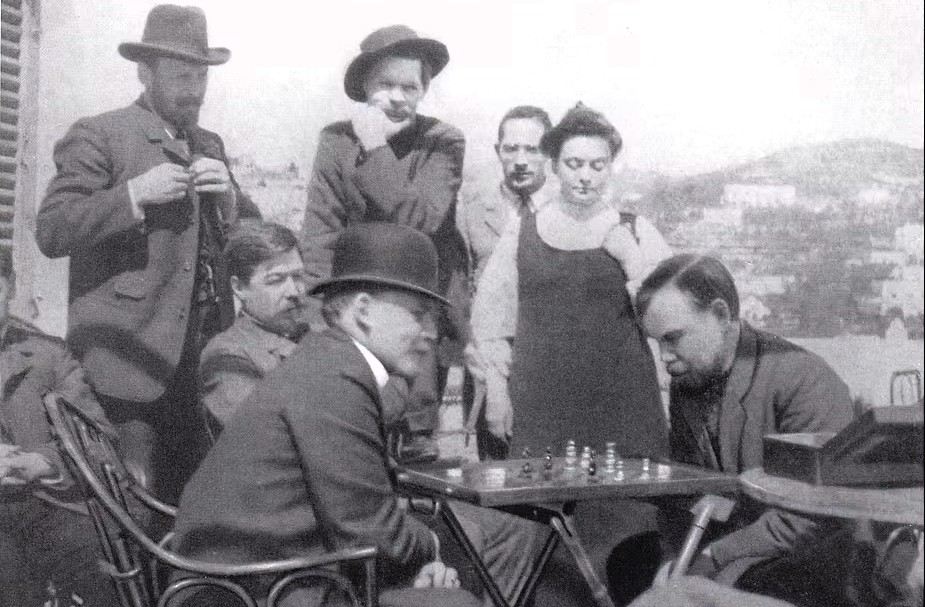
A disappointed Lenin rebukes Gorky’s liberal illusions in the possibilities the new post-Czarist government might bring peace. Originally written in March, 1917.
‘How to Attain Peace’ (1917) by V.I. Lenin from Communist International. Vol. 2 No. 6. October, 1924.
I HAVE just read (March 12/24) in the Neoveau Journal Auisse (No. 517 of March 24) the following communication transmitted by wire from Berlin:
“We are informed from Sweden that Maxim Gorky has sent enthusiastic greetings both to the government and to the Executive Committee. He welcomes the victory of the people over the lords of reaction, and calls upon all the sons of Russia to help in the building of the new Russian State. At the same time he calls upon the government to crown its work of liberation by the conclusion of peace. This must not be, says he, peace at any price; for there is less foundation at the present time in Russia than ever before to strive for peace at any price. It must be peace of a nature that will enable Russia to live with honour among the other peoples of the world. Enough human blood has been shed. The new government would acquire the greatest merit not only in the eyes of the people of Russia, but of all humanity, if it succeeded in an early conclusion of peace.”
So is the contents of Gorky’s letter reported.
One experiences a bitter sensation reading this letter, permeated through and through with middle class prejudices. The writer had occasion in his meeting with Gorky on the island of Capri, to warn him against this tendency and to rebuke him for his political mistakes. Gorky parried the rebuke with that inimitable sweet smile of his and the frank declaration “I know I am a bad Marxist, but then we artists are all irresponsible people.” It is difficult to quarrel with a statement like that.
There is no doubt that Gorky is a great artistic genius who has rendered and is still rendering great service to the world proletarian movement.
But why should Gorky concern himself with politics? In my opinion, Gorky’s letter expresses the prejudices so extraordinarily widespread, not only among the petty bourgeoisie, but also among that section of the working class which is under their influence. All the strength of our Party, all the efforts of our conscious workers must be directed toward stubbornly and persistently combating these prejudices.
The Czarist government began and carried on the present war as an imperialistic, predatory, robber war for the purpose of plundering and oppressing the weak peoples. The government of Gutchkov and Miliukov is a landlord and capitalist government, which is forced to continue, and wishes to continue the war for the very same ends. To address a proposal to conclude a democratic peace to such a government is the same thing as to address a sermon on virtue to the keeper of a brothel.
Let me explain what I mean.
What is imperialism?
In my brochure “Imperialism as the Highest Stage of Capitalism,” which was accepted by the publishing house “Parus” before the revolution, and whose forthcoming publication was announced by them in the journal Letopice (Chronicle), I answered the question thus:
“Imperialism is capitalism in that stage of development, when the domination of monopolists and finance capital has become established, when the export of capital has become a matter of supreme importance, when partition of the world by the international trusts has begun, and the division of all the territory of the world by the great capitalist countries has been completed.” (Chapter 7, of the above-mentioned brochure, announced in Letopice, when the censorship was still in force under the title “Modern Capitalism,” by V. Illin).
The result of this is that capital has grown to enormous dimensions. Small groups of the most powerful capitalists (united in combines, syndicates and trusts) deal in milliards and divide the whole world among themselves. The whole earth has been divided up. The war was the result of the collision of the two most powerful groups of millionaires, the Anglo-French and the German, over a new partition of the world.
The Anglo-French group of capitalists wish first of all to plunder Germany, to take away her colonies (most of them have already been seized), and Turkey.
The German group of capitalists wish to seize Turkey for themselves and to compensate themselves for the loss of their colonies by the seizure of the small neighbouring states (Belgium, Serbia and Rumania).
This is the real truth, cloaked with the whole gamut of bourgeois lies regarding liberating ” and ” nationalist war–war for “right and justice” and all the rest of the fol-de-rol with which the capitalists always fool the common people.
Russia is not carrying on the war on her own money. Russian capital is a shareholder in Anglo-French capital. Russia carries on the war in order to plunder Armenia, Turkey and Galicia.
It is no mere chance that people like Gutchkov, Lvov, and Miliukov, our present ministers, are now in office. They are the representatives and leaders of the entire landlord and capitalist class. They are bound up with the interests of capital. Capitalists may no more repudiate their own interests than a man can raise himself by his own hair.
In the second place, Gutchkov, Miliukov and Co. are bound up with Anglo-French capital. They have waged and are still waging the war on foreign money. For the use of billions they have promised to pay an annual interest of hundreds of millions, and to squeeze this tribute out of the Russian workers and peasants.
In the third place, Gutchkov, Miliukov and Co., are united by direct treaties regarding the piratical aims of war, with England, France, Japan, Italy and other groups of robber-capitalists. These treaties were concluded by Czar Nikolai II., while he was still in power. Gutchkov, Miliukov and Co. took advantage of the struggle of the workers against the Czarist monarchy to seize power for themselves, and they have confirmed the treaties concluded by the Czar.
This was done by the entire Gutchkov-Miliukov government in its manifesto, transmitted abroad by the “Petersburg Telegraph Agency,” on March 7/20: “The Government (of Gutchkov and Miliukov) will faithfully observe all treaties uniting us with other powers,”–so says the manifesto. The new Foreign Minister, Miliukov made the same declaration in his telegram to all Russian representatives abroad on 5/18/17.
These treaties are all secret, and Miliukov and Co. do not wish to make them public for two reasons: (1) they are afraid of the people, who do not want a predatory war; (2) they are bound up with Anglo-French capital which demands secret treaties. But everyone reading the newspapers and informing himself on the matter knows that these treaties deal with the plunder of China by Japan, of Persia, Armenia, Turkey (Constantinople in particular) and Galicia by Russia, of Albania by Italy, of Turkey and the German colonies by France and England, etc.
Such is the condition of affairs.
Therefore, the proposal to the Gutchkov-Miliukov government that they should speedily conclude an honest and democratic peace will bring just about as much result as the proposal of the good village “batoushka ” (priest) to the landlords and merchants that they should live “in a Godly way,” love their neighbours, and turn the other cheek to their enemies. The landlords and merchants listen to the sermon, continue to persecute and rob the people, and are delighted with the “batoushka’s” ability to soothe and appease the moujhiks.
Just such a role is played consciously or unconsciously by those people who address themselves to the bourgeois governments during the present imperialist war with well- meaning speeches about peace. Sometimes the bourgeois governments refuse entirely to listen to such speeches, and even forbid them, sometimes they listen to them, scattering assurances right and left that they themselves are fighting for the speediest possible conclusion of a “most righteous peace” and that only the enemy is to blame for delay. The practical result of speeches about peace addressed to bourgeois governments is merely deception of the people.
The capitalist groups, spilling oceans of people’s blood for the division of the earth, for the capture of markets and concessions, cannot conclude an “honourable” peace. They can only conclude a shameful peace, a peace of division of stolen booty, of the partition of Turkey and the Colonies.
But in addition to this the Gutchkov-Miliukov government is not at all desirous of peace at the present moment, because their share of the “booty” would be “only” Armenia and part of Galicia, and they wish in addition to grab Constantinople, and to win back Poland, that country so ruthlessly and shamefully oppressed by Czarism from Germany. And further the Gutchkov-Miliukov government is in reality, no more than the clerk of Anglo-French capitalists who want not only to retain the colonies stolen from Germany, but what is more, to compel Germany to restore Belgium and part of France. Anglo-French capital helped Gutchkov and Miliukov to overthrow Nicholas II. in order to obtain their help in conquering Germany.
What then?
To attain peace (and what is more, a really democratic and honourable pace) it is necessary that the political power should belong not to the landlords and capitalists, but to the workers and poor peasants. The landlords and capitalists are a negligable minority of the population; the capitalists, as you well know are piling up huge profits out of the war.
The workers and peasants are the overwhelming majority of the population. They make nothing out of the war, but are reduced to complete poverty and starvation. They are bound neither by capital nor by the treaties between groups of robber capitalists: they can end and sincerely wish to end the war.
If political power in Russia were in the hands of the Soviets of Workers’, Soldiers’ and Peasants’ Deputies, then these Soviets and the All-Russian Sovict elected by them might and certainly would agree to adopt the peace programme which our Party (the Russian Social-Democratic Labour Party) already indicated on October 13th, 1915, in No. 47 of the Central Organ of the Party, the Social Democrat (printed at that time in Geneva because of the pressure from the Czarist censorship).
This peace programme would probably contain the following clauses:
1. The All-Russian Soviet of Workers’, Soldiers’ and Peasants’ Deputies (or its provisional substitute, the Petersburg Soviet) would declare immediately that it was not bound by any treaties either of the Czarist monarchy or of the bourgeois governments.
2. It would immediately publish all those treaties in order to expose at once to public shame the scoundrelly aims of the Czarist monarchy and every one of the bourgeois governments without exception.
3. It would openly and without delay propose the immediate conclusion of an armistice to all the warring powers.
4. It would immediately make public our workers’ and peasants’ peace conditions for the information of all the peoples.
The liberation of all colonies.
The liberation of all dependent, oppressed and enslaved peoples.
5. It would declare that it expects nothing good from the bourgeois governments and proposes to the workers of all countries to overthrow them and transfer all political power to Soviets of Workers’ Deputies.
6. It would declare that the debts amounting to milliards incurred by the bourgeois governments in carrying on this criminal, barbarous war, may be paid by the capitalists themselves, but the workers and peasants do not recognise these debts. To pay interest on these loans means to pay tribute for years to come to the capitalists for their kindness in permitting the workers to kill each other so that the capitalists might divide the spoil.
Workers and Peasants!–the Soviet of Workers’ Deputies would say–are you willing to pay hundreds of millions of roubles to the capitalist lords as a reward for the war which was waged to effect the partitioning of the African colonies, Turkey and other weak peoples?
For these conditions of peace the Soviet of Workers’ Deputies would, in my opinion, agree to wage war against any and all bourgeois governments of the world, because this would be a really righteous peace, because all the workers of all lands would help to bring it about.
The German workers now see clearly that the militaristic monarchy in Russia has been replaced by a militaristic republic, a republic of capitalists, who desire to continue the imperialist war, and to carry out the robber treaties of the Czarist monarchy.
Judge for yourselves whether the German workers can have confidence in such a Republic.
Judge for yourself, whether the war can continue, whether the domination of the world by capital can endure, if the Russian people aided by their vivid recollections of the great revolution of ’05, shall win full freedom and transfer political power entirely into the hands of the Soviets of Workers’ and Peasants’ Deputies.
N. LENIN.
Zurich, 12/25 March 1917.
The ECCI published the magazine ‘Communist International’ edited by Zinoviev and Karl Radek from 1919 until 1926 irregularly in German, French, Russian, and English. Restarting in 1927 until 1934. Unlike, Inprecorr, CI contained long-form articles by the leading figures of the International as well as proceedings, statements, and notices of the Comintern. No complete run of Communist International is available in English. Both were largely published outside of Soviet territory, with Communist International printed in London, to facilitate distribution and both were major contributors to the Communist press in the U.S. Communist International and Inprecorr are an invaluable English-language source on the history of the Communist International and its sections.
PDF of full issue: https://www.marxists.org/history/international/comintern/ci/new_series/v02-n06-1924-new-series-CI-grn-riaz.pdf

