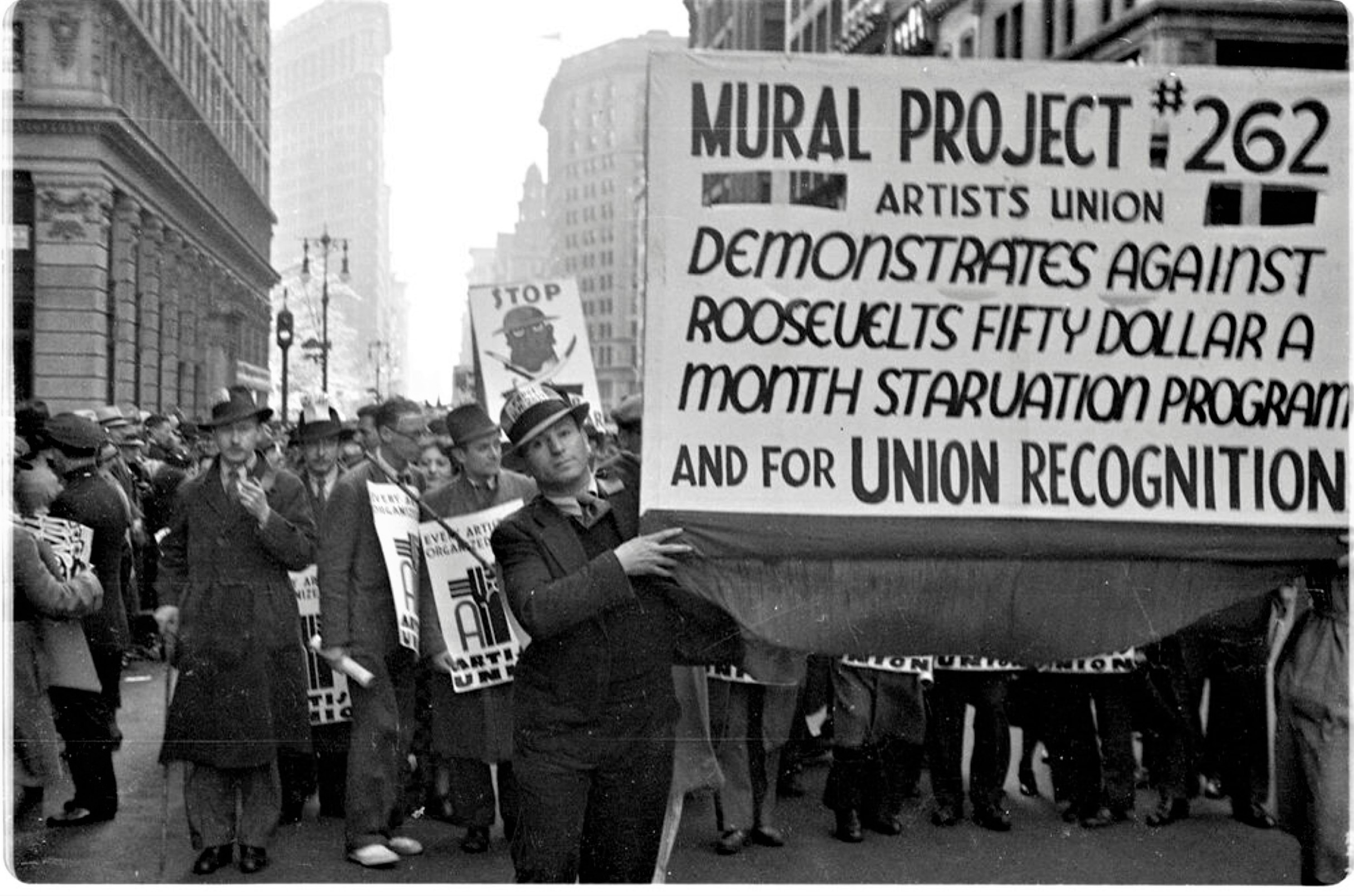
The Artists’ Union began to defend the interest of arts workers in the W.P.A. during the Great Depression. A report on their work to the founding American Artists’ Congress.
‘The American Artists Union’ by Boris Gorelick from Papers of the American Artists’ Congress, 1936.
The Artists’ Union of New York today is an organization of eighteen hundred artists. On behalf of these artists I extend fraternal greetings to this Congress, and pledge their support to its objectives.
The issues which led to the formation of this Congress and which occupy our deliberations are War, Fascism, the Defense and Preservation of Culture. The wide response to the Call of the Congress is indicative of two significant facts: the emergence of the artist as a socially conscious individual, and the recognition by him of the necessity for organization.
The Artists’ Union has played an important part in breaking down the isolation of the artist and in broadening his consciousness with respect to his social status. Artists of all esthetic perspectives have been welded together into a single union on the basis of common needs and common experiences. For two and a half years our Union has waged a continuous, determined struggle for the economic well-being of its members.
Originated by a group of twenty-five artists threatened with acute destitution, the organization has grown into a mighty body of national scope and influence. The closing of all channels of income, especially that of private patronage, which accompanied the continued crisis, placed before the artist an inescapable alternative: either to abandon his art and seek his subsistence in some other distressed field, or to build a new support for his creative activity. In order to perpetuate his art, in order to perpetuate his individuality itself, the artist discovered that he could no longer stand alone.
Some of you in this audience have, happily, escaped this bitter pressure. You have come here in obedience to the freer motives of social conscience and historical understanding. We of the Artists’ Union welcome the opportunity to stand at your side, despite the fact that at the moment you may not be fighting in the same trench. The Artists’ Union, too, has gone on record to resist with all its might Fascism and War. The dread powers of reaction, working to stifle even the limited liberties of the American people, have already aimed blows against our Union of Artists. In our effort to procure governmental support for art under the various Public Works Programs, in our effort to compel the Government to recognize its obligation to provide for artists, as producers deprived of their means of maintenance through no fault of their own, we have at all times been subject to the onslaught of those enemies of progress whom you have come here to resist. It is precisely in the economic life of the people that Fascist elements first manifest themselves. No program against Fascism can fail to recognize its tie-up with the struggle for economic security.
The Public Works of Art Project contained certain features which had been actively advocated by the relatively small group of New York Artists from which the Artists’ Union arose. The creation of these projects recognized the major principal of our organization; the Government assumed responsibility for the welfare of the artist. It also acknowledged the principle of a so-called professional wage. The Public Works of Art Project, however, restricted its responsibility to certain hand-picked Grade “A” artists. It neglected the great mass of competent artists who, somehow, could not find their way into its original and sometimes even fantastic category of selection. Moreover, for most of those employed, the Public Works of Art Project lasted for a period of only six weeks to three months. The “Grade A” artists, who had been specially picked for preservation, were then thrown back upon their own resources, after those resources had been officially acknowledged to be non-existent.
The Public Works of Art Project “professional wage” was not food fallen from above. It was won by the persistent demands of organized artists. The brevity of its life attested to the fact that the strength of the artist was not sufficient to overcome the Government program of retrenchment. Projects for Class “A” artists alone can never be long-lived. In order to resist the never ending pressure of the reactionaries for Government economy, in order to maintain the very place of art in the social structure, it is necessary that all artists of professional status be supported in their need to work and live.
The P.W.A.P.’s brief career was over May 1934. Here in New York was have had since that time a continuing Art Project. Organized under C.W.A. it has lived through a whole series of administrative transformations: C.W.S., F.E.R.A., W.P.A. Today it employs in New York over 1500 artists, models and technical workers. It has created an unprecedented interest in art.
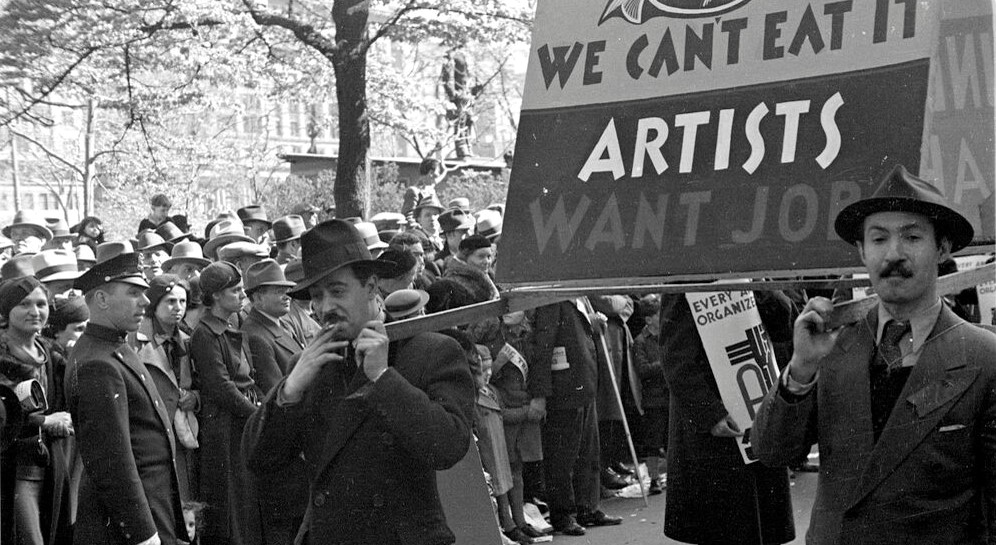
The development of this art program synchronizes with the development of the Artists’ Union and depends directly upon its efforts. Every official gesture of retrenchment has been met by the firm resistance of our organization. The artists have learned how to make use of the defensive instruments of the Labor Unions. Met with a threatened wage cut, the artists adopted the weapons of a picket line, mass demonstration and stoppage. On the occasion of this proposed 10% wage cut our united action forced the retention of the previous scale. By these methods we have procured the lowering of our work week to 24 hours, and the allotment of a 25% non-relief quota in the interest of artists who had not reached the lowest level of destitution. The organization of the employed and unemployed artists into one union, the cooperation of this union with other professional groups, architects, engineers, photographers and musicians, the support of the organized movements against War and Fascism–all these methods of augmenting our strength and securing our position have been taught us by our experience.
During these two years of dealing with Government agencies we have learned in concrete, unforgettable terms the meaning of social reaction. Our picket lines have been attacked by police, our members have been jailed and fined, our artistic productions have been censored and destroyed by backward critics and art dictators. In the pages of Mr. Hearst’s Mirror we have been presented in a disgustingly sensational fashion as a predatory gang of libertines and “Reds.” From the very beginning our struggles have involved the need to protect the Negro and foreign born artists against discrimination.
At this very moment the Hearst Press, the Liberty League and all organized forces of reaction are crying for the abolition of the whole system of Relief and Government Projects. In their drive to lower the standard of living of the American people and to break the power of organized labor, these reactionary groups attack also the cultural and creative expression of progressive thought. The policy of the government in the face of these reactionary attacks constitutes a retreat which can be halted only by organizations like our own. We artists are met with a double responsibility–not only must we protect ourselves in our individual names, there rests upon us also the obligation to defend the advancement of culture.
What does the experience of the Artists’ Union mean to all artists?
We can with the authority of this experience assert the following conclusions:
Organization of artists on a common basis is possible despite all esthetic differences.
Organized and concerted action is imperative in order to advance the interests of artists to defeat reaction.
Every improvement of the economic condition of the artist on government projects has been obtained through the existence, guidance and mass actions of the organizations of artists.
The fear that organization is incompatible with individuality is unfounded. It is precisely the existence of organization that guarantees the perpetuation of individual and esthetic freedom.
The establishment of arbitrary esthetic standards as a basis of organization is unsound and detrimental.
We, whose struggle against Fascism stems directly from our efforts to work and maintain ourselves as artists, feel certain that you will recognize the community of your interests and ours. The fight against War and Fascism for the defense of culture takes its most concrete form in the defense of economic standards. We hope and expect that out of this Congress will be formed a permanent organization with an aggressive program against the menace of War and Fascism. To such an organization we pledge our full and unqualified support.

