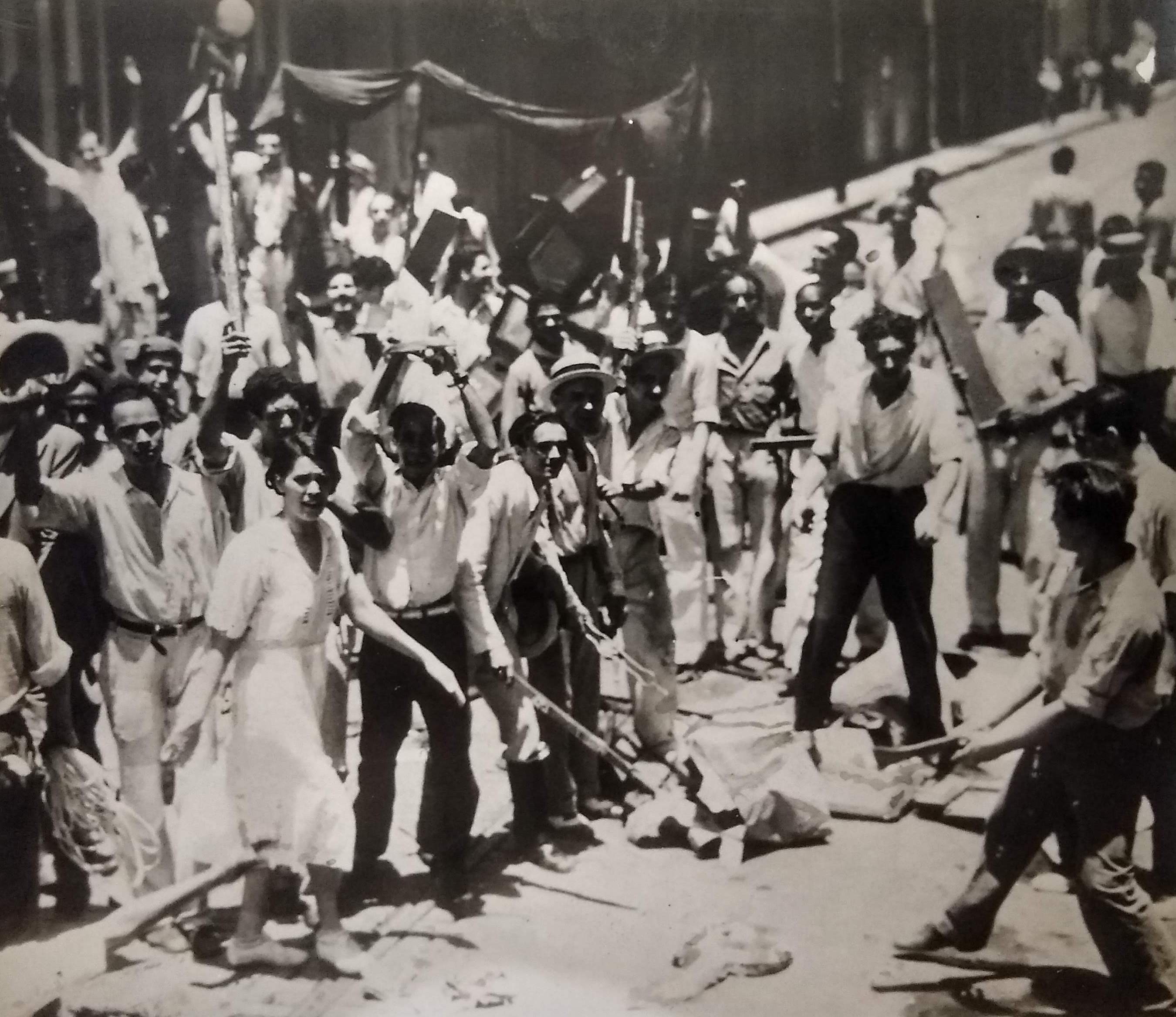
Cuba faced a confused and extremely unstable situation following the overthrow of the U.S.-backed Machado dictatorship in an unfinished revolution.
‘The New Phase in the Revolutionary Events in Cuba’ by G. Sinani from The Communist. Vol. 12 No. 12. December, 1933.
THE revolutionary events in Cuba after the military revolt, which overthrew the Cespedes government, have entered a new phase which demands that the Communist Party of Cuba show the greatest flexibility and a combination of enormous revolutionary activity to overcome its lagging behind the course of events.
One of the special features of the development of the revolution in Cuba is the combination of internal conditions, which on the whole are taking a favorable course, with the extremely serious international difficulties which arise from the closeness of the powerful imperialism of the U.S.A., which is economically and strategically greatly interested in maintaining the semi-colonial situation of Cuba.
By the middle of August the internal conditions in Cuba had taken the following form on the whole:
The proletariat, both in the towns and in the countryside, carried on an active aggressive struggle to improve their situation. Their struggle was by no means restricted to economic demands. The revolutionary struggle of the Cuban proletariat (strikes, demonstrations, street fighting with the police) dealt the chief blow at the dictatorship of Machado. But the Cuban working class was not inclined to stop its revolutionary offensive after Machado had been replaced by Cespedes and after Cespedes had been replaced by San Martin. It continued to strike, demanding and securing increased wages (e.g., the dock strike at Havana). In this connection, it made a wider practice of seizing the factories with the aim of forcing the employers to grant its demands. Partly by strikes and partly by direct action, it secured the open existence of the Communist Party and the revolutionary trade unions which had recently been driven deeply underground. It carried on a struggle to get possession of the local government organs, trying to make them really democratic. Finally, it was the working class which took the initiative and led the anti-imperialist movement of the broad toiling masses, especially against the danger of intervention by the U.S.
Together with the growth of the revolutionary activity of the working class, its organization increased. New trade unions were formed and the old ones enlarged. Factory committees and plantation committees were organized. Various trade union conferences were prepared to form national trade union centers. A second conference of the sugar workers (workers in the factories and plantations) was held.
In all this, the influence and significance of the revolutionary unions rapidly increased. Under the general leadership of the Communist Party they showed ever greater activity (the leadership of the strike movement). A rapid leftward swing took place among the masses in the reformist trade unions (railway men, tobacco workers, etc.). Ever more favorable conditions were formed not only for widening our influence in the reformist unions, but also for winning them over.
The influence of the Communist Party greatly increased. By its active leading participation in the revolutionary movement of the working class against Machado—a tremendous impulse for its development was the August First campaign of the Communist Party—and in the subsequent struggles of the proletariat to improve their situation, the Communist Party showed its fighting powers, its close contacts with the masses and its ability to lead them. At the same time, the Communist Party of Cuba has not yet overcome its organizational lagging behind its growing political influence, and even this influence is lagging considerably behind the possibilities which are being created by the rapid development of the revolutionary crisis.
In the course of these events, when the proletariat of Cuba had won freedom of organization and struggle, it rapidly became an armed class, building up armed bands of workers’ self-defense both spontaneously and under the leadership of the Communist Party and the revolutionary trade unions.
There is no doubt that the disarming of the police, the seizure of police stations, small warehouses, etc., gave the workers a large number of weapons which it is naturally impossible to estimate under the present conditions.
The peasants, who were crushed by the ruling semi-feudal relations which dominated both in the estates of the Cuban landlords and in the possessions of the American sugar companies, etc., and the banks, and who were being ruined under the blows of the crisis and the attacks of the local ruling classes and imperialism, began to get into more and more revolutionary motion. The struggle against the landlords, the American land-owning companies and the bloody regime of Machado who stood on guard to protect the semi-feudal robbery of the peasants, even at the beginning of 1933 led to a series of peasant revolts (the provinces of Orienta, Camaguey and especially Santa Clara). These revolts were crushed with ruthless violence. The punitive expeditions took no prisoners, hanging and shooting everyone whom they caught. But in all these provinces the struggle of guerilla bands continued up until the fall of Machado.
At the present time the abolition of the military and police terror has opened up tremendous possibilities for the rapid growth and the further revolutionizing of the peasant movement. At present we possess less information on the concrete facts of the revolutionary struggle in the villages than about the movement of the working class. But even the information on hand shows that the agrarian revolution is beginning in Cuba. In a number of places the peasants are seizing and dividing the land, cattle and implements of the landlords.
Before the fall of Machado, the peasant movement, which on the whole was a spontaneous movement and only in a few districts was under the direct leadership of the Communist Party, to a certain degree was also led by the bourgeois-landlord “national opposition” which tried to use it as a basis to overthrow Machado. Even at that time, the peasant movement frequently overflowed the banks of the “purely political” struggle against the Machado regime in which the “opposition” tried to keep it (e.g., the looting of the estate of Menocal, leader of the opposition, by the peasants).
There is no doubt that at the present time all the bourgeois and bourgeois-landlord organizations consider the revolution to have been completed by the overthrow of Machado, whereas in reality it has only just begun.
They will try and are already trying to wind up the peasant movement at the exact time when it is stormily rising, when it is taking on an ever clearer character of a revolution of the poor and middle peasants and the farm hands against semi-feudal exploitation, ee against the rule of the landlords and imperialism. But this in itself creates ever more favorable conditions for the extension of the influence of the Communist Party to the villages. The Communist Party is calling on the peasants to refuse to pay rent and debts and to seize the lands of the landlords. Ever more favorable conditions are rising for the political unity of the toiling peasants around the slogan of the revolutionary workers’ and peasants’ government, which alone is able to guarantee their land demands, etc.
The peasant movement is growing further into an agrarian revolution. Evidently it is still mainly spontaneous and unorganized. But at the same time there is an undoubted growth of the significance of the peasant committees of struggle and the League of Revolutionary Peasants, which were formed at the initiative of the Communist Party.
Finally, the peasants are becoming better armed owing to the disarming of the village police, the guards of the landlords’ estates, the plantations, etc. The Communist Party of Cuba is organizing peasant self-defense detachments, also making wide use of the existing guerilla detachments for this purpose.
In the towns there is an increased revolutionary movement among the poorest strata of the petty urban bourgeoisie, which is expressed, for instance, in the revolutionizing of the left wing of the students (the so-called reorganization committee). Its chief political slogan is at present the struggle for the independence of Cuba, the struggle against the imperialism of the U.S.A., against any attempts at intervention, no matter under what pretext. In Havana and other towns of Cuba, armed bands of students are being formed precisely for the struggle against possible intervention. At the same time, in the process of the split from the A.B.C. and other petty-bourgeois and bourgeois-landlord organizations which do not wish to struggle against the imperialism of the U.S.A., there are ever clearer tendencies for the anti-imperialist revolutionary student movement to draw nearer to the Communist Party, which is faced with the responsible task of getting the leadership of them.
Finally, in estimating the immediate perspectives of the development of the revolutionary movement, in Cuba, the processes which are taking place in the army are of exceptional importance.
There is no doubt that the refusal of the officers to make wide use of the army for the armed suppression of the anti-Machado revolution was not the result of a sudden growth of the sympathy of the officers towards the anti-Machado groupings of landlords and bourgeoisie but was above all the result of their fear of the masses of soldiers, an indirect proof of their growing politicalization and sympathy towards the general revolutionary movement. The further events—the revolt of the soldiers under the leadership of the petty-bourgeois non-commissioned officers against the government of the agent of the U.S.A., Cespedes, and the arrest of Machado officers by the soldiers—speak plainly enough of the awakening of political consciousness and the growing political activity of the soldier masses.
The army is beginning to pass over to the side of the revolutionary people. The armed resistance of the ruling classes is weakening. Ever more favorable circumstances are rising for the development of the revolution.
An exceptionally important and urgent task of the Communist Party is to deepen the process of political radicalization which has begun in the army, to support the demands put forward by the soldiers and sailors, and by practical direct action to break up the old barrack discipline, to hold elections of soldiers’ committees and officers, in order to widen and consolidate the transition which has commenced in the army to the side of the revolutionary people.
The development of the revolutionary offensive of the working class and the poor and middle peasants, the growth of the anti-imperialist movement among some of the urban petty-bourgeoisie and the increasing unrest in the army will undoubtedly be opposed by the united front of the right and “left” bourgeois-landlord and bourgeois groups, the petty-bourgeois organizations (A.B.C., O.S.R.R., etc.) which are under their influence, and finally by American imperialism.
The American ambassador in Cuba, Welles, is working feverishly to build up this counter-revolutionary bloc. At the present moment the bloc has not yet been formed. The Machadists and anti-Machadists are in a state of open warfare against each other and the A.B.C. has only just been driven from power by a soldiers’ revolt which compelled the “left bourgeois” group of two professors, a lawyer, an author and a banker, to become the government. The “national” opposition is a conglomerate of bourgeois-landlord cliques competing against each other. However, what Welles could not do at the beginning of July, when he was trying to bring about an agreement between the Machadists and their bourgeois-landlord opponents to avert the impending revolution, he may very possibly be able to do now, when the revolution has already begun and is threatening the basic interests of the Cuban landlords, bourgeoisie and American imperialism.
Thus the present state of affairs in Cuba is characterized by a definite change in the relationship of forces between classes, their new distribution, very different from those which existed under the dictatorship of Machado.

In Havana, at any rate, the “lefts” still remain in power, but they are still the undoubted representatives of the exploiting classes who are feeling out the possibilities of agreement with the imperialism of the U.S.A. behind the backs of the masses and at the cost of some small concessions on its part. They were spontaneously carried to power on the crest of the revolutionary wave and they fear very much any further development of the revolution. But while remaining formally the government, they have not the power in their hands to the full extent. The army has to a great degree been torn from the hands of the exploiting classes. For this very reason at the present time they are not in a position to start in practice to crush widely the growing revolution, in spite of their hatred towards it. For this reason it is possible that there will be a rapid growth of the workers’ and peasants’ movement, against which the “left bourgeois” government cannot yet make up its mind to use military and police repression (in any case to the extent which would be necessary to suppress it).
But at the same time the forces of the revolution are as yet far from being consolidated.
The influence of the Communist Party has increased tremendously. It is rapidly moving towards the winning over of the majority of the working class, but very important detachments of this class (e.g., the railway men) are still on the whole under the influence of the reformists. The agrarian peasant revolution has begun but has not yet developed. The basic masses of the villages have not yet been drawn into it. The elements of spontaneity still predominate in the peasant movement. It is characterized by great inequalities in various provinces and districts. The influence of the Communist Party is growing. Its slogans are mobilizing the peasants to the struggle. But the Party has not yet won the hegemony of the proletariat over the poor and middle peasants.
The Communist Party of Cuba at the present moment stands still further from the winning of the hegemony of the proletariat over the lowest and most exploited and politically downtrodden strata of the urban petty-bourgeoisie, who are as yet only being drawn into the movement under anti-imperialist slogans and for whose support of the agrarian peasant revolution it is still necessary to carry on a stubborn and energetic struggle. The army has broken away from the hands of the exploiting classes, but its transition to the side of the masses of the people is not yet firm, has not been consolidated.
The continued lagging of the Communist Party behind the possibilities which are arising together with the spontaneous efforts of the masses, which is exceptionally dangerous at the present moment, is shown with sufficient clearness by the formation of the “professor-banker” government of San Martin (which in practice is undoubtedly connected with the landlords) as the result of the soldiers’ movement against the government of Cespedes which was “legally elected” by the imperialism of the U.S.A.
In short, at the present time (in the middle of September) the revolutionary movement of workers and peasants is rapidly rising, but both its level and especially its subjective factor, i.e., the Communist Party, do not vet ensure the possibility of directly bringing about the revolutionary democratic dictatorship of the proletariat and the peasants. At the same time, counter-revolution is now, after the overthrow of Cespedes, trying to pass from the condition of progressively disorganized power to a state of stability, collecting all its forces under the auspices of the American Consul acting behind the scenes. But at the present moment it is not yet able to undertake a wide offensive.
There is no doubt that this situation is fraught with extreme dangers. Between the revolution and the counter-revolution there is taking place a competition to win tempo for rallying and consolidating their forces. The question of the initiative in the forthcoming class struggles for power depends on the winning of this tempo.
It is difficult to doubt that in the very near future in Cuba there will very probably be various counter-revolutionary actions, for example, on the part of the reactionary groups of officers or the A.B.C. There is no doubt that North American imperialism, which, for reasons of foreign policy, would like to avoid open armed intervention in Cuba, is not only building up a counter-revolutionary bloc of varied cliques of the Cuban ruling classes, but is also prepared to give material support (in arms and money) and to assist any counterrevolutionary organization or action.
In Havana itself, there are 300 well-armed officers, driven out of the army by the soldiers, who continue to occupy one of the central hotels, gathering in it under the wing of Welles, who lives there. They are not only hostile to the workers’ and peasants’ movement but also to the government of San Martin, demanding the restoration of Cespedes. With the aim of preventing their armed action, the hotel is blockaded by bands of soldiers with machine guns. The A.B.C. has still armed bands which are already trying to terrorize the revolutionary mass movement in a number of districts of Cuba. The newspapers give information of a number of cases in which the soldiers of various small units and the police have shot at demonstrations. It is plain that counter-revolution is by no means disarmed, that the ruling classes on the whole have not lost the leadership of the government apparatus of violence.
At the present time it is very probable that there will be attempts on the part of the San Martin government openly to crush the revolutionary movement, and also attempts on the part of the bourgeois-landlord groups who are most closely connected with the U.S.A. to overthrow the San Martin government with the aim of establishing an open counter-revolutionary dictatorship.
The situation of the San Martin government is becoming more and more unstable. The presidential palace is guarded day and night by machine-gun posts. According to the latest information, San Martin himself has already informed the political groups which support him of his resignation.
Nevertheless, the present situation in Cuba is noteworthy precisely as a transition situation, and it will not be solved by a simple seizure of the “central” power in Havana by any reactionary organization supported by the U.S.A. One of the manifestations of this transitional situation is the fact that the scope of the power of the “central” government was tremendously reduced together with the commencement of the passing of the army to the side of the revolutionary people (which is only commencing).
Into the revolutionary movement which is ever widening and accelerating, the basic masses of the proletariat and the peasants have come. The question of the further development of the Cuban anti-feudal and anti-imperialist revolution, bourgeois-democratic at its first stage, can only be solved in mass fights. The internal conditions, as we have seen, are undoubtedly favorable at the present moment for rallying the majority of the proletariat around the Communist Party and for the winning of the leadership in the peasant revolution, i.e., for forming the conditions which are most favorable for the victory of the revolution. The situation in the army, which is becoming more and more difficult for the exploiting class to utilize against the revolution, increases these chances many times,
In these circumstances, the question of the open armed intervention of the U.S.A. and the time when it will take place becomes of exceptional and decisive importance.
In mobilizing and organizing the masses for the struggle, leading their revolutionary actions, struggling for influence on the soldiers of the old army and building up the armed forces of the workers and peasants, the Communist Party of Cuba is striving to do everything possible to avert intervention and to create the greatest possible forces for resistance to it, if it nevertheless takes place.
But this is only possible by means of concessions to the imperialism of the U.S.A., at the price of which the Cuban toiling masses under the leadership of the Communist Party will try to buy off intervention. It is precisely with this aim, while carrying on the most energetic campaign explaining the increasing danger of intervention and mobilizing the masses in the struggle against it, that the C.P. Cuba tries to direct the chief blow of the revolutionary masses above all against the local Cuban ruling classes.
It is precisely with this aim, while extending the struggle of the working class for the improvement of its situation and winning the leadership of this struggle, that the Communist Party of Cuba considers it inadvisable for the workers to seize the American enterprises, and puts forward the slogan of workers’ control carried out through factory committees (if there are revolutionary conditions) which can secure the satisfaction of the demands of the workers.
Precisely with this aim, while organizing the peasants, winning the leadership of their struggle and leading them to the immediate revolutionary seizure of the land of the Cuban landlords, the Communist Party of Cuba considers it inadvisable to force ahead the seizure of plantations belonging to American capital, and fights above all for considerable reductions of the rent of this land, for the annulment of all the old debts of the peasants and an improvement in the situation of the agricultural workers.
Precisely with this aim, while striving to do everything possible to avert intervention, the Communist Party of Cuba considers it advisable for the workers’ and peasants’ government, if it should be formed, to enter into negotiations with the government of the U.S.A. on the conditions of nationalization of big foreign property, while not abandoning this nationalization, i.e., it allows the possibility of buying out this property. With the same aim, the Communist Party of Cuba allows the possibility of retaining American ownership to some extent in the form of concessions, as to the conditions of which as well as the conditions on which the property will be bought out (amount, forms and date of payment, etc.) negotiations will have to be carried on between the future revolutionary government of Cuba and the government of the U.S.A.
While seeing in advance the possibility and necessity of making these concessions to imperialism to ensure the easiest and most rapid victory of the revolution, the Communist Party of Cuba considers that their advisability will be quite clear and understandable for the broad toiling masses of Cuba if suitable explanations are made.
There is no doubt that such a position of the Communist Party in case the U.S.A. refuses to negotiate on these concessions in spite of the open expression of the readiness of the workers’ and peasants’ revolutionary government and in case of attempts at armed intervention, will help to organize a real nation-wide armed resistance to the interventionists.
We have already mentioned that, for international reasons, the imperialism of the U.S.A. would obviously like to avoid armed intervention in Cuba. This is shown plainly enough if only by the statement of Roosevelt to the ambassadors of the countries of South and Caribbean America who were specially invited to the White House for this purpose.
It would mean a tremendous outburst of anti-American feelings in all the countries of South and Caribbean America, a strengthening of English influence and partly of Japanese influence and a breakdown of the plans for subordinating South and Caribbean America to itself with which the U.S.A. is preparing the December Pan-American Congress in Montevideo. The London Times openly writes that the success of the negotiations of the U.S.A. with Argentina and Brazil on the signing of commercial agreements depends on whether it can solve the Cuban crisis without intervention.
At the same time, open intervention by the U.S.A. in Cuba would be utilized by Japan as “moral” justification of its annexationist policy in Manchuria and would give it a strong weapon for anti-American propaganda in China, Mexico and other countries, Naturally, the U.S.A. would like to avoid all this.
For this reason it is trying and evidently will continue in the future to try to organize the suppression of the Cuban revolution by the hands of the local ruling classes, whose chief adviser and leader on counter-revolutionary matters at the present time is precisely the American Ambassador in Cuba, Welles. However, if the line marked out by the Communist Party of Cuba for the development of the revolutionary movement which was spoken of above is energetically carried out, these attempts can be defeated,
The U.S.A. will then have to chose between the partial agreement with the revolutionary government of Cuba as proposed by the Communist Party of Cuba and open intervention. But, as the experience of little Nicaragua, which has not a mass Communist Party, showed, this is by no means an easy task even for powerful American imperialism, and the unfavorable international results of which are evidently well considered by the U.S.A.

In pointing out these tactics, the operation of which requires from the Party great flexibility and the ability to explain it to the broad toiling masses, the Communist Party of Cuba correctly takes account of the difficulties of American imperialism and bases its line on the thorough mastering of the international experience of the revolutionary proletariat, in particular the experience of the U.S.S.R. and the Communist Party of the Soviet Union.
In the present international conditions, when the guns of the American warships constitute the chief and fundamental menace for the Cuban revolution, the Communist Party of Cuba correctly combines the policy of the greatest activity in the development of the revolution, in the organization of the workers, peasants and soldiers, in the struggle to disintegrate the old bourgeois-landlord army and create the armed forces of the revolutionary workers and peasants, with the tactics of making the necessary concessions to imperialism.
Only in this way is it possible to ensure the formation of a workers’ and peasants’ government which really relies on the masses. Only on the basis of these tactics can the Communist Party of Cuba do everything in its power to avert intervention and to organize really nation-wide armed resistance to it if the U.S.A. nevertheless undertakes it.
The chief and fundamental guarantee for the success of these tactics is the organizational, ideological and political strengthening of the Party itself, the extension of its mass influence, the creation of the greatest confidence in it among the masses, and the winning of the leadership in the revolutionary fights which are developing.
There are a number of journals with this name in the history of the movement. This Communist was the main theoretical journal of the Communist Party from 1927 until 1944. Its origins lie with the folding of The Liberator, Soviet Russia Pictorial, and Labor Herald together into Workers Monthly as the new unified Communist Party’s official cultural and discussion magazine in November, 1924. Workers Monthly became The Communist in March, 1927 and was also published monthly. The Communist contains the most thorough archive of the Communist Party’s positions and thinking during its run. The New Masses became the main cultural vehicle for the CP and the Communist, though it began with with more vibrancy and discussion, became increasingly an organ of Comintern and CP program. Over its run the tagline went from “A Theoretical Magazine for the Discussion of Revolutionary Problems” to “A Magazine of the Theory and Practice of Marxism-Leninism” to “A Marxist Magazine Devoted to Advancement of Democratic Thought and Action.” The aesthetic of the journal also changed dramatically over its years. Editors included Earl Browder, Alex Bittelman, Max Bedacht, and Bertram D. Wolfe.
PDF of full issue: https://www.marxists.org/history/usa/pubs/communist/v12n12-dec-1933-communist.pdf

