
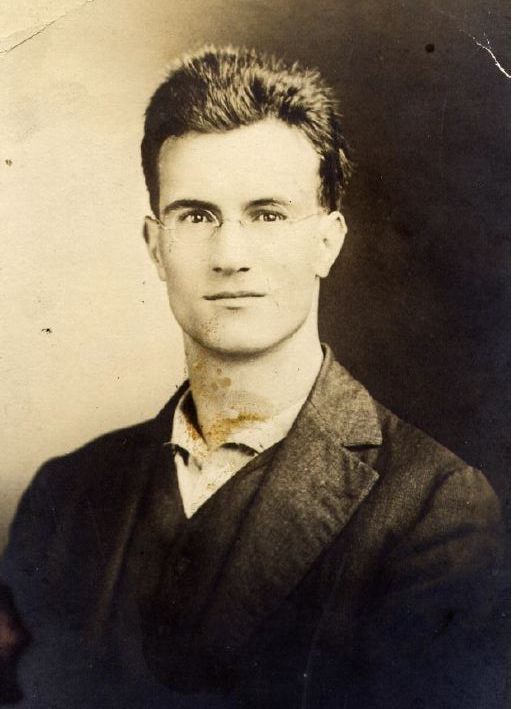
The Bulgarian-born Andreytchine came to political prominence in the strike he describes, which had as profound effect on him as it did the mining communities of Northern Minnesota.
‘The Revolt on the Mesaba’ by George Andreytchine from Industrial Worker. Vol. 2 No. 15. July 21, 1917.
Barbarous Conditions Which Little Over Year Ago Forced Miners Into Historic Struggle, Leading to First Permanent Organization of Steel Trust Slaves in Minnesota.
Of all the struggles of the working class in this country the heroic fight of the Mesaba miners was the most significant and peculiar. In all great battles of the working class against the robber class errors have been made and victories reaped. Every strike has a double meaning to the working class; it awakens class psychology and class antagonism and leaves a material gain with which to support their physical needs.
The Steel Trust is the actual master of the enormous wealth on the Mesaba Range. Master of all municipal, county and state institutions! Against such a formidable foe the unorganized miners arrayed themselves. Never before has the Steel Trust permitted its slaves to organize and collectively make demands for the betterment of their lot.
The First Struggle.
Working long hours for a mere pittance, the revolt of the miners had been brewing for the last decade and constantly gaining force. The first struggle of the miners in Minnesota was a failure, owing to the introduction of slaves brought from the Balkan states–Montenegrins, Bulgarians and Croatians. The newcomers from those poverty-stricken countries were only too glad to take the jobs of their striking workers. They did not know yet what industrial solidarity meant.
The strike of 1907, organized mostly by Finnish Socialists, failed from lack of experience, lack of solidarity among the two chief nationalities, Italian and Finnish, but mostly from the dirty and highhanded methods used by the Steel Trust’s gunmen and private thugs, and the antagonism of the local authorities and nationalistic prejudices among the workers.
Nine long years of industrial slavery and inhuman exploitation followed this first heroic battle of the Mesaba Range miners. Favoritism and bribery were rampant. Miners even had to submit the honor of their wives and daughters to the mine captains and straw bosses in order to get jobs or to keep the ones they already had dearly paid for. I know personally of many cases where the miners were forced to pay from five to ten dollars a month to the shift boss in order to save themselves and their families from starvation. The abuses heaped upon them would make an animal revolt.
Consumption Instead of Freedom.
The speed-up system was employed and resulted in early deaths from overwork or injuries for life. Many thousands of healthy young Slavs, who came from their oppressed countries to save a little money and to escape from persecution and military service, died before their time. Consumption was known to these mountaineers before they came to this land of plenty and freedom. The thousands that received injuries every year got a few dollars for their sacrifices. The miners knew not the language of this country and cunning lawyers deceived them easily.
Ten hours in the open pits and eight hours in the underground mines was the schedule in the spring of 1916. Low wages and the increased cost of living made the miners desperate and they were forced to revolt or to starve. They chose the former, though more uncertain, for it meant long days of starvation and bitter struggles with mine guards and scabs. Some of them were veterans in the class struggle. Many of them had left the bloody shambles at Ludlow and Calumet, and many were old fighters from the first strike in 1907.
On June 1, 1916, a mine near Aurora struck against the low pay and favoritism shown. The miners demanded an eight-hour day (that is, to go into the mine and come out of it on the company’s time); three dollars a day for dry places and three-fifty for wet places; abolition of contract work, which was only a trick to make the miners work harder for less money, and other minor demands. The bosses refused to grant these insignificant demands (which amounted to an increase in wages of about 20% and a decrease of half an hour’s time for underground workers and two hours’ time for open pit workers) and the strike spread first into neighboring mines and then, after the arrival of organizers for the Industrial Workers of the World, into other mining towns until there were, about the middle of June, some 15,000 miners on strike. Later, others joined on the western part of the Mesaba Range and about one thousand miners from the Cayuna Range, situated about one hundred miles from the Mesaba Range, struck in sympathy and for the same demands.
The State Used by Steel Trust.
The strike was in full swing when the state took steps to stop it. Every active member and organizer was arrested and brought to Duluth and charged with murder in the first degree. This happened after the killing of one deputy sheriff (an American sportsman who had come to the Range to may “take a shot at the damned hunkies”) in the who house of Masanovich, a Montenegrin miner. His house was invaded by a gang of gunmen are who entered without knocking and beat up on Masanovich and his wife. They maltreated the six months old baby of Masanovich and a melee started in which the boarders took part. The killing of the gunman, Myron, and the wounding of one of the boarders resulted. The state accused the I.W.W. leaders and the miners of the murder of the gunman, and this was a good pretext on which to lock up all organizers and so kill the strike.
The methods used by the private gunmen proved a failure so the infamous Governor Burnquist sent a “ukase” to the county sheriffs to arrest every organizer and deport him to the Duluth jail, some eighty miles from the Mesaba Range, to prevent any attempt on the part of the rebellious miners to release them. They had already shown their disregard for the “laws” of the Steel Trust and had taken a few of their imprisoned fellow workers out of jail. They also had beaten up the mine guards and had them terrorized so that they were afraid to show their faces on the streets.
The Murder of Allar.
On the 20th of June a miner picket, by the name of John Allar, was shot on the streets of Virginia, one of the important mining towns. He left a wife and three children to mourn and starve. It was a proven fact that e a gunman of the Steel Trust killed him, but no one was held responsible for the murder of the poor and innocent miner whose only crime was to ask for better living conditions for himself and his family. His funeral was one of the biggest manifestations of solidarity and over 15,000 miners and women took part in it. After the funeral the miners resolved to fight more bitterly and resolutely the murderers of their fellow worker.
Other terroristic measures were tried by the Steel Trust, but none ever succeeded. After every effort of the gunmen to stop a parade or prevent picketing more miners joined in the strike, the common battle against the common enemy.
Imagine over 25,000 men of more than ten nationalities, getting together to fight their common enemy; the enemy that has robbed them of their health and life, the enemy that has made their lives a chain of unspeakable misery and suffering. Their parades and picnics were an inspiration for a more intense and resolute battle. The miners had a rest for the first time in the last decade and the summer days were helping to restore to them the necessary vigor and enthusiasm. They fought as hard as a man can fight, but the strike lasted too long. They were hungry; the previous winter had been hard and cold; many hundreds of them were unemployed and poor. They endured four months of actual my starvation for the sake of the imprisoned strike leaders, Carlo Tresca, Joe Schmitt, Scarlett, the four Montenegrin miners, Massanovich, Onogorchevich, Orlandich, and Mrs. Masanovich. The spirit of solidarity and determination to win was marvelous, considering the fact that this was the first time the southern Slavs had attempted to organize. The difficulties were many, but all were overcome by the eager young militants.
Enormous sacrifices were made by the miners. Many of them could never return to the mines where they had built their little cottages; many hundreds of them were imprisoned without any charges and heavily fined. There are still three of the Montenegrin miners in the state penitentiary at Stillwater, Minn. Their lives are fading away in anguish and uncertainty as to their fate. The term of imprisonment may be twenty years, and two of them are married and the fathers of more than four children each.
The significance of this strike to the Industrial Workers of the World is great. We have learned that long strikes are injurious to the solidarity of the workers and brings about a lack of harmony. But the methods of the organization were most effective and fruitful.
A Strong, Determined Organization of Miners.
Over fifteen thousand of these miners are in the organization today and are fighting unceasingly for a better world to live in. Their numbers are increasing steadily, and the educational campaigns they are carrying on with speakers in different languages show a healthy sign of proletarian psychology and militancy. Those disorganized slaves of the Steel Trust have learned the value of solidarity and aggressive organization. Since the strike wages have been increased over eighty per cent. and the hours have been shortened. The abuses and bribes have disappeared and the miners are ready to fight for their rights, for better living conditions and for complete emancipation. Their actions and activities have spread b into the Michigan mines and thousands of miners there have already joined the Industrial Workers of the World and have won a substantial increase in wages.
The Iron Range Miners are true, class–conscious revolutionists and they hold the destinies of the iron industries in their hands. Are the bosses going to provoke a general uprising on the Minnesota and Michigan Ranges this year to celebrate the first anniversary of the glorious battle of last June?
Whatever the profit mongers attempt to do on the ranges we can be certain that the militant miners have a good weapon to fight them–a weapon that they have learned to al use through hard and bitter experience–industrial solidarity and the general strike. One year of industrial education was enough to make fighting men out of a disorganized horde of different nationalities.
The Industrial Union Bulletin, and the Industrial Worker were newspapers published by the Industrial Workers of the World (IWW) from 1907 until 1913. First printed in Joliet, Illinois, IUB incorporated The Voice of Labor, the newspaper of the American Labor Union which had joined the IWW, and another IWW affiliate, International Metal Worker.The Trautmann-DeLeon faction issued its weekly from March 1907. Soon after, De Leon would be expelled and Trautmann would continue IUB until March 1909. It was edited by A. S. Edwards. 1909, production moved to Spokane, Washington and became The Industrial Worker, “the voice of revolutionary industrial unionism.”
PDF of full issue: https://washingtondigitalnewspapers.org/?a=d&d=IWW19170721

