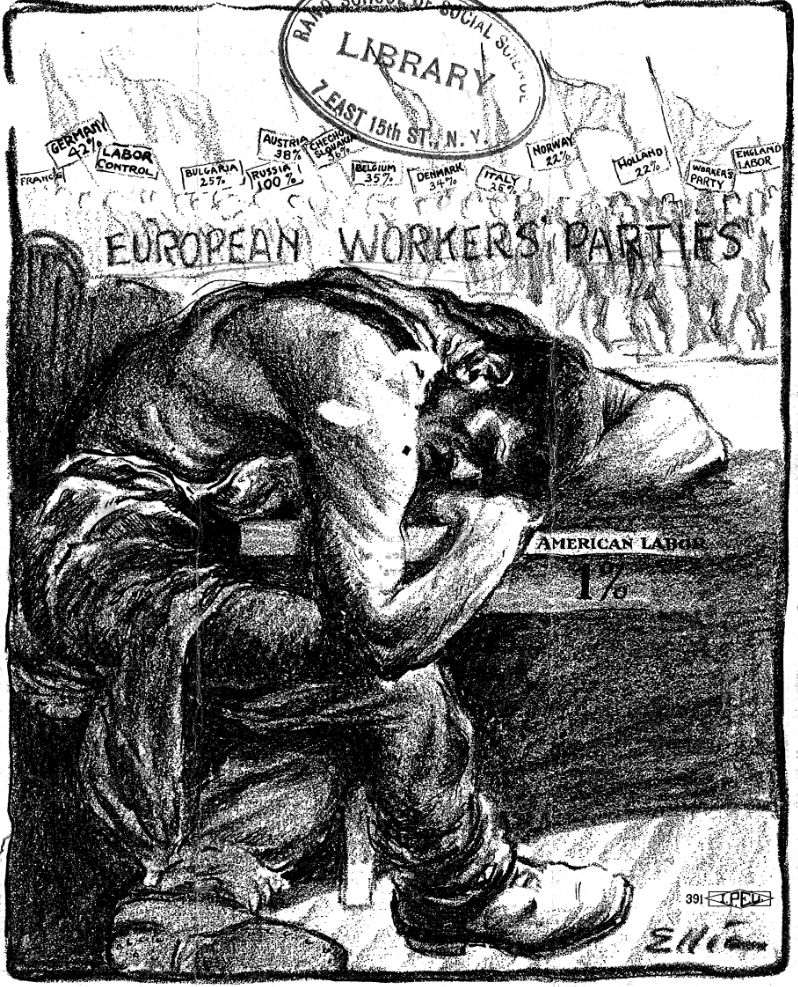
A statement from the T.U.E.L. on the need of a workers’ party and what its obstacles were.
‘A Political Party for Labor’ from Labor Herald. Vol. 1 No. 10. December, 1922.
By the National Committee of the Trade Union Educational League
LABOR in the United States, industrial and agricultural, must have its own political party, uniting all its forces against the organized power of the capitalist class. The workers in this country must organize to wage the class war upon the political as well as the industrial field. Recognizing this need, the Trade Union Educational League, in its first National Conference, August 26-27, 1922, “unequivocally condemned the Gompers political policy as fatal to the success of the trade union movement, and called upon the workers of America to take the necessary steps for engaging in a militant campaign of independent working-class political action.” The time is over-ripe for a general Labor Party.
Labor’s Political Weakness
The American labor movement is alone among the important countries of the world, in having no party of its own. In all other countries, industrially developed, it is no longer a debatable question as to whether or not the workers should organize politically on class lines. This is universally understood, and is taken for granted by the workers. Their political differences are only as to what kind of a working-class party they must have, whether it shall be Reformist Labor, Socialist, Syndicalist, or Communist. Only in America do we find a labor movement so undeveloped, so unconscious of itself, so infantile in its political conception, that it has not yet learned this fundamental lesson. It is still dragging along in the rut of the obsolete policy of “rewarding their friends and punishing their enemies.”
This primitive and outworn political method of the American labor movement has reduced it to political impotence. It has practically disfranchised the working class. In the matters of Government our labor movement has but the slightest influence. Labor, for example, is almost completely lacking in representation in the various legislative bodies. Those few nondescript “card men,” the boast of the “nonpartisan” advocates, are often even more corrupt and treacherous than the capitalist politicians themselves. In the local, state and national legislative assemblies, Labor is almost totally unrepresented. The whole law-making and law-enforcing mechanism is in the hands of the enemy, who do as they please with it. Gompers’ policy has resulted in wiping out Labor as a political factor.
That this is so is made strikingly clear if we compare our condition with the position of Labor in European political life. There, where the workers have organized their political power along class lines, Organized Labor is a great political factor. In Germany the various workers’ parties control 42% of the members of the national legislative assembly, in Austria 38%, Checho-Slovakia 36%, Belgium 35%, Denmark 34%, Italy and Bulgaria 25%, Norway, Holland, and Switzerland 22%. In Great Britain the Labor Party will challenge the domination of the capitalist parties in the next election. The workers of Europe are a definite political power which must always be reckoned with.
Suppression from Without
The political weakness of Labor is realized in the naked Governmental suppression of strikes, annulling of labor protection laws, limitation of free speech, and assemblage, etc. In the field of protective legislation this country hopelessly lags behind, due to our political impotence. Mr. Gompers gave testimony to this in 1909, when, returning from Europe, he said:
“We are, in the United States, not less than two decades behind many European countries in the protection of life, health, and limb of the workers. We are behind England 10 years. We are behind Germany 20 years.”
Since this judgment was rendered, our relative position in respect to all political aspects of the labor movement has become more unfavorable. During the past dozen years, and especially since the war, European Labor has made political gains of great importance, but we have gone backward steadily. While European workers have been wresting concession after concession from the capitalists, our movement in America has been stripped by the capitalist powers of many of our most fundamental rights. There has been a veritable flood of anti-syndicalist laws, under which hundreds of labor militants have been sent to prison on charges, not of criminal actions, but of opinions, for terms the savagery of which has shocked the world. The right of assembly has become little more than a privilege dependent upon the good will of the American Legion, the Ku Klux Klan, or corrupt local officials. Esch-Cummins laws, industrial courts, and the injunction, have literally hamstrung the labor unions in their most vital point, the right to strike. Popular representation in legislative assemblies has been violated, by refusing to seat workers’ representatives regularly elected, while millionaires openly purchase seats in Congress. Gompers’ “great achievement,” the Clayton Amendment to the Sherman Anti-Trust law, has been used–but only against Labor. The Seamen’s Act and the Child Labor Law have been knocked out. In the Coronado Case the trade union treasuries were opened to raids by the capitalists. The Daugherty injunction, outlawing 400,000 railroad men, is only the latest of a long line of acts of suppression and usurpation, testifying to the political incompetence of official Labor’s policy.
Corruption from Within
More serious, however, than even the unprecedented suppression of the workers’ rights, has been the corruption within their own ranks resulting from the Gompers policy. Our trade unions have been opened to every political crook posing as a “friend” of Labor. These parasites on the working class have then become the source of corruption in the leadership of the unions. Cold cash paid in hand for endorsements as “friends” of Labor, has created almost a regular profession among certain labor officials, of delivering the labor vote. This has, in turn, become the source of industrial corruption, for it is but a step from such political betrayal to industrial betrayal; it is an easy transition from delivering the labor vote according to capitalist wishes, to delivering a strike vote for the same reasons. Capitalist political parties in the trade unions have been the most prolific source of corruption.
Most stultifying of all of the effects of the “nonpartisan” policy of Gompers, has been that upon the mass of the trade union membership. It has checked the intellectual development of the entire labor movement, and smothered the growth of class consciousness. The whole capitalistic point of view is injected, with poisonous effect, into the labor movement, as the direct result of accepting capitalist parties as the political expression of the workers. Almost the same social concepts, with their inevitable consequences, are expressed by our labor papers and leaders, as by the capitalist press and capitalist officials. The inevitable result is a united front of capitalist press and Government with the labor press and officialdom, against every movement tending to give the workers a clear understanding of their class position in society. These capitalist chains, binding the brains of the workers and keeping them in slavery, can only be broken when the workers are organized politically as a class.
Workers Waking Up at Last
The crushing drive of the “open shop” campaign is shaking the workers into some recognition of the facts above cited. The open co-operation of all the capitalist parties in this assault upon Labor, with the accompanying armies of gunmen, troops, industrial courts, injunctions, prisons, raids, murders, capitalist financing of the processes of “justice,” and the resulting demoralization and weakening of the entire trade union movement, has finally cracked the hard shell imposed upon the American movement by the Gompers bureaucracy. A political awakening is taking place.
Undoubtedly one of the big factors in bringing about the new attitude on the part of Labor, has been the centralization of power in the capitalist Government, which has dramatized and brought into bold relief those facts of class-government which were hitherto obscured in the intricacies of 48 different State governments. In the period following the war, the economic problems of the capitalist class have forced it to deal with Labor more and more on a national scale, and use the Federal Government for suppression, where theretofore agencies of a masked character were sufficient. Thus, the Daugherty injunction was like a flash of lightning, revealing a thousand old but hitherto hidden facts to the ranks of Labor. The unscrupulous use of the centralized state power by the capitalists has awakened the workers as no other factor has done.
One of the most significant evidences that this is so, is seen in the disintegration of the capitalist party lines. For several years it has become a common thing to see the Republican and Democratic machines unite against candidates of various workers’ or farmers’ groups. This is now being followed by frank public acknowledgment on the part of prominent and influential members of both that there is no vital difference between the capitalist parties; the more militant capitalist politicians are urging the amalgamation of their twin parties, because they sense the inevitable coming of the Labor Party into the field, and they fear it. The old political line-up in America is practically gone, and the clear headed, both among the capitalists and the workers, are an announcing the fact.
The Conference for Political Action
The movement for a Labor Party has been favorably received in the ranks of Organized Labor, sweeping through the unions with particular force in the past year or so. The sixteen railroad unions are committed to the idea, as are the miners, the typographers, the clothing workers, innumerable city central bodies, State Federations, farmers’ organizations, and liberal groups all over the country. The movement found a timid expression in the Conference for Progressive Political Action which met in Chicago early in 1922, and which has called a second national conference to be held in December.
The pioneer work in this movement, as in many other things, came from the Chicago Federation of Labor. This organization was the initiator of the Farmer-Labor Party, the first attempt to give expression to the trade unions on the political field. The practical success of the party has been far outstripped by its moral influence, which has undoubtedly been a large factor in bringing to a definite expression the movement for working class action on the political field.
The Chicago Conference for political action above-mentioned was a distinct disappointment to those who hoped for the immediate formation of an inclusive Labor Party. There were too many feet on the soft-pedal, too much timidity and hesitation, a lack of any clear-cut objective. This spirit of “do-little” was especially evident in the fact that not one thought it advisable to point out the chief obstacle to the formation of a real party of Labor. That obstacle is Gompers. A prime fault of the Conference was that no one raised a voice to point out this fact. The next Conference, with the impetus of a year’s development, should get a new spirit into the work. It should positively and definitely commit itself to the formation of a Labor Party, and prepare to fight the reactionary forces which threaten the success of such a move.
What Kind of a Party?
The problem of what kind of a party should or could be created at this time is of vital importance. There are some general requirements which can be stated. The Labor Party must be definitely rooted in the economic needs of the workers, it must be a party of the working class, yet it must be broad and inclusive enough to take in all the various political parties and groupings of Labor. The first is essential to its existence past history of third parties in American politics has surely demonstrated clearly enough that a miscellaneous collection of people with a grievance is not a basis upon which a permanent party can be founded. The rock of working class interests is the only possible basis for a powerful new party in America. On the other hand it must make every effort to bring into its confines all the existing working-class parties. Not only must there be no exclusion of any group or groups, but there must be a positive effort to unite in common action all the forces of Labor on the political field. A political United Front of Labor against the capitalists is the need. Anything short of this will not meet the historical situation.
Such a united front in the Labor Party means that existing political groupings must be permitted to retain their identity, subject only to the requirements of common action of all groups so united in seizing the political power from the capitalist parties. Such retention of identity by the component groups of the Labor Party is not in the nature of a concession to prejudice, to organization patriotism, or bowing to an insuperable obstacle. It is a desirable thing that a Labor Party shall not be a homogeneous mass. The conflict of ideas, certain to come from contact with each other by definite groups within such a Party, will be the most positive guarantee against stagnation and sterility. The health of the Labor Party demands that unions, groups, and parties, entering into the federated Labor Party, shall continue their own organization identity, press, etc.
The Workers Must Dominate
In order to mobilize all the potential strength of the Labor Party, it is necessary that it make provision for including the exploited small-farming class along with the industrial workers. But the actual workers, being the only class whose interests give them a clear-cut line of action at all times, must dominate the party. The working class is the revolutionary element, it is the element which gives the dynamic energy, which alone can create a party capable of coping with capitalism. It must be a Labor Party in fact as well as name.
This means that it must have the backing of the trade unions. The trade unions are the only possible basis for a successful Labor Party. Not alone must such a party have its roots there, but it should be organized on the initiative of the unions. The historic mistake of the Socialist Party in this country, the fact which largely accounts for the decline of that organization, is that it did not recognize this fundamental truth. It thought that it could recruit its strength from the miscellaneous citizenry. But only on the solid rock of the industrially organized masses can a powerful political party be created in America. The power of all Labor Parties in Europe is directly to be measured by the backing given by the trade unions. The only workers’ Government, the Soviet Republic, has its roots solidly in the trade unions; when the Labor Party of England takes over power there, the trade unions will be the source of its strength. To “Left” and “Right” parties alike, the trade unions are fundamental.
Working-Class Program Indispensable
In addition to being working-class in membership, the Labor Party program must be working-class in spirit and form. It would be a calamity to attempt, as was done at the Political Conference last spring, to warm over a batch of discarded middle-class phrases, and substitute them for a radical and searching analysis of the workers’ class position in society and a clear-cut solution for their problems.
The supreme task of the December Conference is to form a general Labor Party. Its program, to be of working-class character, should challenge capitalism, and hold up the ideal of a workers’ society. This would tend to free the workers’ minds from capitalistic methods of thinking, from capitalist concepts, and capitalist prejudices. A program with such a basis, would be fit for a party determined to engage in struggle with the powers of capitalism at every point, and substitute in their place the power of the organized workers.
A militant Labor Party must be, essentially, a party of battle. All of those proximate things, “immediate demands,” which do not necessarily threaten capitalism itself, must still be set forth as goals to be won by the power of the organized masses, not by compromise and class collaboration. Only in this manner can the Labor Party gather greater and greater strength, and bring closer its inevitable goal of the workers’ society. Only in this way can it avoid the corruption and decay which surely comes from collaboration with capitalism.
Bureaucracy Must be Defeated
Even as in the proposals for amalgamation of the craft unions into industrial unions, and every other step in progress, the movement for the Labor Party will have to fight and defeat the reactionary officialdom. Indeed, not the least value of the Labor Party movement, which is gaining such headway, will be the lining up of the progressive forces, timid though some may be, against the black reactionaries of the type of Gompers and the Crown Prince, Woll. A good fight for the Labor Party will also help the amalgamation movement, just as the amalgamation movement is going to give power and vigor to the Labor Party itself. The two movements are closely related, and mutually assist each other. Gompers’ political policy of rewarding his capitalist friends, is one of the props upholding the bureaucratic structure of his machine in the trade unions. Let us join hands in knocking it out from under him.
All Local Leagues, and all members and sympathizers, should immediately throw all their power back of the demand for a Labor Party. Every possible voice should be raised, in the local unions, in the city central bodies, in the district councils, state federations, and International Unions. Resolutions should be presented and thoroughly discussed. The reasons for a Labor Party should be made clear; the form which it should take should be discussed, the character of its membership and its program should be well debated. The movement for a Labor Party should be shown as related to the movement for the amalgamation of the craft unions; the one for a United Front of the workers on the political field, as the other is on the industrial field. Intelligent political action is as necessary as intelligent industrial action. Big, strong unions are not enough; the workers must also have a big, strong party.
Let Labor’s voice be heard demanding a Labor Party. Our work, as League militants, is to see that the demand is as loud, firm, and definite as possible. We must carry the battle to the reactionaries, and put every one of them on record. We must throw all our strength toward the uniting of Labor’s forces, politically and industrially; this means that we must relentlessly fight against all those who block the path of progress. The reactionary officialdom must be made to understand that the day of their policies is gone; they must fall in line or be swept aside by the march of history. We must remove the calamitous disgrace of our present status, the only great labor movement of the world without its own political party.
The Labor Herald was the monthly publication of the Trade Union Educational League (TUEL), in immensely important link between the IWW of the 1910s and the CIO of the 1930s. It was begun by veteran labor organizer and Communist leader William Z. Foster in 1920 as an attempt to unite militants within various unions while continuing the industrial unionism tradition of the IWW, though it was opposed to “dual unionism” and favored the formation of a Labor Party. Although it would become financially supported by the Communist International and Communist Party of America, it remained autonomous, was a network and not a membership organization, and included many radicals outside the Communist Party. In 1924 Labor Herald was folded into Workers Monthly, an explicitly Party organ and in 1927 ‘Labor Unity’ became the organ of a now CP dominated TUEL. In 1929 and the turn towards Red Unions in the Third Period, TUEL was wound up and replaced by the Trade Union Unity League, a section of the Red International of Labor Unions (Profitern) and continued to publish Labor Unity until 1935. Labor Herald remains an important labor-orientated journal by revolutionaries in US left history and would be referenced by activists, along with TUEL, along after it’s heyday.
PDF of full issue: https://www.marxists.org/history/usa/pubs/laborherald/v1n10-dec-1922.pdf

