A report on the Conference on Negro Student Problems held in Birmingham and the intervention of the C.P.’s National Student League, including their proposals to the meeting addressing the specific demands of Black students.
‘Starting the Ball Rolling’ from Student Review (N.S.L.). Vol. 2 No. 7. May, 1933.
The Student Conference on Negro Student Problems
“BIRMINGHAM is the hell-hole of the South. Only in Memphis, Tennessee, is the number of ‘justifiable homicides’ which occur each day here exceeded. Conditions have become unbearable for the Negro people. Education for the Negro student in Alabama is practically non-existent. There are 28 parks in Birmingham, but a Negro dare not set foot. in any one of them for fear of being lynched by K.K.K. mobs.” These few words of one of the delegates from Miles College in Birmingham convey but a brief description of the terror and oppression to which the Negro people have been subjected. These forms of segregation, Jim-Crowism, lynch terror, intense economic hardships have been accentuated by the prolonged economic crisis of capitalism, which has been steadily developing into overt, fascistic methods of suppression of the Negro and white masses. Against these conditions which vitally effect the students, the National Student League has waged a vigorous and untiring struggle. For such purposes, it was decided to begin a widespread campaign with the calling of the Conference on Negro Student Problems.
The work of the Conference was started over two months ago, with the setting up by the National Student League of a provisional committee. This small group invited representatives of educational interests to join the committee for the Conference, which was, in its final form, a combination half of teachers, leaders of organizations, and professional men, and half of students doing undergraduate and graduate work. Emphasis was placed on the value of a conference on Negro Student Problems at this time, when the acuteness of the problems of the white student has made those of the Negro abnormally apparent. It was easy to see, even in the early stages of preparation for the Conference, that its value would be lost if it were not strictly a student project, if it were not realistic in the way it faced historical fact and present social conditions, and if it broke up, as so many inter-racial meetings have, without laying the groundwork for a permanent organization and formulating certain definite and basic principles to be carried into action immediately.
The difficulties too, were apparent: to bring together students with little faith in interracial work and break down the barriers resultant from their disappointment in earlier conferences; to give, in the allotted three days, enough background information to let the Conference draw up plans intelligently and on a sound basis; to bring out resemblances between Southern and Northern education as reflection of the active social systems; and to answer in some way the need of the white student for an adequate education in the problems of the Negro.
The committee, knowing that unity would be necessary on issues involving so many separate details, included in its body people of such different inclinations as Roger Baldwin, Franz Boas, George Counts, Countee Cullen, E. Franklin Frazier, Donald Henderson, J.B. Matthews, Reinhold Neibuhr, and William Patterson. It invited representatives of the International Student Service, the National Student Federation of America, the League for Industrial Democracy, and the National Student League to present the opportunities each organization offered to the Negro student in solving his difficulties, and to the white student in joining with the Negro to solve special and common problems.
The first session of the Conference was introduced by M. Moran Weston, of Union Theological Seminary and the Chairman of the Committee, who prefaced the opening speeches with an explanation of the purpose of the Conference and a suggestion of the problems that would have to be solved by such a meeting. Over two hundred delegates had come, and although most of them were from New York, there were a fair number of delegates from Southern and midwestern schools and colleges. The ratio of Negro to white students was lower than it should have been, since many of the white delegates had come as much for information not taught to them in their classrooms as for active participation. Conrad Lynn of Syracuse University made a short keynote address, emphasizing the effects of retrenchment on the students, and warning us that we must organize the data shown to us and find out, if we saw discrimination, what particular group the discrimination benefited. There is no discrimination without its being useful to some one, he pointed out, and added that if discrimination and its attendant evils were not surface ills, but were symptomatic of a deeper disease, eradication according to a materialistic approach would be the only cure after all palliatives had failed.
Elections of the committee necessary to carry out the mechanics of the Conference was followed by a speech by Donald Henderson. He placed stress upon the character of Negro student problems as being, in the case of discrimination, Jim-Crowism, etc., special student problems. The white student, particularly in the South, was held culpable for not taking the lead in breaking down the barriers between Negro and white, in order to forge a powerful, united force of student action in meeting successfully their common problems.
In the afternoon, Dr. E. Franklin Frazier, of Fisk, spoke about the types of dependence in Negro schools, of the split between the Dubois and Booker T. Washington principles. Classical education, it was held for a long time, would obliterate race problems, and Dubois had carried the fetish of the academic point to view to such a point that there was now a whole section of academic Negro students, who, when they were asked what they thought of lynching “would ask you to wait a minute while they got statistics and drew a curve.” The belief that the Negro should be kept in submission has limited discussion of their own problems. Dr. Frazier corrected a report in the Student Review of the protest at Fisk. There had been little protest at Negro colleges about Scottsboro, and that was because of administrative suppression. There had been articles censored and meetings discouraged, and all of this was part of a very open system which should function to keep the Negro student piously conservative, desirous of aping the white ruling class, and, even with the number of Negro college graduates increasing yearly, should keep the Negro standard of culture on a low level. Dr. Frazier was followed by Arthur Hugh Fauset, who analyzed the major problems of the Negro student, and told of his aim of widening the group of enlightened intellectuals, white and Negro, who should explode the old fallacy of race supremacy.
But the speakers, and those of the following day, were not as vital to the Conference as the very active discussion groups that met after the presentation of the groundwork had been made. The four groups had their subjects divided: one met on the problems of students after graduation, one on retrenchment in education, and the other two on academic freedom in the South, and on discrimination against the Negro student. The delegates were encouraged to tell of personal experiences; in these groups we were given the material on which the final set of resolutions were based. We were told of discrimination at religious conferences, of colleges whose funds were threatened because a delegation of Negro students had visited a white college to talk about world peace, of jim-crowism extending to the college chapels. To many of the students, the facts brought out during the discussion groups, and during the discussion invited after each speaker, were entrance to a system whose barbarism had not been exposed in textbooks, whose cruelty had never been taught and now seemed almost unbelievable, even as fact.
The second day consisted of speeches and discussion open to the general public. This procedure, although of little value, because of the vague generalities prominently indulged in, served, however, to bring out striking reformist positions detrimental to the Negro student. Rayford W. Logan, one of the speakers, advocated a policy for the Negro, that had long been practiced by the lily-white Democratic administration now in Washington. His advice was entirely postulated on the continued segregation and oppression of the Negro people. His words were corroborated by the Reverend Dr. Haynes, trustees of Fisk University and a member of the Council of the Federated Churches.
Reverend Haynes attacked “foreign-born agitators” and outlined for the Negro student a course of Uncle-Tomism, submission, “pie in the sky” and the “wow of poverty.”
The absence of representatives from the League for Industrial Democracy was quite conspicuous. With the exception of Elizabeth MacDougal, a speaker invited for the following day, and one or two others, the L.I.D. did not participate in the Conference. The National Student League, alone, carried on the fight to isolate the Negro students from the Negro reformist leaders whose pernicious doctrines are designed to keep intact the system of oppression.
On the third day the discussion groups were continued and the resolutions drawn up, after a presentation of the position of various student organizations. The International Student Service and the National Student Federation of America, it was remarked from the floor, were notably lacking in their concern with the problems of the Negro. The National Student League’s representative, Joseph Cohen, made a strong demonstration of the activity that the N.S.L. has pushed to solve problems of discrimination. The representative of the League for Industrial Democracy, Elizabeth MacDougall, explained the work of the L.I.D. in the University of Kansas, especially, and startled the audience with her assertion that Negroes are excluded from the N.Y.U. swimming pool. Representatives of two Negro student associations emphasized the importance of racial integrity and a consideration of Africa as homeland, with nationalism as a basis for a group movement.
But group differences on political and racial issues were eliminated when the problem was to be drawn up, and the following PLEDGE, accompanied by a comprehensive series of facts and resolutions based on them, was passed unanimously by the Conference.
A permanent committee was set up, with temporary headquarters at 600 West 122nd Street, New York City, in care of M. Moran Weston. The committee adopted the name of the National Student Committee in Defense of Negro Student Rights, and set up subsidiary high school, Southern, and Western committees to work with the main division.
The work of the Conference is just begun. Its accomplishment depends on the energy with which the delegates work in reporting the plan of the Conference to their clubs and organizations, and the student cooperation in building a strong and active permanent committee. With a national organization backed by the National Student League and ready to function with the cooperation of existent student organizations, we will be able to see the progress of student action toward the abolition of jim-crowism, suppression, and discrimination, and to work more and more effectively towards the ends outlined by the Conference, which officially declared in the preamble to the Resolutions, that the “fundamental and ultimate solution rests only in the liberation of the masses of the exploited and oppressed.” In the beginnings of such accomplishment is the beginning of the student work, whose first step has been the Student Conference on Negro Student Problems.
***
A Guide To Action
Proposed Resolutions of Student Conference on Negro Student Problems
AT the present time the latent weaknesses of our civilization are being brought out in glaring relief. In the course of the economic crisis the difficulties formerly faced almost alone by Negro students are fast becoming characteristic of the major part of the American student body. The sharp retrenchments made everywhere in educational budgets are reducing the general educational facilities of the country to the lowest level. The crowding of classes, the closing of schools, the administrative repression of the rights of freedom of speech and press, the realization of the ineffectiveness of a college education from the point of view of earning a livelihood, of unemployment after graduation, the increasing danger of war, and the growing militarization of the schools–these are our common problems.
However, as facts show, the effects of the depression have been even more severe upon the Negro students. In addition, the Negro student faces the special problems of discrimination, of segregation, and in the South, of legal jim-crowism. Confronted with these problems the consciousness of the Negro and white student has not only been awakened to their common misery and the need for a way out, but has also been brought to the realization of the necessity of immediate joint action by Negro and white students for the solution of their problems.
It is primarily for the purpose of crystalizing this and laying a base for joint action that this conference has been called. Yet, while this conference is held for such specific purposes, it is necessary to recognize the wider significance of the source of these problems. They are part of the general exploitation and economic subjugation of the Negro people, which entails peonage, disfranchisement of even the elementary democratic rights, and vicious terror in the southern states. The fundamental and ultimate solution rests only in the liberation of the masses of the exploited and oppressed. On the basis of such understanding will be carried on the struggle for the betterment of the conditions facing the students.
DISCRIMINATION
Whereas, 17 southern states and the District of Columbia have separate educational systems for Negroes; and
whereas, in some places only one-quarter of the per capita money allotment allowed for education is spent for Negro students; the length of term in many Negro schools in the South is from two to three months for Negro students and from eight to nine months for white students; and
whereas, Negro teachers generally receive much less than white teachers, for example in some places In Virginia where the Negro teachers receive $200 per year and the white teachers receive $945 per year; and
whereas, governing boards of schools in the South are dominated by whites, as at Tuskegee; and
whereas, Vassar, Princeton, Swarthmore and other large colleges and universities do not admit Negro students; and whereas, practically all colleges and universities, especially professional institutions limit the number of Negro students admitted; and the Negro students are denied equal opportunities for clinical practice; and
whereas, swimming pools, proms, fraternities, recreational centers, etc., bar Negro students; practically no enjoyment of parks or playgrounds in the South; and
whereas, the above facts attest the severe discrimination practised against Negroes throughout the country which in many cases takes on a veiled form and in others is legalized by state and city ordinances, and
whereas, these practices are integral parts of the general policy pursued by the white oppressors in subjecting the Negro people to the most ruthless exploitation and oppression;
We, therefore, stand for the abolition of all forms of discrimination and in particular we stand for the abolition of jim-crow education; the admittance of Negro students to all schools and public places; equal distribution of appropriations for Negro students’ education in the South, equal recreational facilities for Negroes, and further, we are against all laws and practices which bar Negro students from attending class rooms together with white students. We stand for the deletion from texts of statements derogatory to the Negro people, the complete discard of such texts and no discrimination in any schools against books written by Negroes.
RETRENCHMENT AND RELIEF
Whereas, there is extreme retrenchment in education caused by the decrease in governmental appropriations and curtailment of financial support of philanthropic and church institutions; and
whereas, the closing of schools, the over-crowding of class rooms, the curtailment of the curriculum, the cutting of teachers’ salaries, etc., have taken their greatest toll from the Negro students (witness the almost complete closing of the schools in Alabama and Arkansas), considerably reducing the already low expenditures of pre-crisis days; and
whereas, the forces clamoring for retrenchment are the banking and real estate interests of the country and the civic organizations which represent them; and these interests are still reaping profits; and
whereas, the government of the U.S. spends millions of dollars in war preparations and within the last year has Increased its appropriation for the R.O.T.C. over one million dollars; and
whereas, the government subsidizes large industrial enterprises, banks and railroads through the Reconstruction Finance Corp., and
whereas, more millions are wasted yearly through graft, and inefficiency in the various governmental departments, and
whereas, at the present time there is great suffering due to unemployment, low wages, etc., and the parents of many students are unable properly to feed and clothe their children to go to school or to furnish them with the necessary supplies and carfare;
We, therefore, stand for no retrenchments in education; adequate relief for the needy students, equal educational expenditures per capita for Negro and white students, better educational and recreational facilities for Negro students, and further, we are against cuts in teachers’ salaries and for equal salaries to Negro and white teachers.
We propose that funds for this purpose should be raised by diverting appropriations for war for educational purposes, and We further propose federal support and control of educational institutions in order to insure equal and adequate educational opportunities for the Negro and white students.
ACADEMIC FREEDOM
Whereas, the suppression of academic freedom of students and teachers, either through veiled intimidation or open dismissals and expulsions, is common to most schools and colleges throughout the country; and
whereas, the practice is becoming more prevalent, witness the dismissal of Kenneth Barnhart from Birmingham Southern, Donald Henderson from Columbia University, recent expulsion of students from New York high schools, etc., at a time when the effects of the prolonged crisis have induced greater necessity of discussion and action on problems with which students and teachers are confronted; and whereas, this suppression is sharper in the jim-crow institutions of the South where little or no students’ self government, or students’ participation in the governing of their school life, exists; and
whereas, the schools and colleges of the South are controlled by church, state and philanthropic funds, which dictate the policies of the school administrations; and
whereas, students attaining strategic positions in student groups are brought under administration control by means of scholarships immediately presented to them; and
whereas, “Porkbarrel” politics are utilized to gain control of students’ governing boards; and
whereas, these practices are attempts on the part of the oppressors to kill the initiative of the Negro student, to prevent his cultural and political development and to instill submission and passivity, thus safeguarding the status quo and the power of the oppressors;
We, therefore, stand for full academic freedom for Negro stunts and instructors, and, in particular, student control of student organizations and newspapers, and further, we are against victimization of students and teachers who express their free opinions, and for the abolition of compulsory religious services.
THE PROBLEMS OF THE NEGRO STUDENT AFTER GRADUATION
Whereas, the problems facing the Negro and white graduates, or those students forced to leave school before graduation, center mainly about the problem of unemployment, and
whereas, this problem of unemployment has not only added to but has also accentuated the glaring conditions of prejudice and discrimination, thus making the lot of the Negro student an even more miserable one than that of the white students: and
whereas, before the crisis, the exclusion of the Negro. students from the various professions, such as engineering and aviation, and also from professional and vocational schools confined them within a restricted few, and whereas, these professions of medicine, law, dentistry and teaching were studied mainly within jim-crow institutions where they are even subjected to great competition with the white students, and
whereas, even the doors to these limited fields have been practically closed due to the marked decrease in the earning capacity of the segregated Negro working people who constitute the source of the income of the Negro professionals;
we therefore demand that all professions and vocations be open to Negro students; that the National and State governments hire Negro students and professionals on the same basis as white students, that is, on the basis of grades achieved in examination; that as a relief measure the federal government employ graduates to return to the South to do social work;
that the ruling requiring a photograph of all civil service applicants be revoked; that colleges and universities offer free graduate and professional courses to unemployed students;
that social service work be given Negro graduates; that unemployment Insurance for Negro and white students be provided for by the government.
RESOLUTION OF PERMANENT ORGANIZATION
To further the work of this Conference a permanent committee of five shall be elected to be known as the National Student Committee for the Defense of Negro Students.
This committee shall consist of five members residing in the City of New York and shall act as a resident bureau for this conference, and shall act as the center of coordination for the delegates at this conference.
This committee shall publish the proceedings and program of this conference and secure their widest distribution. This committee shall issue from time to time material for furthering the work in carrying out the program of action adopted at this conference.
This committee shall cooperate with all groups which carry on struggles for the rights of Negro students on the basis of its program.
This committee shall have the right to call other conferences from time to time.
CONCLUSION
Lastly, inasmuch as the very severe conditions facing the Negro students in the South make it difficult for them to come forth and break down the barriers of discrimination and segregation, and
Inasmuch as the white students are in a better position, because of the more favorable conditions enveloping them to accomplish these ends,
It is the duty of the white students to lead in the struggle to break barriers, which tend to divide the student body.
PLEDGE
We pledge ourselves:
A. To carry on a vigorous fight to destroy all illusions of racial supremacy as fostered by our schools and other educational agencies.
B. To carry on a militant struggle against lynching, jim-crowism and similar vicious attacks on Negro workers and students.
C. To popularize the achievements, the life and culture of the Negro people and to make clear the proper role of the Negro people in the history of the world.
D. To serve untiringly in the promotion of the unity of Negro and white students in meeting their common problems.
RESOLUTION ON IMMEDIATE ACTION
1. To hold meetings in each school in order to popularize and publicize the program of action adopted by this conference.
2. To establish clubs where none exists and to utilize existing ones for the furtherance of this program.
3. To spread and distribute throughout the country and through all available agencies of publicity the bulletin of the resolutions adopted and such other factual material as shall he prepared by the National Student Committee for the Defense of Negro Students Rights.
4. That we send a delegate to the International Negro Youth Conference to be held in Chicago, Illinois, June 20-23, 1933, as the official delegate from this conference, and to make every effort to elect delegates from our respective schools to this conference.
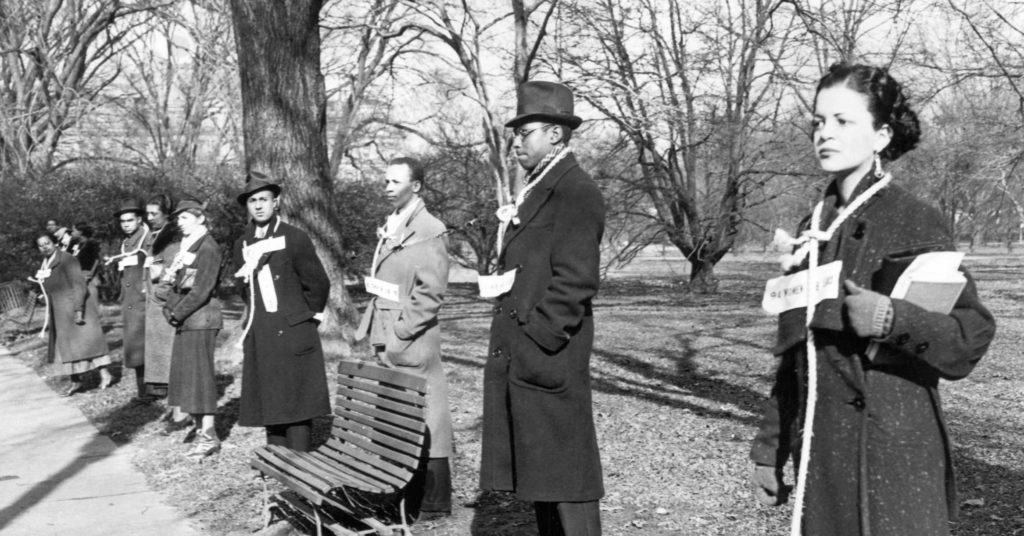
5. To elect three official delegates to the Scottsboro March on Washington initiated by the Amsterdam News, and to work for the election of a maximum number of delegates upon returning to our respective schools.
6. To take every step in combatting legalized jim-crowism as exemplified by the statutes of those southern states which decree that Negro and white students cannot sit together in the same class room and further to take immediate action to test the constitutionality of such laws.
7. That all efforts be made to further the work of the conference by taking another step forward by calling another conference in the South (Thanksgiving).
Emerging from the 1931 free speech struggle at City College of New York, the National Student League was founded in early 1932 during a rising student movement by Communist Party activists. The N.S.L. organized from High School on and would be the main C.P.-led student organization through the early 1930s. Publishing ‘Student Review’, the League grew to thousands of members and had a focus on anti-imperialism/anti-militarism, student welfare, workers’ organizing, and free speech. Eventually with the Popular Front the N.S.L. would merge with its main competitor, the Socialist Party’s Student League for Industrial Democracy in 1935 to form the American Student Union.
PDF of full issue: https://www.marxists.org/history/usa/pubs/student-review/v02n07-may-1933-student-review.pdf

