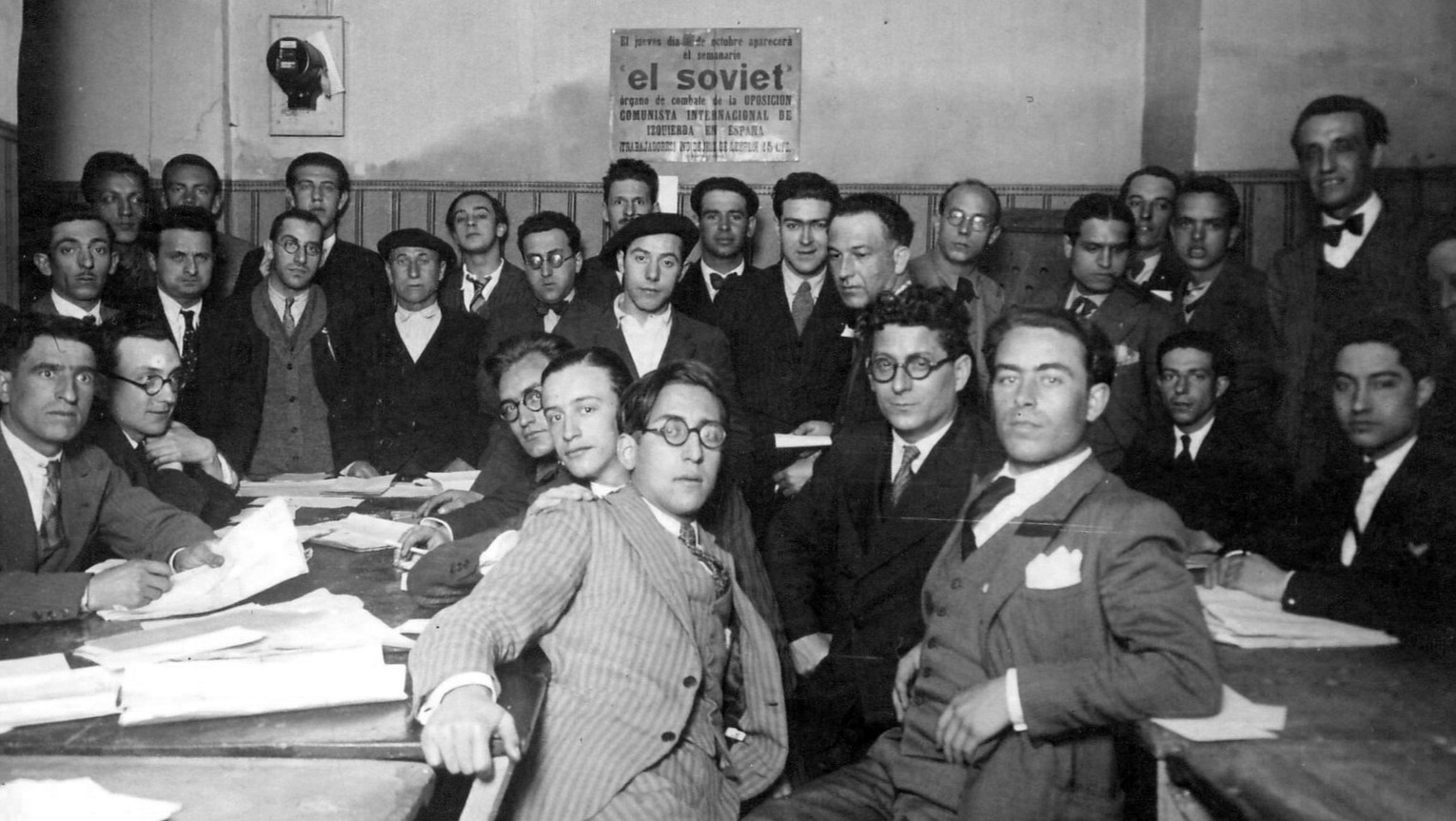
After the 1930 overthrow of Primo de Rivera all manner of exiled revolutionaries returned, with the Spanish Left Opposition, based in Belgium, having their first conference in Spain. There, in the early 1930s, Oppositionists, both ‘Right’ and ‘Left’ were large enough to compete with the official Communist Party. With the syndicalists a major actor and the Socialists also active, various organizational avenues were opened as the divisions between Nin and Lacroix over relations with other forces makes clear. Lacroix, Francisco García Lavid, was former leader of the Communist Party who became an early Left Oppositionist, General Secretary of the Communist Left, to be expelled from the Trotskyist movement in 1933. Joining the Spanish Socialist Party, he would become a Commissar in the Republican Army during the Civil War. Having publicly denounced Communist officers, he was arrested near the French border and executed by the C.P.-led Lister Brigade near the end of the Civil War in early 1939.
‘Second Congress of the Spanish Left Opposition’ by Henri Lacroix from Communist League of America International Internal Bulletin. Vol. 1 No. 8. 1931.
Our Spanish comrades held their second National Conference on June 7, at Madrid. Below we give extracts from the minutes of the conference, sent to us by the Madrid comrades. As can be seen from what follows, the question of the tactics of the Left Opposition in the elections to the Cortes particularly occupied the attention of the delegates to the Conference. The question of our attitude toward the C.P. as a whole is at present in the course of being elaborated in concrete political action and under complex and very difficult circumstances. In submitting this discussion to examination by all our national sections, we want to induce the whole International Opposition to participate in the work of elaborating the policy and the tactics of one of our sections which stands today at the point of revolutionary struggle.
Madrid, Jure 10, 1931.
TO THE GROUPS AND COMRADES OF THE S.C.O., TO THE INTERNATIONAL SECRETARIAT, TO COLRADE L.D. TROTSKY.
Dear Comrades:
The Spanish Communist Left Opposition has just held its second National Conference, on June 7 at Madrid, and the Executive Committee considers it its duty to inform the comrades of the entire Left Opposition of the resolutions adopted and also of part of the debates that took place at the Conference between the representatives of the different groups in the Spanish Opposition.
This was the second Conference of the S.C.O. The first was held at Liege (Belgium) by the Spanish Opposition group at the beginning of 1930. It was there that decisions were made on the organization of the Left Opposition in Spain and a plan of work elaborated. This was emphasized by Comrade Lacroix in the political report given in the name of the Executive Committee. After supplementary reports were given by the delegates representing the various districts, the political report was unanimously adopted.
One particularly encouraging fact resulting from the report of the E.C. and the supplementary reports is the following: despite the material hardships, despite the defection of a few hesitants, despite the difficult circumstances and the continuous arrests, the Spanish Opposition has developed in a firm and imposing fashion. From a little group of comrades (residing in Luxembourg) who made a declaration of solidarity with the deported Russian oppositionists, growing into groups of Left Communists in Luxemburg and in Belgium and reentering Spain at the moment when the C.I. gave the Spanish Communists the order to return to Spain, we have become an organization grouping within it the best comrades in the Communist Party of Spain, having little nuclei in regions in which the official party never had an organization before–in Extremadura, for instance. On all political questions, on the situation of the Communist party and the working class organizations, on the tactics of the C.P.—it is the Spanish Opposition alone which expresses the correct point of view and gives the correct revolutionary slogans. The Left Opposition, the vanguard of the Communist party, always struggles for Communist unity, struggles to make the C.P. a strong party capable of becoming the leader of the revolution.
The theses and resolutions adopted at the Conference should be studied by all Oppositionists and we urge them to express their point of view in order to help us elaborate our platform.
DECISIONS
On the Political Situation in Spain.
A very broad discussion is opened on the political situation, the tasks of the Communists, the reorganization of the C.P.S. and the position of the S.C.O. (the Opposition). After the discussion, the conference decides to charge the E.C. with the task of editing the theses on the political situation, taking into account the second pamphlet of Comrade Trotsky on Spain. The review COMMUNISMO will publish this pamphlet under the title “Communist Publications”. The theses will be published in #3 of COMUNISMO and submitted for discussion as well as for the approval of the isolated groups and comrades.
In the course of the discussion on the present day political situation, an important debate takes place on the forthcoming elections to the Cortes. In the name of the E.C., Comrade Lacroix proposes the following resolution:
The S.C.O., which has always fought for a clarification of the principles, policies and tactics of the C.P.S., as well as for the reestablishment of Communist unity which was disrupted by the bureaucracy of the party, leaving aside, for the moment, the question of a Unification Congress of Spanish Communism, appeals and proposes to all Communist groups–to the Catalonian Federation, to the Madrid “Agrupacion”, to the E.C. of the official party, to all Spanish Communists without exception–to constitute a Communist United Front for the coming elections. The Left Opposition will continue its criticism of the adventurist policies of the leaders of the official C.P. It proposes the united front at the elections, knowing full well in advance that the Stalinist E.C. will oppose the constitution of a Communist, united front. If the official C.P. will, despite all this, continue to sabotage the unity of all Spanish Communists, even if only for the electoral struggle, the Spanish Communists, with the S.C.O. at their head, will denounce this criminal splitting tactic of the Executive Committee by pitilessly unmasking before the masses the enemies of unity. But, at the decisive moment, in the moment of struggle, the Communists must all unite to vote for the candidates of the C.P. and must not permit the presentation of other candidates from independent Communist organizations.
Comrade Lacroix defends the proposal of the E.C., pointing out that in this manner the S.C.O. is making still another effort for Communist unity at the same time as it denounces the enemies of unity. Comrades Nin, Andrade, and Loredo Aparicio are against the resolution of the E.C. They claim that by voting for the candidates of the official party, authority would be given to people who do not possess any now. Lacroix intransigently insists that the proposal of the E.C. must be defended. He poses the following question: If the Catalonian Federation calls upon the workers not to vote for the candidates of the official party under the pretext of not giving any authority to the E.C. of the official party, what will the attitude of the Left Oppositionists be in this case? Nin: The Catalonian Federation does not and will not propose a united front with the E.C. or the official party, because in Catalonia it has an enormous majority over the official C.P. Andrade: Believes we ought to restrict ourselves in our resolution to saying that the S.C.O. proposes the united front, without speaking of the possibilities of realizing the united font nor of the electoral tactic itself. Lacroix: According to Andrade we should leave in suspense, without giving a clear answer, a question as important as that of the tactic of the Communists in the elections. But the S.C.O. will fail in its task as the vanguard of the C.P. if it will leave this question unanswered. Comrade Nin does not want to give the bureaucrats of the official party any prestige by voting for them, but in voting fer the Catalonian Federation, which is “oppositionist” only insofar as the E.C. of the C.P.S. alone is concerned, we would merely increase the confusion. At Barcelona, the C.F. will have its can candidates, because it is the strongest there, and at Seville, or in Biscaye, for instance, where the party is stronger, we must vote for its candidates. In this manner, the slogan of unity only becomes a camouflage.
Taken to a vote, the resolution presented by Lacroix is adopted. Comrade Nin declares that it is probable that a Communist organization in Catalonia will present him as its candidate in the elections. The resolution adopted by the Conference will make his position in the C.F., in which we have a great future, very difficult. Andrade is of the opinion that Nin’s nomination is incompatible with the resolution. Comrade Nin ought to accept a nomination for the elections. Lacroix is against the presentation of Nin as a candidate. The S.C.O. is not a party but a faction, striving to change the political course of the C.P. but not to combat it, especially not in an election struggle. If any of the sections of the C.F. will nominate Nin, even though he is not a member of the Federation, it is because Nin is a banner around which the Catalonian Federation can gather votes. Comrade Nin must not fall for this trick, not being a member of the C.F. Nin declares that he will not be a candidate before formally joining the C.F.
The resolution previously adopted is up for discussion again. A motion is made to nullify it; only the part giving the arguments in favor of unity ought to remain. A declaration is made in which the S.C.O. proposes that the candidates nominated by the local organizations be voted for. Comrades Estaban Bilbao and Lacroix are opposed to this proposal because it only reenforces a faction that is against the C.P., a faction full of political errors, with whom we cannot declare our solidarity.
On the second ballot, Nin’s proposal is adopted.
The thesis on the reorganization of the party, published in the review COMUNISMO, are adopted with minor modifications. The E.C. is charged with editing them before the final publication of the platform of the Spanish Communist Left Opposition:
THE THESES ON THE TRADE UNION QUESTION.
A very interesting discussion takes place on the trade union question. After this discussion, it is decided to introduce two new points in the trade union thesis: one, on the united front of the existing trade union organizations for a labor struggle on the basis of immediate demands; the other, on the constitution of factory and shop councils. A modification is also made regarding the activity of the Communists in the reformist trade unions of the UGT (General Labor Union–under Socialist leadership).
THE THESES ON THE NATIONALITIES PROBLEM.
The Conference voices its unanimous agreement with the draft theses, on the national question. These theses are published in #2 of COMUNISMO.
THE THESIS ON THE AGRIAN QUESTION.
A draft thesis on the agrarian question is studied by the Conference. The draft is adopted. The Conference decides on their publication in #2 of COMUNISMO and calls upon the groups to discuss it before taking it as a basis for the platform.
THE LIFE OF THE REVIEW “COMUNISMO”.
The entire conference rejoices at the information given by Comrade Ooredo Aparicio that the 1500 copies of the first number of the review are almost all sold out and that there are not enough left to cover important orders in many places. The number of subscribers is increasing constantly; the perspectives for COMUNISMO are very good. But we need the aid of the comrades, especially their material aid. The Conference charges the E.C. with the circulation of monthly collection lists for the review and calls upon the comrades to exert all their efforts for COMUNISMO, both from the financial point of view, as well as for its distribution among the workers. Comrade Nin will have to organize its sale in Catalonia, because the first number is almost unknown in Barcelona.
MISCELLANEOUS QUESTIONS.
The first pamphlet by Comrade Trotsky on the Spanish revolution was a big success. It was well distributed and aroused lively discussion in various circles in Spain. The conference decides to publish the new pamphlet of Comrade Trotsky on the current situation in Spain immediately.
The Conference ratifies the Executive and Central Committees elected by the meeting of the Madrid militants in agreement with the delegate of the International Secretariat.
Before adjourning, the Conference decides to send its warm greetings and an expression of its complete solidarity with the leader of the world revolution, to Comrade Trotsky and the Russian revolutionaries imprisoned and deported by Stalin, and to the International Secretariat of the Left Opposition. An address of solidarity with all the victims of bourgeois oppression in every country, is also adopted. The Conference adjourns with cries of: “Long live the Communist Left! Long live the Communist International of Lenin and Trotsky!”
For the Executive Committee of the Spanish Communist Opposition, Henri Lacroix
The U.S. Trotskyist movement began official, semi-regular internal bulletins to host political debate and discussion as the Communist League of America in 1930. In 1931, an International Bulletin was also produced running through 1934 to separate out the international debates. After the formation of Workers Party of the United States bulletins continued. With the entry of the Workers Party into the Socialist Party in the ‘French Turn’ internal bulletins were discontinued. In a reflection of the different size and resources of the CP, the CLA-WP-SWP bulletins were largely mimeographed rather than printed. A new set of Bulletins for internal discussion of the newly formed SWP in January of 1938 were produced, as well as another International Bulletin for discussion of the founding of the Fourth International. As a whole, these bulletins, unlike the internal bulletin of the CP, focus on long-form debate and internal discussion of Party resolutions and policy with the movement’s top leaders and thinkers contributing. Often, before congresses or plenums, special bulletins would be printed to host the relevant debate. The International Bulletins contain many of Trotsky’s and other international voices’ first English-language translations. Often those voice used pseudonyms, Crux is Trotsky. An invaluable resource for students of US Communism, Trotskyism, and the larger US workers’ movement.
PDF of issue: https://www.marxists.org/history/etol/document/swp-us/idb/cla-iib/08-1931-ND-international.pdf

