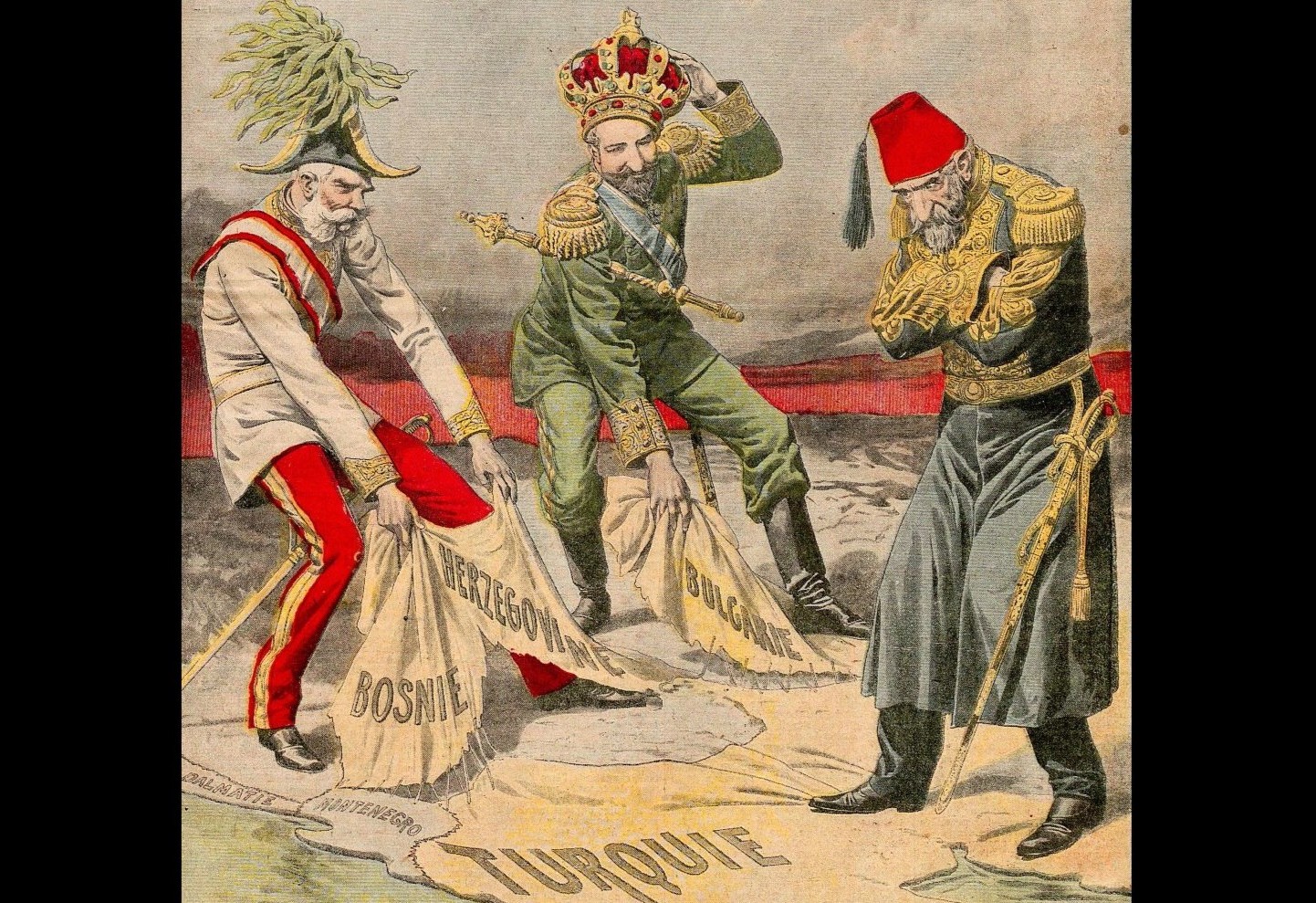
Pavlovitch, who analyzed the Balkan Wars from their beginnings to (temporary) end in 1913 summarizes the results, which destroyed the Ottoman Empire in Europe but created a whole new set of nationalist conflicts and openings for imperialist intrigues. Prolific Marxist writer and historian Mikhail Pavlovitch (Weltman) came from a middle class Ukrainian Jewish family, studied law and history, joined the RSDLP in 1898, he went into exile after the 1905 Revolution, spending most of his time in Paris where he wrote extensively for the international Left press. A Menshevik, he returned to Russia in the Summer of 1917, joined the Bolsheviks and participated in the Civil War. Always interested in the national question, Pavlovitch organized the Congress of the Peoples of the East in 1920, worked in the People’s Commissariat for Nationalities, and began the Moscow Institute of Oriental Studies, editing New East and Marxist History magazines until his 1927 death from cancer.
‘Peace in the Balkans’ by Michael Pavlovitch from New Review. Vol. 2 No. 2. February, 1914.
I. EUROPEAN CAPITAL IN THE OTTOMAN EMPIRE
With peace in the Balkans assured it is interesting to examine the prospects which a termination of the war affords. This grand bit of war history will, no doubt, radically modify conditions of life on the Balkan peninsula: it is pregnant with developments of high moment for Europe, but particularly for Asia Minor and the entire Mussulman world.
European publicists, confronted with the riddle of the Balkan crisis, usually fall back upon two ideological factors as an adequate solution. The backward stage of Turkey in general and Macedonia’s misery in particular, the reign of terror and the poverty that fanned the late war were due, according to this publicist theory, first, to the civil and nationalistic feuds that had been ravaging Macedonia, and second, to the religion and spirit of Islam, which is incompatible with any kind of progress.
The mere overthrow of Ottoman rule cannot stop the racial war in the Balkans. The interests of the Greek, Bulgarian, and Servian sections of the Balkan bourgeoisie are not identical, and this fact is bound to lead to ever new conflicts among these Christian nationalities. But this question of nationalities now assumes a new aspect and enters a new phase of development.
To the thoughtful student closely and dispassionately viewing the whole situation, it is clear that the theocratic character of the Mussulman state does not account for all the misery and all the dark sides of the Turkish regime. Let us probe the matter further.
It is wrong to view Islam per se as the sole check upon the regeneration of Turkey. For in the first place, every religion is, at bottom, conservative and inimical to progress. Nor, indeed, is Islam in any way more harmful than the Japanese worship of the Mikado as a being of solar descent. That Christianity itself no longer seriously retards European progress is due to the fact that the material and social conditions shaping life in Europe have shorn this religion of many features that could act as a drag upon progress and forced it to adapt itself to this new life.
Secondly, Islam itself has recently shown in a striking manner the ease and rapidity with which it adapts itself to the new scheme of life brought about by the overthrow of the old despotic regime and the inauguration of the parliamentary system in Persia and Turkey. Islam’s plasticity to the new imperative needs of our time is best shown by the prominent part which the Persian priesthood played in the events of 1905-1907 as the vanguard of the revolutionary army. Many Persian priests fell in the cause of the revolution; some were killed by blows of the soldiery in street demonstrations, many died on the gallows, and others were shot down or tortured to death in the prisons.
Again, Mussulman society, when watched at close range, is just now displaying a decided breakdown in its spiritual make-up and aspect. Its more advanced elements in India, Morocco, Algeria and Tunis are in the throes of an internal revolution affecting spiritual and ethical standards and beliefs and traditional modes of thinking and feeling in connection with religious and social matters and problems. It is a new intellectual wave sweeping even over the darkest spots of the creed of Islam.
The race war in Macedonia, far from explaining anything, itself needs explanation. This nationalistic conflict owes its specific character to the archaic methods of production still prevalent in European Turkey, or what lately was such. Moreover, the cause of the whole deplorable situation in the Ottoman Empire lies rather in the economic system which European capitalism has forced upon this weak country than in race, religion, law or any other ideological factor. The backward state of this empire is primarily due to the peculiar ways in which foreign capital operates in Turkey.
Official statistical data show, approximately, how the tremendous bulk of foreign capital invested in the Ottoman empire is distributed French capital, $500,000,000; German capital, $180,000,000; English capital, $150,000,000. The French investments in Turkey represent one-fifteenth of all French capital invested abroad. In spite of this, the degree to which Turkey’s manufacturing industry is developed does not in the least correspond to this enormous amount of foreign investment in the empire. As is well known, this industry is still in its infant stage. True, there are the power tanneries in Salonica, Constantinople, and Smyrna. Of late, especially since the abdication of Abdul Hamid and the beginning of the new regime, textile works, fez factories, and other industrial plants have been opened in Salonica and the interior of Macedonia. But these weak beginnings of large industry were fostered into life by the legis lative efforts of the Young Turks, aided by the expedient of raising the tariff rates on certain imports from 8 percent to 11 percent–a measure which Europe was forced to sanction. European capital as such, however, has done very little to develop large industry in Turkey. The entrance of European capital into backward countries unable to resist economic pressure from abroad first stimulates the economic activities of the country in question, breaks down traditional forms of life by undermining their very foundations, develops the market both at home and abroad, and helps the native commercial class to greater wealth, numerical strength and power. But the moment the merchants, tired of playing the middleman between foreign capital and the home consumer, evince a tendency to shoot off a sub-class of native industrial entrepreneurs, the economic pressure of outside European capital becomes a check upon the development of the productive forces of the backward country. This tendency is especially noticeable in the case of the French investments in Turkey.
Of the $500,000,000 of French capital operating in this empire, $300,000,000 are invested in Turkish state securities; $80,000,000 in railroads with a trackage extending from tidewater to the interior to a maximum of 186 miles; $20,000,000 are invested in real estate; $10,000,000 in marine transportation; $16,000,000 in banks; $12,000,000 in commercial agencies and only $12,000,000 in coal mines supplying fuel for the above railways and in other industrial undertakings. We see, then, that only 2.4 percent of the French capital in Turkey operates in a purely productive capacity by utilizing industrially the natural resources of the country. French capital provides Turkey with wharf facilities for unloading European goods; it builds railways connecting points along the seaboard with the interior and forming mere extensions of the French merchant marine; it opens and maintains banks, export and import houses, postal bureaus, and, in short, creates a great variety of facilities for flooding the markets of Turkey with foreign manufactures.
Foreign capital kills the small native industry and home handicraft; it helps in breaking down the strength and stability of the Turkish peasantry, once the sturdy bulwark of the Ottoman state during the most trying times when the nation’s life was at stake. But foreign capital is not constructive in a capitalistic sense; it does not develop large industry in Turkey, nor does it contribute to the rapid growth of new social classes, those builders of the future. The same is true of English and German capital.
The Ottoman empire is still a peasant country. Farming is the basis of Turkey’s economy. It is the only source of income for over 95 percent of the people and supplies the main items of state revenue. The poor Mussulman peasantry, the only toilers and producers in the empire, were always hampered by the necessity of supporting the large landowners, the military and the civil officials. There are few Mussulmans in business, while the Mussulman proletariat is made up largely of harbor and railroad workers. The Christian element of the population in the European territory conquered by the allies consists chiefly of peasants and intellectuals.
Macedonia’s intellectual class had suffered at the hands of the Ottoman bureaucracy. Though yielding to the spirit of the times in other directions and ready to grant many reforms, the young Turk government persisted in shutting out Macedonians from civil service, especially the higher offices. Foreign capital has no need for native proletarian brain power. And so an intolerable glut of the intellectual market arose when the universities and technical schools of Western Europe, Bulgaria, Servia, Greece and Roumania unloaded their output on Macedonia. This vast army of young graduates could not be absorbed either by the civil service or by the infant industry of the Ottoman empire. Many of them took up teaching, but many were left stranded. It is this reserve army of school teachers and floundering intellectuals which proved a powerful ferment for breeding popular revolt. The peasantry were merely the plastic dough which the intellectuals of Macedonia, urged on by the sheer instinct for self-preservation, attacked like a subtle leaven. The risen bread was the Balkan war.
The influence of this intellectual class, with its narrow mentality and its clannish group interests, gave the political conflict in Macedonia its nationalistic tinge. Not large issues on the broad lines of social-economic cleavage, but narrow race squabbles determined the make-up of the parties of the Conservative, Liberal, Radical, and Socialist types. Macedonia has now a full crop of political clans shouting their Bulgarian, Servian, Greek, Roumanian and other race slogans.
However, the social situation will now begin to undergo a radical change. The Servians, as reported by foreign consuls, are already abolishing, of their own accord, the so-called “capitulations” [*Exemptions and immunities granted by the Porte to the subjects of foreign Powers by special treaties.] in their territory–a step in the right direction, which will undoubtedly be followed by the Bulgarians and Greeks. Europe will now have to accept mutely this bold attitude on the part of the young and daring Balkan countries. Disregarding Europe and the interests of English, French and Austrian manufacturers, the Balkan governments will revise the existing tariff system upwards. Such tariff protection is imperative for them, as for every country at a certain stage of economic development, so as to shield their embryonic industry against foreign imports, and especially against imported articles that can be profitably produced at home. The next move will be the overhauling of the shipping rates operative on the railroads still owned by western European countries. Foreign capital drawing its dividends from Macedonia but located in Vienna, Berlin, Marseilles, Birmingham, and Manchester, will be forced either to give up the Balkan market or to become domiciled in the Balkans. Thus fears were recently voiced in the special French press that some of the tanneries located in Havre and other French cities would have to shut down at home and in the guise of Bulgarian, Servian, or Greek firms, transfer their plants to the Balkan peninsula. The same will be the case with many scores of other plants located in Europe and doing business in the Ottoman empire. No wonder, then, that at the beginning of the war a great many of the French papers were so biased against the Balkan allies and so sympathetic to the Turk. They will now have to tone down their hostility and bow to the victors, since they will from now on dictate the terms upon which foreign capital will be admitted to the former European dependencies of Turkey.
Soon Macedonia will have its new social-economic classes, its industrial bourgeoisie and factory proletariat. The latter will leave its stamp on the map of the country’s future. The Tobacco Workers’ Federation already has a membership of 50,000 in Salonica, Cavalla, Drama, Seres, and other towns. These organized workers have shown grit and fighting mettle in the recent battle with the employers, which was waged during the heat of the Balkan war. In a few decades these will be joined by the harbor and railroad workers, and unions in other industries
II. THE AGRARIAN REVOLUTION
The Agrarian revolution which is bound to follow the downfall of Turkish rule will play a tremendous part in the economic transformation of Macedonia. The principle underlying the agrarian laws of Turkey is that no real estate can be alienated to pay a debt. This old legislation was essentially an effort to preserve certain types of the Mussulman peasantry, the bulwark of old Turkey. It successfully warded off any attempt at divorcing the farmer from his means of production. But such a law is incompatible with modern capitalist economy.
The advent of the victorious allies will change the scheme of land tenure in the conquered territory of Turkey. The governments of Bulgaria, Servia and Greece will obtain immense tracts of fertile territory, hundreds of villages and ploughed fields deserted by poor Turkish peasants who have quit Macedonia and Thrace forever. True, the peasants of Bulgaria, Servia and Greece, and the cotters of Macedonia who went to war against the “infidels” and so lustily mowed them down, thought that they themselves would be the first to step into the shoes of the conquered ones. But the hopes of these landless peasants will never materialize.
A part of this fertile land has already been grabbed by all sorts of land sharks. Taking time by the forelock, they have cornered what is best for a song. As usual after every successful war, a fair share of the territory seized will go to reward doughty war generals, or endow ministers or favored members of the Balkan royalty. Finally a part of the land deserted by the Turks will go to the agrarian banks to be sold; the buyers will be Macedonian refugees returning home, and Bulgarian, Servian, and other peasants.
But whatever the outcome, land in Macedonia and Thrace will henceforth become a commodity to be bought and sold just like any other “use-value” in modern capitalist economy. From now on, in all Macedonia not a single rood of land whose owner has become insolvent will be immune from forcible alienation.
It is for the near future to decide whether or not the new agrarian order soon to be crystallized into law will confer any benefit upon the small landowners and the Turkish peasants who have not fled. But the immediate effects of the Balkan victories, at any rate, may be forecasted with certainty. They will speed up the development of capitalism in rural Macedonia and facilitate the entrance of private industrial capital into a territory hitherto walled in from any direct contact with “agrarian banks” and other agencies of financial capital. In the near future this will lead to a more or less disguised but none the less real expropriation of the greater bulk of the rural population, this time Christian in its make-up, followed by a stampede to the cities on the part of a great mass of formerly independent farmers. Then will follow mass emigration and the building up of a rural reserve proletariat. In short, Macedonia and Thrace will be completely trimmed down to fit the scheme of modern European economy.
III. THE EVE OF A NEW DAWN
The result of this war will be to lash the revolutionary movement to a quicker pace, both among the Christians in the territory wrested from Turkey as well as in Bulgaria, Servia and Greece themselves. The millions of peasants and workmen in these three countries, now dazed by jingoism, will sober up and realize how far the Socialists were right when they vigorously denounced the attack on Turkey. Sakharoff, the Bulgarian Social Democrat, fearlessly denounced in the Bulgarian National Assembly the aggressive policy of his country’s ruling class. Zaxos, the Greek Socialist, court-martialed for his daring anti-war propaganda and sentenced to death, was saved from the hangman only through the mighty protest raised by the Greek Socialists against such judicial murder. Many Balkan peasants and wage-workers who blindly followed their generals and colonels and marched to battle against their Mussulman brothers, very soon came to look upon the above two Socialists as prophetic heroes. The masses in the Balkan peninsula are bound to go through fundamental changes which will result in the dawn of class consciousness.
This is borne out by recent history elsewhere. At the start of the Russo-Japanese war the Japanese were told that their country could not live without Korea, that its conquest would open a vast new industrial market which would absorb Japan’s unemployed and raise wages at home. And though the Japanese victories were beyond their wildest dreams, the veterans of this glorious war tramp the streets of Tokio to-day in search of work they cannot find. Many of them are literally dying of starvation, for the cost of living has increased to a great degree, and rice is selling for twice as much as during the war. There were 10,000 suicides last year. A spirit of revolt has seized the whole country. Here and there are underground rumblings which herald in an unmistakable manner an approaching social upheaval such as Asia has never known before.
In Italy also the masses are beginning to recover from their jingoistic trance. They were told that at the close of the war millions of Italians would emigrate to Cyrene and Tripoli. When the first few thousands prepared to go, the Italian government announced that only those who had previously procured employment would be allowed to emigrate, as there was neither work nor prospect of it in the conquered African territory. The Italian masses are disillusioned. While the war enriched a handful of manufacturers and financiers, it gave the people nothing but thousands of new cripples and invalids to care for, an inflated state debt, and higher taxes.
The Balkan Slavs and Greeks will soon realize that economic gains obtained through war are short-lived and never repay one-thousandth part of what is lost on the battlefield. And that lesson has to be learned before they are ready to take up the battle of their class and finally unite with the international proletariat in the combat against wage slavery.
The New Review: A Critical Survey of International Socialism was a New York-based, explicitly Marxist, sometimes weekly/sometimes monthly theoretical journal begun in 1913 and was an important vehicle for left discussion in the period before World War One. Bases in New York it declared in its aim the first issue: “The intellectual achievements of Marx and his successors have become the guiding star of the awakened, self-conscious proletariat on the toilsome road that leads to its emancipation. And it will be one of the principal tasks of The NEW REVIEW to make known these achievements,to the Socialists of America, so that we may attain to that fundamental unity of thought without which unity of action is impossible.” In the world of the East Coast Socialist Party, it included Max Eastman, Floyd Dell, Herman Simpson, Louis Boudin, William English Walling, Moses Oppenheimer, Robert Rives La Monte, Walter Lippmann, William Bohn, Frank Bohn, John Spargo, Austin Lewis, WEB DuBois, Arturo Giovannitti, Harry W. Laidler, Austin Lewis, and Isaac Hourwich as editors. Louis Fraina played an increasing role from 1914 and lead the journal in a leftward direction as New Review addressed many of the leading international questions facing Marxists. International writers in New Review included Rosa Luxemburg, James Connolly, Karl Kautsky, Anton Pannekoek, Lajpat Rai, Alexandra Kollontai, Tom Quelch, S.J. Rutgers, Edward Bernstein, and H.M. Hyndman, The journal folded in June, 1916 for financial reasons. Its issues are a formidable and invaluable archive of Marxist and Socialist discussion of the time.
PDF of issue: https://www.marxists.org/history/usa/pubs/newreview/1914/v2n02-feb-1914.pdf
 Revolution's Newsstand