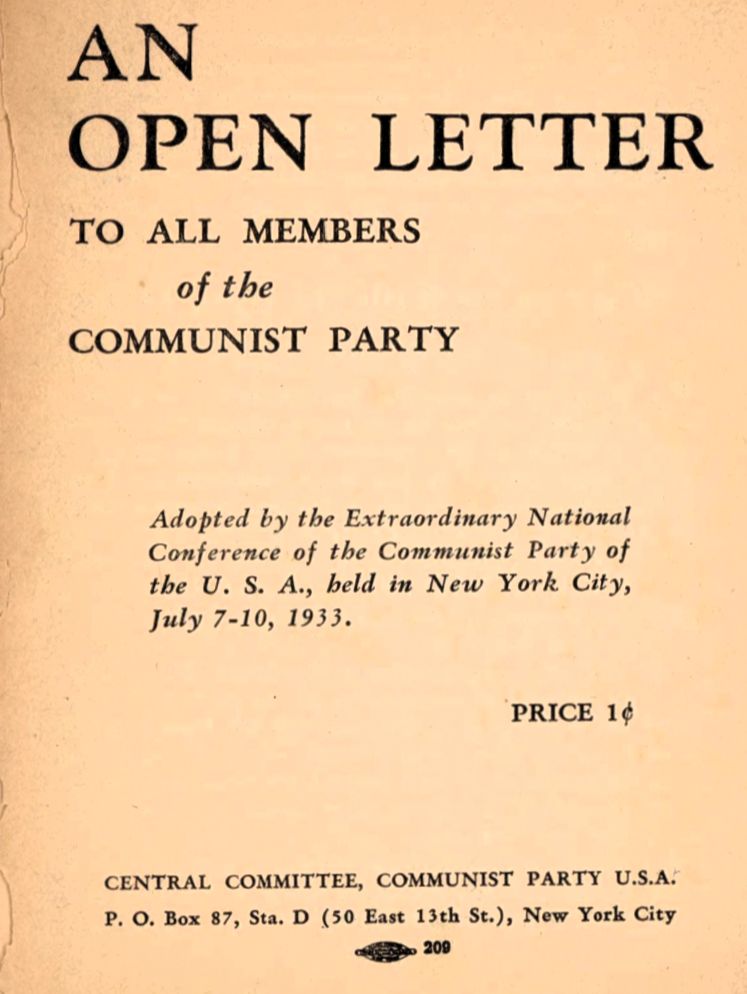
‘An Open Letter to All Party Members’ from the Daily Worker. Vol. 10 No. 167, July 13, 1933.
The full text of this extremely important document from the leadership of the U.S. Communist Party deserves a lengthy introduction, as we will look at the accomplishments and critiques of the Open Letter in several later posts. An Open Letter issued by the C.P. was as significant a direction to its members and secondary leaders as any document. They were meant to be studied, discussed, implemented, and reported on.
While, arguably, there is much to criticize in the politics of the ‘Third Period’; which split the existing union movement to create dual, ‘Red Unions,’ weakening and dividing working-class organization and ghettoizing the best worker-militants; the extraordinarily sectarian ‘Social Fascist’ position which claimed that Socialist Parties and other left forces were either consciously facilitating fascism, or themselves fascist (damning A.J. Muste as a fascist frankly, just didn’t ring true for most people) then refusing a United Front against the very real fascist menace; and finally an approach to all political questions—big and small–as one being a struggle for immediate power–even when your party could claim no majority, let alone hegemony within the class.
However, the ‘Third Period’ was also rooted in a very real crisis, one nearly terminal for working-class organizations that had abandoned even the pretense of the class struggle, with Socialist Parties themselves facilitating repression and violence against revolutionaries. And all this just as that struggle was greatly accelerating in the late 1920s, with vibrant anti-imperialist, anti-colonial movements, and increasing working class militancy within the imperialist core. In short, whatever its problems, the Third Period was rooted in reality, even if that reality was misunderstood and lessons misapplied.
A central premise of the Third Period, that fascism had essentially already arrived, was blown out of the water in March, 1933 when fascism did formally arrive. Almost immediately, the Communist Party abandoned one tenant after another from the previous ‘Third Period’ perspective; some with genuine positive consequences. It was clear that Communists had not won the leadership of the class through their own specific organization, and it was therefore necessary to shift again to working within existing organizations, including reformist ones. And therefore working much more in step with the class as it was. The former Social Fascists were now themselves under Nazi persecutions and the first, though tentative steps, toward an organizational relationship with the Socialists began; and finally the fight for power as the immediate perspective was abandoned to creating issue campaigns.
All these changes occurred within months of March, 1933–of course not uniformly and without resistance. They would soon develop into whole new categories, and soon making steps toward the very different politics of the Popular Front. That policy consciously subsumed working-class politics into a an increasing ‘radical-liberalism,’ complete with vulgar nationalisms and myth-making necessary for a fictitious ‘common cause’ between workers, the petty-bourgeoisie, and the ‘liberal bourgeoisie.’ In the sphere of international politics, the world of inter-state diplomacy replaced support of class struggle confrontations, with the SOviet Union joining the League of Nations and negotiating pacts with newly anointed ‘democratic’ imperialist powers like France.
Codified at the Comintern’s Seventh World Congress in 1935, the Popular Front being, in your host’s perspective, a betrayal of the working class and of Marxism as great as that of August, 1914. With its class-collaboration, ‘democratic-imperialist’ betrayal of the colonial world, and rejection of the proletarian dictatorship, it simply abandoned revolution as an option, let alone a necessity, for as long as there was the possibility of fascism, which can always be argued as a possibility. Forget the debate about whether Leftists should bloc with Tucker Carlson (WE SHOULD NOT), the real question is whether ‘Leftists’ should be in a bloc with Liberalism—one of capitalism’s classic and constituent ideologies. If you want to know when Leftist’s got lumped in with liberals, our traditional and inveterate enemies, which to our great detriment has tainted our movement with the liberal brush among workers for generations, its modern beginnings are in the Communist Party’s Popular Front policies in the 1930s.
‘An Open Letter to All Party Members’ from the Daily Worker. Vol. 10 No. 167, July 13, 1933.
Adopted by the Extraordinary National Conference of the Communist Party of the U.S.A. Held in New York City, July 7th to 10th, 1933.
Party Comrades:
THE tremendous sharpening of the economic crisis, and the new severe attacks of the bourgeoisie on the workers and toiling masses, as well as the feverish preparations of the imperialists for wars among themselves and for intervention against the Soviet Union, make a rapid turn of the Party to revolutionary mass work among the decisive sections of the American industrial proletariat an imperative task. The rise of the strike movement, the mass actions of the unemployed, the increasing opposition within the A.F. of L. against the bureaucracy, the various movements which are growing at a tempestuous pace among the poor farmers and ruined middle farmers, the movements among the masses of petty bourgeoisie in the cities and the toiling intelligentsia, especially among teachers, students and intellectuals–all these factors indicate that the revolutionary upsurge is gaining momentum. But in spite of the spread of the mass movements, and, above all, in spite of the radicalization of the masses of workers, the Party has not developed into a revolutionary MASS PARTY of the proletariat, even though it can point to a number of achievements in its work, such as in the Detroit strike, in the Hunger Marches, in the veterans’ movement and in the Farmers’ Conference.
Developing the Party Into a Mass Proletarian Party
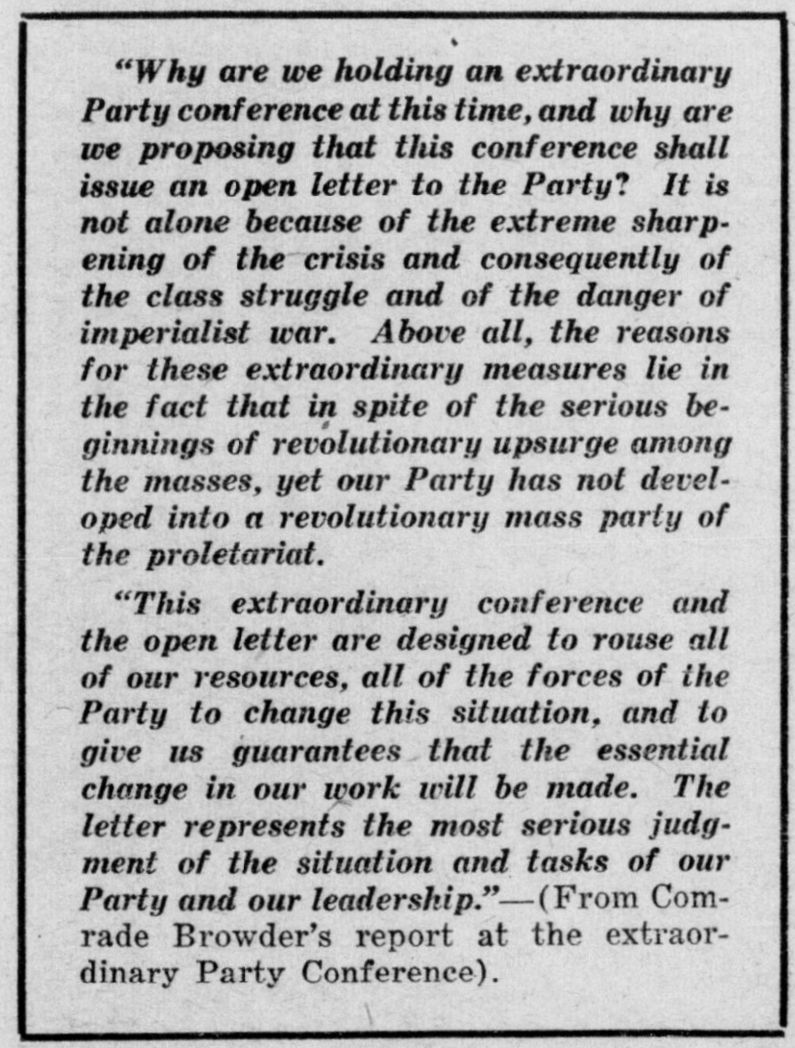
IN many resolutions we already set ourselves the task of developing our Party into a proletarian mass Party. We did this with the greatest thoroughness over a year ago at the XIV Plenum of the Central Committee. But all these resolutions have for the most part remained on paper. The leading organs of our Party have not succeeded in mobilizing the masses of members for a systematic and determined application of these resolutions or in giving the Party membership practical assistance in putting these resolutions into force. At the XV and XVI Plenums, the leading organs of the Party did not call themselves ruthlessly to account for the failure of the Party to make any headway in the carrying out of this turn.
WHAT did we decide at the XIV Plenum? At this Plenum we declared that we are still isolated from the main masses of industrial workers; that we still have no firm contacts with these sections of workers, and that we are not keeping pace with the general revolutionary advance. In order to overcome this situation we set ourselves the following tasks:
a) The organization of a firm basis for our Party and the revolutionary trade union movement among the decisive strata of the American workers in the most important industrial centers;
b) The consolidation and strengthening of the revolutionary trade unions, especially revolutionary unions of the miners, steel and metal, textile and marine workers, and systematic work in the reformist trade unions, above all among the reformist unions of miners and railroad workers, with a view to organizing a broad revolutionary trade union opposition;
c) The organization and mobilization of the millions of unemployed, together with the factory workers, for their most urgent needs and the organization of the struggle for unemployment insurance as the central immediate struggle of the Party;
d) The transformation of the DAILY WORKER into a really revolutionary mass paper, into an agitator and organizer of our work;
e) The wide development of new cadres of workers; the establishment of really collectively-working leading bodies of our movement and the improvement of the work of these leading bodies by the drawing in of new capable working class elements.
IN order to carry out these tasks, we worked out a concentration plan and pledged ourselves to transfer the center of our work to a number of selected most important large factories, sub-districts and districts. The entire work of the Party and the best forces of the Party were to be directed first of all to building up and consolidating the Party and revolutionary trade union movement in the most important industrial centers of the country, to effectively and systematically win the decisive sections of the American workers, free them from the influence of the reformist and bourgeois parties, mobilize for the struggle against the bourgeoisie, and get our influence solidly established in these centers.
Main Tasks Not Carried Out
BUT THESE TASKS HAVE NOT BEEN CARRIED OUT. Only 4 per cent of the membership are organized in factory nuclei, and only a small portion of these are organized in nuclei in big factories. The Communists have neglected and worked badly in the revolutionary trade unions, and consequently the chief red trade unions, such as the unions oz the coal miners, the steel and metal workers, the textile and marine workers have not gone forward, but have stagnated. The work in the reformist trade unions has in general been neglected by the Communists, which particularly led to the fact that the “left” reformists (Muste) were able to bring many radicalized workers, especially American workers, under their influence (Sothern Illinois), and that the influence of the reformists has extended also to some elements of unorganized workers.
The circulation of the DAILY WORKER has fallen off. In spite of the fact that there have been widespread movements among the workers and many workers have come forward in the struggles, the cadres of functionaries of the Party have not been rejuvenated and strengthened from the ranks of these workers, and sectarian elements, who are beyond hope of improvement and have lost touch with the masses, have not been replaced by new worker cadres who have distinguished themselves in struggle.
THE clearest expression of the failure to carry out this concentration is the fact that during the past year the majority of strikes were led by reformists, while we made no serious attempts to get the leadership of these struggles away from them, thus abandoning militant workers to the disorganizing and disrupting activities of the reformists. More than that even. In fact the reformists in Eastern Ohio, a concentration district of the Party, succeeded in taking over the leadership of miners who had previously carried on a heroic strike under the leadership of the National Miners’ Union. This was possible only because the Central Committee and local leading bodies of the Party failed in an inexcusable manner to devote sufficient attention to this movement of one of the most important sections of workers, and consequently did not realize the militancy existing among the miners. The success of the Party and of the Automobile Workers’ Union in Detroit shows what can be accomplished by the Party and the revolutionary trade unions in other districts when they vigorously defend the interests of the workers and carry out the principle of concentration in the proper way.
We did not devote our full energy to the campaign for unemployment and social insurance a campaign offering the possibilities of welding the employed, part-time and unemployed workers together in the struggle against allowed the initiative to be snatched from our hands (Cleveland, etc.). We underestimated and neglected the struggle against social-fascism, and did not link it up with the daily revolutionary work in the factories and trade unions, as well as among the unemployed. We did not take the trouble to answer carefully all the arguments of the social-fascists. All of which constitute one of the chief reasons for a growth of the influence of the reformists, especially “left” reformists among the workers.
Party Leadership Bears Full Responsibility
THIS situation in our work, for which the THIS WHOLE PARTY LEADERSHIP BEARS FULL RESPONSIBILITY, makes it the iron revolutionary duty of the Party to carry out a decisive turn in our work in a most speedy way, in view of the tremendously rapid development of the crisis and the growing revolutionary advance.
***
OWING to the change in the administration, the American bourgeoisie was in a position to spread among broad masses of workers temporary illusions of an approaching improvement in their situation. But the depth and tempo of the economic crisis have established favorable conditions for a speedy unmasking of the policy of the parties of the bourgeoisie. Roosevelt is continuing Hoover’s policy against the working class and other laboring masses in an intensified form, ushering in his term with bitter attacks (inflation, reduction of salaries of government employees, reduction in veterans’ allowances, the Allotment Plan, forced labor and militarization of unemployed workers, the sales tax, etc.).
The radicalized workers, who had their bitter experience with the Republicans, are now well on the way to meeting with the same experience from the second traditional party of finance capital, namely, the Democrats, and the movements among the workers against robber measures are bound to increase. The poor farmers and the ruined middle farmers who only yesterday voted for the bourgeois parties are, in fact, already taking the path of struggle against the policy carried on by these parties, and are constantly intensifying their efforts to attain an “independent” policy. Thus, as a result of the development of the crisis, which is characterized no not only by a rapid extension of the labor movement, but also by a widespread movement among the petty bourgeoisie, we find a far-reaching mass movement of workers, farmers and other middle elements which is directed against the old bourgeois parties, and against the government, and which is growing continually stronger.
THE American bourgeoisie, which fears a development of great class struggles and clashes, is already making attempts to block this development. It is no mere chance that the Socialist Party, with the calling of the so-called Continental Congress, is developing the greatest activity they have shown for years, that the Musteites are intensifying to a very marked degree their activity, especially among the American sections of the working class, and that at the same time efforts and tendencies are coming to light in the direction of organizing a Farmer Labor Party, and that various reformist, fascist and semi-fascist organizations among the unemployed farmers, etc., are springing up all over the country. On the one hand the bourgeoisie is attempting with the help of the reformists to establish all kinds of rallying centers for intercepting the disillusioned masses, and to set up barriers against Communism. On the other hand, and at the same time, the bourgeoisie is intensifying direct terrorism and provocation against the masses and coming more and more to adopt fascist methods of violence and demagogy and to establish fascist organizations.
Social Fascists Strive To Paralyze Influence of Party.
THE reformists and especially the Musteites are attempting in the most active manner to paralyze the influence of the Communists by their own activity, which is directed also toward the organization of a Farmer Labor Party. As opposed to our policy, namely: alliance of the proletariat with the poor farmers and ruined middle farmers under the hegemony of the proletariat and struggle for the revolutionary way out of the crisis,–they are putting forward their policy, namely: a policy which goes in the direction of establishing a Farmer-Labor Party, in which the workers become an appendage to the petty bourgeoisie and the petty bourgeoisie become an appendage to the bourgeoisie, and for “democratic” methods of struggle.
Main Link–Execution of Correct Policy
EVERY Party member must now understand that it depends on correct policy and above all, the execution of the correct policy, whether we will be able to mobilize the masses of workers for struggle and whether our Party, in this historically favorable situation, will become the decisive mass Party of the American proletariat, or whether the bourgeoisie with the help of its social-fascist and fascist agents will succeed in disorganizing the mass movement and keeping it down. Never before was the situation in the country so favorable for the development of the Communist Party into a real revolutionary mass Party. But from this it follows also that failure of the Party to understand its chief task–namely to become rooted in the decisive industrial centers, in the important big factories–never before represented such great danger for the fulfilment of our revolutionary tasks as a whole.
***
WHY IS IT THAT THE PARTY ADOPTS RESOLUTIONS SUCH AS WERE ADOPTED AT THE XIV PLENUM OF THE CENTRAL COMMITTEE, AND DOES NOT CARRY THEM OUT? Why is it that we do not learn from our experiences and mistakes in strikes, trade union and factory work, and from our work among the part-time workers and unemployed? Why is it that the leading bodies of the Party do not concentrate the full forces of the Party to help the comrades in a practical way in their difficult but most important Party work, namely work in big factories, enabling them to overcome all the difficulties in this work? Why is it that the entire Party, from top to bottom, is not working to determine the best ways and means for establishing contacts with the most important sections of the workers, learning to overcome their prejudices, speak a language they understand and persistently and patiently help them to organize the struggle against hunger? Why is it that the Communist fractions in the revolutionary unions do not make a concrete investigation of the weaknesses in the work of the revolutionary trade unions in order to overcome these weaknesses?
Main Task–To Establish Solid Base Amongst Decisive Elements of American Proletariat
BECAUSE in the Party, and particularly among the leading cadres, there is a DEEP GOING LACK OF POLITICAL UNDERSTANDING of the necessity for strengthening our basis among the decisive sections of the American workers. From this follows the fact that the leadership of the Party has not adhered to a fixed course for overcoming the main weaknesses of the Party, allows itself to be driven by events, and does not work out carefully with the comrades of the lower organizations ways and means for the carrying through of resolutions and checking up on their execution. The result is that we talk about factory and trade union work in countless resolutions, without carrying this work out.
***
IT IS time that the entire Party should understand that without a solid basis among the decisive elements of the American workers, the Party cannot lead the revolutionary struggles of the working class and free them from the influence of the social democrats and the bourgeoisie, which still prevails among the decisive elements of the working class, however favorable the conditions for our influence may be. It is idle chatter to talk about the revolutionizing of the working class by the Party unless the Party conquers a firm basis for itself among the miners, metal and steel workers, railroad workers, auto, marine and textile workers.
It is idle chatter to speak about the leading role of the Party without establishing contacts with the decisive strata of the workers, mobilizing these workers and winning them over to our side. Talk about the defense of the Soviet Union and struggle against imperialist war is nothing but empty phrases unless systematic work is carried out in the war industry plants and in the ports; talk of struggle against social fascism is nothing but empty phrases unless the struggle is carried on from day to day in the big factories, in the reformist unions and among the unemployed. It is nothing but phrase-mongering to speak about building up the Party and the revolutionary trade unions without doing this among the important bodies of workers, in the big factories, in the important industrial sections. It is idle to talk about the necessity of new cadres without developing them from among these very sections of workers.
***
THE working class will be in a position to fulfill its role as the most decisive class in the struggle against finance capital, as the leader of all toiling masses, only if it is headed by a Communist Party which is closely bound up with the decisive strata of the workers. But a Communist Party with a very weak and inadequately functioning organization in the big factories and among the decisive sections of the American industrial workers, a Communist Party whose entire policy, whose entire agitation and propaganda, whose entire daily work was not concentrated on winning over and mobilizing these workers and winning of the factories, a Communist Party which, through its revolutionary trade union work, does not build highways to the broadest masses of workers, cannot lay claim to a policy capable of making it the leader of the working class within the shortest possible time.
***
THE necessary concentration of our work on the most important factories does not of course in any way mean that we should allow our work among the unemployed to slacken. In carrying out this main task we should not for an instant lose sight of the fact that we represent the interests of the entire class, and that, especially under the present conditions the unemployed constitute a factor of greatest revolutionary importance. One of the chief tasks of the Party is the organizing and mobilizing of the millions of unemployed for immediate relief and unemployment insurance and the linking up of their struggles with the struggles of the workers in the big factories–full time, as well as part-time workers–especially now, in view of the introduction of militarized forced labor for the unemployed and the increased attempts to bring them under reformist and fascist influence. But the Party cannot carry out this task successfully unless at the same time it establishes its base in the decisive big factories. Hunger marches and other activities of the unemployed must be accompanied by sympathetic actions on the part of the workers in the factories, while the actions of the workers in the factories must receive the most active support from the unemployed.
The Allies of the American Working Class
THE fact that great masses of the petty bourgeoisie and particularly poor and ruined farmers are getting into action, the right sectarian failure to understand such movements, as expressed in the stand of leading comrades against participation in the veterans’ movement, and the opportunist tendencies to succumb to the influence of petty bourgeois views (the report of a CC member about the activity of a Party organization in the Pittsburgh coal district in connection with the preparation of the struggle of the miners for April 1st: “They forgot 10,000 miners who are ready to struggle. In order not to offend the feelings of the business people, they forgot about the militancy of the miners”)–all these factors make it urgently necessary for the Party to take a clear stand with regard to the allies of the proletariat in order to win these allies and to protect itself against errors and deviations.
The Hegemony of the Proletariat
THE most important allies of the American working class are the poor and small farmers. These farmers, as well as broad sections of the middle farmers, are hardest hit by the whole development of post-war capitalism and especially by the economic crisis and are most brutally exploited by the government, by the banks, by the trusts and the insurance companies. Their interests are consequently directed objectively against finance capital.
In this situation the main task of the Party in its work among these toilers consists above all in the organization of the agricultural workers independently of the farmer in organizing them into the Party and trade unions, in organizing and leading strikes of the agricultural workers, which in many places already played an important role in the development of the farmers’ movement. At the same time the Party has the possibility of mobilizing not only the poor and small farmers, but also broad sections of ruined middle farmers, for the struggle against capitalism on the side of the proletariat, while at the same time it can neutralize other sections of middle farmers. The winning over of broad masses of farmers as allies of the working class is an important prerequisite for a successful struggle against the offensive of capitalism, against fascism and for the defense of the Soviet Union, and finally for the victory of the proletariat.
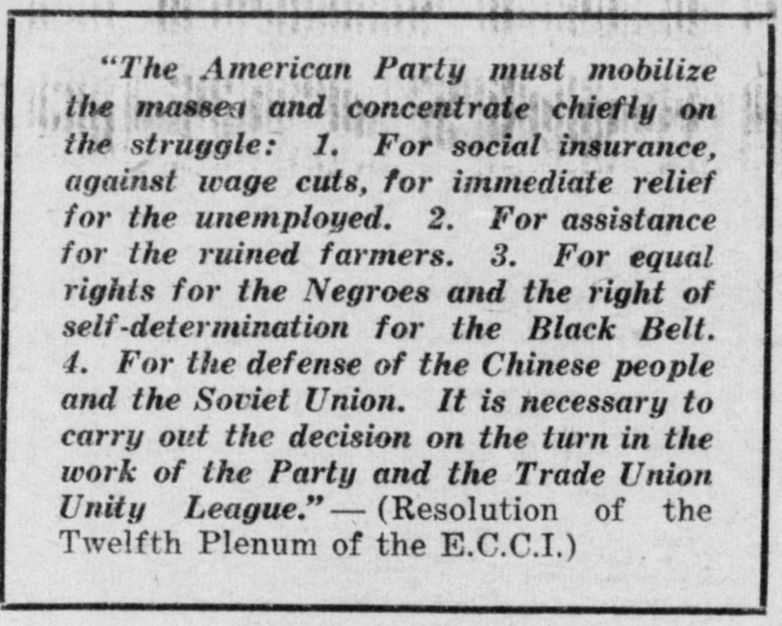
THE other important ally of the American proletariat is to be found is the masses of Negroes in the struggle against national oppression. The Communist Party, as the revolutionary party of the proletariat, as the only party which is courageously and resolutely carrying on a struggle against the national oppression of the Negroes, which is becoming particularly intense with the developing crisis, as shown by the recent death sentence against the Scottsboro Negroes–can win over the great masses of Negroes as allies of the proletariat against the American bourgeoisie, The Party can stand at the head of the national revolutionary struggle of the Negro masses against American imperialism only if it energetically carries through the decisions of the XIV Plenum of the CC on work among Negroes. The Party must mobilize the masses for the struggle for equal rights of the Negroes and for the right of self-determination for the Negroes in the Black Belt. It must ruthlessly combat any form of white chauvinism and Jim Crow practices. It must not only in words but in deeds overcome all obstacles to the drawing in of the best elements of the Negro proletariat, who in the recent years have shown themselves to be self-sacrificing ghters in the struggle against capital. In view of this, special attention must be given to the promotion of Negro proletarians to leading work in the Party organizations. In all mass actions, strikes and unemployed struggles the Party must pay particular attention in formulating practical demands, it takes into consideration and gives expression to the special forms of exploitation, oppression and denial of the rights of the employed and unemployed Negro masses. At the same time the Party and in the first place the Negro comrades must genuinely improve the methods of patient, systematic but persistent struggle against the ideology and influence of petty bourgeois nationalists among the Negro workers and toiling Negro masses.
BOX 3
***
IT is possible also to win over to the side of the workers, or at least to neutralize broad sections of the lower petty bourgeoisie and intellectual workers in the cities who have been brought into action as a result of the tremendous pressure of the crisis (employees, lower officials, teachers, intellectuals, students, petty bourgeois, war invalids), if only the Party will come out resolutely in defense of their interests (teachers’ strikes, students’ demonstrations, resistance to reduction of salaries of employees, to robbery through inflation and bank crashes, etc.).
PUT the one way for the proletariat to secure and maintain its hegemony is for it to prove in all struggles that it is the vanguard, the leader, that strikes most courageously against the common enemy, namely, finance capital. There is no other way to win hegemony. An absolutely necessary but AUXILIARY means toward this end is the winning of the influence of the proletariat on the non-proletarian sections through REVOLUTIONARY work of the Party among these strata. It is the task of the Party to organize all toiling masses who have been brought into action against finance capital and its government, into a broad revolutionary political army, in which the proletariat is the leading class, and the broad masses of the petty bourgeoisie in the towns and in the rural districts are its allies in the struggle against the bourgeoisie. To ignore this task means objectively to impede the proletariat in the winning of reserves and thus make it easier for the bourgeoisie to recruit fascist gangs from among the petty bourgeois elements and to isolate the proletariat.
BUT the more widespread the movement among the non-proletarian masses becomes and more acute the task of winning allies of the proletariat becomes, the more intensely must the Party work to extend and organize its proletarian basis. This very extension of the movements of the non-proletarian masses makes it incumbent on the Party not to allow itself to be SIDETRACKED from its main task, namely, the winning of the influence in the factories, above all in the big factories, and the systematic building up of factory nuclei, and trade union organizations.
The Danger of Farmer-Laborism
IF the Party intensifies its activity among the petty bourgeois masses without at the same time and above all strengthening its basis in the big factories and among the most important sections of the American working class, but this base even having become weaker–as expressed in such facts as the leaving of the majority of the strikes to the leadership of the reformists, the decline of the factory nuclei, the unfavorable development of the revolutionary trade unions, and the decline of circulation of the DAILY WORKER–THEN THE DANGER ARISES that the Party, having only weak contacts with the decisive section of American workers, will be driven away from its proletarian base, and instead of leading the petty bourgeois masses will succumb to the influence of petty bourgeois sentiments, illusions and petty bourgeois methods of work. The root of this danger lies in the sum total of objective conditions created by the crisis, and in the relationship of class forces.
In spite of the rapid revolutionary advance, the work of the revolutionary Party, as well as the class consciousness of the American proletariat is still weak, while at the same time the movement among the farmers and the movement among the petty-bourgeois elements are rapidly spreading. If the Party does not further make a turn to the work in the large factories, and does not, organize strike movements and movements of the unemployed, if it does not strengthen its proletarian base and build up the revolutionary trade union movement, then the danger exists that the Party, under the elemental pressure of the petty bourgeois masses, especially the masses of farmers, will be switched to the wrong track, in the direction of a Farmer-Labor Party. The Farmers’ Conference in Washington was, in spite of its mistakes, a great success, and marked the beginning of serious work among the farmers, which must be carried out most energetically, but in a more correct and improved way. But the Party must now bend all its efforts to carry out the work among the industrial workers in such a way that the Party I will make decisive HEADWAY among the industrial workers, and thus make impossible ALL DANGER OF THE PARTY GOING OFF ITS PROLETARIAN BASE.
THE IMMEDIATE TASKS OF THE PARTY
THE Party is now faced with the task of organizing the united struggle of the American workers and all toiling masses for their vital immediate demands. This includes:
1. The organizing of struggles against direct wage cuts and the reduction of real wages through inflation, for increase of wages, against every form of the stagger plan, for a reduction of working hours with no reduction in pay.
2. Closely linked up with the mobilization against the wage cut offensive is the campaign for the organizing of the struggle of the unemployed and part-time workers for immediate relief, and the organization of the struggle for UNEMPLOYMENT AND SOCIAL INSURANCE at the expense of the government and the employers. Of the greatest importance at the present time is the task of developing a broad struggle against forced labor and the militarization of the unemployed, in the press, through meetings, demonstrations strikes, raising the slogans: “For the abolition of all forms of forced labor”; “Against the militarization of the unemployed”; demanding “trade union rates upon all public works” and organizing especially within the labor camps and among the workers on public works, the struggle for these demands and for their grievances.
3. For the cancellation of debts on mortgages, taxes and rents of the great masses of farmers; for the abolition of the slavish exploitation of the share croppers.
4. The organization of the struggle against the reduction of veterans’ disability allowances and for the payment of the bonus.
5. For equal rights and resistance to all forms of oppression of the Negroes and for the right of self-determination for the Black Belt.
6. Struggle against all forms of terrorism, denial of freedom to strike, speech, press, and against all forms of persecution and deportation of foreign-born workers.
7. Against German fascism and for the release of all proletarian political prisoners.
8. Struggle against a new imperialist war and intervention against the Soviet Union and against financial and military support of Japanese imperialism.
The campaign and the mobilization of the workers for the struggle on behalf of these demands must be carried out by all Party organizations, above all by the factory nuclei. The factory must form the center of our Party and trade union work in carrying on this struggle. All leading Party bodies must first of all set themselves the task of concretizing these demands in accordance with the conditions in the particular factories, sections and districts.
The organizing of the struggles of the working class for these demands must be carried out on the basis of the united front, in which the Party must always have the initiative. The united front tactic consists in organizing and mobilizing the workers, regardless of Party or trade union affiliation, religion or color, for common struggle in behalf of their most immediate and urgent demands. In the factories and trade unions and among the unemployed we must help the workers formulate their demands concretely and effectively, really adapting them to the immediate demands of the workers. These demands must serve to develop their solidarity and class consciousness, and bring the broadest masses of workers into action.
THE systematic application of the united front in the big factories is of decisive significance in the question of leading strikes, the establishment of a united fighting front, and in tearing down of the barriers between the revolutionary workers and the masses of other workers. The decisive factor in carrying out this united front is tireless revolutionary everyday work among the workers, in order to prove in every question the correctness of our slogans and our proposals for action.
SUCH systematic day to day work in the factories is the necessary condition for all serious preparation of strikes and for the launching of strikes at the proper moment. The workers will have confidence in us as strike leaders only if they see that we take every necessary step for the careful preparation of strikes, selecting the proper moment for the declaration of the strike, firmly welding the united front of all workers before and during the struggle through fighting organs based on proletarian democracy, and if they see that we mobilize all moral and material assistance for the strikers and know enough to call a strike off at the proper moment if the mass of strikers are not able to carry the struggle further. There must be no repetition of such cases as those in Warren, Kentucky, and Allentown, when after the strike was lost the Party and the revolutionary trade unions left the workers to themselves and failed to carry on any work whatsoever. It is only by adhering to all these conditions in the preparation and leading of strikes that strikes will serve to strengthen our position among the masses of workers, that the confidence of the workers in us will be firmly established, and the readiness of the masses for further struggles will be increased.
BOX 4
THE united front tactic must not be limited to THE special campaigns or activities which we abandon because we have not succeeded at once in winning over the workers for struggle, in convincing them, and because they do not at once want to separate themselves from the reformist leaders. The united front must also not lead to the subordination of the revolutionary policy to that of the reformist leaders in the name of a so-called “united front”. The united front demands an uninterrupted, patient, convincing work to destroy the influence of the reformists and the bourgeoisie. The rejection of the united front proposals of our Party for the immediate urgent demands of the workers by the reformist leaders must impel us to make even stronger efforts to organize a common fighting front in the factories, mines and among the unemployed masses with the workers who are under the influence of the reformists. The Party must in the everyday work clarify the workers, in a popular and concrete way, on the principal difference between us and the reformists. The Party must prove to the workers by its practical work that we are the vanguard fighters for a united struggle and that the reformists are the splitters and disrupters of the struggle.
Persistent Struggle Against Sectarianism
IN ORDER to get the Party now firmly rooted among the decisive elements of the American workers, it must in all seriousness carry out the concentration on special factories, districts and sections. The center of gravity of Party work must be shifted to the development of the lower organizations, the factory nuclei, local organizations and street nuclei. It goes without saying that it is our task to place ourselves at the head of every movement which breaks out spontaneously in the country, and to lead such movements, or where the reformist leaders stand at the head of a movement, to work for the building of fighting organs of the masses, independent of the bureaucrats, in order to aid the masses in the exposure and replacement of the reformist leaders. But unless we tenaciously concentrate our work on the most important industrial centers, we cannot build up a stable Party and revolutionary trade union movement, capable of resisting all blows and persecutions by the bourgeoisie. The German Communists offer us the best example of this.
It is only because the CP of Germany is closely linked up with the decisive sections of the German proletariat that it is able to carry on its struggle against German fascism uninterruptedly, in spite of brutal fascist terror.
The Party is confronted with the task of drawing in the young workers in the class struggle. This demands that an end be made to the underestimation of youth work, and of the necessity of putting up special youth demands. All Party organizations, especially the factory nuclei, as well as the fractions in all trade unions and mass organizations, must organize youth sections and give active support to the Young Communist League. Every Party factory nucleus must help to organize a nucleus of the Y.C.L.
In order to effectively carry out this turn to the decisive sections of the American workers, it is necessary to carry on a persistent struggle against the sectarianism which expresses itself in all Party and trade union work which continues to be one of the chief obstacles to the establishment of firm and live contacts with the decisive masses of workers. This sectarianism expressed itself above all in the lack of understanding of the necessity of the Party and its leading organs for carrying through the turn to mass revolutionary work, to develop broad revolutionary unions and unemployed organizations and to build the basis of the Party in the most decisive industries. This sectarianism can be overcome only if the Party carries on a continuous struggle against the main danger, namely, Right opportunism as well as oppo tunism clothed in “left” phrases.
IN the present situation, when the American working class, stands before great tasks, any attempt at factionalism would be the greatest crime before the Party and revolutionary movement, and would only help our enemies in their struggle to destroy the Party. The Party must watch closely that, FIRSTLY, no factional opposition is developed against the leading organs of the Party, and SECONDLY, that not a single Party functionary, whether he be in the leading organs or in the lower organizations, misuses his position to carry on factional methods of work. If such manifestations appear, the leading organs of the Party and all organizations must decisively combat and liquidate every such factional attempt, not shrinking before the removal of incurable factionalists from the Party. It is only by vigorously preventing all forms of unprincipled factional struggle, and by energetically liquidating all factional methods of work, ABOVE ALL BY REALLY DEVELOPING COLLECTIVE LEADERSHIP FROM TOP TO BOTTOM, will the Party be able to make the necessary turn to the decisive strata of the working class and develop the proletarian mass struggle. But it must be absolutely clear that positive criticism and PRACTICAL proposals, and COMRADELY MATERIAL EXCHANGE OF POLITICAL OPINIONS, for improving the work of the Party are a vital necessity for the Party and that all bureaucratic tendencies to interfere with such criticism and proposals all bureaucratic intolerance of criticism must be decisively fought.
AT the same time the Party must carry on a systematic struggle against the bureaucratic isolation of the apparatus from the Party masses, against the suppression of inner Party democracy, for the development of political life in the lower organization, particularly in the factory nuclei, for the development of thorough-going self-criticism, for the development of initiative in the lower organizations and for the improvement of its functioning cadres. Every Party member, and especially every Party functionary, must be a real organizer of mass struggle in his particular sphere, of work. From this standpoint, the Party must judge the activity of its functionaries and must choose its leading bodies. All leading bodies, especially those in the sections, must reorganize their work on the basis of the carrying out of revolutionary mass work. Revolutionary work is the task of the entire membership. The secretaries of the leading bodies in their work must not replace the work of the membership. It is their task to plan and organize the work together with the members, to give the members practical assistance in carrying out their tasks and to check up on the carrying out of these tasks. As delegates to all Party conferences, section and district conferences and above all to the Party congress, there must be elected comrades who carry on active mass work and who have distinguished themselves in mass struggles.
***
COMRADES: The Party has approved the estimation of the International situation given by the XII Plenum of the Comintern, stating that we are approaching a new round of wars and revolutions. It is time that we should draw from this declaration the practical conclusions for our activity. The development of mass struggles depends to a great extent upon the speed with which we succeed in drawing the industrial proletariat into the struggle and in becoming the revolutionary mass Party of the American working class.
IS IT POSSIBLE TO CARRY OUT SUCH A TURN IN OUR WORK? OF COURSE IT IS POSSIBLE. The members of the Party have shown in countless activities in strikes, in hunger marches, demonstrations and in painstaking day to day work, that they are loyal and self-sacrificing revolutionists. Now all members and all Party organizations must at once proceed to determine how the work of the Party can be improved and what practical measures must be adopted in order to guarantee and carry out the turn in the Party.
THE discussion of this letter must not take place merely in a general way. Every nucleus, every organization, every Party fraction MUST LINK THIS DISCUSSION up with CONCRETE TASKS, working out ways and means how to bring about immediately a real turn in the entire work of each individual organization, for the carrying out of this turn. The leading organs of the Party are responsible to the membership, the membership is responsible to the leading bodies and the Party is responsible to the American working class and the international working class.
The Daily Worker began in 1924 and was published in New York City by the Communist Party US and its predecessor organizations. Among the most long-lasting and important left publications in US history, it had a circulation of 35,000 at its peak. The Daily Worker came from The Ohio Socialist, published by the Left Wing-dominated Socialist Party of Ohio in Cleveland from 1917 to November 1919, when it became became The Toiler, paper of the Communist Labor Party. In December 1921 the above-ground Workers Party of America merged the Toiler with the paper Workers Council to found The Worker, which became The Daily Worker beginning January 13, 1924.
PDF of full issue: https://www.marxists.org/history/usa/pubs/dailyworker/1933/v10-n167-Nat-jul-13-1933-DW-LOC.pdf

