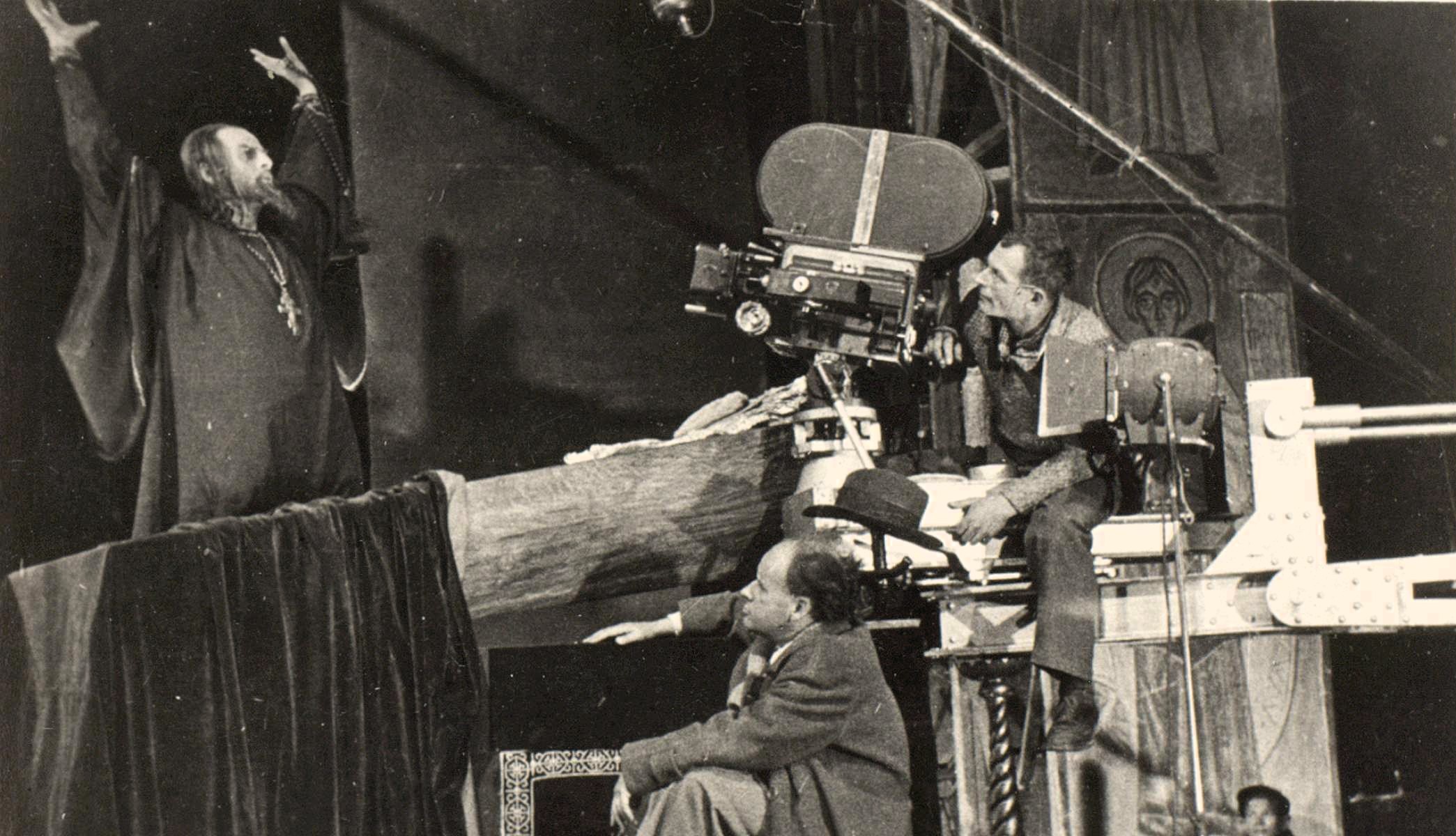
New Masses editor Joseph Freeman in Moscow during 1927 makes it a point to stop at the offices of Sergei Eisenstein, already the foremost Soviet filmmaker and among the greatest artists of the 20th century. Then working on his next film, The General Policy, less of an interview and more of a wide-ranging conversation, Eisenstein offers opinions on the Chinese Revolution, film forms, Sigmund Freud, and the transformation of village life under the Soviets.
‘The New Holy Grail: Talking with Eisenstein’ by Joseph Freeman from New Masses. Vol. 3 No. 3. July, 1927.
I found the director of Potemkin in his studio on the Chistia Pruda, towards the outskirts of Moscow. He lives in one large room, furnished simply with a bed (behind a screen), a working table littered with stills and clippings, a small writing desk and several bookcases crowded with magazines, pamphlets, and books. The ceiling is decorated with a series of concentric circles, red and blue. This target was painted by Eisenstein himself in his early, futurist days.
It seems strange to use the word “early” in connection with Eisenstein. He is only twenty-nine. Yet, like most of the young art workers in Soviet Russia, he has gone through decades of experience in the past ten years. Starting as an architect, he found himself attracted to the theatre even before the revolution. When October swept away the old stage along with the old regime, he was at the head of the Proletcult Theatre and a member of the Lef group, which included futurists like Mayakovsky, Meyerhold, and Tretyakov.
Thus the first agitational plays of the Proletcult—which is on the extreme wing of the proletarian theatre in Soviet Russia—were directed by a young man in his earliest twenties, who describes himself not as a proletarian but as an intellectual. But so thoroughly has he absorbed the teachings of Marx and Lenin, and so whole-heartedly has he thrown himself into the construction of Socialism in Russia, that today he is entrusted by the workers’ and peasants’ state with the direction of its greatest films. This is no mean job and no small honor, for the Soviet government still holds to Lenin’s view that “of all forms of art the film is for us the most important.”
Potemkin has, by general acclaim of specialists in the field, placed Eisenstein among the greatest movie directors in the world. Douglas Fairbanks and Mary Pickford saw the picture in Moscow last summer, and after smothering it in the usual American superlatives, invited Eisenstein to Hollywood. In all probability he will accept the invitation. Like most Russians, he admires American technique, and is curious to see the results of combining it with Russian ideas.
Freud, Marx and Movies
For the present, however, he is engaged on a new film which will be shown in November during the celebration of the tenth anniversary of the revolution. It was about this new film that I came to see him. I found him talking over the telephone to Serge Tretyakov, the author of a remarkable play on China running at Meyerhold’s constructivist theatre. Eisenstein is writing an autobiography in collaboration with Tretyakov, and at that moment he was discussing the necessity of including a chapter on Freud.
“We must show Freud’s influence on me,” he explained later, “for I am a Freudian as well as a Marxian. Freud discovered the’ laws of individual conduct, just as Marx discovered the laws of social development. I have consciously used such knowledge of Marx and Freud as I possess in the stage plays and movies I have directed in the past ten years.”
In addition to his native Russian, Eisenstein speaks fluently German, French and English. His library is jammed with books in all four languages on politics, sociology, literature, biology, mechanics, anatomy, psychology, the plastic arts, the theatre, the film.
There is nothing of bohemia or of Hollywood about him. As a matter of preference, he neither smokes not drinks; but he is no ascetic. He is dressed neatly in the fashion of an American or Englishman, and speaks quietly with logic and humor. Essentially, he thinks of himself not as the traditional “artist,” intuitive, emotional, moving under the spontaneous and unpredictable influence of “inspiration”; but as a scientific engineer whose field happens to be the movies. He studies the film from every angle, relates it constantly to the life about him, and constructs his pictures rationally and deliberately with the conscious aim of producing definite effects.
Eisenstein is primarily interested in mass art. Even before the revolution had made all Russians artists mass-conscious, he had developed the theory of the “play without a hero.” He had an opportunity to experiment with this theory in the Proletcult Theatre, where even in the classics of Ostrovsky, he was able to switch the focus of attention from the individual to the entire group involved in the action. There were scenes where the satire was heightened through exaggeration, as in a celebrated 19th century comedy where a ball-room scene became in Eisenstein’s hands a circus scene.
Plays Without Stars
He manipulates his knowledge of Freud, not to dissect the difficulties of the disturbed individual soul, but to evoke certain feelings in his audience. He has directed no “psychological” plays or movies; his productions have no “stars.” In fact, most of his films have no professional actors. All but one of the players in Potemkin are amateurs, most of whom have never appeared on the screen before or since. The sailors’ parts were played by sailors of the Soviet fleet; other players were chosen in Odessa from various walks of life. For every new film Eisenstein personally selects the types he wants from factories, farms and institutions.
Eisenstein’s conception of art—like the conception of most young art workers in Soviet Russia—differs in principle from concepts prevalent in western Europe and the United States. In the vocabulary of Soviet artists the term “aesthetic” amounts to an insult; it is the equivalent of the term “bourgeois” in the political lexicon of the people.
Instead of Hand Grenades
This is how Eisenstein discussed his new film:
“When I had finished Potemkin, the Russian Soviet was face to face with two burning questions: events in China and the development of the Soviet village.”
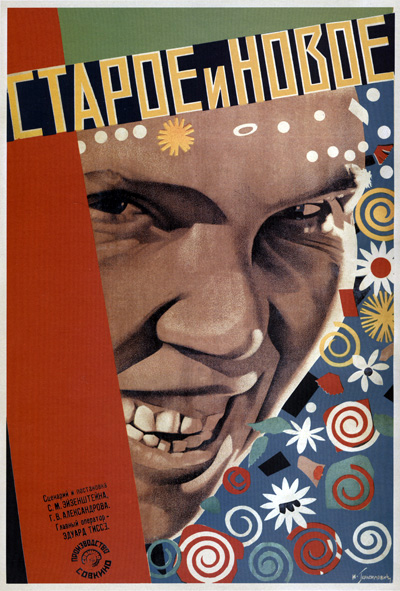
“The Chinese workers and peasants are going through a life and death struggle for freedom. There is a profound need for fighting movies. Concrete agitation material was needed in China itself. Perhaps for the first time in history, the film was to become as terrible a weapon as the hand grenade. There on the battlefield where the fight is carried on is the place of that art which stands in the front ranks of battle—the art of the film. For our so-called art is only a means, an instrument, a method of struggle.”
Eisenstein planned to turn out a gigantic Chinese film in three parts, but was unable to do so for technical reasons. There remained the theme of the Russian village. For over a month, Eisenstein and his assistants studied the problems of the village. They went to the editorial offices of peasant newspapers, the People’s Commissariat of Agriculture, the trade union of agricultural workers, the institutes of experimental biology, the agricultural schools, the peasant cooperatives, the poor villages, the government model farms. Then came weeks of reading through newspapers and magazines, theses, reports and statistics.
Eisenstein wanted to turn out a picture which would not only give the spectator scenes of country life or a story connected with agriculture. Far from merely enchanting the spectator’s heart, the film is intended to grip him and bring him face to face with the most important problems of the village. It must make him conscious of the work of Communist youth in the villages, the cultural activities of various organizations, the peasant correspondents movement, the cooperatives, the new Soviet family, the struggle against religion, the women’s movement, the battle against the rich peasants, the industrialization and reorganization of the village. Eisenstein attempts to make his art not static but kinetic: the new film is intended to force the Russian spectator to participate in the solution of village problems.
“The movies of the bourgeois west,” he explained, “carry on propaganda for patriotism, for god and the honest traveling salesman; they erect monuments for the unknown soldier. We must make our vast audiences fall in love with the peasant’s daily work. We must acquaint them with cattle, hens, and tractors. The tractor is vital in building up the Union of Socialist Soviet Republics, and is a heroic theme for the film.”
For a principle to unify the unlimited material afforded by the changing Russian village, Eisenstein went to the theses of the fourteenth congress of the Communist Party of the Soviet Union, which formulated the “general line” for economic progress. The line is the collectivization of economy and the industrialization of the village.
Lenin’s Five Epochs
This is the theme of Eisenstein’s new film entitled General Policy. It is the first big film based on peasant material, dealing in a vivid way with problems of profound political and social importance.
“The official terminology of theses, resolutions, and decisions,” Eisenstein said, “comes to life on the screen in herds of fat cattle, in the rumble of harvesters and tractors, in warm stables, in the opening of the earth under the spring snow, in a thick layer of manure on a field which is collectively cultivated.” A little later he asked me, “Does America know about the extraordinary struggle on our ‘peace front’? about the heroism of the first attacks of the pioneers of the agricultural revolution? Many Russian movie houses are now running Buster Keaton’s comedy, Three Epochs. My new film involves Lenin’s analysis of ‘five epochs.’ It shows the five stages of economy which exist side by side today in Soviet Russia. We have still a patriarchal economy, domestic economy, and private capitalism along with state capitalism and socialism. The stone age lives side by side with the latest achievements of science and social organization, and, what is most remarkable, we are building in all five epochs at once.”
If Eisenstein differs from bourgeois artists in his preoccupation with socialist problems, he differs no less from many proletarian artists in his intense preoccupation with form. He defines sublimation, for the artist at any rate, as “matter finding its most adequate form.” Certainly, to find the most adequate form for the agricultural theses of the fourteenth Party congress is no easy matter.
The New Holy Grail
The action of General Policy is merely a thread on which Eisenstein has strung a thousand effects which must be seen to be appreciated. The story, such as it is, moves simply through various problems of the new Russian village. It begins with a group of poor peasants who organize an artel, i.e., a small cooperative. They obtain credit from the government on easy terms, and buy a milk separator.
“The milk separator,” Eisenstein explained, “plays the same role in my film as the holy grail plays in Parsifal. The poetry of the milk separator! Think of it, from milk separator to a first-class bull, from a bull to a tractor, from one tractor to ten tractors, a thousand tractors, to the industrialization of the village, to raising the economic, political and social level of the entire Russian people.”
With the profits turned out by their milk separator, the peasants in the new film purchase a young bull at a government model farm; with the second profits of their enterprise they want to buy a tractor. Enter the various villains of contemporary Russia—the bureaucrat, against whom the Soviet is waging relentless warfare, the kulak or rich peasant, and others who try to thwart the ambitions of the poor peasants. But in a series of exciting scenes, including a chase of the new tractor by peasants on horses, (a device deliberately lifted by Eisenstein from the American cowboy movie), the peasants are triumphant.
From this point the film proceeds to the development of agricultural economy. It shows model farms, Baku oil fields, the breeding of cattle, the latest agricultural methods, all connected up with the story, of which the hero is no single individual but the Russian village. It shows among other things, Eisenstein explained, that the Soviet Union already has enough developed resources to carry on a prosperous national economy.
In one sense General Policy is education; at the same time, however, it is rich in dramatic and comic moments, and presents with an art as great as that of Potemkin one of the great epic themes: man’s struggle to subdue nature through a higher form of economy. When this film penetrates the west (no doubt, Germany will be the first to show it), it will infuse new blood into an art in constant danger of growing anemic for want of heroic material.
The New Masses was the continuation of Workers Monthly which began publishing in 1924 as a merger of the ‘Liberator’, the Trade Union Educational League magazine ‘Labor Herald’, and Friends of Soviet Russia’s monthly ‘Soviet Russia Pictorial’ as an explicitly Communist Party publication, but drawing in a wide range of contributors and sympathizers. In 1927 Workers Monthly ceased and The New Masses began. A major left cultural magazine of the late 1920s to early 1940s, the early editors of The New Masses included Hugo Gellert, John F. Sloan, Max Eastman, Mike Gold, and Joseph Freeman. Writers included William Carlos Williams, Theodore Dreiser, John Dos Passos, Upton Sinclair, Richard Wright, Ralph Ellison, Dorothy Parker, Dorothy Day, John Breecher, Langston Hughes, Eugene O’Neill, Rex Stout and Ernest Hemingway, Artists included Hugo Gellert, Stuart Davis, Boardman Robinson, Wanda Gag, William Gropper and Otto Soglow. Over time, the New Masses became narrower politically and more journalistic in its tone.
PDF of full issue: https://www.marxists.org/history/usa/pubs/new-masses/1927/v03n03-jul-1927-New-Masses.pdf

