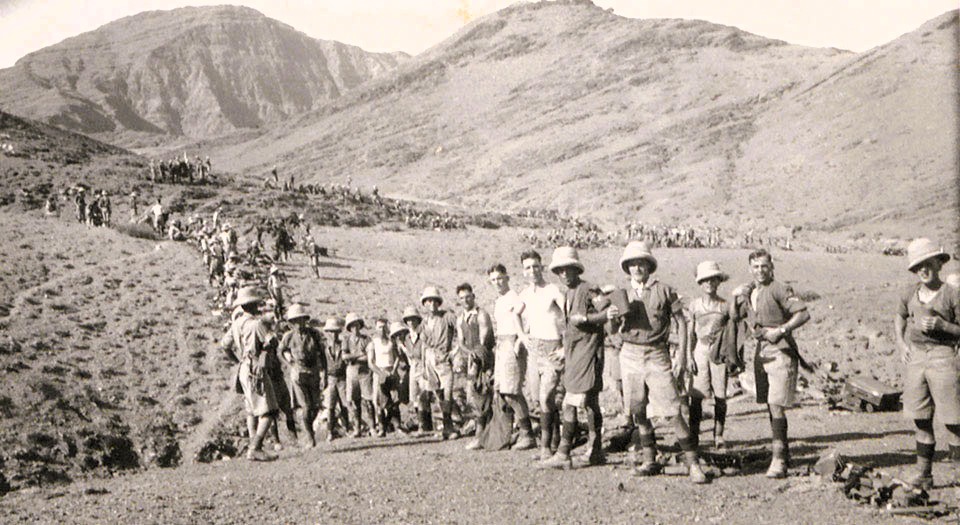
The pirates of the British East India Company took the Northwest Territories, today’s Pakistani province of Khyber Pakhtunkhwa, in their 1849 robber-war against the Sikh Empire. An uninterrupted series of revolts and cross-border fights with Afghanistan have followed in the tribal region until today. Chatto reports on the 1930 rising of the Afridi people, the ‘Redshirt Rebellion,’ and its repression by the Empire.
‘The War on the North-West Frontier of India’ by Virendranath Chattopadhyaya from International Press Correspondence. Vol. 10. No. 29 & 37. June 19 & August 14, 1930.
I. A Prelude to the War against the Soviet Union.
The savage war that is being waged by the MacDonald Government against the independent tribes of the North-West Frontier of India deserves the closest attention of the workers of the world. European imperialism has conducted a number of such wars during the last twelve years, as e.g., the French and Spanish wars against the Moroccans, the Prench war against the Druses in Syria, the Italian war in Tripolis, the British attack on the Arabs of Palestine and on the Nubar tribes in the Sudan. But the present campaign on the North-West Frontier of India is of even greater importance because of its immediate connection with the coming war that is being planned by British imperialism against the Soviet Union.
Wars on that Frontier are nothing new in the history of British imperialist aggression. Between 1858 and 1922, according to the Simon Commission’s Report just issued, there have been no less than 72 “military expeditions”, i.e., an average of one war every year, against those freedom-loving tribes, whom British imperialist propaganda has systematically stigmatised as “wild”, “unruly” and “barbarous”, in order to create moral justification for its wanton attacks on their liberty. As far as the tribes themselves are concerned, they have hitherto successfully resisted every attempt to reduce them to subjection, although regiments recruited from among them have taken part in Britains wars abroad and they have often made themselves feared during their raids into India by plundering Indian peasants and shopkeepers.
But the general revolt of the tribes that is now in progress shows three new characteristics that were entirely absent in previous wars with the British. Firstly, the offensive of the tribes aims at the overthrow of British imperialism altogether and not merely at preserving their own liberty. Secondly, the tribes are acting for the first time in solidarity with the Indian masses, as is shown by the complete absence of looting and by their armed support of the Indian revolutionaries in Peshawar, Kohat and other towns of the Panjab frontier. Thirdly, there are for the first time signs of a revolutionary movement among the tribes themselves, as is shown by the organisation of their youth in the “Red Shirts”.
While this remarkable development is due to their miserable economic condition and to the growing agrarian discontent throughout the North-West, it has undoubtedly been stimulated also by the ideological influence exercised by the very existence of the Soviet Union.
Before the War, the enormous military and secret service expenditure, the unproductive and costly network of strategic always in the North-West, the numerous wars and military expeditions against Afghanistan and the independent tribes, were all justified by the British imperialists on the ground of e “Russian menace”, i.e., the imperialist expansion of Tsarist Russia into India. The clash between the two rival imperialist powers was averted by robber agreements in 1907 regarding spheres of influence” in Persia, Afghanistan and Tibet. But war and revolution swept Tsarist Russia out of existence, and is place has been taken by a free Russia that is a standing warning to all imperialist oppressors and a message of liberty to the oppressed nations. To this free Russia of the workers and peasants, enslaved India is a danger. It is the British menace to Soviet Russia that has to be realised and fought against by the workers of the world, and they must therefore not only give their most active support to the Indian revolution make special efforts to paralyse the whole military apparatus that is being set in motion on the North-West Frontier.
The British imperialists, however, still continue their cry of the “Russian menace”, so as to mobilise support for their war plans among the Indian propertied class. How far this imperialist propaganda has effected the thought of the “educated” Indian is shown by the following statement made by Professor B.G. Sapre in discussing the question of the “defence” of India on the North-West Frontier in his recent book on the Indian Constitution:
“The danger of Soviet Russia beyond Afghanistan is as imminent as ever. The agents and emissaries of that Government have been continually busy, and it is difficult to foresee what the ultimate consequences will be of their revolutionary and mischievous propaganda.”
As a matter of fact, every effort is being made by British imperialism to show that the movement of the tribes has been directly engineered by the Soviet Government. The suggestion was made in the proclamation of May 12th of the Chief Commissioner of the North-West Frontier Province to the tribal chiefs. And the thought was uppermost in the mind of the Liberal M.P., Dr. Burgin, when in the debate on Soviet Russia on June 6th in the House of Commons he declared:
“If Moscow, in spite of being aware of the feeling in the House of Commons and in the country, systematically attempts to spread discontent among the tribes and the peasants on the North-West Frontier of India, the British Foreign Minister must take steps to find a remedy.”
It is clear that the “forward schools” of imperialists are seeking a pretext for their war preparations against the Soviet Union, and the present campaign against the tribes has given them the opportunity of using their Air Force and bombing-planes as a training and a rehearsal for the coming War.
That the “epoch-making changes” to be introduced in the Indian Army by the new Commander-in-Chief, Sir Philip Chetwode, who is succeeding Sir William Birdwood, are directed against Soviet Russia, is frankly asserted by Wilson, formerly Editor of the semi-official “Pioneer” of Allahabad and now Editor of the “Indian Daily Mail” of Bombay, who is known to have very close connections with authoritative men in military circles. The new Commander-in-Chief is said to represent a more “modern school” than the retiring chief. He and his staff are of the opinion that “the danger to India (!) from beyond the North-Western Frontier can no longer be met in the old way”. In the issue of April 4th, Wilson writes:
“The idea of mobile columns penetrating into the passes and supported with various lines of defence does not find favour with the new type of soldier. The plan which will be put into operation will have as its main feature a flanking base at Karachi, with a light extremely mobile fringe of defence troops on the edge of the passes, while the principal method of defence will be an attack on the communications of the enemy in Afghanistan and beyond from the air. This is of course assuming that Russia is the enemy.”
In addition to this, arrangements are to be made for efficient gas drilling and for bottling gas in large quantities on the Frontier, for, as Wilson writes, “if ever there was a place which could be bottled up with gas, it is the Frontier.”
In view of the fact that the principal weapon employed against the Soviet Union will be attacks from the air not only from the Indian frontier with Karachi as the air-base, but from the Western Border States, Finland, Esthonia, Latvia, Poland and Rumania, the present war on the Frontier where hundreds of aeroplanes have been bombing the tribes with thousands of pounds of explosives is of more than usual significance. The workers of the world and particularly the British workers should hinder the manufacture and transport not only of guns, warships and troops to India, but also of aero planes, aero plane parts and gas which are to play so deadly a part in the plan for the destruction of the Workers’ and Peasants’ Republic.
II. The War on the North-West Frontier of India.
The only news we have of the military operations on the North-West frontier and of the movements of the independent frontier tribes against the British comes through the usual imperialist channels. The frontier war was begun in the middle of April and has now continued for exactly four months, and imperialist reports have attempted to produce the impression that the thousands of tons of explosives with which the R.A.F. bombing planes have been blowing the tribes and their villages out of existence have had a “salutary effect” upon those “turbulent” tribes. It was reported that the anti-British movement was dying down and that most tribes refused to be misled by the “young bloods”. But now we are told that the situation is again serious, because a lashkar (force) of nearly 10,000 Afridis are moving on Peshawar, and this in spite of the fact that the tribes know the havoc committed by the R.A.F. and that they have been repeatedly “warned” by the British Government. The Afridi advance is described by the imperialist press correspondents as “a temporary triumph over the grave warnings of British Political Officers and over the steadfast advice of the tribal elders”. It is admitted, too, that “there is no indication so far that the operations of the defending forces are producing a general retirement of the Afridis”. In passing, we must draw attention to the description of the British imperialist army and air-force as “defending forces”, a phrase deliberately employed to conceal the real nature of the war on the N.W. Frontier, the objective of which is the occupation of the frontier of the Soviet Union. For this purpose, “there is a large concentration of troops at Peshawar to meet all eventualities” and “air-bombing of Trans-Border districts” is being continued, according to the latest dispatch of the “Times” correspondent at Peshawar.
As for the North-West Frontier Province which is directly administered by the British, it has been in an indescribable condition of suffering during the last four months, for ever since the historic uprising of the masses in Peshawar on April 23rd and 24th, the heroic refusal of the Garhwali regiments to shoot and the action of solidarity taken by the Frontier tribes led by the Haji of Turangzai, the people of the N.W.F. Province have been living under the most terrible conditions about which the very rigid censorship has allowed no information to leak out. But the “Muslim Outlook”, a pro-Government daily published in Lahore, publishes some facts in its issue of July 13th. The Province is in a permanent state of siege, since the military occupation which began early in May. During the whole of May and June whole villages in the Province were continually under the fire of machine-guns. The wounded were allowed to lie in the streets and rot, and by order of the military authorities private citizens were forbidden to render any aid to the wounded. A number of villages, including Utmanudi, Tangi, Dargai, Swabi, Marghaz, Takkar, Gujargarhi, Swai Dher, Mardan, Tashi Mairi, Kot Yar Hussain, as well as the towns of Kohat and Bannu were placed under military blockade. The captured members of the “Red Shirts” are being forced to labour “at the point of the bayonet like galley slaves subject to indignities of various kinds”.
This imperialist terror and oppression is evidence of the revolutionary unrest among the population, consisting mostly of poor peasants living on the verge of starvation, and is contributing not to the suppression but to the enhancement of the general discontent, which is receiving further stimulus from the anti-imperialist movement of the tribes on the other side of the Frontier.
This well-organised, courageous and uninterrupted movement of the tribes, determined to overthrow imperialist rule altogether, is indeed highly remarkable, and it is no reflection on their heroism to suggest that the war is being deliberately provoked by British imperialism for the furtherance of its sinister designs. The propaganda that is being carried on against the tribes shows what the real object of the British Government is. With regard to the new Afridi advance, the “Times” correspondent cabling from Simla, the summer headquarters of the Government of India, says that “the new hostile movement represents the result of prolonged propaganda by revolutionary agents from India”. On the other hand, semi-official Anglo-Indian journals in India are carrying on a systematic campaign to insinuate that Soviet Russia is financing and arming the frontier tribes! For instance, the “Civil and Military Gazette” of Lahore asserts that the activities of the tribes are to be traced to the “supply of money by a Power in the rear”. And an officer of the Royal Air Force contributes an article to the same semi-official journal, in which he states that the position is being made difficult by the fact that the rebel forces are able to draw fresh supplies of “young bloods” won over by money that is being supplied by “some mysterious force in the rear”. “The nature of the money”, says the journal, “gives food for serious thought.” This anti-Soviet propaganda is so obviously a manoeuvre to create a war atmosphere that it is discredited even by openly pro-government and anti-communist journals like the “Muslim Outlook” of Lahore.
Very interesting in this connection is an interview with Abdul Ghaffar Khan, the imprisoned leader of the “Red Shirts”, which has just been published by Sardar Kehar Singh, editor of “Kripan Bahadur”, to whom it was said to have been given. Abdul Ghaffar Khan declared that the “Khudai Khidmatgars” or “Servants of God”, who were now known as “Red Shirts”, were originally volunteers for social service, adhering to the Congress creed of non-violence, that their uniform was originally white but was later dyed purple and not red, that they had nothing to do with Communism, because in fact the leaders were landowners, and that the Government had associated them with the Bolsheviks in order to find a pretext for advancing into their country and for crushing their movement. The quotations from the Anglo-Indian press show how essential it is for the British workers in particular to realise what is going on the North-Western Frontier of India. Attempts are deliberately made to provoke the independent tribes to take up arms in defence of their liberty, while at the same time imperialist propaganda insinuates that it is the Soviet Union that is behind the revolt. This is the way in which the war is being prepared against the Workers’ Republic.
The military preparations are being forced on in order to concentrate all the forces possible on the frontier before the winter snows in November block the passes and make operations difficult.
International Press Correspondence, widely known as”Inprecorr” was published by the Executive Committee of the Communist International (ECCI) regularly in German and English, occasionally in many other languages, beginning in 1921 and lasting in English until 1938. Inprecorr’s role was to supply translated articles to the English-speaking press of the International from the Comintern’s different sections, as well as news and statements from the ECCI. Many ‘Daily Worker’ and ‘Communist’ articles originated in Inprecorr, and it also published articles by American comrades for use in other countries. It was published at least weekly, and often thrice weekly.
PDF of full issue: https://www.marxists.org/history/international/comintern/inprecor/1930/v10n19-apr-17-1930-inprecor-Virginia.pdf
PDF of full issue: https://www.marxists.org/history/international/comintern/inprecor/1930/v10n29-jun-19-1930-inprecor-Virginia.pdf

