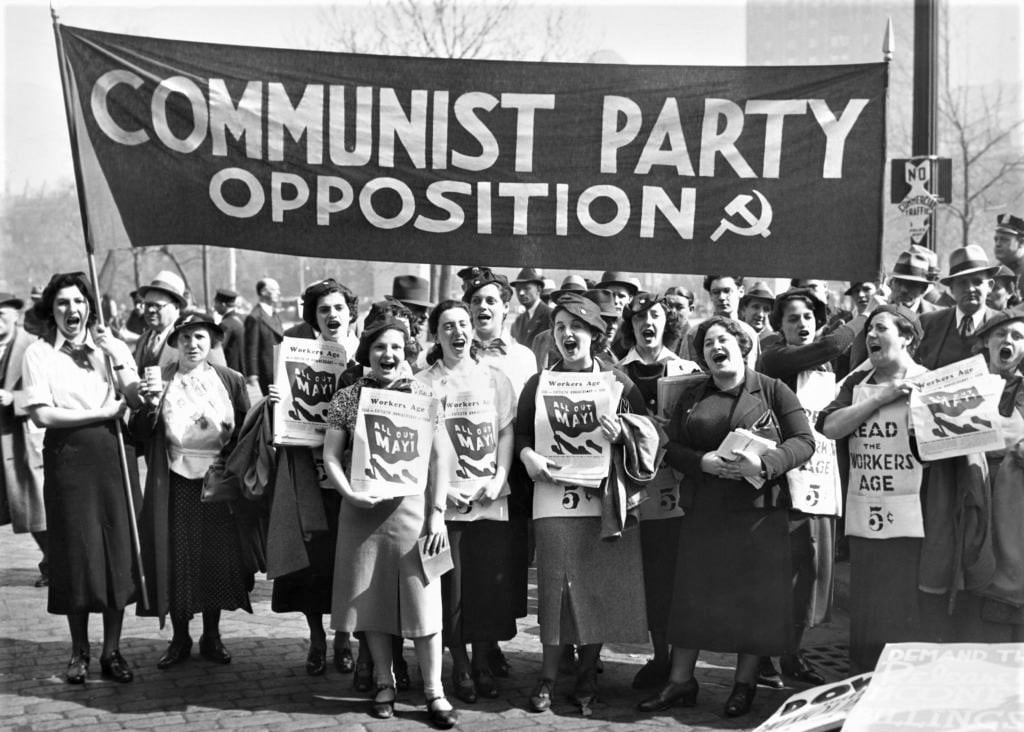
No wing of the Communist movement was more critical of the ‘excesses of the Third Period’ than the so-called Lovestoneites (the Communist, or ‘Right’, Opposition internationally), they based their project on opposing the whole politics of that era. Here, they critically respond to the official Party’s ‘Open Letter‘ which reflected the first, tentative, steps made by the Comintern away from the policies of the ‘Third Period’ in the immediate aftermath of the Nazi takeover of March, 1933.
‘Party Crisis Brings Open Letter’ from Workers Age (C.P.O.). Vol. 2 No. 18. August 15, 1933.
Once again the leadership of the Communist Party of the United States has issued a public confession of its own political bankruptcy: This is the real meaning of the “Open Letter to All Party Members”, adopted by the “Extraordinary National Conference” held in New York City on July 7-10.
In the midst of the most favorable conditions, the leadership of our party can report only failure, wreck and ruin, stagnation and decline, isolation and defeat! How serious the situation really is indicated by the abandonment of the scheduled party convention and pre-convention discussion and their replacement by an “extraordinary conference.” The whole state of affairs spells the complete collapse of the sectarian policies and the clique leadership of the party. But it spells more than that: the life and death fight that the party is waging, a losing fight with the present policies and leadership as a millstone around its neck.
***
Back To The Third “Period” Lunacy!
As a political document, the Open Letter deserves no serious analysis. In its general outlook, it abandons the half and quarter turns of the last year or two and returns to the unadorned sectarianism of 1929-1930, to the unrestrained lunacy of the “third period.” In spite of everything not the slightest attempt is made to criticize the policies which have caused the party’s isolation; on the contrary, everything is done to cover them up!
What are the outstanding features expressing the dangerous condition of the party and its activities, of the failure of its policies?
1. The party’s work among the unemployed is in a position bordering on paralysis. The Unemployed Council, the initiator of the fight for the jobless and at one time in possession of a practical monopoly in the field, has collapsed, discredited and ruined by sectarianism and splitting tactics. Other organizations of the unemployed have grown up and have far outstripped the Council. In a last desperate effort to stave off complete isolation from the organized unemployed, the party has entered into a questionable alliance with the Muste forces, whom it at the same time denounces precisely in this Open Letter, as the worst menace to the workers. All this can only lead to the complete and final elimination of the Unemployed Council as a factor in the movement of the jobless.
The “Menace” Of “Farmer-Laborism”
2. For five years now, the present leadership of the party has been talking about the non-existent “radicalization” of the masses and about the mythical “revolutionary upsurge”, which it brings to the fore again in the Open Letter. But a manifestation of real progress on the part of the masses is not hailed by the party leadership but is actually branded as a “menace”! The Open Letter declares:
“The radicalized workers who had their bitter experience with the Republicans, are now well on the way to meeting with the same experience from the second traditional party of finance capital, namely, the Democrats, and the movements among the workers against robber measures are bound to increase. The poor farmers and the ruined middle farmers who only yesterday voted for the bourgeois parties are, in fact, already taking the path of struggle against the policy carried on by these parties, and are constantly intensifying their efforts to attain an “independent” policy. Thus, as a result of the development of the crisis, which is characterized not only by a rapid extension of the labor movement but also by a widespread movement among the petty bourgeoisie, we find a far-reaching mass movement of workers, farmers and other middle class elements which is directed against the old bourgeois parties and against the government, which is growing continually stronger.”
What form is this movement assuming? Is it rallying around the C.P.? No! If that were so, there would be no Open Letter. This movement is expressing itself in the “efforts and tendencies in the direction of organizing a Farmer-Labor Party.” But this movement, historically necessary and progressive, which the party should support, promote and welcome as the greatest aid, is declared to be a “great menace”! The C.P.’s opposition to the Farmer-Labor movement isolates it from an important section of forward-moving native American workers; such an attitude makes impossible its development into a mass party. History is repeating itself. The same leadership is repeating in 1933 the mistakes it made in 1924.
3. In 1929-1930, when the Communist Opposition was expelled, the party was declared to have entered a period of rapid development. It was declared to be growing at the rate of 100 members a day–35,000 members a year. It was declared to be on the eve of becoming a mass party. It was hailed by the Executive Committee of the Communist International as the “fourth party in the Comintern”, following the Soviet Union, Germany and China! In contrast to these boasts, the Open Letter paints an appalling picture of the party’s condition; it is even declared that the leadership is responsible for this! But this leadership and its policies still remain to guide the party into new disasters. Where are Manuilsky’s remarks about “generals who lose battles”?
Isolation From The Organized Workers
4. In no field is the party’s isolation so evident as in the trade unions. Never, not even in the days of its infantile leftism, has the party had so little influence in the conservative unions as today. The “revolutionary unions”, which, we were told, would organize the millions of unorganized workers, have failed completely in every respect. But the party leaders still adhere to the policy of building up these dual sects, in reality miniature parties. These “revolutionary unions” have no base and cannot grow. Only a small section of the party membership is in them and only the tiniest fraction is in the conservative unions.
There is only way in which this isolation from the organized workers can be overcome: liquidate the dual sects, send the Communists and revolutionary workers back into the mass unions, abandon all splitting tactics, and begin anew have brought the party to the brink of disaster. And what is offered as a cure? Nothing more or less than a continuation, indeed an intensification, of the same policies. In 1929-1930, these policies were offered to us as a cure-all for all of the shortcomings of the Communist movement. And now we see that the “cure” is far worse than the “disease.” False policies can never be an instrument for the correction of shortcomings! The restoration of correct Leninist policies, the course advocated by the Communist Opposition since 1929, can alone achieve this objective.
The Promise Of Democracy
6. The “Open Letter” speaks for inner-party democracy, for the toleration of criticism, against burocratic excesses. This is nothing but the sheerest hypocrisy. At the very same time that this was being written, expulsions were taking place (Joe Davis, Goldman, etc.). What criticism is permitted? Criticism of petty detail or of basic policy? Let a party member make a really fundamental criticism and he is at once branded as “Lovestoneite” or “Trotskyite” and either expelled or threatened with expulsion. The Open Letter wants discussion, but only discussion in agreement with the Open Letter. What has happened to the party convention? Where is the pr convention discussion? Or will the discussion and election take place in the well-known “cleansed” atmosphere introduced by the Open Letter?
Will any discussion be permitted of the catastrophe in Germany, the worst disaster for the international proletariat since the overthrow of the Hungarian Soviet Republic? Will any criticism of the policies of the Comintern and of the German Communist Party be tolerated, policies which helped bring on the disaster? Are we to profit by the costly lessons of our comrades in Germany or are we to follow them blindly to defeat?
The Open Letter speaks against factionalism but it forgets that, since the 1929-30 expulsions, the entire party machinery has been converted into a faction apparatus. The leadership is a hot-bed of factional struggle which is assiduously kept from the membership. The Open Letter itself is a product of factional juggling in the leadership, in which the main role is played by the E.C.C.I.
All this juggling, all this playing which new turns, all this manouvering with open letters, has just one purpose: to prevent real inner-party democracy, to prevent discussion of the real issues, to perpetuate the present false line and clique leadership! This is a game which is not a monopoly of the American party. It has been developed into a fine art by the faction which today stands at the head of the Comintern and which uses it for its own perpetuation.
Act Before It Is Too Late! The Communist Party (Opposition) appeals to the membership of the party to act fearlessly as responsible revolutionists. Four years of passive resistance and passive submission to a false line have brought only disastrous consequences. Further support of the present line and regime is rank treason to the cause of Communism!
Against the ultra-left sectarianism! Against the clique leadership in the American party and in the Comintern!
For a Leninist line of policy! For internal party democracy! For international Communist unity!
Support the struggle of the Communist Party (Opposition)!
Workers Age was the continuation of Revolutionary Age, begun in 1929 and published in New York City by the Communist Party U.S.A. Majority Group, lead by Jay Lovestone and Ben Gitlow and aligned with Bukharin in the Soviet Union and the International Communist (Right) Opposition in the Communist International. Workers Age was a weekly published between 1932 and 1941. Writers and or editors for Workers Age included Lovestone, Gitlow, Will Herberg, Lyman Fraser, Geogre F. Miles, Bertram D. Wolfe, Charles S. Zimmerman, Lewis Corey (Louis Fraina), Albert Bell, William Kruse, Jack Rubenstein, Harry Winitsky, Jack MacDonald, Bert Miller, and Ben Davidson. During the run of Workers Age, the ‘Lovestonites’ name changed from Communist Party (Majority Group) (November 1929-September 1932) to the Communist Party of the USA (Opposition) (September 1932-May 1937) to the Independent Communist Labor League (May 1937-July 1938) to the Independent Labor League of America (July 1938-January 1941), and often referred to simply as ‘CPO’ (Communist Party Opposition). While those interested in the history of Lovestone and the ‘Right Opposition’ will find the paper essential, students of the labor movement of the 1930s will find a wealth of information in its pages as well. Though small in size, the CPO played a leading role in a number of important unions, particularly in industry dominated by Jewish and Yiddish-speaking labor, particularly with the International Ladies’ Garment Workers’ Union Local 22, the International Fur & Leather Workers Union, the Doll and Toy Workers Union, and the United Shoe and Leather Workers Union, as well as having influence in the New York Teachers, United Autoworkers, and others.
PDF of full issue: https://www.marxists.org/history/usa/pubs/workers-age/1933/v2n18-aug-15-1933-WA.pdf
 Revolution's Newsstand