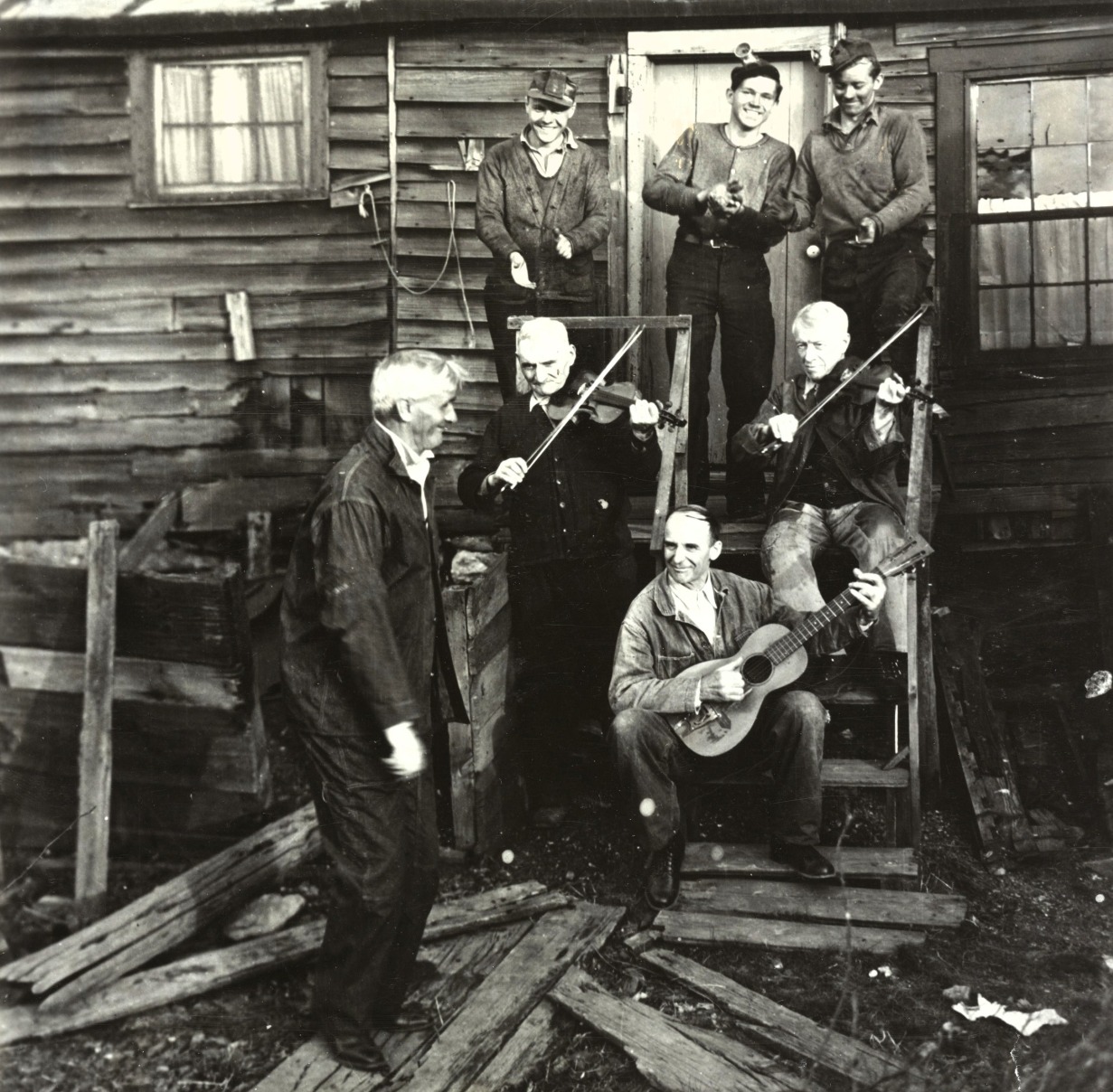
An early essay sees Ed Falkowski review Songs and Ballads of the Anthracite Miner, with his own experiences of that rich folk art. Born in 1901 to a Shenandoah, Pennsylvania mining family, Falkowski went into the mines of at fifteen and quickly became an activist in the UMWA. Always an intellectual, he was accepted to Brookwood Labor College in 1926 and began to write. Leaving the U.S. in 1928 for what would be an eventful decade, Falkowski traveled to Germany as an exchange student, worked in the Ruhr mines, and immersed himself in Berlin’s vibrant left, reporting of his experiences in the U.S. radical press. Becoming a fine writer, he made it to Russia where worked in the Donbas mines and later spent much of the 30s in editing the English-language Moscow News before returning to the States in 1937. Here he taught at Commonwealth Labor College in Mena, Arkansas and was then drafted into the Army for the Second World War. Following the war, Falkowski returned to the factory, living in Queens and working at Eagle Electric, serving as a shop steward for UAW Local 365. He continued to write and be active in progressive New York City politics, dying there in 1984.
‘Scoop-Shovel Singers’ by Ed Falkowski from New Masses. Vol. 3 No. 10. February, 1928.
Songs and Ballads of the Anthracite, by George Korson. Frederick H. Hitchcock, $2.50.
I.
BALLADS not only spring out of traditions, but indicate largely the spiritual and physical margin on which people live. Reviewing the anthracite ballads which once were poured out of throats of sentimental miners, we feel the rugged narrowness of the life that enclosed them. Ballads of scoop-shovels, songs of long hours, dripping melodies about unlucky driver-boys, and touching masterpieces of beloved mules. The songs revolved about the daily work of the miner. What he had in his can, what his wife said, what his neighbor said-these fittingly provided rich theme for Irish imaginations which wove them into simple patterns appealing to the patch-folk whose long winter nights, empty of recreation, cried out for new contributions, welcomed these ballads whose intimacy established them at once in their memories.
Since the blare of saxophones is now mingled with the scream of the whistles whose metallic shrieks still tear the morning silences to crying fragments of sound, one may have to listen more keenly to hear the miners’ songs of today. The margin between the primitive life which was stretched out thinly over a sparing number of slices of bread and butter with salted pig in winter, and the full-pailed career of the coal digger today is echoed in the songs he sings.
Impoverished folk who feed their stoves with wood, and guard their crumbs for uncertain meals to come are filled with the dark misery that surrounds their bare existence. Life peels itself down to the naked problem of survival. Emptiness shrieks out in the ballads, and sore bones avenge themselves in the blustering fullness of a rollicking song in which they laugh at the boss and the hours and the scoops that torture them, and the asthma that grips them by their throat–their despair compels them to roar their challenges to mute culm banks or at the dying flask of amber liquid that grins at them from the table.
II.
Minstrels, wandering poets, blind singers groping through the world are always sad. Ed. Foley and Pat Johnson and “Giant” O’Neal and John Curtis–rude Homers wandering from tavern to tavern. Staggering audiences lined up along the bar and the wick on the kerosene lamp was trimmed to give better light as these worn singers voiced the sorrows and joys in the wobbly houses that stood feebly at the foot of culm banks, or grew in a cluster of wooden boxes lit up at night with dim-sputtering oil lamps: these were called towns.
Hard times gripped the anthracite by its belly. Wives spent long hours mending old clothes. Shoe-leather thinned and other leather replaced it. The meals became sparing, eyes darkened as weeks rolled on with patient waiting for breakers to start up. Nothing happened. The prosperity that had come blowing tin trumpets and swimming in ale as the Civil war guns blew southern toilers to bloody smears and banners of flesh dangling from withered trees, had collapsed, and the rolling chanteys that had accompanied oceanic quantities of beer, had become now funeral moans for the departure of the fat days.
Breaker whistles became mute. Their frozen throats were outlined against a stiff clear sky, bleak winds howled and raged, pounding at thin walls whose cracks were stuffed with old burlap and paper to hold in the warmth. Great sacrifices of local live-stock were required to keep miners alive. Pigs, cows, geese, chickens, were slaughtered by groups of neighbors who visited one family after another, and upon promise of drinks and eats, would clean up the live-stock and provide the family with a barrel of meat.
When spring-suns thawed away the snows, rusty whistles would crash the strained quiet of these cold months with immense summons to work, and the familiar squeak and thud of boots would once more be heard of mornings long before the east was more than a red fever of promise, and the white mists curled and hung in branches of trees. Joy once again–such joy as there is–leapt into song, and put a kick into beer, and the meals grew richer in proteins, and all was well again.
This rhythm of fat and lean has always been the miner’s existence, painting itself against the background of sombre hills. But the miner felt in himself something of the strength of these hills. Organizations never begged for a miner’s support. From the first Bates Union of 1849 down to this day history marks the rise and collapse of union after union, and every union full of muscle and bone, resisting to the last the efforts of invisible masters to crush them against the wall, and struggling to release themselves from the pressure of long hours and short wages. His songs bubble with enthusiasms over organizations. The W.B.A.–the Knights of Labor–these had their day with him, and he fought to retain them with strikes and sabotage until he could fight no more. Beaten, he bit his lips, and bent his back a bit. But not long after he was found again fighting his masters who have always thirsted to squeeze an extra dollar out of his sweated hide.
III.
Gray red-faced men who pioneered into this once-wilderness recall the shuddering period of Molly Maguires of which they delight to talk for endless hours, caught in a dream of heroism.
History has recorded in its terse manner the fact that the Mollys existed, pestered the anthracite country, and were hounded and tortured into wavering memories in the minds of old settlers.
Hungry men who found themselves discriminated against at the mines, driven from place to place to seek work and not finding it only because their faces looked too Irish certainly could not stomach the abuse forever, and quietly perish without more than a snort of protest. That would be a terribly un-Irish way of succumbing to a fact. The Irish always challenge facts with fists, and succeed frequently in changing them.
The Welsh had, with the English, occupied the strategic positions at the mines. Experience in the old country fitted them for the tasks here, so that when the Irish landed, they found themselves crowded out and marked for the lowest class of unskilled work, if any. Time after time, violent discriminations were practiced, and with no organization to appeal to at the time, no redress procurable any known where, they preferred to remedy matters in their own fashion and formed the gang which for nearly eight years kept bosses dancing ballets of terror, and sent the owners up in panicky shudders as old man Gowan fished for a cur dirty enough at bottom to undertake a task which has since heroized him in the eyes of law-abiding citizens whose loaded guns stood always beside their beds as they slept.
Gruesome stories give a bloody complexion to this chapter of history. But the remedy worked, and the Irish have since enjoyed a decent amount of favorable discrimination, and, it might be added, they welcomed the opportunity a few years later to practice hardships on the Slavs whose dumb wonder singled them out for ridiculous persecution. Polacks and Lithuanians were safe only in large gangs. Walking alone through the dark street was always exciting and sometimes fatal.
But life on the whole was still rugged, and the throats that liked their ballads and beer quivered with hard times and favorite mules, and bread supply. Civilization had only smiled from a great distance; it passed through anthracite on fast passenger trains; it rolled curious eyes at its ramshackle houses and bleary saloons. But it was a far off din whose enlightening tumult could not be heard by these dust choked ears which heard only the stern voice of the breaker and the sharp silence of the mines.
IV.
We come then through the breathless adventures of a sliding scale that threatened to slip the miners into the pockets of operators; and the uphill of the Spanish war, followed by more oppression till John Mitchell came into the region from the soft coal fields, and the miners laid down their tools and made history.
Since then prosperity’s hymns ooze out of churches on the official day of thanksgiving. The old generation has crept through the breakers to its tiny pits in the hill outside of town where tiny stone slabs hold their meaningless legends to the stare of an indifferent moon.
Formidable churches raise proud steeples against the sky; breweries hiss and churn; poolrooms click and bustle; the street is jammed with impatient traffic which the street swallows in tiny nibbles to the rhythm of a red and green traffic light. Broadway clothes and plug hats and latest music swell the night’s dazzle of commotion. Theatres hurl their streaming banners of light against the sky, and the crowds sink their hard hands into their pockets, groping for the coin of admission. Love and death dance up and down these noisy little streets rippling with a mighty vitality between the brooding quiet of the culm banks whose shadows fall upon the town, and the questioning dark of the mines where these men drip their sweat for this tossed-away money. “Hard come-easy go!” is the miner’s view of finance.
Civilization has come. Its frontiers of gas stations and clumsy taxis which waddle like greasy ducks, and civic clubs that spill weekly quantities of talk over their expensive platters, and hordes of agents and undesirables, and advertising of the “Wow” school whose psychology has all the insight of a fog-horn are all concentrated within towns whose square mile shall never grow bigger.
But beneath this flare and fuss is a grimy miner whose sweat still pours down his underwear, and whose cusswords are as cosmic and primitive as before. He does not take to this shell of fury which revolves about him, but like the center pole of a flying-horse circus sees things moving madly about him, and asks himself what can they mean. He walks the crowded streets with a yearning for ancient quiet. He disdains this senseless rumpus that annoys his hours of leisure.
Yet when he finds his favorite saloon he breaks into a volume of noise which would be strange to the merely civilized person. He will yell and spatter round, sound oaths and give lung to a tremendous song of a juicy courtesan whose nakedness blinded him with mad desire. And hearing him through the heavy fog of tobacco smoke curling on the air one knows that the ballad-spirit of the anthracite is not dead. Only Korson has not been able yet to find the secret soul that tears and gropes and kicks up dust at the stars—the living soul of the hard coal digger!
The New Masses was the continuation of Workers Monthly which began publishing in 1924 as a merger of the ‘Liberator’, the Trade Union Educational League magazine ‘Labor Herald’, and Friends of Soviet Russia’s monthly ‘Soviet Russia Pictorial’ as an explicitly Communist Party publication, but drawing in a wide range of contributors and sympathizers. In 1927 Workers Monthly ceased and The New Masses began. A major left cultural magazine of the late 1920s and early 1940s, the early editors of The New Masses included Hugo Gellert, John F. Sloan, Max Eastman, Mike Gold, and Joseph Freeman. Writers included William Carlos Williams, Theodore Dreiser, John Dos Passos, Upton Sinclair, Richard Wright, Ralph Ellison, Dorothy Parker, Dorothy Day, John Breecher, Langston Hughes, Eugene O’Neill, Rex Stout and Ernest Hemingway. Artists included Hugo Gellert, Stuart Davis, Boardman Robinson, Wanda Gag, William Gropper and Otto Soglow. Over time, the New Masses became narrower politically and the articles more commentary than comment. However, particularly in it first years, New Masses was the epitome of the era’s finest revolutionary cultural and artistic traditions.
PDF of full issue: https://www.marxists.org/history/usa/pubs/new-masses/1928/v03n10-feb-1928-New-Masses.pdf

