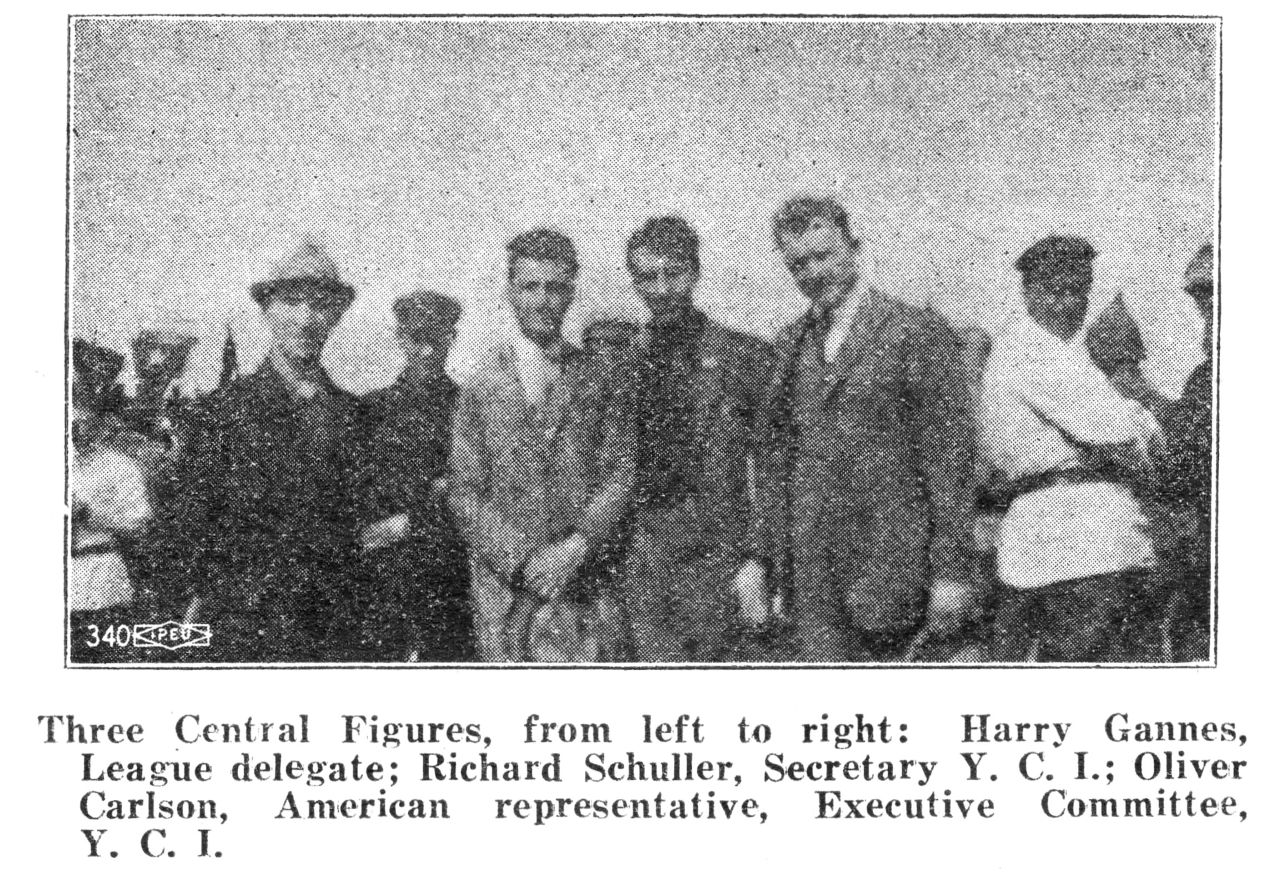
Gannes, a delegate from the Young Workers League, reports on the July, 1923 leadership meeting of the Young Communist International in Moscow.
‘The Fourth Bureau Session’ by Harry Gannes from Young Worker. Vol. 2 No. 10. October, 1923.
Delegate from the Young Workers League of America to the Fourth Bureau Session of the Young Communist International
FOR the first time since the Young Workers League of America came into being, the League was represented at an international bureau session. That was at the fourth bureau session of the Young Communist International, held in Moscow, July 13-23, 1923. “Now, what is a bureau session?” is the reasonable question that will arise in the minds of most of our members; and I shall answer that and proceed to a brief outline of the work done by this world body and the importance to the young workers of this country, and particularly the Young Workers League, of the decisions made there. A bureau session is a gathering of representatives of the more important leagues in the international (usually one delegate to a country) for the purpose of reviewing the work and activities of the leagues in carrying out the decisions of the last congress. Bureau sessions are set midway between congresses. The fourth bureau session, which I attended, was held seven months after the third world congress of the Young Communist International, attended by Martin Abern, secretary of the Young Workers League, and John Edwards, head of our industrial department.
Plainly, it was the task of this bureau session to examine the work of the leagues in carrying out the decisions adopted by the third congress of the Y.C.I. as well as the activities of the executive committee of the international.
The Session Opens for Work–and Works.
The following countries were represented by a delegate each: Germany, Czecho-Slovakia, England, Mexico, Austria, Finland, Switzerland, Sweden, Norway, Russia, United States, Italy, Bulgaria and the Baltic States. The French delegate was arrested in Switzerland while on his way to Moscow. Comrade Blenklow, of the Berlin Young Communist League, who was in Moscow to present a banner from his organization to the Moscow young comrades, was given a voice in the meeting.
Right at the opening, the comrades got to work. Richard Schuller, secretary of the executive committee of the Young Communist International, briefly set out the duties of the session. Karl Radek then followed on behalf of the executive committee of the Communist International. He reported on the meeting of the enlarged executive committee (similar to a bureau session of the Young Communist International) and on the world political situation. It would require too much space here properly to give even the barest outline of Radek’s masterly speech. I urge every comrade carefully and deeply to study the report of Radek’s speech which appears in the current issue of the Y.C.I. Review.
Report of the Executive Committee.
In a long yet interesting report, Schuller pointed out that the economic and trade union struggle of the leagues had been pushed into the background since the third congress because of the Fascist and war-danger developments. In Germany, the league was faced with a rising Fascist movement. In Bulgaria a militarist group had gotten into power, and in Italy the league was making a life-and-death fight against the Fascisti. Schuller touched on the growth of the nuclei, but I will take that up under the report by Gyptner on shop nuclei work. Here I shall deal shortly with what the secretary had to say about the Young Workers League of America. That our league heretofore did not do enough to further the economic struggle and that it was not active enough in the trade unions, was the main criticism leveled at our organization; but Schuller spoke at length on the big step forward made by our convention on these fields and the great possibilities before the league. News had just reached us about that time of the conference with Gompers and this was hailed as a fruitful outcome of our convention’s work. We were warned not to rest content with a mere conference, but to double our effort and agitation within the unions for the admittance of the youth on equal terms.
The Struggle Against War and Militarism.
The danger of war grows daily. The situation in the Ruhr, instead of coming to a solution, becomes more involved as the days go by. A mad race is on between England and France in the building of their air fleets. The Bulgarian government is in the hands of a band of cut-throats. And our own government spends millions to increase its war machinery. It is this situation that was pointed out by Comrade Michelic in his report on the struggle against the danger of war and militarism. He outlined the anti-military work done since the third congress by the various leagues. As always, the most was accomplished in this direction by the French league. Co-operation has been established between the German and French young comrades in the Ruhr district, but many hard problems had yet to be met. As for the United States, we could show very little. True, we had passed what may be termed a good anti-military resolution, but the test is: What are the results? Michelic pointed out, that although in the United States there is no standing army, there is an acute military development, which must be combated by the league.
The Foundation of All Our Work.
“The shop nuclei is not so much a matter of reorganization as it is of means of ORGANIZATION,” was the central theme of Richard Gyptner’s report and resolution on the shop nuclei problem. He showed that the rapid growth of the German league was due to the building up of shop nuclei by individual comrades; that the formation of shop nuclei is the means of getting a mass movement.
In the discussion on the nuclei question, most of the leagues reported the establishment of shop nuclei. Gyptner pointed out that the United States, with its large basic industries, (with the workers usually living in the vicinity of the factories) offered a fertile field for the planting of the nuclei. He had the mistaken idea, however, that the Young Workers League did not have a large enough proportion of real young workers. The latest figures prove that our organization is composed more than 75 per cent of workers, mostly in industry. That, we must remember, is all the more reason why we must begin to show live nuclei. The plan to be followed where nuclei have not yet been established is: Wherever possible at least one nucleus in a city be established as a lesson (as a living example) to those comrades who doubt the superiority of this new form of organization. The fourth congress expects to hear of the establishment of many, many shop groups by the Young Workers League of America.
Fascism and Reaction.
In the fight against fascism, the leagues must act in fullest harmony with the party. Fascism is an acute problem in such countries as Italy, Germany, Czecho-Slovakia, Bulgaria, and so on; in the United States, on the other hand, we have but the beginnings of a Fascist movement. We here are more concerned with reaction–the open class-character of the government and the attacks of anti-working class organizations. This is not fascism. The resolution adopted on Fascism clearly marks down the tasks of the league in combating Fascism and reaction.
The Farming Youth Get Attention.
The matter of the farming youth was something new to a bureau session. To be sure, the Young Communist International has talked about the young farm slaves before. But the decisions were vague. Now, since the Communist International has emphasized the importance of the working farmers in the revolution, organizing the farming youth becomes very important. Paasonen of the Finnish league reported on this subject. His resolution, which was adopted with but slight changes, contains specific demands for the farming youth, such as, for instance: Organization of the farming youth into organizations similar to unions, equal pay for equal work with adult workers, medical attention when injured or ill, and many others which will give us a practical working field among the rural youth. Comrade Carlson, our representative on the executive committee of the international, pictured the condition of the farmers and farming youth in America. He showed the problem we had in reaching the migratory workers–a problem not faced by any other league, except Canada. When the resolutions of the bureau session are in print (which will be very soon) we urge our farmer comrades to read this particular one and let our national executive committee know their opinion of it–let us have some pointers on how to apply it; let us know what the farming leaguers think of it.
The Sport Movement and the Youth.
For the first time, the question of the factory sport organizations was taken up in detail. Michelic, the reporter on the question, showed that the larger industrial plants had and were organizing factory sport clubs. Especially in the United States is this true. In the resolution passed on the question, a whole section deals with factory sport organizations. It will make more than interesting reading to all our members. Even in sports we come across the shop nuclei; for the shop nuclei must take notice of the factory sport organizations and work within them for the interest of the working class youth. Some specific demands were drawn up for the shop nuclei to put forward and act upon, demands on which we can rally those young workers who are mainly taken up with sports. A long and interesting discussion took place on the sport problem. To cover it all would require, to say the least, an article much longer than this one.
Here I wish to bring out just one more thing on this matter (at the same time I urge all my readers to make it a point to read the whole resolution): It is necessary for the good of the labor movement that a workers’ sport movement be built up and that the young workers take the most active part in that organization. In Germany and the other central European countries, they have large workers’ sport and athletic movements. Here we have none. Yet the American youth is more inclined to sport than the youth of any country in the world. We have a big and wide-spread system of factory sport clubs, and a vast amount of sport activities–all in the hands of the bosses. When we find that sport clubs become very useful tools in the hands of the fascisti (anti-working class) and strike breaking organizations, we begin to feel the pressing need for us to get the workers to form their own sport clubs that can be used by and for the workers and against the factory owners and their class.
Education, Trade Union and Economic Work.
A campaign is to be started in the fall by all young communist organizations to get as many of their members as possible into the trade unions. In this country the work can be tied up with the Gompers’ affair; but we must keep this in mind: that it will not be easy for our comrades to agitate for this aim if they themselves are not good-standing members of a union. Our national organization now has many important campaigns on, but it will be necessary always to stress the importance of our members being in the union one hundred per cent. The partial registration (see other part of this magazine) shows we have a pretty good proportion within the unions now, but until all, or nearly all of our young workers are in the union we must consider ourselves in the midst of a campaign for union members in our own organization. The main reason for this is simply–how can you urge a young worker outside of the organization to become a member of a union if you yourself are not in the union?
On education some good decisions were made. Our attitude on religion came up under this head. In Sweden one of the party men, Hoeglund, brought the question to the fore, and the Young Communist International, found it necessary clearly to state its position, urging all leagues to take a communist stand against religion, while avoiding becoming merely a Jesus-killing society.
The Press and the Publishing House.
An important move was made affecting the International of Youth. Heretofore this paper was issued haphazardly and it did not have a definite, clear-cut tone, though it will be admitted by all that a great change for the better is to be seen both in make-up and contents of this international magazine since its first issue. Beginning with 1924, the International of Youth will be put out once every two months on a regular date. The paper will be mailed directly to our branches, preventing delay. The price of the paper remains at 10 cents. The national executive committee will arrange a club subscription rate for the Young Worker and the International of Youth. The details will be announced later.
The New Policy of the Paper.
Now, a word as to the policy of the International of Youth–why it is published and what it will contain. The International of Youth is intended, primarily, to be a paper for members of the English speaking leagues of the Young Communist International. It will contain articles on the problems of the young communist leagues of the world. In it you will find the news of the many leagues affiliated to the international; the results of their campaigns; there will be unequaled articles written by keen writers in the communist international; there will be book-reviews, pictures, poems, stories for the class conscious young workers. The International of Youth, in short, is the English expression of the executive committee of the Young Communist International.
Many new pamphlets and books are going to be published by the Young International Publishing House. The Young Worker has contained announcements of some of them. Among others there will be a hand-book on organization; Blonsky’s, The Work School; Chicherin’s The Torch-Bearers,–Chicherin, by the way, is commissar of foreign affairs for the soviet government, and has been closely connected with the youth movement. Many other publications are planned and nobody will be able to say that there is not enough literature in the English language on the communist youth movement.
There were many other things taken up which have not so wide an interest. For ten days the delegates were kept very busy discussing the problems of the young communist movement of the world, and they by no means settled all of them. They made some pretty real and definite statements as to what they expect to do in the future–all based on the decisions of the third congress and the experience of the past few months. All the decisions are worthless, however, if the members do not understand them and carry them forward.
To be Issued in Pamphlet Form.
These decisions are now on the press. Together with the decisions are being printed extracts from the more important speeches. The pamphlet, when issued, will be the latest guide to action for all young communists, and we expect every one of our members to get and study a copy.
The fourth bureau session has passed. All I could say there regarding the activities of the Young Workers League was: Our organization is working hard; it has taken upon itself many grave tasks and has shown the willingness and the understanding necessary to success. It is entirely up to our members whether our delegates to the fourth congress of the Young Communist International, which will be held in Moscow, sometime in March 1924, will be able to show actual results in carrying out the resolutions of our second convention.
The Young Worker was produced by the Young Workers League of America beginning in 1922. The name of the Workers Party youth league followed the name of the adult party, changing to the Young Workers (Communist) League when the Workers Party became the Workers (Communist) Party in 1926. The journal was published monthly in Chicago and continued until 1927. Editors included Oliver Carlson, Martin Abern, Max Schachtman, Nat Kaplan, and Harry Gannes.
PDF of full issue: https://www.marxists.org/history/usa/pubs/youngworker/v2n10-oct-1923-yw.pdf

