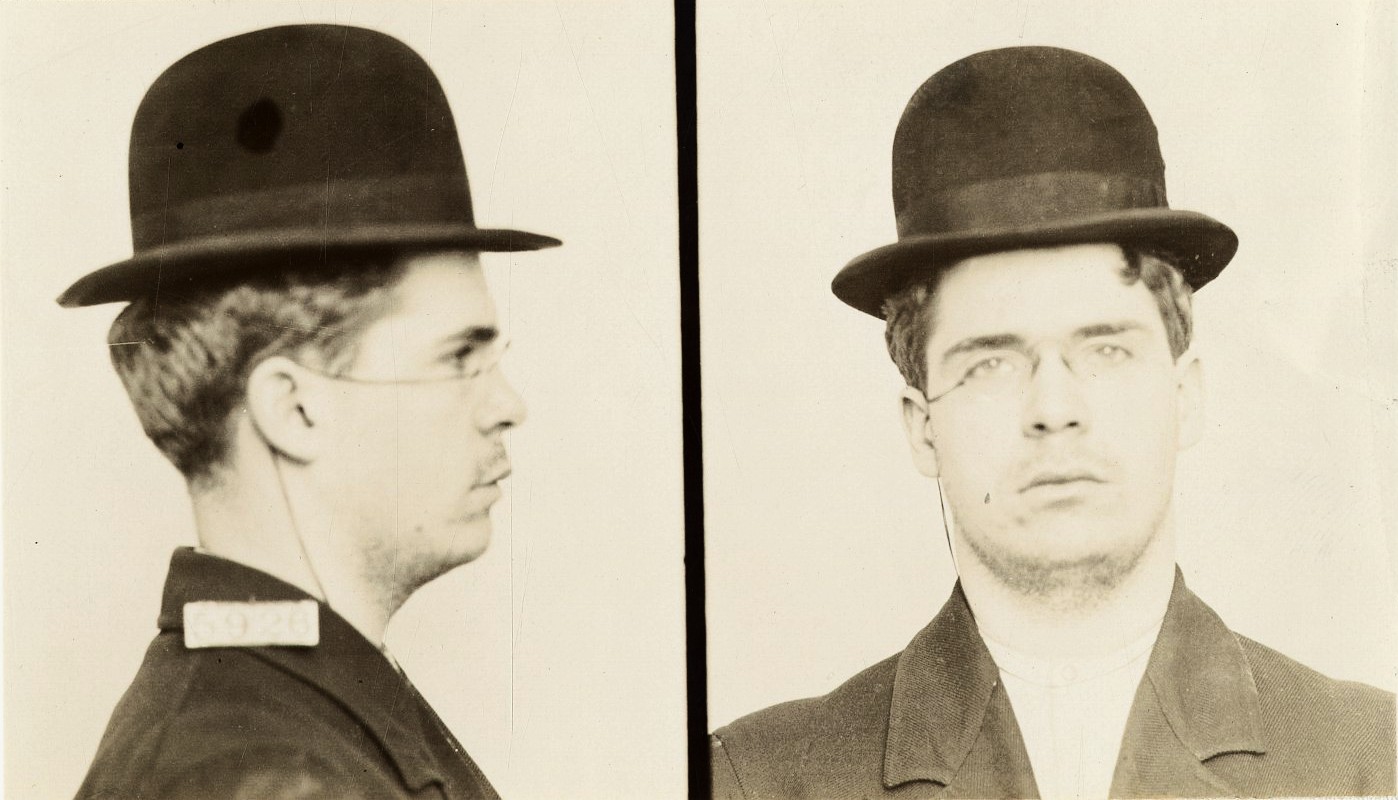
James Kelly Cole was a wobbly on his way from Chicago to Spokane as a volunteer in the free speech fight when he was killed in a railroad accident on November 17th, 1909. Reading a collection of his writings published after his death, Frank Bohn sees in Cole a type of the new generation, self-educated young workers at war with a society at war with them.
‘The Life Work of James Kelly Cole’ by Frank Bohn from Industrial Worker. Vol. 3 No. 12. June 15, 1911.
James Kelly Cole was killed in a railway accident at Tomah, Wisconsin, November 17th, 1909. He was on his way to take part in the Spokane free speech fight and was riding free. At that time I wrote a short letter in the Call, drawing attention to the self-forgetfulness which led to the untimely death of this young comrade. To me he was simply one of many who were then fighting for freedom of speech in Spokane and elsewhere. I had not even learned his name. It is therefore a peculiar pleasure to discover that, dying in the cause, he left us something very much worth while. A little book of poems entitled “Revolutionary Writings” suggest to us the deep loss suffered by the movement when he went to his death.
His picture as well as his poems makes one regret not to have known him personally. He was a representative of a type–the type of idealistic young Americans of both sexes who are now thronging into the Socialist movement. He was fortunate in having had educational advantages. He had been a student at one of the Chicago High schools and abundant leisure during his youth afforded him opportunity for wide reading on a variety of subjects.
The most significant feature about his personality and his work was the revolutionary spirit. His intense hatred for misrule coupled with his desire for emancipation from wage slavery once led him into a tactical error. He was forced to spend more than a year in the federal prison at Leavenworth, Kansas.
“Revolutionary Writings,” by James Kelly Cole, price 25c, Vincent St. John, 160 N. Fifth Avenue, Chicago, Ill.
The savage brutality of our prison system is suggested in a number of poems expressive of the revolutionary attitude toward this phase of our present fiendish criminal law. We regret that space will not permit us to quote “The Shadow of the Bars” in full.
“The raven croaks her lone, prophetic flight
Across the dismal waste, and sable Night
Hath clothed the prison wall in garb of gloom.
Unseen the orbs which through eternal time Are
Wisdom’s fount, and source of Hope sublime;
The fearful shadows shroud a living tomb.
The vagrant wind taps constant on the pane,
A dreary chant of woe, without refrain,
It heats with careless count the pulse of strife:
And restless, fevered thought of bitter things,
Discordant with the wind intensely rings
The tuneless canto of a wasted life.
Unknown, upon that hard and narrow cot,
The peaceful sleep of boyhood’s happy lot:
Here dreams grotesque the fevered brain abuse:
Dreams conjured in the glaring pit of hell,
Wove red with threads of pain in Mab’s weird spell,
With terror glint the eye, the brow suffuse.
Upon a meager shelf a picture stands,
A pile of faded letters, slender strands,
Which hold the heavy heart in Love’s embrace:
‘Tis all that’s left him of the golden hours,
When life was sweet with song and scent of flowers,
And Hope revealed her glory in his face.
Hath not the earth brought forth abundantly,
In field of grain and heavy laden tree.
Enough for all: then why, in justice, should
Some hear the curse’ of poverty and crime.
Some live in sunny places, sweet with thyme,
When all belong to Man’s great brotherhood?
Beneath the callous guard’s malignant eye.
In silence he must toil, nor satisfy
The yearning in his heart for fellowship.
By word or sign to those who share has fate:
All sympathy is crushed or turned to hate,
And self and he hold grim companionship.
Hate grows and feeds upon its monstrous growth.
Vile brooking lust becomes his mate, and both
Rule jointly in the heart where Virtue’s throne
Was burnt to ashes in the flames of fear,
Where Hope was drowned in mem’ry’s acrid tear,
And Faith mocked God and died unwept, unknown.
And now the brazen fell its warning rings:
The lights go out–the night wind gently brings
The solemn tone of taps: nerve-raking jars
Of holts and keys disturb the stifling air,
Beside his bunk the convict kneels in prayer,
And o’er him steals the shadow of the bars.
Taps.
When lights go out and darkness reigns alone:
Borne on the whispering wind, a plaintive tone,
The sacred chamber of my soul invades.
And thrills, and flits with sorrow’s softened shades.
O bugler! well we know, without thy art,
That lights are out in every human heart!
Tear the sad, the solemn call,
Wafted o’er the prison wall.
Never-M-O-R-E! Nev-er-MORE!
Nevermore-Nevermore-Nevermore!
Nev-er-M-O-R-E! Nev-er-MORE!
Nev-er-M-O-R-E! Nev-er-MORE!
“WHAT’S THE USE,” reminds us of a form used by Robert Louis Stevenson in many cedar canoe on the creek, the moon and stars shining over the Southern Pacific at Tahiti, and to the woman he loved who followed him there. James Kelly Cole in “WHAT’S THE USE” expressed the sentiment of a reading, thinking boy who is hustling for a job at hard labor:
“This world is full of pain and gloom;
What’s the use?
We fight through life from crib to tomb
What’s the use?
We work and sweat both night and day,
For that wee bit men call pay,
And then we plod the same old way,
What’s the use?
We rise at dawn to start at work;
What’s the use?
We cannot rest or labor shirk;
What’s the use?
We come home worn at night to sleep,
But when the sunbeams light the steep,
We hustle out our job to keep;
What’s the use?
His poems are not many, but the variety of them gives us some indication of the breadth of his human interests. There is a poem to his pipe, entitled, “AN OLD FRIEND.” Another “MY MOTHER’S GOD.” expresses the state of mind natural to the religious and patriotic American boy when first touched by Socialist thought. Probably a little later period brought forth, “BROTHERS AND SISTERS.” Here he is wiser in the world’s ways. Yet the emotional element still predominates over the harsher attitude of the class conscious revolutionist. It seems to be an appeal to the whole world for pity upon human suffering:
Is he draped in ragged clothing.
Are his hardened features vile;
Do you look on him with loathing.
Or a thoughtless, sneering smile;
Does he leer at you in envy;
Evil gleaming in his eye?
In the darkness of the twilight,
Would you fear to pass him by?
He’s your brother.
Did you meet her in the glamor
Of a city’s gilded hell;
In a mercenary amour,
Did you drink and wish her well?
Did you note the worried visage
Of the “Madame” by her side;
Did you read upon the first page,
Of another suicide?
She’s your sister.
He had been the average American boy in the average church and home. Some of his poems take us back to the simple life and joys of that home. At twenty-one he had broken in fierce rebellion against this smooth, smug, quiet life. He soon became a first class outdoor Socialist agitator. His life teemed with great hopes for the world to be and for the love of the fighting as it is. On the plains of Northern Mexico there now bleach the skeletons of scores of young American Revolutionists of this type, members of the Industrial Workers of the World and of the Socialist Party. The world at large think they are fools and two-thirds of the Socialists utterly fail to understand their passion.
James Kelly Cole studied hard, spoke well, wrote well and organized successfully. But for him there was one supreme means of expressing the feeling toward the world of the present. He longed with all his soul to make physical war upon it. He loved Byron dying for the liberties of Greece and John Brown going to the scaffold. He was both these curious extremes of life. The last stand of the communards was to him the revolutionary reality.
Then came the call. His fellow workers were suffering by hundreds in the jails of Spokane. The old rights of centuries had been denied them. Minds like his are not much troubled by doubting. In the gloom of a November evening in a western wilderness he met death in a most unromantic form.
The last of his published poems is entitled, “TO THE ROSE.” It closes with the stanza:
“Oh, Rose: soon will my journey cease.
My spirit seek an earthly peace.
Among the stones, the clods, the clay,
That gave to thee thy colors gay.
Only a fool would fear to go.
Where tints like thine are taught to grow
And bloom, to meet the shining sun–
The climax this: Then duty done!
I pray my soul, in grand attune.
With natural things, may greet the noon
Of manly deeds and in the light,
Of duty done–then seek the night
Of rest and peace, that other men,
The law of love and life, may ken.
Now to thy soul I make this prayer,
That when I go; no matter where:
I shall have left a few good deeds:
That I may not be cast with weeds,
To die forgotten; but like thee,
Find rest in glorious history.
The Industrial Union Bulletin, and the Industrial Worker were newspapers published by the Industrial Workers of the World (IWW) from 1907 until 1913. First printed in Joliet, Illinois, IUB incorporated The Voice of Labor, the newspaper of the American Labor Union which had joined the IWW, and another IWW affiliate, International Metal Worker.The Trautmann-DeLeon faction issued its weekly from March 1907. Soon after, De Leon would be expelled and Trautmann would continue IUB until March 1909. It was edited by A. S. Edwards. 1909, production moved to Spokane, Washington and became The Industrial Worker, “the voice of revolutionary industrial unionism.”
PDF of full issue: https://www.marxists.org/history/usa/pubs/industrialworker/iw/v3n12-w116-jun-15-1911-IW.pdf

