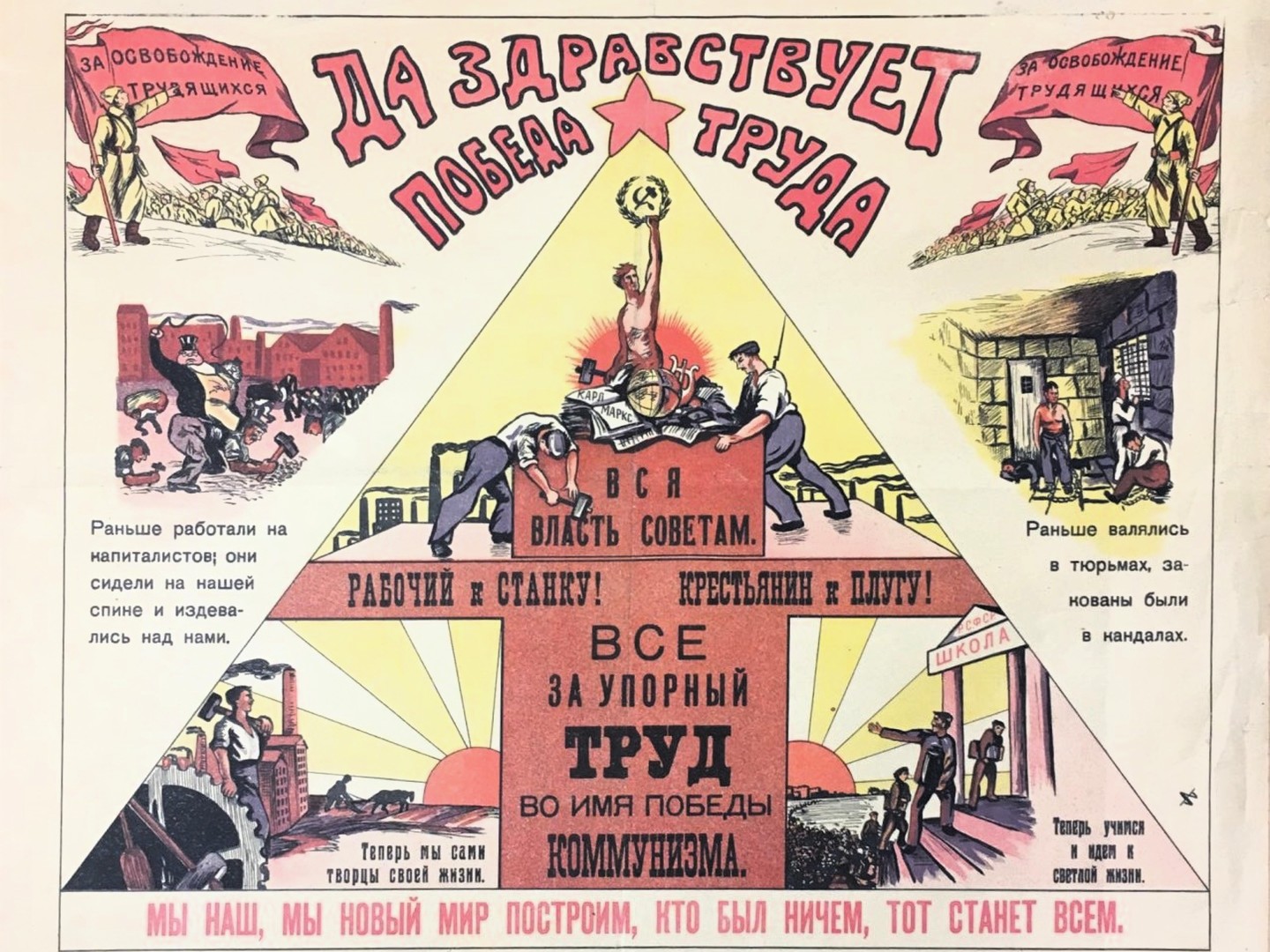
Olgin with an overview of the Russian proletariat under peacetime reconstruction of the New Economic Policy.
‘The Russian Worker at Present’ by Moissaye J. Olgin from Labor Herald. Vol. 2 No.7. September, 1923.
WHEN a long and wearisome strike has just been won by an organization of workers, do not judge the struggle by their lean faces or empty pantries or starved-looking babies. Judge it by the possibilities that the victory opens before the victors in the future.
The Russian workers went on strike against capitalism on November 6th, 1917. The strike has been the most trying in the history of mankind. An economic organization undermined by three years of war under a reckless autocracy, was being shattered for three more years by in ternal wars in the vital areas of the country, by the iron ring of economic blockade, by foreign enemy invasions. A population weakened by the loss of seven million dead and wounded prior to 1917, was being bled white by new pernicious fighting, by devastating epidemics, by hunger and starvation. Leading in all those heroic struggles were the industrial workers.
They have won. The backbone of capitalism has been broken forever. Russia remains Soviet. Russian workers are, not figuratively, but in fact and in practice, the masters of the land. Vast possibilities open before them in the near future. Soviet Russia lays the foundations for a new social order. And it is by those possibilities and by the greatness of the historic achievement rather than by the present level of the Russian workers’ wages or by their housing conditions or by their clothing that their situation is to be gauged. One should not forget that even at present their strike is not completely over. International capitalism is still menacing Soviet Russia. Counter-revolution is still plotting. Russian workers are not yet able to devote themselves entirely to the task of reconstruction.
And when the most enlightened among them try to visualize their present life, what do they find? Politically they have become the dominant class of their country. Economically they are still very poor and backward. As the ruling class they, through the Soviet Government, are the owners and the administrators of the national industries and the natural resources (the land being generally used by the peasants). As industrial workers they have to bear the brunt of privation due to reduced productivity and general economic deterioration. The latter, however, being only a temporary evil, they know that every improvement in the economic situation will invariably raise the standard of their living, and there being no conceivable limits to the growth of labor’s productivity under the influence of technical inventions, there are therefore no conceivable limits to the future growth of the well-being of a class which is at liberty to take as big a share of the national produce as it pleases.
It is in the nature of things that the Russian worker should appear simultaneously in the capacity both of a governing class and of a wage-earner. In the former he is a member of the Soviets and of the national and local administration. In the latter he is a member of his labor unions. In the former he is for economy first, last, and always, because the building-up of the economic apparatus is his primary concern. In the latter he is for an increase in the share accruing to him as compensation for his labor, because he realizes that no material increase in productivity is possible without an increase of the worker’s capacity to work.
Between these two poles the public life of the worker flows in a colorful stream. It is not always smooth, not always comforting, but always full of fascinating interest and stimulating expectations.
But what about the “Nep” (new economic policy) which has been lately so much talked of?
How about the spectre of private ownership again stalking the wide plains of the Russians? So far, the Soviets have retained and keep on managing for public benefit the entire bulk of the Russian industries plus the entire transport and foreign commerce. According to J. Larin, a well-known economist and an authority on Russian problems, the number of workers engaged in privately-owned and managed factories is 3.9 to every hundred workers, understanding the term “factory” as such industrial establishment which, being equipped with a mechanical motor, employs 16 or more workers, or without a motor employs 30 or more workers. In other words, the grip of private management over the Russian industrial mechanism is almost negligible. The realm of private enterprise is limited to the small shops and to petty commerce; in the latter, however, the field is being successfully contested by co-operative organizations. Altogether, there are no more than 17 per cent Russian workers engaged in private shops, factories, and mines. The absolute numbers will increase in the future with the spread of foreign concessions, but it is doubtful whether the percentage to the total number of workers will become larger, since the Soviet economic organization is also bound to grow and has grown considerably in the last year.
What the “Nep” has actually accomplished is to put every industrial establishment on a rational basis, to eliminate waste, to reduce the personnel, to increase efficiency, to make the enterprise pay its own expenses and yield the commonwealth a margin of profit. “We have got to go to school to the capitalists,” said Lenin to his comrades. And so they went, but not to relinquish their hold on the industrial machinery–quite the contrary to learn how to manage economically, how to stimulate productivity, how to exchange with the agrarian population, how to trade with the world. One result of this “bracing up” may well be recorded. The average wage of the Russian industrial worker has, between the beginning and the end of 1922, increased 86 per cent. It is not a living wage yet. It allows for bare necessities only. But we may venture to say that under private ownership no such advance would have been possible. The wage increase keeps pace with the stabilization of the currency and general improvement with no regard to the number of unemployed. As a rule, the workers in private enterprises are worse off than their comrades in the economic establishments of the Soviets.
The total number of Russian wage earners is about 7,500,000, of whom 2,700,000 are industrial workers, 1,200,000 transport workers, 2,200,000 office workers, shop clerks, educational workers, medical workers, etc., and 1,400,000 are farm hands without land. The industrial workers are nearly all organized (with the exception of the home workers and those engaged in small shops, whom it is very difficult, at times impossible, to reach). Thus, by the end of June, 1923, the Metal Workers’ Union included 96.7 per cent of all the metal workers in the country. The Textile Workers’ Union embraced nearly 95 per cent of all the textile workers. The transport workers are organized 80 per cent. The clerks, educational and medical workers, etc., are organized 63 per cent. The farm hands are organized only 15 per cent. The total membership of all Russian labor unions is approximately 4,500,000.
The number of unions is 23, one to each branch of industry or class of occupation. They are: the Unions of Metal Workers, Textile Workers, Miners, Railroad Workers, Water Transport Workers, Local Transport Workers, Typographical Workers, Chemical Workers, Food Workers, Leather Workers, Sugar Workers, Wood Workers, Paper Workers, Building Workers, Needle Workers, Postal, Telegraph, and Telephone Workers, Medical Workers, Educational Workers, Communal Workers, Soviet employees, Land and Forest Workers. Each union has departments according to crafts, etc. The lower nucleus of the union is the Shop Committee (factory or plant committee) elected by the employees of the industrial establishment. The higher governing body is the Central Committee (National Committee). Representatives of the Shop Committees in every city form the Local Committee of the respective union. A combination of all Local Committees forms the Local Council of Labor Unions.
Membership in the unions is voluntary, dues being collected from individual members either through the Shop Committees or through special collectors.
The difference between the Russian unions and all the others the world over is that the Russian unions are an integral part of the state administration. The activities of the unions will be reviewed in another article.
The Labor Herald was the monthly publication of the Trade Union Educational League (TUEL), in immensely important link between the IWW of the 1910s and the CIO of the 1930s. It was begun by veteran labor organizer and Communist leader William Z. Foster in 1920 as an attempt to unite militants within various unions while continuing the industrial unionism tradition of the IWW, though it was opposed to “dual unionism” and favored the formation of a Labor Party. Although it would become financially supported by the Communist International and Communist Party of America, it remained autonomous, was a network and not a membership organization, and included many radicals outside the Communist Party. In 1924 Labor Herald was folded into Workers Monthly, an explicitly Party organ and in 1927 ‘Labor Unity’ became the organ of a now CP dominated TUEL. In 1929 and the turn towards Red Unions in the Third Period, TUEL was wound up and replaced by the Trade Union Unity League, a section of the Red International of Labor Unions (Profitern) and continued to publish Labor Unity until 1935. Labor Herald remains an important labor-orientated journal by revolutionaries in US left history and would be referenced by activists, along with TUEL, along after it’s heyday.
PDF of full issue: https://www.marxists.org/history/usa/pubs/laborherald/v2n07-sep-1923.pdf

