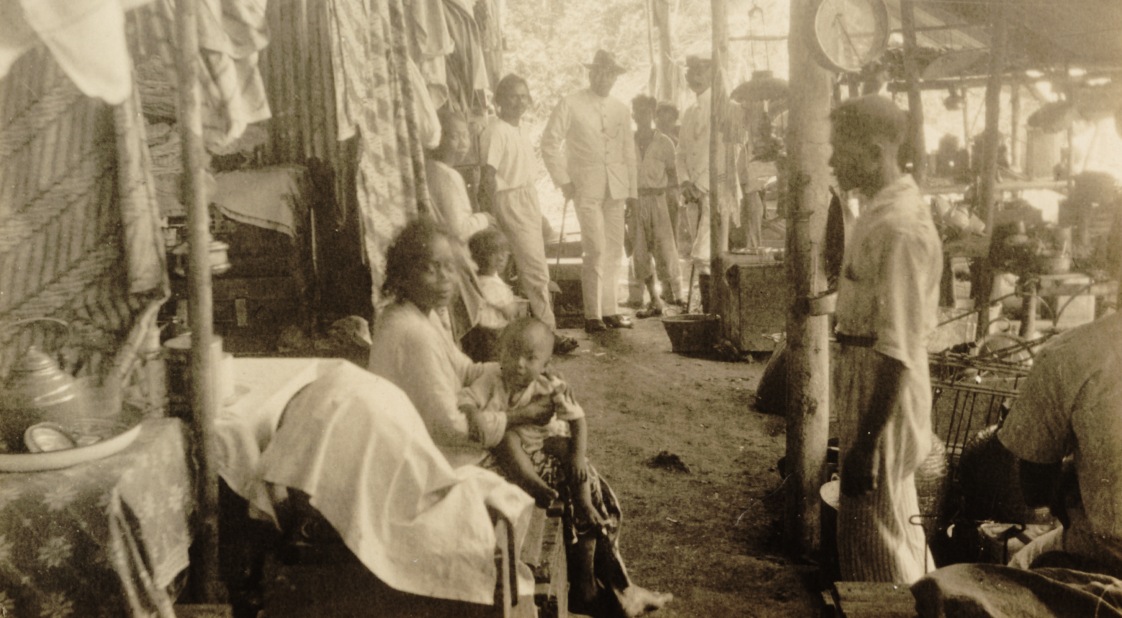
Working in, and partially leading, the popular Islamic party Sarekat Rakyat, the PKI played a central role in the mass rebellion that broke out against Dutch imperialism in 1926. In the aftermath of the insurrection, a mass wave of terror hit the movement, with the notorious Dutch concentration camp of Boven-Digoel, in the isolated in the South Papua interior a brutal exile for thousands of activists and their families.
‘The Terror in Indonesia’ by Alim from International Press Correspondence. Vol. 7 No. 22. March 27, 1927.
The rising in Java in November last and that in Sumatra in January this year were both bloodily suppressed. The Dutch imperialists, with their up-to-date arms, carried off the victory over the rebels, who were not so well armed.
The terror now prevailing in the Dutch colonies is merely a continuation of the many acts of terror practised of late years by the Dutch imperialists. Since the time of the railway strike in Java in May 1923, terrorism has been carried on yet more relentlessly and unscrupulously against the revolutionary movement among the natives. Immediately after the outbreak of the strike, any form of assembly was prohibited throughout the Dutch East Indies. A strike law was promulgated, according to which not only the strike leaders, but all who in any way aided or abetted the strike, were liable to arrest. Subsequently, numerous comrades were condemned to months’ of imprisonment for infringement of this law.
In the same year, bombs were thrown at the Governor General of the Dutch East Indies, who was starting on a tour of inspection through Java. This man made himself, odious to the population not only by the prohibition of meetings and the strike law he decreed, but also by the wholesale dismissal of civil servants and employees, and by an extraordinary increase of taxes, which reduced many small native holders to beggary.
At the time of the celebration of the Queen of Holland’s silver jubilee, bombs were thrown in various places in protest against the persecution of the popular movement. The police arrested many leaders of the Communist Party and of the Sarekat Rayat (People’s Union), although there was not the least evidence against them.
After about six months’ imprisonment, our comrades had necessarily to be released again by the police, in view of the absence of any incriminating evidence.
It is since the end of 1923, that the revolutionary tendency has gained the upper hand in the popular movement. The Communist Party gained more influence and came to occupy a leading position in the popular movement of the Dutch East Indies. Since then, too, the reaction has been directed mainly against our Party and the organisations led by it.
The Dutch press followed the aggravation of the growing differences with serious misgivings. The Liberal papers demanded the return to the system of freedom of assembly, so that the popular movement might be more easily controlled. The reactionary part of the press, meanwhile, urged yet severer measures against that movement. The most prominent Dutch newspaper in the East Indies called for the formation of a “white front”.
Early in September 1926, Dr. Fock, the reactionary and thoroughly unpopular Governor General, retired. His successor spoke with such honeyed words when assuming office, that many might have believed that the new Governor General would really bring about an improvement in the economic position of the people. The native inhabitants, however, were not to be deceived by such blandishments. In spite of these assurances, no change was made in the existing circumstances.
Then followed the rising in Java. The Javanese, the meekest and most patient race on earth, as the famous Dutch writer Multatuli once called them, took up arms to rid themselves of their persecutors. In Western Java, the broad masses of the population took part in the struggle, facing with primitive weapons the rifles and bayonets of the Dutch exploiters. They were shot down by scores. Thousands were arrested. The Dutch newspapers raised a hue and cry and demanded that the rebels should not be taken prisoners but be cut down or strung up at once. How many arrests were made, it is difficult to say for certain, for at present, four months after the rebellion, arrests are still taking place. At a moderate estimate, some 6000 persons at least must have been arrested in Java.
Nine individuals have already been condemned to death and further death sentences are to be expected. The remainder are condemned to penal servitude for life, or else to periods of twenty, fifteen, or at least seven, years. The accused are accorded no legal protection before the tribunals and are thus completely at the mercy of the judges. At their trial many of the accused asserted that an admission of guilt had been wrung from them by maltreatment on the part of the police. The judge, however, refused to believe them.
The trials in Java were not yet at an end, when the rebellion in Sumatra commenced early in the current year. Here again, hundreds were killed and thousands arrested. The number of the latter may be put at quite 2000, for here, too, arrests are still being effected.
The terrorism of the Dutch imperialists is raging furiously. Those who took an active part in the rebellion, will be condemned by the tribunals, while other revolutionaries against whom the Government has no excuse to proceed but who might yet become a danger to the capitalist order, will, as is usual in such cases, be interned, being sent to New Guinea and carried far into the interior of that island, whence escape is impossible. They will be transported to Assike, a place situated 280 miles from the coast. This is an altogether pathless region, and the prisoners are carried thither by a small steamer, the journey lasting several weeks. The inhabitants of those parts are cannibals, practising cannibalism down to the present day; they have no settled abode.
In these remote regions the comrades will be forced to engage in agricultural pursuits as a means of raising foodstuffs, since there is no trade in those parts. At first they will be supplied by the Government with certain small subsidies, with which they can buy foodstuffs of the soldiers guarding them.
Early in February, the first exiles left for Java, being removed from the prisons and put on board the steamer at night, so as to obviate demonstrations among the population.
The trials are not nearly at an end. The Dutch imperialists feel unsafe. The army and the police are to be considerably reinforced. The army will be used for police duty to a greater extent than hitherto. The soldiers, who are mainly concentrated in three towns in Java, will now be distributed all over the Dutch territory, so as to be able to intervene at short notice in case of a disturbance. The white employees on the plantations will be furnished by the Government with rifles and ammunition. Militia and sharpshooter battalions are being founded on all hands, although the Government professes not to agree to such formations. The anxiety of the imperialists is reflected in the columns of the Dutch press.
The death sentences have not yet been carried out. The world proletariat must leave no stone unturned to prevent their execution.
International Press Correspondence, widely known as”Inprecorr” was published by the Executive Committee of the Communist International (ECCI) regularly in German and English, occasionally in many other languages, beginning in 1921 and lasting in English until 1938. Inprecorr’s role was to supply translated articles to the English-speaking press of the International from the Comintern’s different sections, as well as news and statements from the ECCI. Many ‘Daily Worker’ and ‘Communist’ articles originated in Inprecorr, and it also published articles by American comrades for use in other countries. It was published at least weekly, and often thrice weekly. A major contributor to the Communist press in the U.S., Inprecorr is an invaluable English-language source on the history of the Communist International and its sections.
PDF of full issue: https://www.marxists.org/history/international/comintern/inprecor/1927/v07n21-mar-27-1927-inprecor-op.pdf
 Revolution's Newsstand