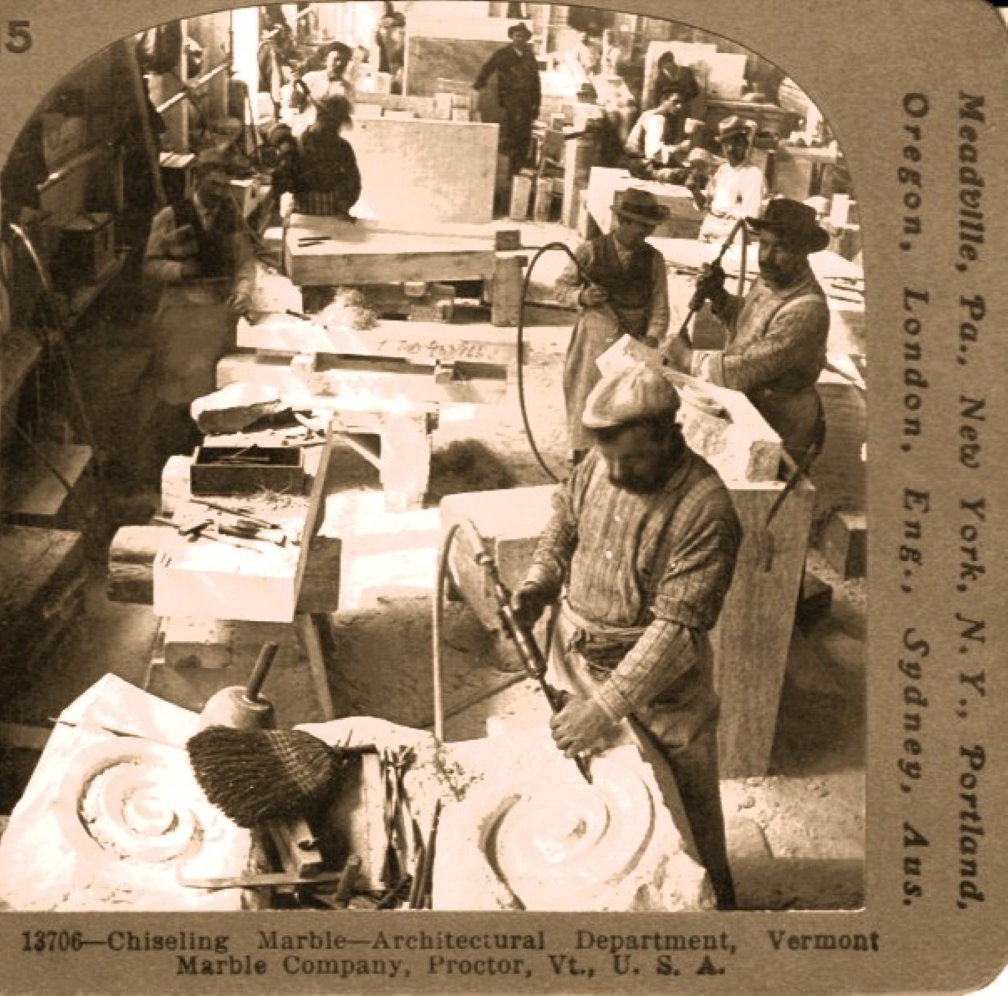
We don’t think of pastoral Vermont has a hotbed of industrial action, because it rarely has been. One section that did see organization and strikes was the state’s stone quarries. Here a fine look at the communities on a long strike against the Vermont Marble Company.
‘The Marble Strike in Vermont’ by Sarah Cleghorn from New Masses. Vol. 18 No. 4. January 21, 1936.
ARLINGTON, VT.
INSTEAD of this article, THE NEW MASSES ought to have one written from long, personal, intimate quarry-town experience, by a next-door neighbor, old friend or relative of quarry workers, to whom all that I know at arm’s length of thirty miles and much that I don’t know, would have been lifelong neighborhood knowledge.
So much for apologies. But at least I am an old Vermonter; I’ve lived where Rutland is the local metropolis for over half a century; and the quarrymen, both those with New England names and those with Hungarian and Polish names from their grandfathers–are the same kind of folks with the same kind of environment in a thousand ways that we have in Dorset and Manchester and Arlington and all the other towns that crowd the Rutland fair in September.
The Vermont Marble Company is fifty-five years old and this is its second strike. But strikes are as rare in Vermont anyway as well, as rich people in winter. These two rarities are related, no doubt, as cause and effect. However, a whole web of other effects and causes hangs from this local unfamiliarity with strikes. All the language of strike experience, pickets, scabs, strike-breakers, injunctions, deputy sheriffs, is foreign to the man in the Vermont village street.
But just as Vermont people can be hungry and cold, though we have no such famines as China and India, so though Pearl Bergoff never made a dollar of his hundred thousand a year breaking strikes in Vermont, yet we do have here in a sober and quiet form our share of the long, hard struggle, earth-wide and bone-deep, of the workers to organize and become responsible partners instead of obedient children in modern industry; and likewise we have here the steady, if almost subconscious, effort of the owners to show them that (as the owners doubtless sincerely believe) the unions are not half so good for them as the personal goodwill of the unchallenged overlord would be.
The Vermont Marble Company, as Vermonters have always heard, is the controlling power in the marble industry in the United States. Beside its Vermont quarries, it owns several in the South. A building in fact is to be reared in Rutland, Vermont, with a front of marble the Vermont Company has quarried in Tennessee.
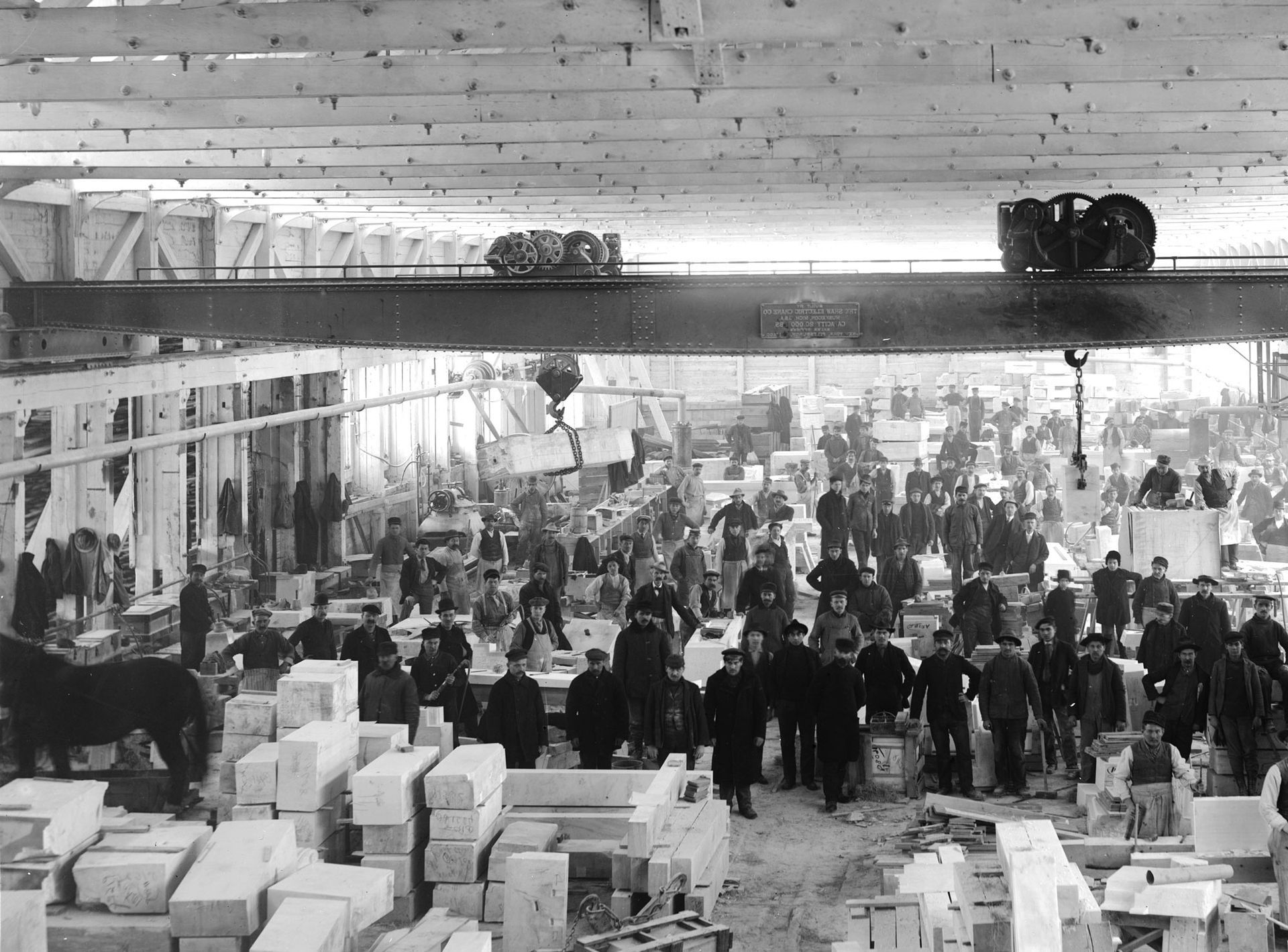
The company was founded by “Old Senator Proctor,” a typical captain of industry of his times, untroubled by “sentimentality,” “out to win.” If in his lifetime he heard the remark, “The Proctors own Vermont,” I don’t suppose he felt any moral embarrassment. His children are of a different type. Perhaps Miss Emily Proctor and her brothers Redfield and Mortimer own Vermont, but I don’t believe they like to think so. Their sincere and practical concern for “the relief and benefit of man’s estate” has been steadily shown for many years, not so much by word, for they are no speechmakers, but by deeds of serviceable goodwill from the founding and maintenance of the Vermont Sanatorium and Preventorium for tuberculosis and the Bryant Camp for delicate children on Redfield Proctor’s own farm, to a multitude of neighborly assistances to hundreds of workers in their quarries, especially as they grew old. Instead of having yachts and manor houses, they have sent workers’ children to college and impersonally raised the standards of Vermont’s public schools.
But still, just as much as the opposite type, the predatory type, of owners, they have earnestly, all these years, kept the unions out. Painlessly perhaps; very unlike the menacing way that U.S. Steel has kept them out; still the result ran true to form. Vermont has had its branch of the A.F. of L. ever since 1909, and there are a hundred local unions in the state, and yet this leading industry has only been organized a year and a half.
And if we Vermonters had been more interested in labor history, that part of history of which educated people know least, we might have been troubled to find these workers, while so “independent” in the Vermont sense, (that of making the ends meet, no matter how shrunken the income and “asking no odds of anybody”) yet by no means independent in the general sense of out-spoken freedom and variety of opinion or initiative of any sort as a group. The workers were encouraged to remain the feudal type of worker, in a safe and contented state of tutelage, perpetual minors in the industrial world.
WELL, thus it seems to have been in the green tree; what in the dry? Marble is a dwindling industry. The company knows it, the workers partly know it and even we outsiders begin to realize it now. The six years of depression have only pushed faster downstream the boat which was already floating down with the current. These new artificial stones seem really to be better than marble, though no Vermonter can acknowledge it without a pang. These new stones are cheaper; they can be moulded to the desired shape and size instead of having to be laboriously cut; they don’t blacken, they don’t crumble, in the open air. The last big order the Vermont Marble Company had was in 1932 or 1933, for the Supreme Court. In the two years or so that it took to fill that order they sent, Vermonters proudly say, a thousand carloads of marble to Washington. Then the brisk activity subsided and semi-stagnation came on; the company, trying to keep its payrolls open, used for wages a fund which had been laid aside for improvements; they tried having small ornaments carved out of marble, for which there proved to be little or no sale; they quarried stocks of marble for which no orders came; and then they tried that mournful expedient of “spreading the work,” with its gradual emaciation of wages, which reminds one of the old British workers’ practice of “clemming” or squeezing in the belt; devices to make what was too little to begin with stretch out ever further and further around, squeezing down the human needs accordingly.
“What principally caused the strike?” I asked a strike leader a few days ago. In one word he answered “Wages.”
What were wages just before the strike, for the lowest-paid men in the company? I wrote and asked the chairman of the company’s Board. “The minimum monthly rate for common labor in the late marble code. which we continue to observe,” he replied. “was 371⁄2 cents per hour in the Northern states and 30 cents per hour in the Southern states. At Danby the minimum hourly rate for common labor, except for one man, was 38 cents an hour, equal to $13.30 for a 35-hour week…”
This is what strikers had always told me; but recently a letter appeared in The Rutland Herald in answer to an inquiry I’d made in The Herald on the same point.
“As an individual and having about thirty years’ experience as an employe of the Vermont Marble Company I might be able to throw some light onto that question. During the years…when the Company received that huge order for the Supreme Court building in Washington, and soon after when they cut the wages twenty percent, I was operating a polishing machine here in the Company’s shop. I was required to work three and five days a week, and my weekly earnings were from four to seven dollars.”
I don’t know how a polisher’s pay could have been so low as this, even after a twenty-percent cut. It was certainly lower by a good deal than the Danby scale against which the men walked out. Or could it have been after deductions for rent and hospital expenses had been taken out?
“I have no accurate records” he goes on, “of my yearly earnings. That, of course, is in my accounts in the books of the Company of that period. Anyway it must have been three or four hundred dollars a year…” And he adds, in regard to the union:
“In the early part of 1934 the Blue Eagle flew into Proctor with the message that the workingmen also must be represented in collective bargaining, and the Company gave us a fair chance by the ballot to show in what organization we wanted to be represented. It was overwhelmingly voted through the quarries and mills that we wanted to be represented by the International Union. As soon as the result of this ballot was out, the Company began to form a company union. It caused quite a confusion among the workers. The International locals that were here already also began functioning more active and getting more members. I was asked by a fellow worker to join the union and I did and became a member of Local 94. Soon after the company began to lay off the men, paying no attention to their importance or their family affairs. That caused considerable ill-feeling among the men. I also was notified that I was laid off indefinitely. Some time after that the negotiations between the union and the company began and were conducted until the strike…”
This account agrees substantially with all I’ve heard before.
In September 1934 a conference was held between company and union, which was evidently inconclusive, for another was called for October; but then the union broke off and appealed to the Regional Labor Board in Boston, complaining of these discharges and of the company union. I don’t know what caused this breaking off; but it was in that month of October 1934 that the Danby men, the same who started the present strike, were dismayed to find themselves staggered to two-weeks’ work a month, or a monthly wage of twenty-seven dollars. However, as strikers in telling me about this hastened to add, enough irregular and extra work occurred to bring the working time up to between two and three weeks, resulting in a little over thirty dollars a month. With deductions, etc., about twenty-five.
Now in Vermont, to be sure, less than a dollar a day for a family of five or seven to live on except for rent isn’t the same grisly joke it would be in most places. This is a frugal, resourceful state, with a good deal of wild wealth in the lap of nature. By gardens in summer and by canning your own vegetables for winter, by keeping chickens, by buying your wood “on the stump” and getting it in yourself, by taking in washings, making Christmas wreaths, helping neighbors in emergencies, you can add a few dollars’ worth to the store; by having had a good start ahead in furniture (and stoves) when you got married, by habitually conserving the pennies as naturally as you breathe and by the prime Vermont habit of “using what you’ve got,” much can be done to eke out a dollar a day and bring it a good deal nearer to a living wage than anybody who lives in a city can imagine.
Provided no illness, no accident, no emergency, no new baby, no destitute relations taking shelter with you, no legal expenses, no necessary journeys, no special food for delicate children, no prolonged convalescence, no funerals and no weddings occur; no breakdown of household necessaries, little need for shoes, rubbers or underwear and none for dentist or eyeglasses; and provided everybody in the house is thrifty and cooperative, and that you have that priceless and in Vermont frequent thing–good neighbors. But what family ever spent a winter in such a fairytale streak of luck?
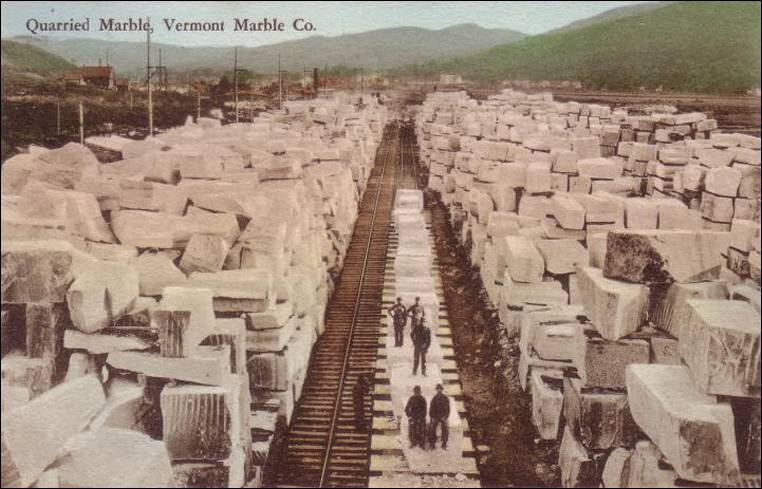
After the couple of months they spent on this pay last fall and early winter, the Danby families dreaded to see that notice posted up again.
ONE of the Danby men who walked out this last October had appendicitis a few years ago. He’d been taken to the excellent Proctor hospital and operated upon. “I was in the hospital thirteen days,” he said, “and not equal to work for eight or ten weeks afterward. When I was working again, I got a bill of forty-two dollars from the hospital. (And a much bigger one from the doctor.) ‘What you going to do about this hospital bill?’ the foreman says. ‘Well,’ I says, ‘I declare I don’t know.’ He began taking five dollars a week out of my pay envelope for it.”
Pay that leaves no margins for this sort of thing is unrealistic pay, no matter how possible it looks on paper (for other people) to live on it or come somewhere near living on it.
Late in July 1935 negotiations began again between the company and union. The company instanced the falling off in its business and stated that the only way to pay a proper wage would be by wholesale dismissals from its rolls. As to opening the books and showing chapter and verse how, why this was so–No. Arbitration–No.
Conferences went on and the next one was to be on October 21, when on the 16th the notice was posted up again in Danby that the men would be staggered and each (a few were excepted) laid off for the fourth week in the month. This made the pay (still $13.30 a week) $40 a month.
Out of the pay envelopes the rent would be taken, as usual, for the company houses in which most of the sixty-seven quarry workers in Danby live. These houses are small–one of them in which seven persons live consists of three rooms–and the rent is correspondingly small–four and a half dollars a month up. Of this half, I believe, had been rebated during the four midwinter months last winter. Also out of the envelope were taken the small weekly charges for light, water, pension and insurance. They might have been expected to contain, when they reached the worker’s hands, something between thirty and thirty-five dollars, provided there were no such charges upon them as the hospital bills I’ve mentioned.
Remembering the previous year’s two-months’ experience, even though this year the prospects were a few dollars a month to the good, the men walked out; inside of an hour, and without waiting for a strike to be called by the union. The union upheld them and on November 4 declared a strike.
These five quarry towns are by no means all of a kind. Florence and Proctor, the northernmost, are trim, comfortable, well-to-do looking places; Proctor, in particular, is praised by everybody. West and Center Rutland are much less attractive. Poverty is visible there; and when the Rev. Mr. Harris, from Hanover, New Hampshire, visited the strike regions, he said “I don’t need to see Danby after seeing West and Center Rutland; I’ve seen enough!” In Danby, the southernmost of the five, the workers’ surroundings are poorer still.
And as the five towns are, so are the proportions in which the strike affects them. In Florence, I believe, no men at all are out; in Proctor but a handful; practically all the strikers are in the three other towns. In Danby, the poorest of all, the strike began. There were, I was told, altogether eighty-six of those deputy sheriffs whose presence in a strike the reader of labor news has long since learned to dread. To my Vermont notions the number seemed extraordinarily large; and the money they cost the company is, I know, a source of bitterness to the strikers, who ask why, if the company can afford such an expense to protect its property, it cannot afford better pay to protect flesh and blood from poverty?
The news about the bloody fight on Tuesday the ninth has only partly come in. The Rutland Herald printed next day an account by the union as well as an account by the company; each attributed the beginning of the battle to the other side. It seems clear that marble had been loaded in the presence of a considerable number of pickets and that three automobiles, two of them full of deputy sheriffs, the third (and leading) one carrying two officers of the company, were returning when the fight began.
Meantime, the Department of Labor is considering the findings of Commissioner of Conciliation Charles J. Post, who was sent to study the strike a month or more ago.
WHILE these leisurely courses are being taken by groups of persons none of whom are in need of underwear or regard a square meal as an important event, how are the strikers living? How meeting the vicissitudes of average experience and the downward excursions of the thermometer?
When I was talking to two of them last week, I asked about this in some detail. “Does the union really do much for you. in the way of supplies?”
“Why yes–quite a lot. We get flour and we get milk–evaporated milk–and some other things. We have a right to the necessaries of life–that’s the law–from the towns, without a man’s being forced to take any job that’s offered to him.”
“The towns have help about that from the Federal Government, don’t they? Didn’t I see in The Rutland Herald that the government is supplying meat to the strikers? Beef, milk and prunes to a hundred and twenty-five families in need in West Rutland, it said—including strikers. Did Danby get some too?”
“Yes, we’ve got some of that. The government’s been sending that into the state for some time. Strikers’ families didn’t get it, though, till now. The union sent a telegram to Hopkins that strikers was being discriminated against; and then we got some.” “Why did the Danby strikers authorize a statement in The Herald saying they needed no help, the union was providing for them?” “Oh, that statement–yes, that was a mistake. The children did need shoes and underwear–gosh, we need underwear!–so bad they couldn’t go to school.
“I thought Vermont towns had to furnish what children of school age needed?” “Well, yes, there’s such a law, but they told us to get the union to clothe the children. Then we had a parade and showed ’em. The women paraded; and then the town of Danby furnished every child of school age that needed it with one union suit, shoes and rubbers; children under school age didn’t get a union suit nor nothing.”
The Socialists, I knew, had sent some little help to the strikers; and now I asked about the Communists, who, I was sure, had sent a good deal more. I knew that the Communists had been a bone of contention and that some strike leaders had tried energetically to discourage them. “Did the Communists furnish you cash and clothing too and help you in all kinds of ways?
“Yes, we got some good help from Mr. Wilgus and them. Sure we did! You probably heard about the college boys in Hanover too? They sent us a lot of clothing and so forth–collected it at the minister’s house there–Reverend Harris.”
“What if you–you two, for instance–tried to see somebody high up in the company and laid things clearly and honestly before him?”
“Well, tell you how it is when the union delegates or any of us try to see the chairman or anybody–as soon as one of the men gets down to brass tacks, the chairman turns to another one and asks him a question. Then when he gets to telling anything important, he turns to another one still and asks him something. We can’t talk to a man like that–he knows too many big words.”
The New Masses was the continuation of Workers Monthly which began publishing in 1924 as a merger of the ‘Liberator’, the Trade Union Educational League magazine ‘Labor Herald’, and Friends of Soviet Russia’s monthly ‘Soviet Russia Pictorial’ as an explicitly Communist Party publication, but drawing in a wide range of contributors and sympathizers. In 1927 Workers Monthly ceased and The New Masses began. A major left cultural magazine of the late 1920s and early 1940s, the early editors of The New Masses included Hugo Gellert, John F. Sloan, Max Eastman, Mike Gold, and Joseph Freeman. Writers included William Carlos Williams, Theodore Dreiser, John Dos Passos, Upton Sinclair, Richard Wright, Ralph Ellison, Dorothy Parker, Dorothy Day, John Breecher, Langston Hughes, Eugene O’Neill, Rex Stout and Ernest Hemingway. Artists included Hugo Gellert, Stuart Davis, Boardman Robinson, Wanda Gag, William Gropper and Otto Soglow. Over time, the New Masses became narrower politically and the articles more commentary than comment. However, particularly in it first years, New Masses was the epitome of the era’s finest revolutionary cultural and artistic traditions.
PDF of full issue: https://www.marxists.org/history/usa/pubs/new-masses/1936/v18n04-jan-21-1936-NM.pdf

