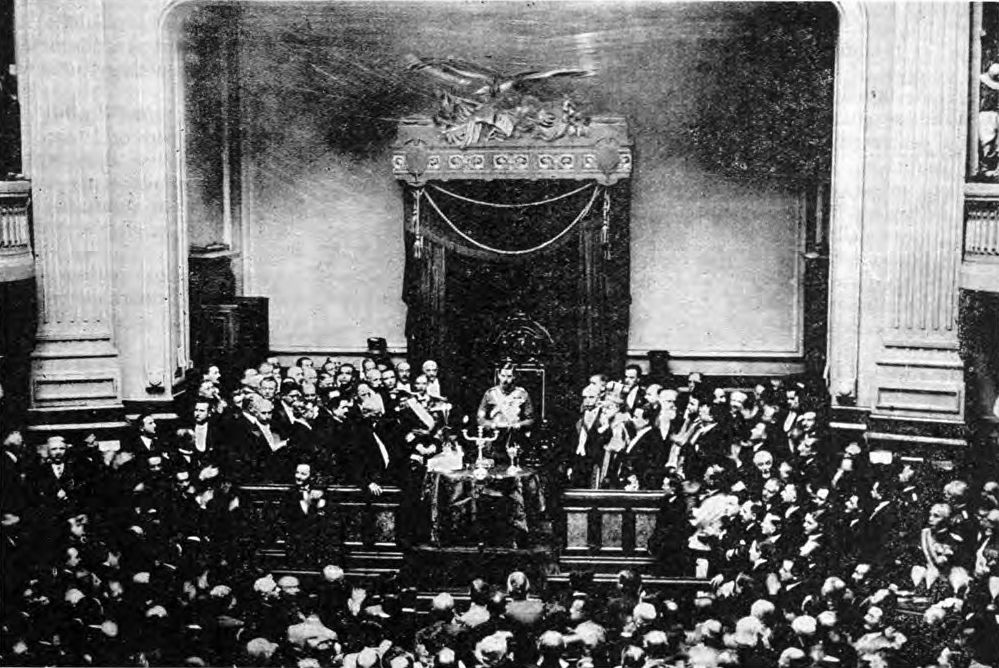
The deposed Crown Prince would be the central figure of Romanian politics for the turbulent 1930s after came to power, with French assistance, in a coup overthrowing his own son’s regency and placed him on the throne as Carol II. An analysis of that important event in Romanian history below.
‘The Coup d’Etat in Rumania’ by Ovid Receanu from International Press Correspondence. Vol. 10 No. 28. June 12, 1930.
On 6th June the ex-Crown Prince Carol, deposed by the Liberal Party in January 1926, landed “suddenly” in Rumania, in order to receive the royal crown from his National Zaranist-Fascist followers. He arrived in a French aeroplane, and was awaited at the Cluy Aerodrome by several aeroplanes of the Rumanian air fleet which he once commanded. He was received by Fascist flight officers and accompanied to Bucharest. Here he was received, on entering the royal palace, by a regiment commanded by Carlist officers.
The National Zaranist government reported briefly and baldly the “return of Prince Carol”, but at the same time it had flags flown and placards posted in the capital: “Long live King Carol II”. The National Zaranist parliament received the news of Carol’s arrival with enthusiastic cheers for “King Carol”. On the same day Maniu kept up appearances by resigning, and made way for a cabinet formed by his foreign minister, with the express mission of legalising, under “lawful forms” the entirely counter-constitutional assumption of the throne by Carol. On 9th June the Parliament passed by 486 votes against one the law submitted by the cabinet, restoring to Carol his old rights. After this Carol was proclaimed King of Rumania. The Mironescu Government, the sole object of whose existence was to push through the laws to be passed by the Parliament, now resigned, its mission accomplished. The Parliament meets again on 11th June, by which time the “government crisis” will probably be solved. There is every likelihood that Maniu will again be entrusted with the formation of the cabinet.
This coup d’etat of Carol’s followers has been prepared and carried out with the aid of the French imperialists, of Carol’s Fascist adherents, of the Fascist party of the National Zaranists and the Fascist Maniu government. Preparations have been going on both at home and abroad for months. In Rumania itself the National Zaranists commenced a Carlist agitation in the army, especially among the subaltern officers. In the barrack of Bucharest Carlist manifestoes have been openly distributed. The Carlist leader Manoilescu, who recently joined the National Zaranist Party, has carried on, aided by other deputies, the agitation for Carol in the provinces and in Parliament. The anti-Carlist pamphlets and newspapers of the Liberal Party, which demanded measures against the Carlist agitation, have been confiscated. At court the opponents of Carol have retired more and more into the background. Several members of the royal family, among others, have been bribed by sums running into millions. The Prince Regent Nicolas was won over for the idea of the Carlist coup d’etat, and Marla, the Dowager Queen corrupted by Liberal finance, has been obliged to leave the country.
Carol’s return has been the subject of equally thorough preparation abroad, in order to secure the support of the leading imperialist powers above all of France. Carol having first parted from the lady who was now too compromising, he became “competent to govern”, and took up much more profitable connections with the agents of French imperialism. He changed his residence to Paris. He was repeatedly visited by several leaders of the National Zaranist Party and other Fascist party leaders, such as Professor Jorga, General Averescu. He was introduced into French governmental circles. These recognised in the person of the “romantic prince” an excellent tool for the firmer establishment and intensification of the Fascist dictatorship now suffering from a crisis, for the strengthening of French influence, for the strengthening of the anti-Soviet front in Rumania. When the new military laws were passed in March this year, the then minister of war of Maniu, one of Carol’s adherents, travelled to Paris, where he discussed these laws and the newly elaborated war plan against the Soviet Union, with Carol and his French protectors.
The French general staff and the French government have therefore given not only the aeroplane for this royal “adventure”, but at the same time the order that the monarchist Fascist dictatorship is to be developed along the lines of the Yugoslavian, and the execution of the war plans of the great imperialist states against the Soviet Unions is to be secured by bloody force. The Yugoslavia of Alexander, the Poland of Pilsudski, the Czechoslovakia of the Fascist-Social-Fascist united front, are to combine with a Rumania of the Fascist chieftain Carol to form a Fascist war bloc against the Soviet Union, under the hegemony of the French imperialists and the leadership of the French general staff.
This same Prince Carol made an attempt, two years ago, to carry out a similar fight from London. He intended to appear on the day of the National Zaranist Peasants’ Congress in Alba-Julia, and to attain his object with the aid of the then National Zaranist opposition, which at that time enjoyed great popularity. This was however prevented by the Liberal government, with the aid of the British government. At that time the leaders of the National Zaranists were not in favour of Carol’s return, and refused to support him. At that time it appeared to both the imperialist powers and to the leaders of the National Zaranist Party to be unnecessary to risk such a dangerous undertaking. The National Zaranist Party had reached the zenith of its popularity, and still represented an enormous reserve of the Fascist bourgeoisie. It was hoped that it would be possible to organise and establish the Fascist dictatorship with the aid of the enormous popularity of the National Zaranist Party alone, without Carol, and without an open violation of the existing constitution.
These hopes were not fulfilled. The economic crisis, and especially the agrarian crisis, increased rapidly in acuteness during brief term of Maniu’s government. In spite of the stabilisation of the currency, and in spite of help from foreign capital, the Maniu government did not even succeed in retarding the rapid aggravation of the economic crisis. More than one half of the surplus grain from last year’s crops are still lying unsold in the country, and the still greater surplus from this year’s will have even less prospect of finding a sale, in the world’s markets. The grain prices have fallen by 50% since last autumn, and the agrarian production of even the large-scale capitalist agricultural undertakings is no longer profitable by any means, whilst the small and middle peasants cannot carry on their farms at all, and drift in masses into the cities.
The crisis in industry and trade is increasing with equal rapidity. During the one and a half years of National Zaranist rule the output of the industries working for home consumption has declined by about 40%. In the export branches working on the dumping system (petroleum, wood), there has hitherto been a certain progress, but since the spring these two branches too have fallen off. The number of bankruptcies has doubled, the cases of insolvency have increased by 35%. The number of unemployed in the cities and industrial centres has increased to over 200,000, to say nothing of the great masses of out of work agricultural labourers and peasants, who wander about the country looking for work or starve in the villages.
The rapid intensification of the economic crisis during the brief rule of the National Zaranist government, from November 1928 to the present time, has however not only frustrated the stabilisation plans of the Roumanian bourgeoisie, but has greatly shaken the influence of the National Zaranist Party over the broad masses cast for the National Zaranist Party at the municipal elections The great falling off in the votes and second ballots, and the repeated demonstrations of the petty bourgeoisie of the towns against the National Zaranists bear witness of the disillusion of the masses, whilst frequent peasant risings, and a large number of mass strikes and mass actions (Maros Valley, Shil Valley, Bukovina, Buhusi, Astra, Lemaitre, etc.) demonstrate the rapid radicalisation of the masses of the workers and peasants.
Before the Fascist Maniu government had succeeded in concentrating the forces of Fascism against the broad masses of the workers and peasants, and in consolidating the Fascist dictatorship under the National Zaranist leadership, it came into conflict with the petty and middle bourgeois strata of the cities. The Liberal Party made use of this conflict, and of the growing general discontent, for its own Fascist purposes, and grouped the dissatisfied masses of the small and middle bourgeoisie of the towns, of the kulaks, of the civil servants, and even of some sections of the poorer peasantry and of the working class around it, in order to overthrow with their help the Maniu government and to set up a fascist dictatorship under their own leadership.
This inner crisis of Fascism was accompanied by constant agitation all over the country, and signified a constant danger for Fascism as a whole. It hindered the Fascist concentration of the bourgeoisie, and the execution of the war plans against the Soviet Union. The French imperialists and the National Zaranists anticipate that by means of the return of Carol, and his coup d’etat, they will be able to exercise a pressure upon the Liberals forcing them to collaborate in concentrating the whole of the forces of Fascism, in forming the united Fascist front, and in Intensifying and more firmly establishing the Fascist dictatorship, to the end that the revolutionary workers’ and peasants’ movement may be forcibly crushed and shattered, and the preparations for war against the Soviet Union carried forward.
The advancing economic crisis, the threatening catastrophic collapse of agrarian production, the radicalisation of the broad masses of the workers and peasants, will however not be held back for a moment by the Carlist coup d’etat. And it is a question whether this coup will so rapidly smooth out the inner crisis of Fascism, the conflict between the various groups and Fascist camps. It is true that some elements among the Liberals are already demanding an attitude “in accordance with actual facts”, but the Liberal Party, which has under its leadership at the present time not only the Liberal section of industry, but great masses of the petty servants and the heads of the civilian and military state apparatus, has not recognised the Carlist power. It has issued to the country a manifesto expressly stating that it “in no way agreed” with events. It remains to be seen what attitude will be adopted by the various imperialist states, especially Italy, towards the changed conditions in Rumania, which signify a strengthening of French influence in the Balkans.
In this situation it is the task of the C.P. of Rumania to utilise the Carlist coup d’état for the deciding mobilisation of the revolutionary workers and peasants against the Fascist dictatorship in Rumania, whether in a Carlist form, or any other.
PDF of full issue: https://www.marxists.org/history/international/comintern/inprecor/1930/v10n28-jun-12-1930-inprecor-Virginia.pdf

