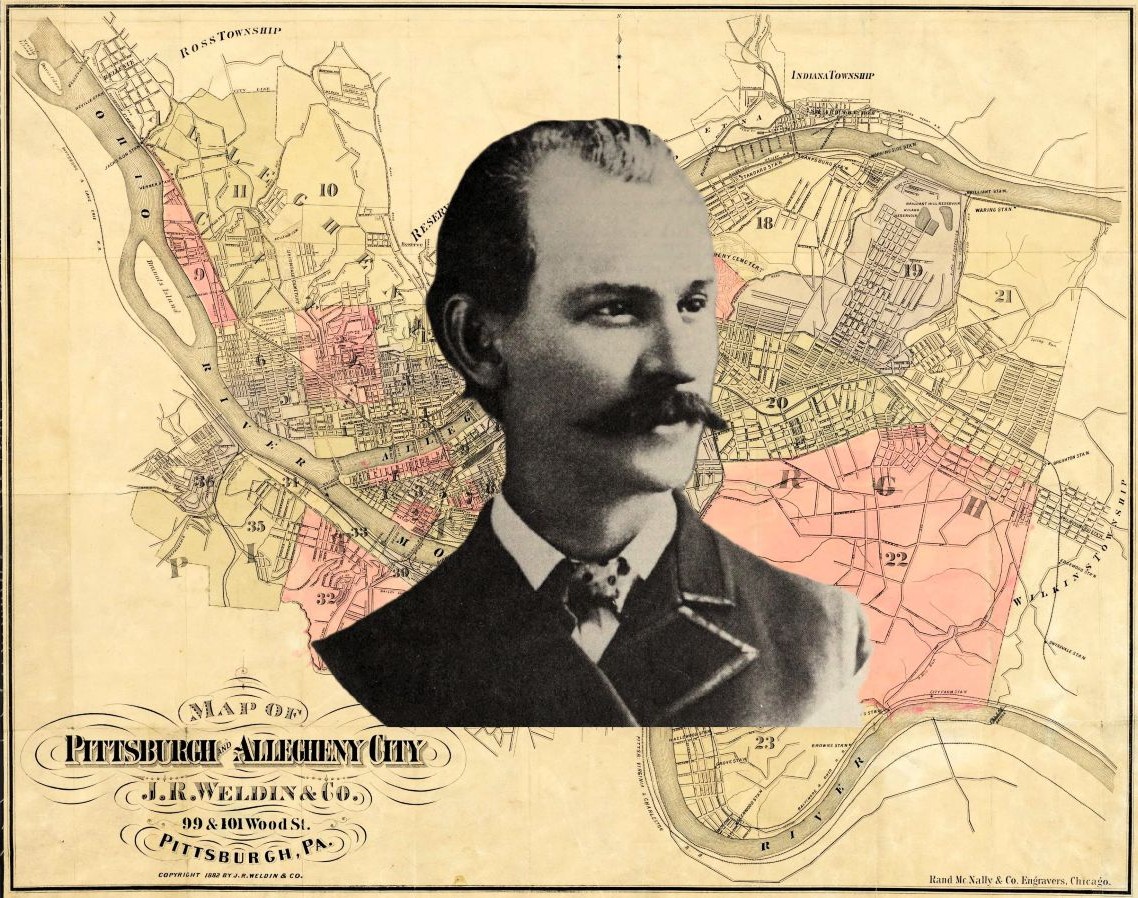
Whole courses on U.S. history could be taught through the incredibly rich letters of Albert Parsons as he organized workers in the early 1880s. Here, after a week snowed in with comrades in Pittsburgh, he ventures up the Monongahela Valley to bring English-speaking coal-miners into the ‘American Section’ of the International Working Peoples Association.
‘The Battle for Bread in the Monongahela Valley’ by Albert R. Parsons from The Alarm (Chicago). Vol. 2 No. 12. January 23 1886.
Mass Meetings la Pittsburg and Allegheny City.
COMRADES: I reached Pittsburg from Salineville, O., on January 3, and on the Wednesday following addressed a mass meeting at Turner hall, Allegheny City, which had been arranged by Group No. 1, of the International Working People’s Association. On the Thursday following e held a very good mass meeting Jefferson hall, Allegheny City. In the meantime letters were addressed to different points along the Monongahela valley with a view to carrying the propaganda into that region. The excessive cold snap which locked up everything in its grasp for more than a week compelled me to remain at the house of our worthy comrade Clemens Baumketter, who with his estimable wife has made my sojourn among the Pittsburg and Allegheny comrades both comfortable and pleasant. At the break of the icy weather I hurried up the Monongahela valley where my advent had already been extensively heralded by the capitalistic newspapers. On arriving at Monongahela City, some thirty miles up that river from Pittsburgh, I found that our energetic Comrade Robert F. Hill had arranged a mass meeting the following evening (Saturday, January 16) at Courtney, a mining town on the Monongahela river. I addressed a mass meeting of miners and citizens in the school house at his place, evidently with good results. Opposition was made to our address by a temperance fanatic who held that the temperance question was the labor question, that the Monongahela valley miners, as well working men in general, were poor because they wasted their wages on intoxicating drink. The temperance reformer was informed in reply that Socialism was not much concerned about what a man did with his money before he got it. That workingmen were not poor because they drank; on the contrary, they often drank to excess because of their poverty, and they were poor because they were robbed, and the capitalists were the robbers, and hence the real manufacturers of drunkards, as well as all other forms of misery and vice. Socialism proposes to secure the producer his product, and it is premature and ridiculous to discuss temperance, whether the wage-slave shall get drunk or not on what he earns, so long as he is deprived of the right to anything at all, or is robbed when he is permitted to work of over two-thirds this labor product. The audience enjoyed the evident discomfiture of the temperance reformer, who seemed to be paralyzed with the truths of Socialism.
The next day a meeting was called at Coal Valley, which is the very heart of the recent hand to hand struggle for bread which has raged this valley for the past seven months. Dorsey’s Hall, a large comfortable building, was the place, and 2:30 p.m. Sunday afternoon the time for the meeting. A large concourse of rugged, scar-worn miners greeted us. For over three hours they paid the closest attention to a presentation of the aims and objects of Socialism and Anarchy, before adjourning organized [] American group of thirty-five earnest, intelligent, revolute men. They were shown the folly and utter futility of strikes, boycotts, arbitration, prayers, legislation, or petitions. Copies of the ALARM were distributed as well as Lucy E. Parsons address “To Tramps, the Unemployed, the Destitute, and Disinherited,” and copies of the Pittsburg Manifesto of the International. The meeting adjourned by singing that revolutionary hymn of the proletariat, “The Marsellaise.” This group is determined to stay, and grow and flourish its expanding branches will overspread the poverty-stricken and enslaved miners of this valley. Long Live the American group of Coal Valley! May they forever bear aloft the glorious standard of “Liberty, Fraternity, Equality.”
I have formed many lasting and valuable friendships among the men of this valley, and if the organization progresses as it has begun, we will witness in less than a month from now what has transpired in Newburg, Ohio, where we held several mass-meetings among the Chisholm workers of the Cleveland rolling mill, where, in consequence of our Socialistic agitation, the mill czars have voluntarily conceded an advance of 10 per cent in wages to appease the rising wrath of their indignant wage-slaves. I say that a voluntary increase of probably one cent per bushel will follow the Socialist revolutionary agitation which we are now making in the Monongahela valley. This is the tub thrown by the capitalists to the labor whale. It may serve to calm the troubled waters for a brief time, but the waves will rise again with redoubled and overwhelming fury. The torch of freedom has been lit and its rays will yet penetrate the Egyptian slavery of the capitalistic system.
I speak in Sunnyside tonight. With Anarchist-Socialist greeting, A.R. PARSONS.
In haste,
Allegheny City, Pa., Jan. 19.
The Alarm was an extremely important paper at a momentous moment in the history of the US and international workers’ movement. The Alarm was the paper of the International Working People’s Association produced weekly in Chicago and edited by Albert Parsons. The IWPA was formed by anarchists and social revolutionists who left the Socialist Labor Party in 1883 led by Johann Most who had recently arrived in the States. The SLP was then dominated by German-speaking Lassalleans focused on electoral work, and a smaller group of Marxists largely focused on craft unions. In the immigrant slums of proletarian Chicago, neither were as appealing as the city’s Lehr-und-Wehr Vereine (Education and Defense Societies) which armed and trained themselves for the class war. With 5000 members by the mid-1880s, the IWPA quickly far outgrew the SLP, and signified the larger dominance of anarchism on radical thought in that decade. The Alarm first appeared on October 4, 1884, one of eight IWPA papers that formed, but the only one in English. Parsons was formerly the assistant-editor of the SLP’s ‘People’ newspaper and a pioneer member of the American Typographical Union. By early 1886 Alarm claimed a run of 3000, while the other Chicago IWPA papers, the daily German Arbeiter-Zeitung (Workers’ Newspaper) edited by August Spies and weeklies Der Vorbote (The Harbinger) had between 7-8000 each, while the weekly Der Fackel (The Torch) ran 12000 copies an issue. A Czech-language weekly Budoucnost (The Future) was also produced. Parsons, assisted by Lizzie Holmes and his wife Lucy Parsons, issued a militant working-class paper. The Alarm was incendiary in its language, literally. Along with openly advocating the use of force, The Alarm published bomb-making instructions. Suppressed immediately after May 4, 1886, the last issue edited by Parson was April 24. On November 5, 1887, one week before Parson’s execution, The Alarm was relaunched by Dyer Lum but only lasted half a year. Restarted again in 1888, The Alarm finally ended in February 1889. The Alarm is a crucial resource to understanding the rise of anarchism in the US and the world of Haymarket and one of the most radical eras in US working class history.
PDF of full issue: https://digitalcollections.crl.edu/record/1117354?ln=en

