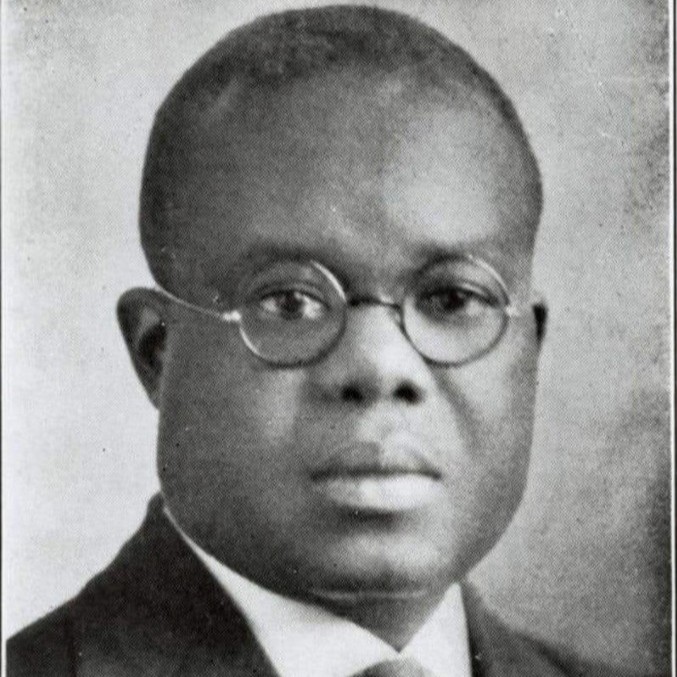
With traditional Black electoral support for the Republican Party under challenge in the run-up to 1920’s elections, Harrison details facts from that Party’s actual attitude towards its Black base.
‘The Grand Old Party’ by Hubert H. Harrison from When Africa Awake. Porro Press, New York City. 1920.
In the early days of 1861, when the Southern Senators and Representatives were relinquishing their seats in the United States Congress and hurling cartels of defiant explanation broadcast, the Republican party in Congress, under the leadership of Charles Francis Adams of Massachusetts, organized a joint committee made up of thirteen members of the Senate and thirty-three members of the House to make overtures to the seceding Southerners. The result of this friendly gesture was a proposed thirteenth amendment, which, if the Southerners had not been so obstinate, would have bridged the chasm. For this amendment proposed to make the slavery of the black man in America eternal and inescapable. It provided that no amendment to the Constitution, or any other proposition affecting slavery in any way, could ever be legally presented upon the floor of Congress unless its mover had secured the previous consent of every Senator and Representative from the slave-holding States. It put teeth into the Fugitive Slave Law and absolutely gave the Negro over into the keeping of his oppressors.
Most Negro Americans (and white ones, too) think it fashionable to maintain the most fervid faith and deepest ignorance about points in their national history of which they should be informed. We therefore submit that these facts are open and notorious to those who know American history. The record will be found slimly and shamefacedly given in McPherson’s “History of the Rebellion”; at indignant length in Blaine’s “Twenty Years of Congress” and Horace Greeley’s “The Great American Conflict? The document can be examined in Professor Macdonald’s “Select Documents of United States History.” These works are to be found in every public library, and we refer to them here because there are “intellectual” Negroes today who are striving secretly, when they dare not do so openly, to perpetuate the bonds of serfdom which bind the Negro Americans to the Republican party. This bond of serfdom, this debt of gratitude, is supposed to hinge on the love which Abraham Lincoln and his party are supposed to have borne towards the Negro; and the object of this appeal to the historical record is to show that that record demonstrates that if the Negro owes any debt to the Republican party it is a debt of execration and of punishment rather than one of gratitude.
It is an astounding fact that in his First Inaugural Address Abraham Lincoln gave his explicit approval to the substance of the Crittenden resolutions which the joint committee referred to above had collectively taken over. This demonstrates that the Republican party at the very beginning of its contact with the Negro was willing to sell the Negro, bound hand and foot, for the substance of its own political control. This Thirteenth Amendment was adopted by six or eight Northern States, including Pennsylvania and Illinois; and if Fort Sumter had not been fired upon it would have become by State action the law of the land.
The Republican party did not fight for the freedom of the Negro, but for the maintenance of its own grip on the government which the election of Abraham Lincoln had secured. If any one wants to know for what the Republican party fought he will find it in such facts as this: That thousands of square miles of the people’s property were given away to Wall Street magnates who had corrupted the Legislature in their effort to build railroads on the government’s money. The sordid story is given in “Forty Years in Wall Street,” by the banker, Henry Clews, and others who took part in this raid upon the resources of a great but stupid people.
But the Civil War phase of the Republican party’s treason to the Negro is not the only outstanding one, as was shown by the late General Tremaine in his “Sectionalism Unmasked.” Not only was General Grant elected in 1868 by the newly created Negro vote, as the official records prove, but his re-election in 1872 was effected by the same means. So was the election of Rutherford B. Hayes in 1876. Yet when the election of Hayes had been taken before the overwhelmingly Republican Congress this shameless party made a deal whereby, in order to pacify the white “crackers” of the South, the Negro was given over into the hands of the triumphant Ku-Klux; the soldiers who protected their access to the ballot box in the worst southern states were withdrawn, while the “crackers” agreed as the price of this favor to withdraw their opposition to the election of Hayes. For this there exists ample proof which will be presented upon the challenge of any politician or editor. As a Republican Senator from New England shamelessly said, it was a matter of “Root, hog, or die” for the helpless Negro whose ballots had buttressed the Republican party’s temple of graft and corruption. So was reconstruction settled against the Negro by the aid and abetting of the Republican party.
And since that time lynching, disfranchisement and segregation have grown with the Republican party in continuous control of the government from 1861 to 1920 with the exception of eight years of Woodrow Wilson and eight years of Grover Cleveland. With their continuing consent the South has been made solid, so that at every Republican convention delegates who do not represent a voting constituency but a grafting collection of white postmasters and their Negro lackeys can turn the scales of nomination in favor of any person whom the central clique of the party, controlled as it has always been by Wall Street financiers, may foist upon a disgusted people, as they have done in the case of Harding. So long as the South remains solid, so long will the Republican delegates from the South consist of only this handful of hirelings; so long will they be amenable to the “discipline” which means the pressure of the jobs by which they get their bread. Therefore the Republican leaders will know that the solidarity of the South is their most valuable asset; and they are least likely to do anything that will break that solidarity. The Republican party’s only interest in the Negro is to get his vote for nothing; and so long as Negro Republican leaders remain the contemptible grafters and political procurers that they are at present, so long will it get Negro votes for nothing. Through it all the Republican party remains the most corrupt influence among Negro Americans. It buys up by jobs, appointments and gifts those Negroes who in politics should be the free and independent spokesmen of Negro Americans. But worse than this is its private work in which it secretly subsidizes men who pose before the public as independent radicals. These intellectual pimps draw private supplementary incomes from the Republican party to sell out the influence of any movement, church or newspaper with which they are connected. Of the enormity of this mode of procedure and the extent to which it saps the very springs of Negro integrity the average Negro knows nothing. Its blighting, baleful influence is known only to those who have trained ears to hear and trained eyes to see. And now in this election the standards will advance and the cohorts go forward under the simple impulse of the same corrupting influence. But whether the new movement for a Negro party comes to a head or not, the new Negro in America will never amount to anything politically until he enfranchises himself from the Grand Old Party which has made a political joke of him.
July, 1920.
When Africa Awakes by Hubert H. Harrison. Porro Press, New York City. 1920.
Harrison’s uniquely important collection of writings from 1917-1920 published in various journals from the time, published by Porro Press (personally published).
Contents: Introduction, THE BEGINNINGS). Launching the Liberty League, Resolutions Passed at Liberty League Meetings, Petition to Congress, DEMOCRACY AND RACE FRICTION) The East St. Louis Horror, ‘Arms and the Man’, The Negro and the Labor Unions, Lynching Its Cause and Cure, THE NEGRO AND THE WAR) Is Democracy Unpatriotic?, Why Is the Red Cross?, A Hint of ‘Our Reward’, The Negro at the Peace Congress, Africa and the Peace, ‘They Shall Not Pass’, A Cure for the Ku-Klux, THE NEW POLITICS) The New Politics for the New Negro, The Drift in Politics, A Negro for President, When the Tail Wags the Dog, The Grand Old’ Party. THE PROBLEMS OF LEADERSHIP) Our Professional ‘’Friends’, Shillady Resigns, Our White Friends, A Tender Point, The Descent of Du Bois, When the Blind Lead, Just Crabs, THE NEW RACE CONSCIOUSNESS) The Negro’s Own Radicalism, Race First versus Class First, An Open Letter to the Socialist Party, ‘Patronize Your Own’, The Women of Our Race, To the Young Men of My Race, OUR INTERNATIONAL CONSCIOUSNESS) The White War and the Colored World, U-need-a Biscuit, Our Larger Duty, Help Wanted for Hayti, The Cracker in the Caribbean, When Might Makes Right, Bolshevism in Barbados, A New International, The Rising Tide of Color, The White War and the Colored Races, EDUCATION AND THE RACE) Reading for Knowledge, Education and the Race, The Racial Roots of Culture, The New Knowledge for the New Negro, A FEW BOOKS) The Negro in History and Civilization, Darkwater, The Rising Tide of Color Against White World-Supremacy. EPILOGUE: The Black Man’s Burden A Reply to Rudyard Kipling.
PDF of full book: https://archive.org/download/ldpd_13339574_000/ldpd_13339574_000.pdf

