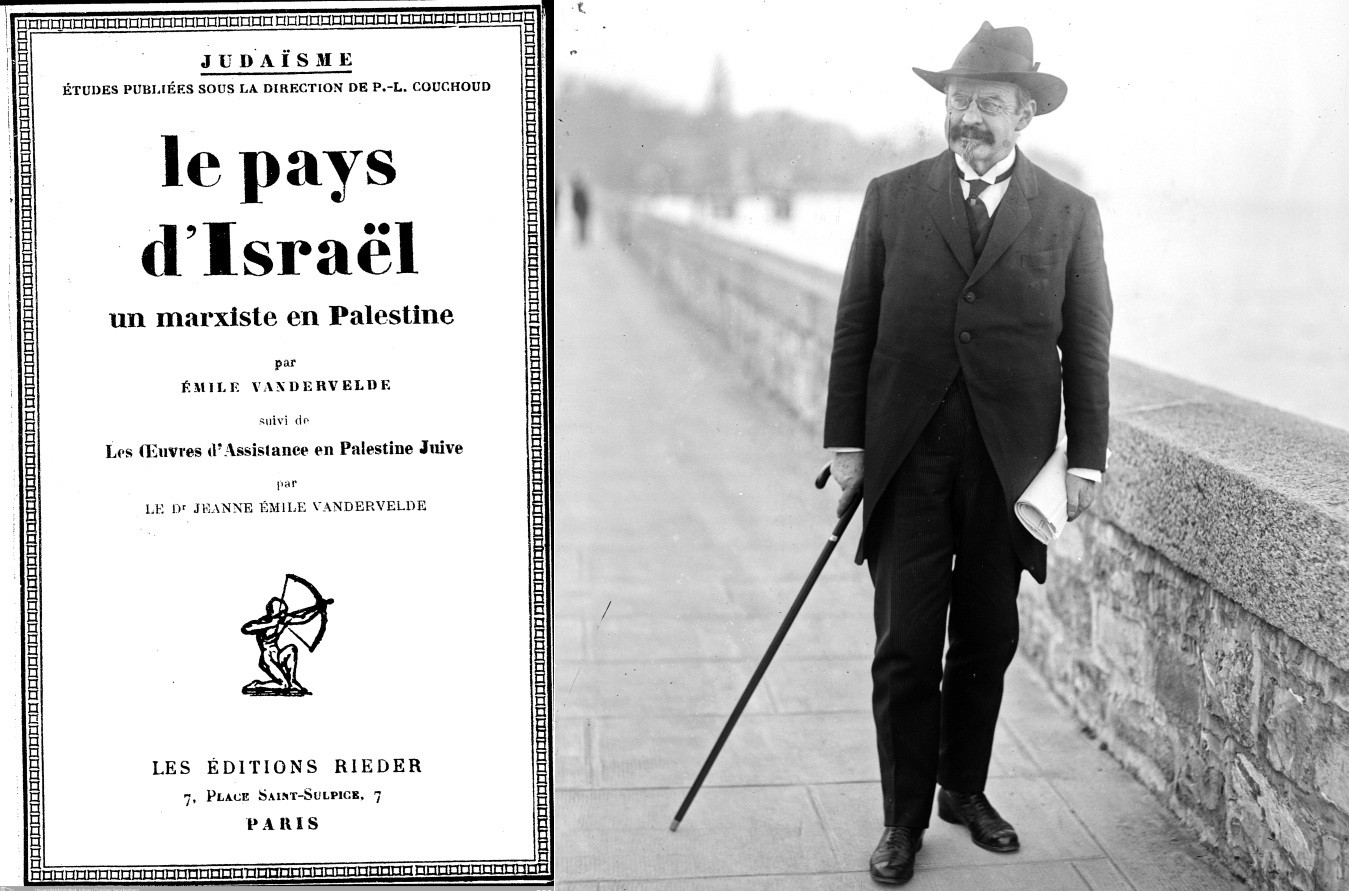
Berger’s fantastic excoriation of Emile Vandervelde’s pro-Zionist, imperial piety written on his visit to the Wailing Wall could be said today about any number of public figures.
‘Vandervelde at the Holy Sepulchre’ by Joseph Berger from International Press Correspondence. Vol. 9 No. 21. May 3, 1929.
Ladies who have passed their prime and in their young days enjoyed life to the full and had a gay old time on occasion, generally become pious and devout. Such is the case with the venerable leader of the II. International M. Vandervelde, Ex-Minister to his majesty, the King of the Belgians, war agitator and defender of counter-revolutionary conspirators, whom we find at the silent meeting of the Holy Sepulchre, it drew him–and so he, “a free thinker, gentile, socialist”, could not resist the invitation of the Zionist organization to view the Land of Israel. And now M. Vandervelde has written an account of pilgrimage in a book bearing the somewhat bizarre title: “The Land of Israel, A Marxist in Palestine”.
A Marxist? Right in the preface M. Vandervelde sees to that no false significance is placed upon his Marxism:
“I do not know whether there are still many people who interpret historical materialism as do Paul Lafargue or the Bolshevists…Those who still hold to this crude conception of Marxism can only be advised to cure themselves of it by means of a pilgrimage to Jerusalem, a journey to Jewish Palestine.” (Page 10.)
It is necessary to gain inspiration from the Holy Ghost in order to be cured of a “crude” conception of Marxism.
Then one understands, for instance, that the Marxist description of a land of Easter feelings, reminiscences of the exodus of the Jews from Egypt, must begin with the manna in the desert and the Land of Canaan; the voyage of exploration itself with a visit to the Holy Sepulchre, the wailing place of the Jews and then Jesuit monasteries. Then, interlarded with bible quotations and innumerable banal anecdotes, one must pass on to eulogies of the Zionist colonies; finishing up with sentimental soliloquies on the heroism of the Jews.
“who are adopting a new life with the object of building a national home which shall, in the first place, form a centre from which the Jewish idea shall radiate into the whole world”. (Page 212.)
The contents of the work correspond to the strictly Marxist construction of this book, designed to cure bad Marxists. The facts and figures given in the book have been taken from Zionist leaflets and propaganda brochures. Vandervelde does not share the dry, mummified conception of Marxism (P. 214), which, for instance, a thorough study of the material demands, derived as it is from different sources. He imbibes as sacred truth everything his Zionist friends set before him and relate to him; he admits that he went to Palestine “with a prejudice in favour of Zionism”. (Page 195.) He fills pages with inveiglements taken from Zionist brochures, with well-trimmed tables meant for superficial newspaper readers and with fulsome praise of things of no importance. When one discovers: that in spite of the magnificence of the Jewish national home there are living in the whole of Palestine no more than 150,000 Children of Israel though 12 years have passed since the Balfour Declaration was made (the Jewish population of the single city of Warsaw two or three times as large; that of New York eight times as large!), that of these 150,000 only about 30,000 are engaged agriculture, while as Vandervelde himself is obliged to admit, in the Soviet Union twice as many were provided at one stroke with land and set up in colonies; when one further reads that Vandervelde himself does not regard the “possibility of creating a Jewish majority in Palestine as either existing o desirable” (pages 120-121). that there can, therefore, be question of a solution of the Jewish national question by means of Zionism, one cannot help thinking “Much Ado about Nothing”.
But the purpose of this pious trip appears to be rather more serious than the satisfying of the desire to do penance on the part of a “Marxist” grown old in the betrayal of the workers. The journey was made immediately before the Congress of the Labour and Socialist International in Brussels, and the colonial question was on the agenda of this congress. On this occasion not only were the British mandate for Palestine and the Balfour Declaration approved but an international pro-zionist committee was formed with Vandervelde, Leon Blum, Henderson, Renaudel, and Bernstein among its members. The II. International is searching feverishly for excuses to justify the pro-imperialist and pro-colonial attitude of its sections, and especially the British, French and Belgian sections. In this regard, the “civiising” role played by the imperialists in the “backward” countries is to constitute the chief argument. Zionism and its activity in Palestine appears to the gentlemen to be a good example, and the Zionist bourgeoisie and the Zionist reformists very gladly collect the material required by M. Vandervelde.
And the rest is done by silence. For a volume twice as large is that in which the Socialist leader expatiates on every piece of Zionist tripe and dwells, en bon marxiste, on the interrelation of dairy farms and market gardens in the microscopically small Zionist settlements could be filled with the things which M. Vandervelde did not see and had no desire to see. He, however, devotes a few words, borrowed from his non-Marxist but social-imperialist friend Wedgewood, to a description of the Arabian population, which numbers in Palestine lone almost 700,000 and in the whole territory several millions. Vandervelde has nothing to say about an expropriation of land from Arabian peasants, in which his socialist friends, devoted exclusively to idealism, heroism and communism, have taken part with enthusiasm (yes, Vandervelde constantly emphasizes, tastefully, the “communist” settlements, the “communist” ideology of his Zionist friends, in contrast to the “Bolshevists”, who, are, of course, as everywhere else, are only a disturbing minority, who are quite rightly chased out, etc. A remarkable paradox: anti-communist Bolshevists). Vandervelde’s socialist heart is left equally cold by the circumstance that the whole of the population of Palestine lacks the most elementary “democratic rights”, not to mention socialist rights, that the population is permanently impoverished by taxation and exploitation, that thousands of Jewish emigrants and emigrant families have been obliged to leave the country again completely ruined by their Zionist adventure, that revolutionary workers are persecuted and maltreated cruelly and that in this regard the Zionists play the part of spies, informers and agents provocateurs, that under the pretext of spreading the Hebrew language( to which Vandervelde devotes a whole chapter) a terrible Fascism is developing, which bludgeons the workers, that class antagonisms are becoming aggravated, that the cleavage between exploiter and exploited is leading to ever fiercer conflicts.
Things of this kind are neither seen nor heard of when one dines with Jewish financiers, as Vandervelde admits he did (age 30), is the guest of the imperialist French High Commissioner in Syria and travels the country in sleeping cars and saloon automobiles. If however, these are the new methods of present-day and non “crude” Marxist investigation, then to borrow the biblical pathos from M. Vandervelde–Woe to these Marxists!
“Le pays d’Israel, un marxiste en Palaestine”, par Emis Vandervelde, Les Editions Rieder. Paris. 262 pages.
International Press Correspondence, widely known as”Inprecorr” was published by the Executive Committee of the Communist International (ECCI) regularly in German and English, occasionally in many other languages, beginning in 1921 and lasting in English until 1938. Inprecorr’s role was to supply translated articles to the English-speaking press of the International from the Comintern’s different sections, as well as news and statements from the ECCI. Many ‘Daily Worker’ and ‘Communist’ articles originated in Inprecorr, and it also published articles by American comrades for use in other countries. It was published at least weekly, and often thrice weekly. Inprecorr is an invaluable English-language source on the history of the Communist International and its sections.
PDF of issue: https://www.marxists.org/history/international/comintern/inprecor/1929/v09n21-may-03-1929-inprecor.pdf

