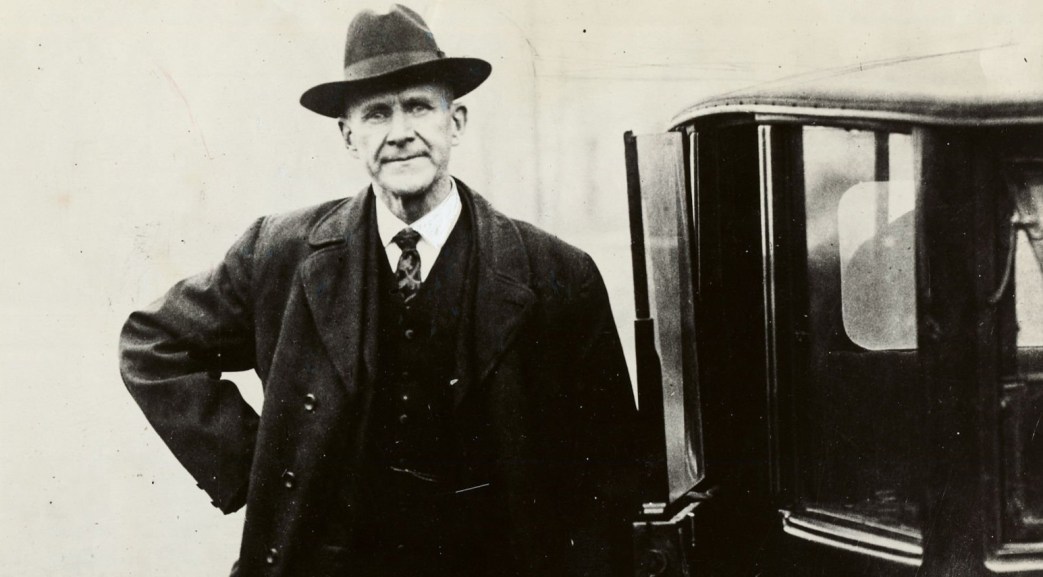
Essential history of Debs’ last day of freedom as the 63-year-old takes the grueling trip on April 13, 1919 from Cleveland to the federal prison in Moundsville, West Virginia guard by police with comrades in tow.
‘Was Debs Spirited Away for Fear of Worker’s Wrath?’ from The Ohio Socialist. No. 65. April 23, 1919.
Why the Mad Chase Through the Streets of Cleveland? Why the Round-About Trip to Moundsville? Many Pertinent Questions Asked About Rough Methods Used in Taking Debs to Penitentiary.
Fear was written in every action by the authorities in their attempt to rush Eugene V. Debs to Moundsville and place him “safely” behind penitentiary bars. The first scene in this drama took place at the Union depot, Cleveland, Sunday morning, April 13. Debs was met at the station by a daily paper reporter and several comrades. He was escorted to the Gillsy Hotel. While Debs and the comrades were eating breakfast, the Plain Dealer reporter, loyal to the masters’ interests, reported the arrival of Debs to the federal authorities.
Only a few minutes after breakfast several deputy marshals called at Debs’ room and requested that he accompany them to the Federal building. Marguarite Prevey, who was present, objected to this. She maintained that the regular procedure be followed in imprisoning Debs, namely, that his lawyers be first notified that the U.S. supreme court mandate had arrived, that his lawyers then notify his bondsmen to surrender him to the authorities. One of the deputies left the room to telephone to the Federal building. Whether he did or not will remain a mystery. He returned saying that he had orders to take Debs to the Federal building. To this Debs replied: “All right, I am ready to go and the last man who would stand on formalities of any kind.”
Debs was escorted to the Federal building by about fifty comrades, who had gathered in front of the hotel. Many of them had automobiles. Arrived at the Federal building, Mrs. Prevey, who was one of Debs bondsmen, attempted to get into the elevator with Debs and the deputies to go with him to the marshal’s office. She was pushed aside and told that no one could accompany Debs up stairs. The comrades waited on the main floor of the building for Debs to return. The number of comrades who came to see Debs off was increasing every minute. One of the secret service men must have smelled danger in this, for immediately a rumor was circulated that Debs had already left the building for the depot. Many comrades, believing this rumor, rushed to the depot, only to be disappointed.
MAD CHASE BEGINS.
In about half an hour Debs returned from the marshal’s office and between two deputies, left the building at the eastern entrance. He was almost pushed into a waiting automobile, which we feel sure was the property of or engaged by the Plain Dealer. It was not the property of the federal authorities nor engaged by them so far as we know. No attention was paid to Debs’ baggage, his grips and valise. Mr. Baur, Debs’ brother-in-law, who had come with Debs all the way from Terre Haute, was not permitted to enter the automobile with Debs. Mr. Baur, Mrs. Deibel, J. Louis Engdahl of the Socialist press service, David Karsner of the New York Call, and A. Wagenknecht of the National Office, Socialist Party, hastily jumped into the automobile of Comrade Fried, which was standing close by and the chase through Cleveland streets began. Luckily Fried’s car was a high powered machine, for other comrades with automobiles were soon left far behind while Fried had difficulty in keeping up with the pace set by the car containing Debs and the deputies. Corners were turned on two wheels, practically, and the turns were so numerous that in many instances the car containing Debs was a block ahead nearly lost in the midst of dozens of other automobiles going in the same direction.
After driving Debs out to E. 105th street, bringing him back again to E. 55th St., and rushing him south on that street, the chase finally terminated at the Erie depot on E. 55th So. The automobile containing the Socialist press reporters drove into the depot driveway about ten feet behind the car containing Debs. Several additional deputies had already arrived at the depot to help guard Debs. Tickets were bought for Youngstown, and the deputies, seeing that we were bound to make the trip with Debs, and it not being in their power to keep us off of the same train Debs was to be taken on, became pleasant, glad no doubt that they had evaded most of the Socialists who had come from many surrounding cities to see Debs off.
TRIP LONG AND TIRESOME.
The first of seven laps of a long, tiresome journey was then begun. Youngstown was the first stop. There a weary half hour was spent in waiting for the trolley to Leetonia. It was about noon, and the deputies relieved each other to take a bite at a cheap restaurant near the Youngstown depot. There was no opportunity to sit down at a table to enjoy a satisfying meal. Debs refused to cat, not wishing to bolt a meal and probably disdaining the panicky condition of his body guard. He kept his seat in the depot, making a few memorandums in his note book and reviewing the May 1 speeches, a copy of which had been given him by the comrades with him representing the National Office of the Socialist Party. At Youngstown the comrades accompanying Debs first learned that the trip to Moundsville was to be made by short stages on trolley cars, through the hills of Ohio and West Virginia, in most round-about routes so as to avoid demonstrations in favor of Debs on the way. Before leaving Cleveland several rumors were current that the reason Debs was rushed out of that city was to get him away before the monster demonstration advertised for the afternoon was held. A rumor from police headquarters intimated that the police feared the afternoon demonstration, especially if Debs remained in the city. They undoubtedly remembered the 10,000 crowd that gathered upon Market Square several Sundays ago. That the deputies with Debs were afraid of demonstrations on the way to the penitentiary is amply proven by the circuitous route taken to reach Moundsville.
CHANGE CARS SEVEN TIMES.
As we stated, we left Cleveland for Youngstown, waited half an hour for a trolley and then left Youngstown for Leetonia. From Lettonia we went to East Liverpool, from East Liverpool of Steubenville, from Steubenville to Wellsburg, from Wellsburg to Wheeling and from Wheeling to Moundsville, arriving at Moundsville about 10:30 p.m., more than twelve hours after leaving Cleveland. It was a body-racking trip, tiresome in the extreme even to the younger comrades in the party. Not a minute was allowed for refreshments or a meal until Wheeling was reached at about 9 p.m.
The strain told on Debs and we could see that with more and more difficulty he climbed aboard each successive trolley we took. After leaving Steubenville he fell sound asleep in his seat. Many miles were traversed, the scenery along which was unseen by the eyes of Debs. The backyard dumbs, littered with tin cans and broken pottery. The pottery and coal mine slave villages, stuck in the hillsides, rickety hovels, about ready to tumble down; children half naked and barefooted for the want of shoes. And among all this misery nature asserted itself, for there was also the velvety green of the wheat fields and the pink blossoms of the peach trees.
DEPUTIES TOO PANICKY TO EAT.
At Wheeling the deputies hurried into a restaurant and straddled chairs at the quick service lunch counter We braved their displeasure, as Debs down at a table and had him order a satisfying meal. We were very hungry and ate heartily. Karsner had to leave before he had quite finished his meal in order to send a telegram to his paper. In his absence Debs reached over to Karsner’s plate and helped himself to what Karsner had left. We begged him to give an order for whatever else he desired to eat, but the haste of the deputies who were already standing at attention at the door of the restaurant made eating sufficient an uncomfortable process, and we arose and followed them to a street corner where we mounted the trolley for the last lap of the journey. Moundsville was reached within an hour. Debs was in a reflective mood all the way, too tired to talk or to give his usual smile of good cheer, which he had so generously bestowed upon deputies and Socialists alike during most of the trip. Arrived at the penitentiary he was introduced to the warden, who immediately took him to the north cell block, scarcely giving us time to say good night to the champion of the workers. The warden must have reflected upon his hasty action, for immediately upon his return to his office he asked us if we desired to see Debs for a few minutes before we left. We were glad of the opportunity. We entered the turn table and were swung around to the cell block entrance. The warden expected to find Debs seated in the guards office, but instead Debs had requested to be locked up at once so that he could repose his aching body and find much needed rest in sleep.
DEBS IN CELL 51.
We were taken to cell 51, second tier, and there we found our comrade, partially undressed, about ready to retire to a three-feet by five and a half feet steel bunk. Whether or not he truly rested comfortably that night will probably remain a secret. Comrade Debs claims he did, but how his large frame could find comfortable repost upon a “bed” so small will remain a problem.
He stretched his long arm and large hand through the steel bars and shook us each warmly by the hand, asked us not to worry about him and bid us good night.
Thus ended Debs’ trip to prison. And now begins the demand of the workers for his release. May this demand come quick and come in such volume that those who now hold Debs in prison will have only one thing to do and will have to do that quick.
Already they fear the mighty working class. If they do not, why did they spirit Debs out of Cleveland and why did they avoid demonstrations? Why did not the government order out several regiments of troops to escort Debs to jail if it felt that demonstrations by workers of Cleveland and other cities, which Debs would have passed through had he not been taken to the penitentiary in such a round about way, would interfere with the safe conduct of Debs to prison?
Only a few days before Debs received a long distance telephone call supposedly from Federal Prosecuting Attorney Wertz, he was sick in bed, hardly able to walk. The telephone message came. Was it the prosecutor who telephoned? And who was the mysterious party who telephoned Mrs. Prevey to inquire about Debs? Was Debs fooled into coming to Cleveland? Why did not his lawyers advise him to stay in Terre Haute until they were notified that the supreme court mandate had arrived? Since we started to write this we have learned that the automobile which met Debs at the depot in Cleveland and took him later upon that tearing trip through Cleveland streets, eventually landed him at the Erie depot, was hired by the Plain Dealer reporter at the Waite Auto Livery. Why did the Plain Dealer reported give Debs to understand that he was connected with the federal authorities? Why did the Plain Dealer reporter make it his business to wake up the secret service in order to tell them that Debs was in town? Why did United States Marshal Lapp use a Plain Dealer car to spirit Debs out of Cleveland? Why did the deputies permit the Plain Dealer reported to accompany Debs in the mad ride through Cleveland streets and deny that right to one of Debs’ family? These are questions which we ask and which hundreds of thousands of Debs’ friends want to know about.
Debs, just out of bed and still suffering with lumbago, after making a night trip to Cleveland from Terre Haute, during which trip he only secured about an hour’s sleep, was taken against the will of his bondsmen, who had not been notified to surrender him, and hurried to Moundsville. No chance was given him to eat until 9 o’clock in the evening. He was rushed from one trolley to another, almost dragged about, his 64 years of age seeming to make no difference at all to those who were representing the government, the strong United States government.
NO REGARD SHOWN FOR DEBS’ AGE.
Why was not more regard shown for Debs’ age? Let President Wilson and his underlings answer. Why was not Debs permitted a few days to arrange his business affairs? Let President Wilson and his underlings answer. Debs came to Cleveland, believing no doubt that all that was wanted of him immediately was that he place himself within the jurisdiction of the federal court in which he was convicted. He felt sure that a few days would be allowed him in Cleveland to attend to some correspondence and other business. Instead, he was rushed out of the city for the penitentiary almost the minute he entered it, being given only time enough for a hasty breakfast. As a rule, when the mandate arrives from the supreme court, the marshal notifies the attorneys of the defendant, the attorneys notify the bondsmen to give up the defendant and then the bondsmen take the defendant to the Federal building and turn him over to the marshal. Why was not this procedure followed in Debs’ case? May we have an answer? And right away?
The same Sunday upon which Debs was spirited out of Cleveland 15,000 workers met at Market Square, Cleveland, and protested Debs’ imprisonment. After the meeting they paraded three miles to the Federal building. An army of policemen were drawn up before the building and all doors were securely bolted. Cries of “Release Debs,” “Hurrah for the General Strike,” and “Down With Capitalism” filled the air. The parade then retraced its steps a block and another monster meeting was held right under the windows of the court room where Judge Westenhaver sentenced Debs.
Debs is in prison. He is twice as great and powerful in prison as out of it. This the capitalist class will very soon learn. When capitalism placed Debs behind prison bars it added oil to the fire which is even now sweeping away a foul system of robbery and human despoilation.
Demands for Debs’ liberation are growing daily in volume and in forcefulness. The national, state and local Socialist parties will leave nothing undone to free our comrade, whose service in the cause of the workers has ever been most conscientious and full of love and veneration.
The Ohio Socialist, published by the Left Wing-dominated Socialist Party of Ohio in Cleveland from January, 1917 to November, 1919. It was edited by Alfred Wagenknecht Wagenknecht spent most of 1918 in jail for “violation of the Conscription Act.” The paper grew from a monthly to a semi-monthly and then to a weekly in July, 1918 and eventually a press run of over 20,000. The Ohio Socialist Party’s endorsement of the Left Wing Manifesto led to it suspension at the undemocratic, packed Socialist Party Convention in 1919. As a recognized voice of the Left Wing, the paper carried the odd geographical subheading, “Official Organ of the Socialist Parties of Ohio and Kentucky, Virginia, West Virginia and New Mexico” by 1919’s start. In November of that year the paper changed to the “labor organ” of the Communist Labor Party and its offices moved to New York City and its name changed to The Toiler, a precursor to the Daily Worker. There the paper was edited by James P. Cannon for a time.
PDF of full issue: https://www.marxists.org/history/usa/pubs/ohio-socialist/065-apr-23-1919-ohio-soc.pdf

