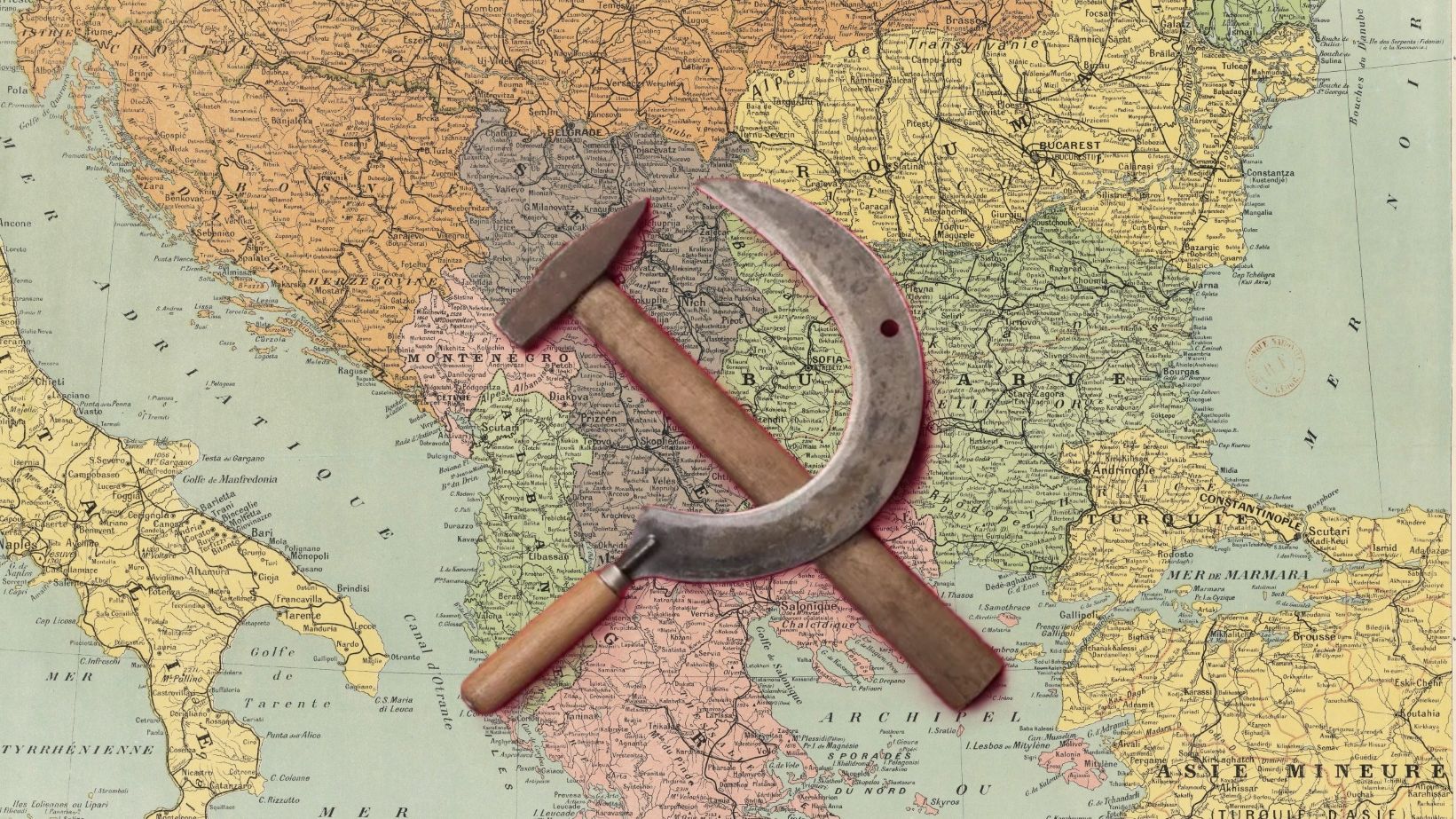
Held in April, 1929 the texts of resolutions from the seventh B.C.F. conference on the general political situation and tasks, the situation in Romania, organizational tasks of the Federation, the founding of the Albanian Communists Party, and the ‘Croation-Macedonian Alliance’ are below.
‘Resolutions of the Seventh Congress of the Balkan Communist Federation’ from International Press Correspondence. 1929.
The Resolutions of the VIII. Party Conference of the Balkan Communist Federation.
A short time ago the Balkan Communist Federation held its VIII. Conference. The conference was participated in by the Yugoslavian, Bulgarian. Roumanian and Greek Parties, as well as by the recently founded Albanian Communist group.
After a thorough discussion of the situation in the Balkans and the common tasks of the Communist Parties of the Balkans the VIII. Conference of the Balkan Communist Federation unanimously adopted three resolutions, each of which we shall publish in turn. The first resolution reads:
The Political Situation and the Tasks of the Balkan Communist Federation.
I.
The general political situation in the Balkans at the present moment as well as the situation in the various Balkan countries can be correctly characterised only from the point of view of the preparation of a counter-revolutionary war against the Soviet Union, conducted by international imperialism with Great Britain at the head. In view of the strategical importance of the Balkans and the importance of the Balkan peoples as cannon-fodder, British imperialism is persistently working to establish a Balkan united front and to include it in the general anti-Soviet front. The new Franco-British agreement will facilitate and accelerate the solution of this task. The Balkan States, which are under pressure of Anglo-French capital and in spite of the resistance of Italian imperialism, to come to an understanding under conditions which will be dictated to them by their powerful “protectors”.
The Franco-British agreement, which is mitigating the inter-Balkan conflicts, pushing into the background the local Balkan wars and at the present moment reducing the acuteness of the Italo-Yugoslavian crisis, produces at the same time in the Balkans the acute danger of a war against the Soviet Union. The all-round preparations for war against the Soviet Union will influence the general inner and international policy of the Balkan governments: placed under imperialist control this policy will be conducted with greater rapidity in this direction.
It is therefore the chief task of the Communist Parties of the Balkans in the period that lies ahead to mobilise the broad working masses against the war danger, to organise and conduct a mass struggle against the planned anti-Soviet and counter-revolutionary war and for the defence of the Soviet Union. This task is to be carried out in the sense of the theses on the fight against war adopted by the VI. Congress of the Comintern. The Balkan Communist Federation must make it its special and chief task to support effectively the various Communist Parties of the Balkans in the carrying out of this their chief task and to ensure their close co-operation among themselves as well as with the Parties of the neighbouring countries (Hungary, Turkey, Soviet Ukraine, Poland, Italy etc.).
The Balkan Communist Federation draws the special attention of the Communist Parties of the Balkans to the decisions of the VI. World Congress regarding the carrying out of the International Day for the Fight against War. The increased danger of war in the Balkans imposes upon them the special duty of exerting all their forces for the all-round preparation and energetic carrying out of the international demonstration against war. This demonstration must express in a clear and impressive manner the firm will of the working masses in the Balkans to defend the Soviet Union with all means and to convert the imperialist war into civil war. The Communist Parties in the Balkans must in this connection overcome all difficulties which arise from their illegal or semi-legal position and must not shrink from any threats of fascism and any raging white terror.
II.
The advance of international imperialism in the Balkans. which has become particularly apparent since the imperialist States adopted the definite aim of crushing the Soviet Union by armed force, more and more converts the Balkans into a semi-colony of imperialism. International finance capital is taking advantage of the crisis which the Balkan countries are undergoing as a result of their economic backwardness, their financial and economic devastation after the war and their unbearable indebtedness, in order to seize the natural riches and chief sources of existence of the Balkan peoples. Ever greater portions of the coal mines and oil wells, of the forests, of the means of traffic and of the great industrial undertakings are getting under the control of foreign capitalists; ever greater portions of the incomes of the Balkan workers and peasants are being applied for redeeming the war and reparations debts, for the payment of high interests on the new slave loan in the form of super-profits which the foreign capitalists are drawing from their banking, commercial, industrial and other concessions, all of which bear a colonial character. The Balkans are being rapidly converted into an appendage of the capitalist economy of the imperialist States, into a purveyor of agricultural products and raw material for their industries, and the Balkan peoples are being converted into an object of cruel imperialist exploitation. plundering and oppression.
The struggle against advancing imperialism which is threatening the economic and political independence of the Balkan peoples, is inseparably connected with the struggle against the war against the Soviet Union which is being prepared.
The Communist Parties of the Balkan must devote special attention to this struggle. The common front of the workers and toiling peasants in the Balkan countries, as well as on an inter-Balkan scale, must be established for the successful conduct of this struggle. The Federation of Workers’ and Peasants’ Republics in the Balkans is the slogan under which the struggle against imperialism will be conducted.
III.
Owing to the influence of the imperialist States the Soviet tendencies of the Balkan governments are increasing. terrorist policy is more and more winning the approval support of their great “protectors”. The Anglo-French agreement will undoubtedly promote unity in the bourgeois can and effect the united and coordinated offensive of counter-revolution in the Balkans both in the individual countries well in the whole of the Balkans. It will bring about the transition of Balkan social democracy into the camp of bourgeoisie.
The achieved relative and very shaky capitalist partial stabilisation is taking place on the basis of a profound general economic crisis which is disintegrating all the Balkan countries and is leading to an intensification of the class contradictions and of the class struggle both in the towns and on the countryside. The chronic mass unemployment is a reflection of this crisis. The severe tax screw and the constantly increasing exploitation of the workers and peasants are calling forth the discontent of the masses and accelerating the process of their revolutionisation which is expressed in the extension and growth of the worker and peasants’ movement in all Balkan countries.
In spite of the extremely unfavourable conditions for economic struggles, the wave of strikes in the Balkans will extend as a result of the unbounded exploitation of labour, the long working day, the rising prices, the miserable wages, the fascist suppression and government terror. The crisis in agriculture. the phenomena accompanying which are the plundering of the working masses, land hunger, the new enslavement of the peasants as a result of the partial agrarian reform, the exorbitant taxation, the terror of the officers, kulaks and of the government in the villages–all these nourish the soil for one and more imposing peasant movements in the whole of the Balkans embracing larger masses. In the process of these movements, strikes and struggles the treachery of the reformists and of the bourgeois leaders of the peasant masses will be exposed: there will be accomplished the welding together of the proletariat, the formation of a bloc of the toiling masses in town and country, and the sympathies of the masses for the Communis: Parties will increase.
The tasks which the swing to the Left of the masses and the intensification of the class struggle in connection with the relative and shaky capitalist partial stabilisation in the Balkans confront the Communist Parties of the Balkans and the Balkan Communist Federation are especially important and full of responsibility. All-round preparation, maximum organisation and firm class leadership of the struggle are of the greatest necessity. The situation demands as an essential condition for the victorious fight the rallying together of the masses, trade union unity, the alliance of the workers and peasants, and all this can achieved only in the process of fighting, by means of ruthless be exposure of the treachery of the social democracy, of the reformist and Right peasant leaders and by means of active participation of the Communists in the fight for the rights of the masses and for their defence. It is the special task of the Balkan Communist Federation to consolidate the inter-Balkan and international solidarity of the workers and peasants and to organise mutual aid and support on an inter-Balkan and international scale.
IV.
National oppression in the conquered and oppressed territories, which is exercised by the ruling bourgeoisie of all Balkan States in various barbaric forms and is accompanied by unbounded exploitation of the oppressed nations, is a source of discontent of the masses, of outbreaks and fights in the Balkans. The national revolutionary movement in the Balkans remains the main streams of the general revolutionary movement. The Communist Parties of the Balkans stand for the right of self-determination of the oppressed nations up to their separation o independent states. Simultaneously with this they set up slogan of a Balkan Federation as an alliance of the workers’ peasants republics of all Balkan countries including the subjugated territories. With regard to Macedonia, which is divided among Yugoslavia, Greece and Bulgaria, the Communist parties set up the slogan of “independent and united Macedonia”; in regard to Thrace, which has been divided up among Greece, Turkey and Bulgaria, they set up the slogan: “independent and United Thrace”; in regard to Dobruja: “independent and united Dobruja”; in regard to Bessarabia and Bukovina they set up slogan of their union with Soviet Moldavia and Soviet Ukraine. The Balkan Communist Federation must formulate concretely for the Communist Parties of the Balkans appropriate slogans for the national self-determination of all oppressed ions in the Balkans and connect these with the general slogan the Balkan Federation of workers and peasants Republics. These slogans will, however, remain empty words if the Communist Parties of the Balkans do not accord real support to oppressed nations in their fight for self-determination, in defending the right to separation, as well as in the fight against national oppression in general and against the economic exploitation accompanying it in particular.
The Communists are in duty bound to work in the national revolutionary organisations. Their task in these organisations is to fight against the endeavours of the imperialist states and the Balkan Governments to subjugate the national revolutionary movement and convert the national revolutionary organisations into instruments of their policy of conquest. The exposure of the League of Nations, which is an instrument in the hands of the imperialists for misleading the masses, forms a part of this task. The exposure of the so-called “Little Entente,” this tool imperialism in the Balkans and in the European countries, as well as the exposure of the idea of the Serbian imperialists creating by including Bulgaria in present Yugoslavia, a Yugoslavian Federation under the sceptre of the Karaloyevitch dynasty, is an important task of the Communist Parties of the Balkans. The activity of the Communists must be directed towards creating a united front of the revolutionary movement of the oppressed nations and of the revolutionary struggle of the workers and peasants in the Balkans, as well as closely linking the struggle of the oppressed Balkan peoples with the revolutionary struggle of the colonial peoples, with the Chinese and international revolution. The Balkan Communist Federation has e special task of coordinating the activity of the Communist Parties of the Balkans in the sphere of the national revolutionary movement, of securing the connection and co-operation of the Communist Parties of the Balkans with the national revolutionary organisations which, as the Macedonian I.M.R.O., the Dobrujan revolutionary organisation, the Thracian revolutionary organisation, the Bessarabien League of Revolutionary Peasants, stand for the co-operation of the oppressed nations with e revolutionary proletariat.
The forcible driving out of the national minorities, whereby their property is confiscated and they are economically totally ruined, is one of the most abominable forms of national oppression which is practised by the Balkan bourgeoisie and is even sanctioned by international agreements. The fight against this barbarism of the bourgeoisie and of international imperialism, against the robber treaties on the “voluntary” emigration of the national minorities, against the “legal” and arbitrary confiscation of the property of the oppressed nations, the all-round protection of the millions of refugees etc. forms an essential part of the fight against national oppression in the Balkans.
The national revolution in the Balkans is not concluded. Extensive territories are in the position of conquered provinces, and their populations labour under the yoke of national oppression. Even if the national revolution is, according to its nature, a bourgeois-democratic revolution, nevertheless the Balkan bourgeoisie has proved incapable of solving the national problem in Balkans. In the epoch of imperialism the fight of the oppressed Balkan peoples for national emancipation is an inseparable part of the international proletarian revolution. The revolutionary fight against national oppression in the Balkans is inseparably bound up with the fight of the workers and the toiling peasants against capitalist rule; the oppressed Balkan peoples will attain their freedom only as a result of the common victory of the toilers, under the leadership of the revolutionary proletariat, over the capitalist bourgeoisie and the remnants of feudalism.
One of the most essential conditions for the victory of the revolution in the Balkans is the linking up of the national revolution with the proletarian and revolutionary struggle of the toiling peasants. This task which history has set the Communist Parties can be solved by them only if regard is had to the peculiarities of the national revolutionary struggle and the struggle of the revolutionary peasantry in the different parts of the Balkans.
Imperialist war will create in the Balkans favourable conditions for unchaining the national revolution in the rear of the ruling bourgeoisie. For the purpose of preventing and rapidly crushing the national revolution the Balkan Governments will resort to extraordinary measures, of which the most important are: the mobilisation of the whole of the enlightened and active part of the oppressed population which is capable of fighting. and its dispersal among the various groups of the army in the whole country, as well as the occupation of the enslaved districts by reliable troops. The inhabitants of many districts (Macedonia, Montenegro, Thrace, Bessarabia, Dobruja and others), who have already taken part in a number of national insurrections and have experience in armed struggles, will in the event of mobilisation desert in masses and take up the armed fight for their national emancipation, favoured by the mountains which cover the greater part of these districts.
The Communist Parties of the Balkans must take this into consideration and issue at the right time the slogan of partisan fights in the above-mentioned districts in order to unchain national revolutionary insurrection; they must do everything necessary in order to unify the national struggle in the various districts and to link it up and co-ordinate it with the revolutionary struggle of the workers and peasants of all the Balkan countries. The Balkan Communist Federation is faced with the task of establishing connection and co-operation of the various really revolutionary organisations among themselves as well as between them and the Balkan Communist Parties, under the leadership of the latter and of the Balkan Communist Federation.
***
Against the Dissolution of the Revolutionary Organisations of the Toiling Masses and the White Terror in Roumania!
Appeal of the Balkan Communist Federation.
Workers, Comrades,
On the 10th of May the imperialist Roumanian bourgeoisie celebrates the jubilee of the ten years existence of Greater Roumania. This jubilee means in reality ten years of bloody suppression and plundering of the annexed provinces Bessarabia. Dobruja, Bukovina etc., the murdering of thousands of workers and peasants in these districts and in old Roumania, imprisonment of hundreds and hundreds of revolutionary fighters; it means profound misery, hunger, deprivation and mass unemployment.
As a suitable introduction to this celebration the “democratic” Maniu government is feverishly conducting a campaign against the revolutionary movement of the workers, the peasants and the suppressed nationalities. It prepared its bloody attack already in connection with the Congress of the Unitary trade unions of Roumania, which took place at the beginning of April and which was a powerful expression of the revolutionary consciousness and the will to fight of the Roumanian proletariat, and aroused an enthusiastic response among the masses.
When the workers of Temesvar wished to pay the last honours to their champion Johann Fonagy, who had been textured to death in the dungeons of Maniu, the “democratic” government caused the workers’ club premises in which the corpse was on view, to be encircled by drunken troops who opened fire on the workers and women and children who happened to be there. All the trade union leaders and workers who were in the workers’ club were arrested and mishandled and tortured by the Siguranza and military.
But the government was not content with the 500 arrested and many wounded workers. It made use of its own bloody attack as a pretext for suppressing the class trade unions, the workers and peasants bloc and for putting through an exceptional law against the revolutionary movement. With the applause and the collaboration of the Liberal Party. the financial oligarchy and the fascistised Roumanian social democracy, which holds its Parliamentary seats thanks to the favor. tional Zaranists, the National Zaranist go-[several words missing] the revolutionary workers and peasants of their workers’ clubs and trade union premises, is suppressing the whole press of the revolutionary toilers, is imprison the best representatives of the toiling population, is ill-treating and torturing them to death.
The bloody Sunday of Temesvar constitutes the commencement of a large-scale offensive of the Roumanian bourgeoisie, it is a step on the path to fascism which is being conscious and systematically prepared. For the Roumanian bourgeoise is incapable of annihilating by “normal” democratic means the new upsurge of the labour movement, of breaking the growing resistance of the working class, of stifling the struggle of the poor peasantry for land and liberty. The miners, metal workers, wood workers, forest workers and oil workers are conducting obstinate wage struggles; a broad strike wave is rising. The poor peasants of Old Roumania and Bessarabia are in places expropriating the big landowners and are rising against their blood-suckers. This powerful movement of the toiling masses is now to be throttled by bloody fascist methods.
Further, it is generally known that according to the plans of the imperialists it is precisely Poland and Roumania who have been chosen to open the attack upon the Soviet Union. The capitalists and the boyars of Roumania are concluding secret agreements with Poland. Entente Generals are going and fro. Visits of Ministers are following one upon the other General von Seeckt “pays his respects” to Maniu, on occasion agreements regarding the supply of arms and munitions is discussed, the press of the bourgeoisie and the social democracy are conducting a furious campaign against the Soviet Union, all these phenomena clearly prove how intense the Roumanian counter-revolution is preparing the war.
In order to be able to prepare this war of the exploiters without any resistance, the working masses of Roumania, whose sympathy for the Soviet Union and whose preparedness to defend it are increasing, are to be decapitated and deprived of their class organisations. For this purpose the government is setting up its own fascist guards, is working hand in glove with social democracy and conducting a furious terror against the revolutionary movement.
The Roumanian proletariat, the poor peasantry and toilers of the national minorities are fighting determined under the leadership of the Communist Party of Roumania against the planned annihilation of the class organisations, against the raging white terror and the preparations for against the Soviet Union. As a powerful protest against the murderous regime in the prisons, against the furious terror which has been raging for ten years and for a political amnesty, the 800 political prisoners proclaimed a ten days’ hunger strike from 1st to the 10th of May.
The Balkan Communist Federation raises its sharpest protest against the persecution of the revolutionary workers, peasants and toilers of the national minorities, and appeals to the proletariat and all toilers in the Balkans and in the whole world to support energetically the heroic struggle of the Roumanian working masses against the bloody campaign the bourgeoisie.
Workers, Comrades! Conduct a powerful protest campaign in the factories, in meetings and in the press during the “unity celebrations” of the Roumanian imperialist hangmen and exploiters! Protest
Against the bloody White Terror and the threatening fascism in Roumania!
Against the murderous exceptional regime in Roumania! Against the dissolution of the Unitary trade unions and of the workers’ and peasants’ bloc!
Against the outlawing of the revolutionary workers’ and peasants’ movement, of the Communist Party and of the Young Communist League of Roumania!
Raise your voice:
For the general political, military and agrarian amnesty! For the unrestricted liberty of the class organisations an of the press of the toiling masses of Roumania!
Against the imperialist war for the defence of the Soviet Union!
April, 1929. The Balkan Communist Federation.
***
The Activity of the Balkan Communist Federation.
(Resolution of the VIII. Conference of the B.C.F.)
The VIII. Conference of the Balkan Communist Federation records that the activity of the B.C.F. has been greatly weakened during the last three years .The main reasons of this decline are: a) the temporary defeat of the revolutionary movement in the Balkans; b) the organisational weakness of the Communist Parties in the Balkans; c) the inner crises and struggles of the Parties. In addition to this the Conference declares that the secretariat of the B.C.F., in carrying out the line and directives of the E.C.C.I., did not by a long way make use of all the possibilities of a coordinated action of the Communist Parties of the Balkans in the events which took place in the Balkans.
In view of the necessity of closer collaboration and of a joint struggle of the Communist Parties in the Balkans, especially in connection with the growing imperialist war danger and the necessity of a maximum development of activity of the Parties both with regard to the solution of general Balkan questions and to the recovery from the consequences of the defeats which have been suffered, the overcoming of the inner crises of the Communist Parties in the Balkans and the consolidation of their leadership, as well as on the basis of the statutes of the Communist International, the VIII. Conferences resolves:
1. To resume and to consolidate the activity of the B.C.F. in its entirety as a federation coordinating and guiding the work of the Communist Parties in the Balkans in the sphere of general Balkan questions and campaigns under the permanent leadership and control of the E.C.C.I.
2. The competency of the B.C.F. does not extend to the inner affairs and questions of the individual Communist Parties in the Balkans. The latter maintain direct connections with the E.C.C.I. and work under its direct leadership.
3. Every Communist Party in all its economic and political actions which reach beyond the frontiers of the respective country and are of general importance for the whole Balkans, must bring its activity into harmony with the remaining Communist Parties in the Balkans through the agency of the B.C.F.
4. It is necessary in the interest of real collaboration among the Communist Parties of the Balkans that all questions which are of importance for the whole Balkan be thoroughly explained to the Party members in all the Balkan countries. The decisions, appeals, declarations etc. of the B.C.F. must be popularised for the broad working masses by means of the press and all other methods.
5. The B.C.F. has the following organs:
a) The Balkan Communist Conference and
b) the Executive Bureau of the B.C.F.
6. The Balkan Communist Conference shall be convened by the Executive Bureau of the B.C.F. with the approval of the E.C.C.I., at least once every two years, and shall be specially convened when occasion demands.
7. The Executive Bureau is the permanent leading organ of the B.C.F. It consists of a representative of the Yugoslavian, Bulgarian. Roumanian and Greek Communist Parties, a representative of the Young Communists of the Balkan countries and a representative of the E.C.C.I. The Central Committees of the Communist Parties of the Balkans shall send as their representatives to the Executive Bureau of the B.C.F responsible comrades who enjoy the full confidence of the Party in question.
8. The Executive Bureau shall, as and when necessary hold conferences from: time to time with special representatives of all or some of the Central Committees of the Communist Parties of the Balkans for the purpose of clearing up the current Balkan questions and events and organising and carrying out campaigns in the Balkans. For the same purpose the Executive Bureau shall on important occasions send delegates to the individual Balkan countries.
9. The Executive Bureau of the B.C.F. shall maintain a permanent and close contact with the Hungarian, Italian, Polish, Czechoslovakian, Ukrainian, Austrian and Turkish Communist Parties and if necessary also with other Communist Parties.
The Executive Bureau shall also maintain close connection with the Red International of Labour Unions, the International Peasant Council, the Young Communist International, the International Red Aid and the International Women’s Secretariat, for organising work in the respective spheres in the Balkans.
10. For the purpose of ideological and political connection between the proletariat, the peasantry and the oppressed nationalities of the various Balkan countries and the organisation of the struggle in the whole of the Balkan, the Executive Bureau shall work in the following directions:
a) Investigate the situation in the Balkans and the Balkan questions. Closely follow Balkan events and elaborate a common standpoint and carry out of a uniform line in all Balkan questions, problems and events.
b) Keep the various Communist Parties of the Balkans and the E.C.C.I. informed regarding the situation in the Balkans.
c) Consolidate all Balkan connections with regard to the Communist Parties and the Young Communist Leagues, the trade unions and cooperative organisations, the peasant organisations, the national revolutionary movements, the youth, women, sports and other cultural organisations, the labour press and literature etc. Exchange delegates of the various Balkan countries at Congresses, Conferences (of the Party, Youth, trade union etc.) exchange reporters and speakers at meetings and assemblies; exchange articles in newspapers and reviews etc.
d) Organise mutual aid and practical application of inter-Balkan and international solidarity of the proletariat and of the peasantry in the economic and political struggles.
e) Organise common mass Balkan campaigns against the advance of international imperialism, against fascism and white terror, against the war danger, for the defence of the Soviet Union and for the Balkan Federation of Workers and Peasants Republics.
f) Create and consolidate the revolutionary bloc of the proletariat, the peasantry and the suppressed nations in the Balkans.
g) Coordinate the work and set up a common line of the Communist Parties of the Balkans in the national question and in the sphere of the national revolutionary movement, and
h) Organise campaigns abroad against fascism, white terror etc. in the Balkans.
11. The chief task of the Executive Bureau of the B.C.F. in the immediate future is the co-ordination and organisation of the mass movement in all Balkan countries against the anti-Soviet bloc which is being formed in the Balkans, against the imperialist war danger and for the defence of the Soviet Union.
12. The Executive Bureau of the B.C.F. shall promote in the sense of the directives of the E.C.C.I. the process of ideological, political and organisational Bolshevisation of the Communist Parties of the Balkans and their struggle against deviations, thereby devoting chief attention to the struggle against the main danger in the Balkans at the present moment the Right danger.
13. The decisions of the Executive Bureau of the B.C.F. regarding the Balkan questions are binding on all Communist Parties of the Balkans. In case of differences between the Executive Bureau and the individual Communist Parties the E.C.C.I. shall decide the matter.
14. In order to acquaint the broad toiling masses with the tasks of the B.C.F., the VIII. Conference considers it necessary to issue special leaflets in all Balkan languages on the situation in the Balkans, the development of the Communist movement in the Balkan countries and its inter-Balkan tasks and to publish material regarding the creation and the development of the B.C.F. and its activity in the past.
15. The Executive Bureau of the B.C.F. shall issue as its organ the Bulletin of the B.C.F. for the purpose of information and publication of documents relating to the inter-Balkan activity of the B.C.F. and to the individual Communist Parties of the Balkans.
16. The Executive Bureau of the B.C.F. pledges itself to assist the Albanian comrades in preparing the ground for establishment of the C.P. of Albania.
***
The Founding of the Communist Party of Albania.
(Resolution of the VIII. Conference of the B.C.F.)
The VIII. Balkan Communist Federation welcomes initiative for the founding of a Communist Party of Albania, the only country which hitherto had no proletarian Communist Party. It joyfully accepts into its ranks these new revolutionary fighters in the Balkans who are bound to play a leading role the struggle on a very important sector of the Balkan. The Conference instructs the B.C.F. to afford every assistance and support to the young Communist Party of Albania in development, especially in the sphere of organisation and ideological consolidation.
Economic backwardness, strong feudal remnants and colonial dependence are impelling Albania towards the bourgeois democratic revolution, which however with a victory of proletarian revolution in Italy and in the Balkans will take the country to the path to socialist development.
The social basis of the C.P. of Albania is formed in the existing, if only not very numerous, working masses in towns and in the country, as well as by the poorest. oppressed and exploited portion of the Albanian peasants. The C.P. of Albania, which is independent of the Albanian national movement, will in addition to representing the general and immediate class interests of the proletariat, propagate agrarian revolution and the struggle against the imperialists subjugation of the Albanian people.
Extension of the influence over the broad peasant masses, and over the urban artisans and the working intellectuals, establishment of a close connection with these strata, penetration into the national revolutionary organisations of the country, freeing the national revolutionary movement from the influence imperialists and the Albanian big landowners, establishment of connections with the national revolutionary movement of neighbouring countries, with the general revolutionary movement in the Balkans and the international proletarian revolution, these are the most important tasks of the Albanian Communists, the solution of which will contribute to victory of the revolution in Albania. The Communist Parties of the Balkans and the Balkan Communist Federation extend all-round support to the Communists in carrying out these tasks.
***
Declaration of the Balkan Communist Federation on the “Croatian-Macedonian Alliance”.
The agreement concluded and ceremoniously proclaimed on April 20th in Sofia between the “Croatian guest” in Bulgaria, Ante Pavelic, and the “National Macedonian Committee”, which is a legal body of the Fascist Macedonian organisation in Michailov and an instrument in the hands of the National-Fascist Bulgarian bourgeoisie, for common proceedings against military dictatorship in Yugoslavia, an undertaking not unconnected with Mussolini and Horthy is in reality only an attempt to abuse the national freedom movement of the Croatian Macedonian masses for absolutely foreign purposes.
The Fascist Macedonian organisation in Bulgaria, which, on account of its terrible crimes against the fight for freedom of the Macedonian people, is now bankrupt and distracted, hopes through this “agreement” to raise itself to a certain degree in the eyes of, and to mislead, the disappointed and dissatisfied Macedonian masses, who are tending more in the direction of real national-revolutionary movement, with the home Macedonian revolutionary organisation (United) at its head.
For the Bulgarian Nationalistic-Fascist bourgeoisie, this “agreement” has the value of an instrument of pressure whereby gain they various concessions from the Pan-Servians in the region of the mutual relations of Bulgaria and Yugoslavia, which [] is to take place under the compulsive mediation of Anglo-French entente for the purpose of the creation of anti-Soviet Balkan block.
For Mussolini and Horthy it is a weapon in their competitive struggle in the Balkans against Yugoslavia and its protector, French imperialism.
The group of Dr. Pavelic, which is endeavouring to replace Pan-Servian military dictatorship in Croatia by an independent Croatian-Fascist State, tries to get foreign Fascist forces help achieve its object and, at the same time, to keep the Croatian masses from the only proper way of overthrowing military dictatorship in Yugoslavia, from the way of the revolutionary mass fight and mass revolt of the workers, the peasants and of the oppressed nations of the whole of Yugoslavia.
To represent the “agreement” which has been concluded as a fighting alliance of the Croatian and Macedonian peoples against the military dictatorship in Yugoslavia, is flagrant ridicule of the fight for freedom of the Macedonians and Croatians and a low-down political swindle.
This national-Fascist step is not a serious and proper fight against the military-Fascist dictatorship in Yugoslavia; it is not a fighting alliance between the Croatian and Macedonian peoples; it does not all coincide with the interests of the Croatian and Macedonian populace; and it can have nothing in common with the national freedom movement of the Macedonians and Croatians.
It is quite clear that the Macedonian Fascists, who keep the Macedonian population of Bulgarian Macedonia under the most cruel of regimes, who have bestially murdered the best Macedonian revolutionaries, who are a tool of the Bulgarian bourgeoisie for the capture of Macedonia and act like bands of murderers against the workers and peasants who fight so heroically against the Fascist dictatorship in Bulgaria; it is clear that they cannot take the lead in the fight for the liberation of the Macedonians and Croatians from the yoke of the Pan-Servian military-Fascist dictatorship. The Bulgarian Fascist bourgeoisie cannot act in favour of the national liberation of the Macedonian and Croatian peoples, for on several occasions it has decimated the Macedonian people, has murdered 25,000 Bulgarian workers and peasants in order to maintain its Fascist dictatorship and for six years has subjected the whole working population of Bulgaria to a cruel regime. Mussolini and Horthy, both of whom have subjected the masses of their people to an intolerable pressure, are, of course, not at all in favour of the fight for liberty of the Croatians and Macedonians. It is much more likely that Mussolini will try to find tools in Croatia for his imperialist policy, just as he has done in the Macedonian Fascist organisation and their “actions”, for which the Macedonian people have dearly paid with their blood and life.
The Croatian and Macedonian workers and peasants, as also the Macedonian emigrants in Bulgaria, must be very cautious in regard to these “friends” and “protectors”, who at the masses’ cost design to achieve their own purposes and promote their own ends. The Croation and Macedonian workers and peasants, who, under the Pan-Servian military-Fascist dictatorship, have to bear the terrible burden of a double yoke social and national must energetically continue, and in every way intensify, their fight against the Belgrade oppressors in conjunction with the revolutionary proletariat in Yugoslavia and under its leadership, supported by the revolutionary workers and peasants of the whole of the Balkans and of the international proletariat.
The Croatian working people, the peasant masses of the Radic Party, the urban petty bourgeois elements and intellectuals of the Croatian right wing party (Frankovzen) who want to fight earnestly against the Pan-Servian military-Fascist dictatorship, must recognise that the path to the necessary fighting alliance between the Croatian and Macedonian people does not lead through the Macedonian Fascists in Sofia, not through the Fascist “agreement” between Dr. Pavelic and the “Macedonian National Committee”, nor yet through Rome and Budapest, but through a union of the genuine revolutionary forces of the masses of Croatia and Macedonia themselves.
The overthrow of the military-Fascist dictatorship in Yugoslavia, the national liberation of the Croatians and Macedonians, is a matter of a fight of the working masses themselves, of their revolutionary mass fight, of the united revolutionary front of the proletariat, of the peasants and of the oppressed nations.
The Balkan Communist Federation regards it as its revolutionary duty to state all this plainly to the Croatian and Macedonian working masses, to direct their serious attention to the dangerous game, which is being played with the Croatian and Macedonian liberation movement, and to point out the true sense and objective of the “Croatian-Macedonian agreement” concluded in Sofia. The Balkan Communist Federation calls upon the Communists of Yugoslavia and Bulgaria, as also of the whole of the Balkans, who are in the first ranks of the fight against national suppression, against the military-Fascist dictatorship in Bulgaria and the campaign of Fascism in all other Balkan countries, who are fighting for the national freedom of the Macedonians, Croatians, Slovenes, Montenegrins, Albanians, Dobrujans, Thracians and for their unification with the other Balkan peoples in the Balkan Federation of workers and peasant republics, to be on their guard and not to permit the national revolutionary movement to be misused for foreign imperialist and Fascist purposes. In this regard they will undoubtedly find in the Macedonian revolutionary movement and among the Croatian revolutionary workers and peasants complete understanding and support, because these before all are vitally interested in securing their independence and in finding the right path for their fight for freedom.
End of April, 1929.
Balkan Communist Federation.
***
International Press Correspondence, widely known as”Inprecorr” was published by the Executive Committee of the Communist International (ECCI) regularly in German and English, occasionally in many other languages, beginning in 1921 and lasting in English until 1938. Inprecorr’s role was to supply translated articles to the English-speaking press of the International from the Comintern’s different sections, as well as news and statements from the ECCI. Many ‘Daily Worker’ and ‘Communist’ articles originated in Inprecorr, and it also published articles by American comrades for use in other countries. It was published at least weekly, and often thrice weekly.

