
A fine history, particularly of the work of the Socialist Party, of the era-defining Paterson Silk Strike of 1913 written shortly before the strike would ultimately be defeated.
‘The Paterson Strike’ by Dave Cummings from Solidarity. Vol. 4 No. 28. July 19, 1913.
Twenty weeks ago yesterday a war broke out in the City of Paterson. A war not for the possession of some land or for the sake of having some rag floating over it, but a war for sufficient bread and butter. A war of labor against capital.
Nearly 25,000 men and women made up the army of rebels. All of them were employed in the silk industry until twenty weeks ago, and when the war was declared the army did not arm itself with guns and ammunition, but with the idea that they were going to get more bread for their families. And the army stuck to its pledge without losing any forces from among its ranks.
Generals, majors and colonels were conspicuous by their absence. Diplomatic heads who always play important parts in arranging for wars were not needed in this war. The revolution in Paterson was planned and is being conducted by the self-disciplined army of the 25,000 men, women and children employed in the silk industry.
Determined to crush the revolt in the bud, the silk manufacturers got together and called upon several agencies to help them carry out their plans. The Mayor and his Police Department, the professional thugs and cutthroats from the slums were called upon to invade the ranks of the rebels and with clubs and guns knock the idea of revolt out of their heads.
For years the silk workers of Paterson have been working in the mills without enjoying the products of their toil. The silk manufacturers being aware of the fact that their employes were unorganized took advantage of them and continued to make life harder for them. While the cost of living continued to go up almost daily the wages of the silk workers were on the decline all the time.
Being unorganized, the workers were unable to offer any resistance to the wage reductions by the manufacturers. In addition to having the wages reduced the manufacturers also continued to bring in all the modern tools of machinery which increased the production, but which made the task of the workers harder all the time. Instead of gaining by the improved machinery, the workers were the losers by it.
Every once in a while a little strike! would follow a wage reduction or the doubling of the work by the new machinery, but the fights being unorganized and single handed ones, the manufacturers were always able to crush them in the bud. The continuous skirmishes were of short duration, and it finally got so that the workers did, not even attempt to offer any resistance.
But trouble was brewing. Discontent was growing. Realizing that single handed they could not do anything, the 25,000 mill slaves decided to band together their forces and see whether they could not improve their lot.
And they well succeeded in carrying out their plans. Instead of the scattered unorganized forces there arose a slumbering giant army. When in the early part of January one manufacturer, Henry Doherty, a self-styled philanthropist, installed machinery which would double the production of every employe and thus throw a great number out of employment, the workers got together and discussed what part they were going to play in it and see whether they would quietly submit to the plans of their boss. The army of Paterson silk workers decided that Doherty’s employes should go into the mill and do the work as they had done it in the past, and when asked to run that which has since become famous-four looms to resist and if necessary to quit work. The 25,000 mill workers promised their backing to the few hundred slaves employed in the Doherty mills.
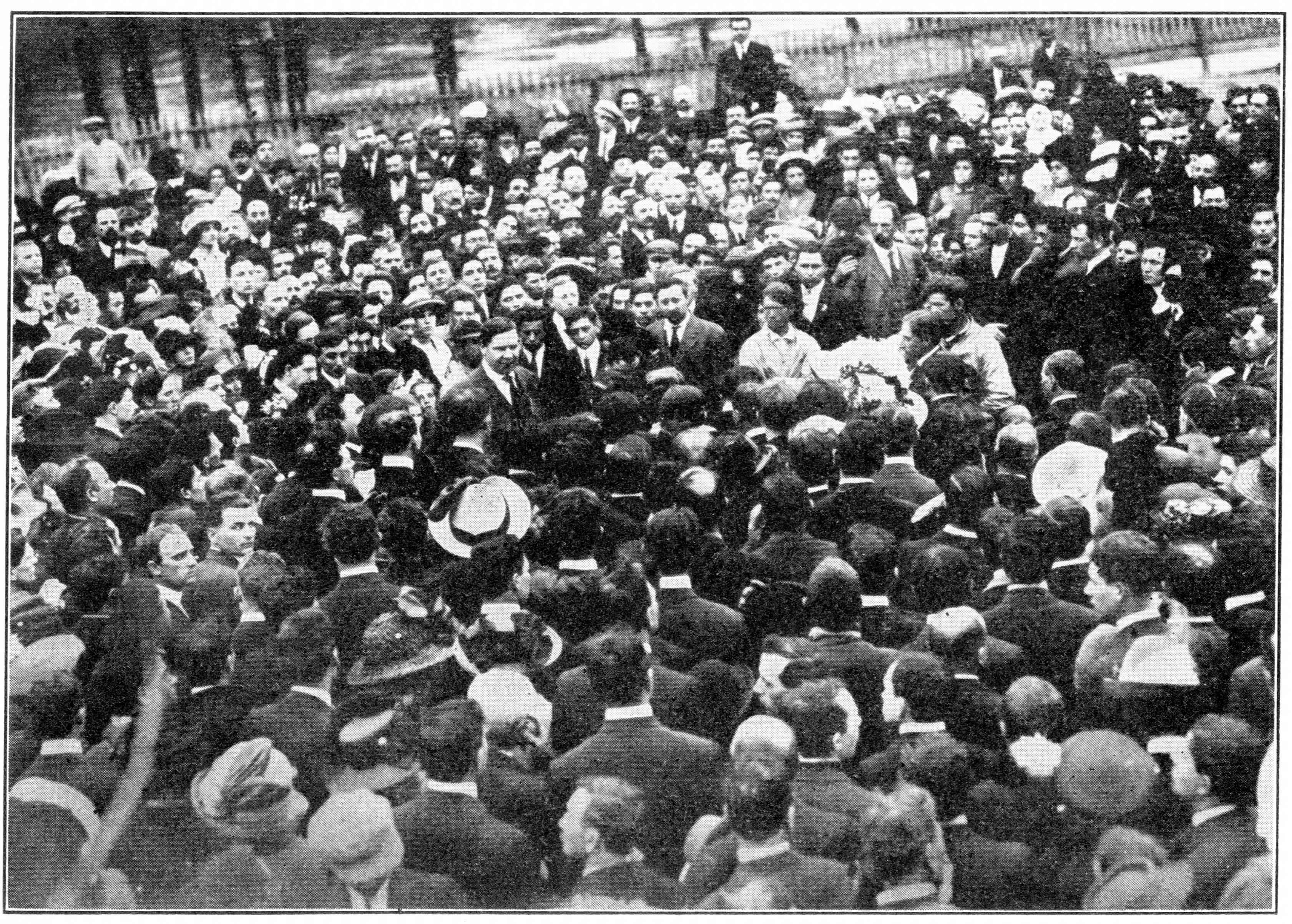
When the silk workers saw that they were not getting anywhere by fighting Doherty alone they decided that something must be done immediately. The other manufactures, seeing that the workers were unable to beat Doherty, also began to install the four-loom system into their plants. This was the signal for immediate action, and February 25 saw the very much alive silk industry dying in agony. Instead of the mill workers rushing to work early in the morning they rushed to the meeting place where they congregate to find out what was to be the next step.
Emissaries were sent to all the silk mills and in less than a week every mill in Paterson was shut down as tight as a drum. No sooner did the workers desert the mills than the manufacturers decided they would drive their slaves back to their looms. The city authorities, who were owned part and parcel by the manufacturers, placed the entire Police Department at the disposal of the manufacturers. A big burly cop, who is the head of the Police Department, announced on the day of the strike was called that it was not going to last for any length of time and that he was going to “nip the trouble in the bud.”
Elizabeth Gurley Flynn, Patrick Quinlan and Sam Kaplan, who came to Paterson to aid the strikers, were taken from Turn Hall, where the workers congregated, over to the police station. There they were given the alternative of leaving town or going to jail. Kaplan was not even offered that, but under an escort of a police guard was taken to the railroad depot and placed aboard a New York train and told not to come back. Miss Flynn and Quinlan, however, told the police that they were not going to leave town and that they were going to fight it out.
As Miss Flynn and Quinlan were arrested an army of police thugs were rushed to the silk mills to attack pickets who were there to gain recruits. The police got busy and smashed heads, but the more heads were cracked the more recruits.
The authorities then announced that they were not going to permit out-of-town speakers to address meetings of strikers. All the hall keepers were ordered to close their halls to the out-of-town agitators,” as the authorities called them, under the penalty of arrest.
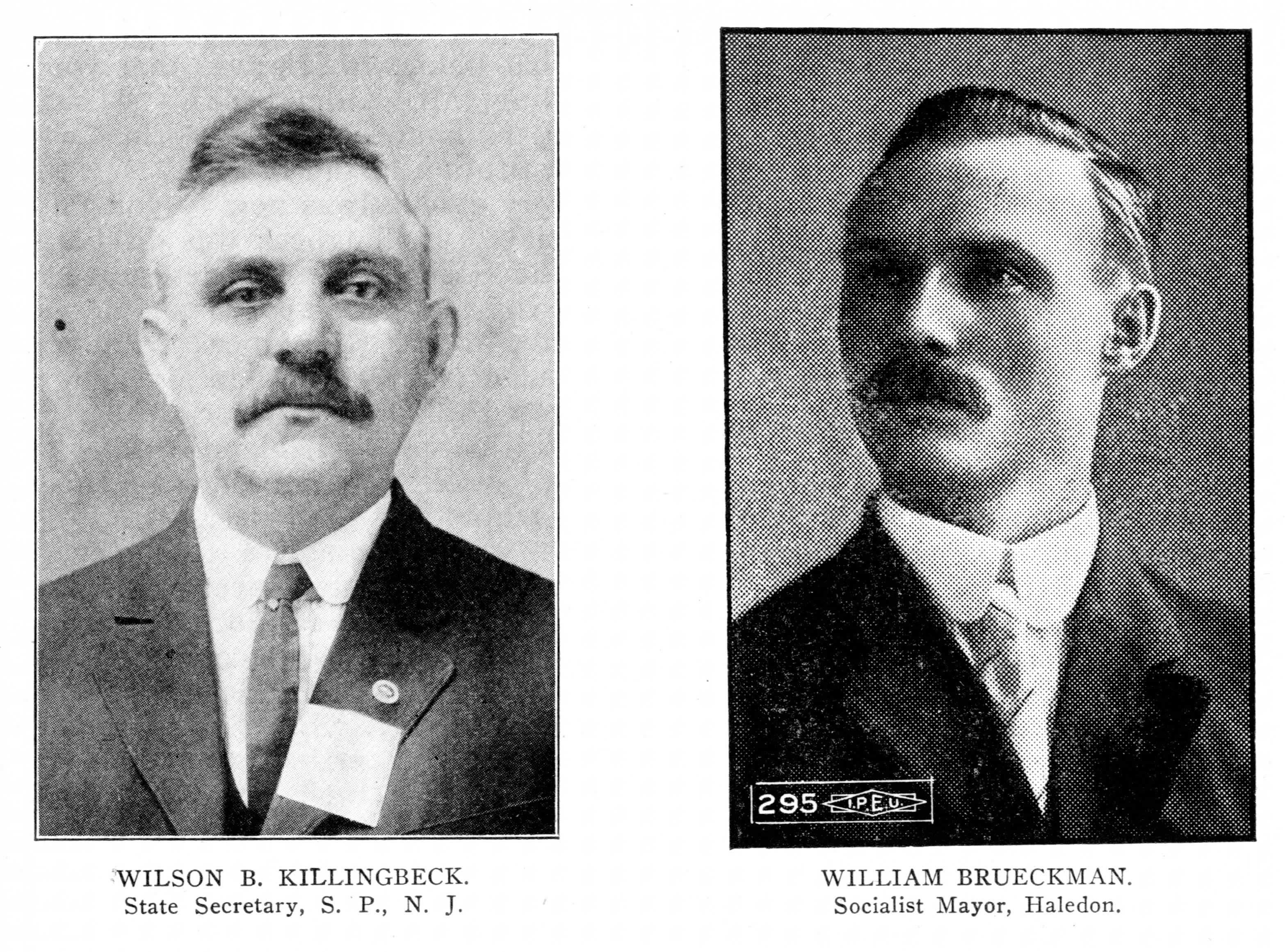
The Socialists of Paterson called a special meeting, where it was decided to “get into the fight” and not to permit the authorities help the bosses break the strike. Wilson B. Killingbeck, State secretary of the Socialist party of New Jersey, came to Paterson and a meeting of the strikers was called the day following the announcement of the police that they were going to “nip the trouble in the bud.”
The meeting did not last very long, however, because Police Chief John Bimson, accompanied by a squad of his “finest,” invaded it and broke it up. No sooner did Bimson get into the hall than he rushed onto the platform and began to read the ancient riot act produced in the days of Columbus, winding up with “God save the King.” Killingbeck, who was reading the Bill of Rights at the time the police enter the hall, was placed under arrest.
When brought to the police station, the burly chief questioned Killingbeck as to what he was doing in Paterson. He then asked him, “And what was that unknown law that you were reading” Killingbeck smiled as the chief was raving and replied: “That I was the Constitution of the State of New Jersey.
Killingbeck was later discharged. This was only a signal to the Socialists to get into the fray and a hall was engaged for a meeting for the next night to protest against the attempts of the authorities to throttle the constitutional rights of the workers.
As the police were carrying out the dastardly plans of the manufacturers the capitalist press came out with glaring headlines praising the police and shouting “good work.” The Socialists of Passaic County own a weekly paper known as the Weekly Issue, and they decided to place it at the disposal of the strikers. A “strike special” was ordered printed for the next day to espouse the cause the strikers were fighting for.
This did not please the bosses and their hirelings, the authorities, and they determined to suppress that, too, that the community should not know what the strike was about. On the day the paper appeared the police broke into the Socialist party headquarters and confiscated 5,000 copies of the Issue. Newsboys who were selling the Issue were ordered to quit selling it under threats of arrest.
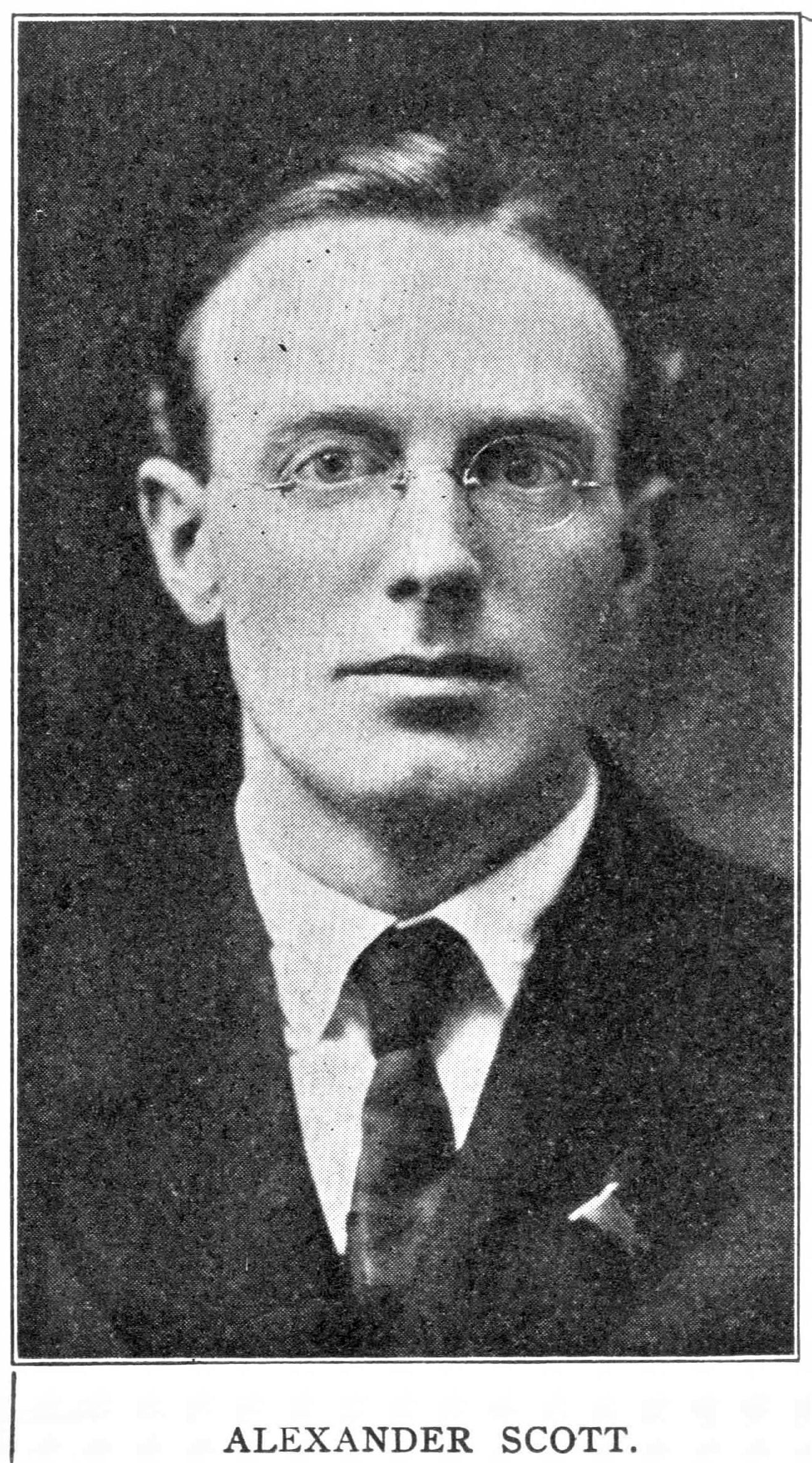
A warrant was immediately sworn out against Alexander Scott, editor of the issue, and police were sent out to “get him.” They were informed that Scott would be at the protest meeting that night, and an army was sent to Iny for him. The hall was crowded to the doors and the police did not dare arrest him until after the meeting was over.
The Issue characterized Police Chief Bimson as “chief of the strikebreakers” and “boss of the Cossacks,” and condemned him for overriding the Constitution. For doing this, Scott was charged “with aiding and abetting hostilities to the government of the City of Paterson.” Scott was thrown into a dingy pen in the police station and kept there overnight. The police did not permit Scott’s friends to bail him out, so he was compelled to spend the night in a police pen. Next morning he was released in $2,000 bail.
The determination of the Socialists to hold meetings for the strikers frustrated the plans of the authorities to close the halls and took the wind out of their sails. The halls were again thrown open and the police did not dare break up any more meetings until May 20, when they were closed by an order of the Police and Fire Commission, of which two silk manufacturers are members.
Realizing that they could not close the halls, the manufacturers began to play patriotism. The very manufacturers that several times robbed the United States by smuggling foreign silks without paying duty all of a sudden turned patriotic and began to champion the cause of the Stars and Stripes. So one fine morning all the silk mills, bonze parlors and “pug hangouts” were decorated with American flags. A large flag with the inscription, “We live under this flag: we fight for this flag; and we will work under this flag.” was hung out over several booze parlors, The Socialists again got on the job, and, to use Chief Bimson’s expression, “nipped the trick in the bud.” Killingbeck and William Glanz, county secretary of the Socialist party of Passaic County, ordered a flag with the inscription, “We refuse to scab under our flag,” hung over the Socialist headquarters.
The next day they ordered the following cards printed, which the strikers wore on their lapels until the flag epidemic was over:
“THE STRIKERS REPLY.
“To the Employers’ Hypocritical Eulogy of the American Flag Is as Follows:
Yes, we have lived, we have worked, we have fought under the flag; but you (who had to buy flags to put them on your mill), you reduced our wages under the flag; you increased our hours under the flag; you took our wives from the homes to work ten hours a day under the flag; you took our children from school under the flag; you fattened on our labor under the flag; now we demand more bread, more meat, fewer hours, longer life, under the flag.
“We, the textile workers, fling your challenge back into your teeth.
“We wove the flag.
“We dyed the flag.
“We won’t scab under the flag.”
Even the Issue partook in the patriotic spell and sent out a big truck through the town with an inscription, “The Weekly Issue Refuses to Be Muzzled Under This Flag.” The Socialists played patriotism for a long while and called the bluff of the manufacturers. This move having failed, the manufacturers got busy and thought of another plan by which they hoped to break the strike.
The manufacturers then ordered that arrests be tried, hoping that it would help break the backbone of the war. On one morning as the strikers peacefully assembled to picket the mills the police charged them without any provocation on the part of the workers and arrested about seventy men and women. They were fined by Recorder Carroll, who has since proven to be a faithful servant of the manufacturers, but they refused to pay it, and preferred going to jail.
When the authorities realized that they could not get any money out of the strikers, they ordered a wholesale jail delivery, and one morning all the strikers were turned out of jail. The manufacturers hoped that by arresting and fining the strikers they would deplete their treasury. The workers, however, were on to their trick and refused to help pay the salaries of the police with their funds.
The strikers have been holding successful outdoor meetings on Sundays, which the manufacturers disliked very much. So the lawyers, who always play the game of the bosses, were set to work and some ancient blue law was dug up, which prohibited the holding of outdoor meetings on Sundays. This time, again, the Socialists were on the job, and they suggested that they proceed to Haledon, where the Socialists elected a Mayor. When the strikers came to Haledon they were welcomed by Mayor William Brueckmann, who asked the strikers to meet there any time they wanted to. The entire Police Department was placed at the disposal of the strikers and were given orders by the Mayor that the workers were not to be interfered with. At one time when two Paterson detectives came to Haledon and attempted to create trouble among a group of strikers, Mayor Brueckmann told them that he proposed that the strikers should not be molested, at least, while they were in Haledon, and ordered them to leave town.
They took the hint and did not make any further attempt to interfere with the strikers while they were in Haledon. But the trip to Haledon was not quite pleasant for the poorly clad striking men, women and children, so they decided to make a test on March 30 to see whether they could not hold a meeting within the city limits of Paterson. They secured permission from the owners of Lafayette Oval, a baseball field, for a meeting. Several thousand strikers were peacefully assembled there waiting for the arrival of the speakers. Police Chief Bimson determined, however, that the strikers should not hold the meeting there and stationed patrols at all the roads leading to the park, with instructions to arrest William D. Haywood and the other speakers as soon as they appeared.
When Haywood, accompanied by Adolph Lessig, appeared near the park he was informed that he could not hold the meeting. “On to Haledon,” he shouted to the strikers, and immediately the strikers started on their way to the “civilization of New Jersey,” as Haledon has since become known. As Haywood was about to cross the border line he and Lessig were grabbed by several burly cops and hustled off to the police station. There charges of disorderly conduct and of unlawful assemblage were made out against them. The next morning they were arraigned before the Recorder and, without being given a chance to explain their side of the case, were railroaded to the county jail for six months each on a dis orderly conduct charge, and held in $2.000 bail for the Grand Jury on the unlawful assemblage charge. Immediately a writ of habeas corpus was sued out for them, and Justice James Minturn, who issued the writ, ordered their release after severely criticising the authorities for making the arrest. He also criticized the authorities for treating Haywood and Lessig like criminals by lining them up before a squad of policemen for the purpose of taking a good view of them, so that they would know them when ordered to “get them,” a term used by policemen.
A new Grand Jury was picked–six men connected with the silk industry having been selected on the jury. The Previous plans of the manufacturers to break the strike having failed, they decided to order wholesale arrests. Immediately the police started out to the mills, and patrol loads of pickets were brought in from all directions. Realizing that they could not get the strikers to pay fines, the authorities decided that they would hold the strikers for the Grand Jury, who they were sure would return indictments against them.
On one expedition of the police Modestino Valentino, a worker not connected with the silk industry, was shot and killed by a private deputy who opened fire on the pickets. The funeral of Modestino was one of the most impressive demonstrations ever witnessed in the City of Paterson, nearly 15,000 men and women taking part in it.
Though the strike agitators were being held in $2,000 and $5,000 for minor offenses, the murderers of Modestino were held in small bail, which was furnished by the manufacturers. The treatment of the Modestino murderers only helped encourage the dirty work of the private thugs, who thereafter beat un pickets on the slightest provocation.
Then began the handing down of indictments. The jury returned them by the wholesale, and at one time the jail, which is an ancient building, accommodated nearly 5,000 pickets.
The clergy, which is always ready to help the bosses crush any rebellion on the part of the workers, also rallied to the raid. Sermons were preached condemning the strike leaders, and the organization to which the workers belonged was branded as an anarchist movement.
A Jewish rabbi, Leo Manheimer, who dared express his opinion about the strike, favoring the cause of the strikers, lost his position as a result. When the election for rabbi came, his congregation, which is made up mostly of middle class men, refused to re-elect him, because of his favorable attitude toward the strikers.
The next important event was the trial of Patrick L. Quinlan, who was charged with “inciting the workers to personal injury.” The first jury that tried Quinlan failed to bring in a verdict, after being out twenty-two and one-half hours. The next jury, which was composed of businessmen, brought in a verdict after being out but a short while. The trial was one of the most farcical events that has marked the strike. About a score of witnesses called by the State, testified that Quinlan told the strikers! “To go to the mills, deg them out, club them out, get them out no matter how you get them, you have got to get them anyhow.”
The State witnesses contradicted themselves and two of them could not give the same version of Quinlan’s supposed-to-be action.
The defense proved that Quinlan did not go to the hall until after the meeting was over, but the jury had its mind made up, and Quinlan was railroaded to jail. He is now out on $2,000 bail, awaiting the outcome of the Court of Errors
The trial of Scott, the editor of the Issue, was even more farcical than that of Quinlan. The only evidence against him was the publication in which he characterized Bimson as chief anarchist and boss of the strike-breakers. The prosecution maintained that the Police Department was a part of the city government, and since Bimson was criticised the government was attacked.
New Jersey has a law on the statute books which was passed short after the assassination of President McKinley. By that law even the slightest criticism of the authorities is prohibited and makes it punishable by a prison term of from one to fifteen years.
The jury that tried Scott returned with a verdict in short order, despite the arguments of counsel for the defense that the law was unconstitutional, since it abridged the constitutional rights of free press. Judge Klenert, who presided at the Scott trial, sentenced the Socialist editor to not less than one year nor more than fifteen years, with a fine of $250.
Realizing that they could not get justice at the hands of the Paterson authorities, the strikers’ attorneys applied to Justice Minturn for an order to have the strikers tried by juries drawn from outside of Passaic County. It took Minturn some time to consider the application–but he finally decided “that after looking into the evidence he found that the strikers and their speakers cannot get justice at the hands of jurors drawn from Passaic County, and ordered that the panels be drawn from Hudson County. The most desperate move on the part of the bosses and their hirelings, the city authorities, was the order for the closing of the halls. When the strikers went to the halls on May 20, they found the doors locked against them, police guards having been stationed at the entrance to keep the terrible strikers out.
This time also the Socialists came to the rescue, and Mayor Brueckmann of Haledon invited the strikers to come to his municipality, where the Constitution of the United States is still a fact and not a dead letter, as it is in Paterson. At one time the Socialist Mayor was even threatened with ant indictment if he did not stop the strikers from speaking in his borough.
The county authorities threatened to intervene and stop the strike meetings. Mayor Brueckmann called their bluff by announcing that should the county authorities interfere with the strike meetings he would dig up all the old Sunday blue laws, under which he could stop the trolleys and automobiles from coming in or from going out of Haledon. This proved a good antidote to the threats of the authorities of Paterson, and the meetings continued without interference.
The most remarkable feature of the strike was the absence of violence on the part of the strikers. Now, in the twentieth week of the strike, the cry of the workers is, “Our fight has just begun.” The workers are full of fight, just as though it had just begun. And their determination is bound to help them win the struggle which caused great suffering among them. Their children have been sent out of town, and they are determined to send even their wives away, if necessary, but they are going to fight until the bosses! abolish the two-loom system, give them more pay and better working conditions.
From the New York Call
The most widely read of I.W.W. newspapers, Solidarity was published by the Industrial Workers of the World from 1909 until 1917. First produced in New Castle, Pennsylvania, and born during the McKees Rocks strike, Solidarity later moved to Cleveland, Ohio until 1917 then spent its last months in Chicago. With a circulation of around 12,000 and a readership many times that, Solidarity was instrumental in defining the Wobbly world-view at the height of their influence in the working class. It was edited over its life by A.M. Stirton, H.A. Goff, Ben H. Williams, Ralph Chaplin who also provided much of the paper’s color, and others. Like nearly all the left press it fell victim to federal repression in 1917.
PDF of full issue: https://www.marxists.org/history/usa/pubs/solidarity-iww/1913/v04n28-w184-jul-19-1913-solidarity.pdf

