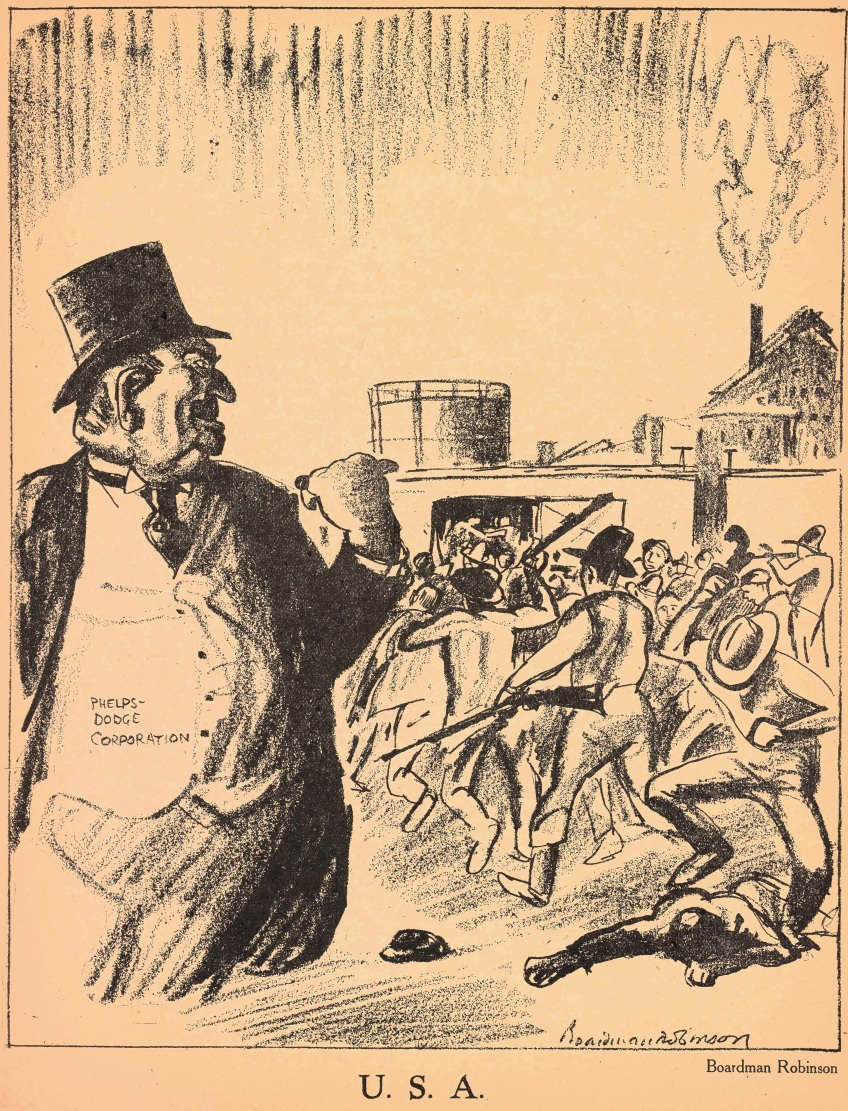
As the United States entered into World War One, what was always a violent and repressive country became and extraordinarily violent and repressive one. From the East St. Louis Massacre to the Bisbee Deportations, Reed wrote this even before the murder of Frank Little and raids on the S.P. and I.W.W. that ended that long, hot summer of 1917.
‘One Solid Month of Liberty’ by John Reed from The Masses. Vol. 9 No. 11. September, 1917.
In America the month just past has been the blackest month for free men our generation has known. With a sort of hideous apathy the country has acquiesced in a regime of judicial tyranny, bureaucratic suppression and industrial barbarism, which followed inevitably the first fine careless rapture of militarism.
Who that heard it will ever forget the feeling of despair he experienced when Judge Mayer charged the jury in the Berkman-Goldman trial:
“This is not a question of free speech,” he said, “for free speech is guaranteed under the Constitution. No American worthy of the name believes in anything else than free speech, but free speech does nor mean license...Free speech means that frank, free, clear and orderly expression in which every man and woman in the land, citizen or alien, may engage in lawful and orderly fashion….”
The italics are ours. The definition is the new American definition of freedom—the freedom for which countless millions have died in the long uphill pull of civilization—which is, in effect, “freedom is the right to do what nobody in power can possibly object to.”
Emma Goldman and Alexander Berkman were not convicted of the charges upon which they were ostensibly tried; they were convicted by the Assistant District Attorney’s constant stress of the term “Anarchist,” and by the careful definition of that term, brought out by both Judge and Prosecutor, as one who wishes wantonly to overthrow society by violence.
After conviction the prisoners were brutally hustled from the court to the trains which whirled them to their prisons, without even the customary respite granted to prisoners to settle their affairs. Moreover, not only was their bank account seized, including money belonging to other persons, but part of their bail was held up while its sources were investigated—ostensibly to find out if any of it belonged to the defendants, but actually with the effect of intimidating those who put up the bail. And last outrage of all, the clerk of the court claimed and took out of the amount of bail some $500 as his rightful fee!
Next in order is the wholesale suppression of the radical press by the Post Office, some eighteen periodicals, among them THE MASSES, being denounced as “unmailable” under the Espionage Act, without any specific grounds being specified.
“Because,” Solicitor Lamar is reported to have said to the representative of one paper, “if I told you what we objected to, you’d manage to get around the law some way.”
Now I happen to have been one of those who lost a good many pounds fighting the original censorship provision of the Espionage Bill in Washington. And we licked it, finally, in the face of the whole Administration. But what did the Administration care? It does what it pleases, and finds a law to back it up. If the entire Espionage Act had been defeated, some obscure statute passed in 1796 would have been exhumed, and the radical press suppressed just the same.
All of which goes to prove that in America law is merely the instrument for good or evil of the most powerful interest, and there are no Constitutional safeguards worth the powder to blow them to hell.
The attack of soldiers and sailors in Boston upon the July first parade and the Socialist headquarters, which sent a thrill of rage through the heart of every lover of liberty in this country, was followed by two horrors more sinisterly suggestive.
The first was the race riot in East Saint Louis, where the large negro town was sacked and burned, and more than thirty black people, men and women, were butchered. Eye-witnesses tell how innocent negro passers-by were pursued by white men with smoking guns, who shot them down in the streets and then kicked their dead faces to jelly; how white women with streaming hair and foaming lips dragged negresses from street cars and cut them mortally in the breasts with knives.
All this of course outdoes the feeble German atrocities. It rivals the abominations of Putumayo and the Congo. The “war of civilization” begins to lose its drawing power. And the spirit of our own American soldiers in battle is beginning to appall those who know it. Read Arthur Guy Empey’s Over the Top if you want to know how barbarians revel in sheer butchery. I met a friend who had served in the British army. I have killed eight Huns with my own hands,” he boasted, “and I want to kill ten more. Greatest sport in the world.” Killing n***s is, of course, also great sport.
Anent this matter, Colonel Roosevelt and Colonel Samuel Gompers had a tiff upon the platform at Carnegie Hall, where both were patronizing the Russian revolutionary mission from the standpoint of our superior democracy. Colonel Roosevelt thought that the workingmen who killed the negroes that were brought in to take away their jobs ought to be hung. Colonel Gompers seemed to think that the negroes were to blame for allowing themselves to be brought in to take the jobs. Neither of the Colonels referred to the gentlemen who had brought the negroes north in order to smash trades-unionism forever.
The second mile-stone in the history of the New Freedom was the wholesale deportation, at the point of a gun, of some hundreds of striking workingmen from the mines in Bisbee, Arizona, into the American desert. These strikers were loudly heralded as “I.W.W.’s” in an attempt to bemuse the truth; but it is slowly leaking out that the mining company deported from Bisbee all the men who were striking in an orderly fashion for decent living wages and conditions, whether I.W.W.’s or not. And not only that, but all sympathizers with the strikers, and even the strikers’ attorney! Many of these men lived in Bisbee, owned property there; some of them were torn from the arms of their wives and children. They were loaded on cattle-cars and sent to Columbus, N.M., whose outraged citizens promptly shipped them back north, until they halted in the middle of the desert—foodless, waterless, homeless.
At the present writing the United States Army is feeding these dangerous characters, and there is talk of interning them for the balance of the war on the ground that they have been subsidized by German gold. And in the meanwhile, the Phelps-Dodge corporation, which owns the mines—and Bisbee—is not allowing any one to enter the town without a passport!
Samuel Gompers protested to the German trades-unions against the deportation of Belgian workingmen. But even the Germans didn’t deport Belgians into the middle of a desert, without food or water, as Bisbee did—and yet Gompers hasn’t uttered a single peep about Bisbee.
Out in San Francisco, the bomb trials go merrily on. In spite of the exposure of Oxman, the utter contradiction and discrediting of the state’s witnesses, Mooney is still going to die. Mrs. Mooney has only with the greatest difficulty been acquitted, and District Attorney Fickert asserts that the other prisoners will be vigorously prosecuted. Alexander Berkman has been indicted in the same case, and Bob Minor is threatened with indictment.
District Attorney Fickert no longer relies upon the evidence. Like Prosecutor Content, he cries, “This woman is an anarchist. Either you must destroy anarchy, or the anarchists will destroy the state!” And so the most patent frame-up ever conceived by a Chamber of Commerce to extirpate union labor goes on, and indictments rain upon all who have dared to defend the Mooneys.
This country-wide movement to wipe out organized labor, which was launched a year ago in Wall Street with such a flourish of trumpets, and which Mr. Gompers defied at Baltimore with quotations from Shakespeare, is developing quietly but powerfully. An investigation recently made in Omaha, Nebraska, by Carl Sandburg, shows the businessmen of that community organizing along the lines of San Francisco, sending out invitations to scabs everywhere, and evidently framing up something on which a union man can be railroaded to the electric chair, as they railroaded Tom Mooney on the coast.
Meanwhile, organized labor lies down and takes it—nay, in San Francisco, connives at it. Gompers is so busy running the war that he has time for nothing except to appoint upon his committees labor’s bitterest enemies. I suppose that as soon as Tom Mooney and his wife are executed, Gompers will invite District Attorney Fickert to serve upon the Committee on Labor.
The suffrage pickets in front of the White House, set upon by mobs of government clerks, then by the police, arrested time and time again upon no charge, and finally committed to the workhouse for sixty days, were, as the world knows, hurriedly pardoned by the President as soon as it was evident how prominent they and their husbands were. But at the same time that he pardoned them for their “crime,” he intimated that he was too busy over his “War for Democracy” to give any attention to their petition—which was a petition for the fundamental rights of citizens.
It is the blackest month for freemen our generation has known.
The Masses is among the most important, and best, radical journals of 20th century America. It was started in 1911 as an illustrated socialist monthly by Dutch immigrant Piet Vlag, who shortly left the magazine. It was then edited by Max Eastman who wrote in his first editorial: “A Free Magazine — This magazine is owned and published cooperatively by its editors. It has no dividends to pay, and nobody is trying to make money out of it. A revolutionary and not a reform magazine; a magazine with a sense of humour and no respect for the respectable; frank; arrogant; impertinent; searching for true causes; a magazine directed against rigidity and dogma wherever it is found; printing what is too naked or true for a money-making press; a magazine whose final policy is to do as it pleases and conciliate nobody, not even its readers — There is a field for this publication in America. Help us to find it.” The Masses successfully combined arts and politics and was the voice of urban, cosmopolitan, liberatory socialism. It became the leading anti-war voice in the run-up to World War One and helped to popularize industrial unions and support of workers strikes. It was sexually and culturally emancipatory, which placed it both politically and socially and odds the leadership of the Socialist Party, which also found support in its pages. The art, art criticism, and literature it featured was all imbued with its, increasing, radicalism. Floyd Dell was it literature editor and saw to the publication of important works and writers. Its radicalism and anti-war stance brought Federal charges against its editors for attempting to disrupt conscription during World War One which closed the paper in 1917. The editors returned in early 1918 with the adopted the name of William Lloyd Garrison’s The Liberator, which continued the interest in culture and the arts as well as the aesthetic of The Masses. Contributors to this essential publication of the US left included: Sherwood Anderson, Cornelia Barns, George Bellows, Louise Bryant, Arthur B. Davies, Dorothy Day, Floyd Dell, Max Eastman, Wanda Gag, Jack London, Amy Lowell, Mabel Dodge Luhan, Inez Milholland, Robert Minor, John Reed, Boardman Robinson, Carl Sandburg, John French Sloan, Upton Sinclair, Louis Untermeyer, Mary Heaton Vorse, and Art Young.
PDF of full issue: https://www.marxists.org/history/usa/pubs/masses/issues/tamiment/t77-v09n11-m75-sep-1917.pdf

