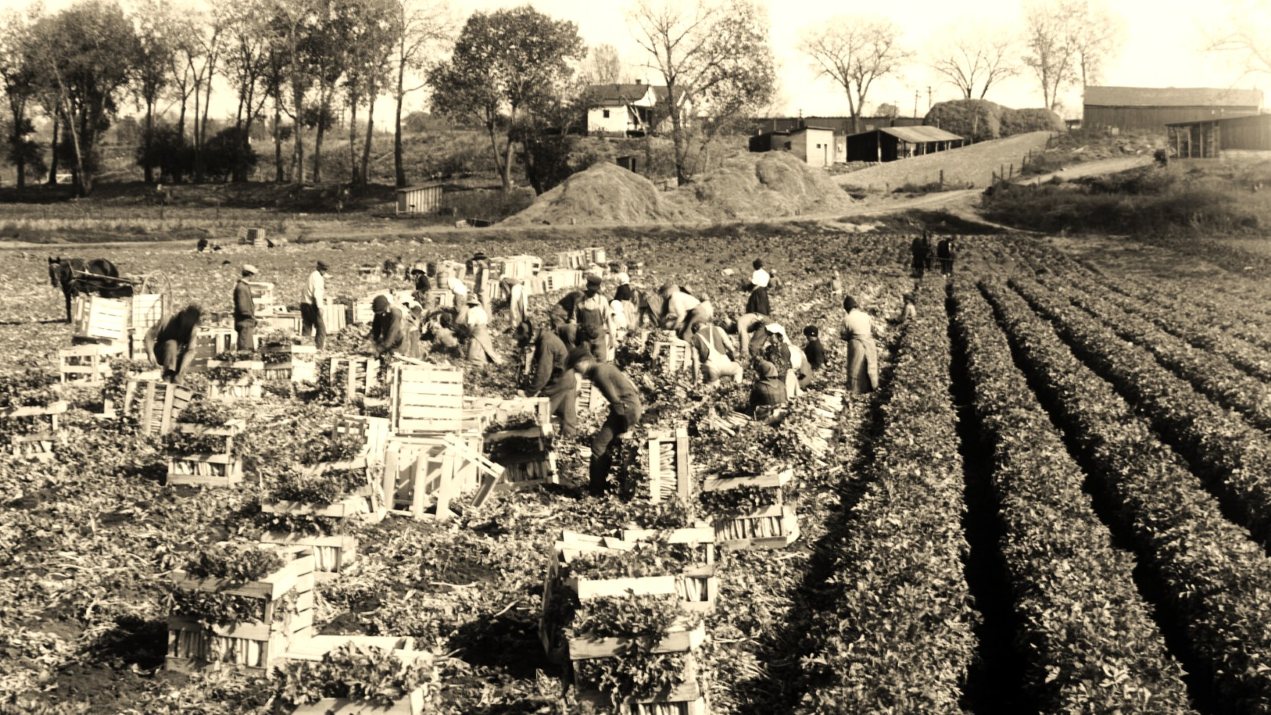
An overview of the creation and development of capitalist agriculture in the United States. Ware was a son of Ella Reeve ‘Mother’ Bloor and the first spokesperson on agricultural affairs of the Communist Party.
‘Our Agrarian Problem’ by H.R. Harrow (Harold Ware) from The Communist (old C.P.A.). Vol. 1 o. 4. October, 1921.
THE development of Agriculture in the United States has created a situation which it is neither wise nor safe for the Communist Party to ignore. Since the earliest colony was established on the Atlantic coast and spread like a fan over the entire continent, American Agriculture has been conducted by individuals. Individualism has persisted in Agriculture against all the forces of a more and more concentrated industrial development. Resources of new land, modern machinery, science and credit have been exhausted one after another in the struggle for economic independence. There is no other resource in sight. The capitalist imperialists are awake to the approaching menace of farm bankruptcy. They sense its danger to their very existence and are formulating definite policies which will separate the rural masses from the city proletariat. The Communist Party must adapt itself to the immediate need of unmasking the hypocritical exploiters of the farmers. It must build a policy to fit the conditions which actually exist throughout the agricultural sections of America. Only by understanding the complex strata which make up the whole Agrarian mass can we hope to understand their reactions and lead each element to its position in the Proletarian Revolution.
HISTORICAL BACKGROUND
1. The Era of Colonization
The development of Agriculture in the United States is most easily followed by dividing it into five chronological periods. The first of these extends over the period of Colonization and through the Revolutionary war to 1783. During this period the early colonists got a foothold along the Atlantic coast. They imitated and improved the methods of the Indians. Land was cheap and labor dear. The indentured servants after paying off their passage money struck out and cleared freeholds for themselves. Land tenure varied somewhat in the different colonies. In New England a semi-communal system was originally tried. In New York and Pennsylvania the land system resembled somewhat the old feudal system. But these land systems were very loose in their control of the colonists, who became more and more dependent upon their own ability to clear and operate a farm. The landing of the first cargo of Negro slaves in Jamestown, Virginia, in 1609, solved the labor problem and changed the whole type of farming for the South. At the time of the Revolution there were already large tobacco plantations of several hundred acres operated by slave labor.
2. Western Expansion
With the nationalizing of the western lands after the revolution the period of western expansion began. Land became a marketable commodity and was held in “fee simple.” The original policy of the government to dispose of the national lands at a few dollars an acre resulted in the formation of land companies. A period of land speculation followed. This condition was brought to an end by the passage of the “Homestead Act” in 1862. It restricted the granting of public lands to actual settlers. Under the terms of this Act the settler was to gain 160 acres by living on and improving the land. The movement West continued as the settlers pushed on into the plain country in their prairie schooners. With the opening of the Erie canal in 1825 the stream flowed North and then West. During this period of expansion cotton played an important role in deciding the development of the South. With the invention of the Cotton Gin in 1793 by Eli Whitney the textile industry started in New England. An increasing demand for cotton was created. Since the Negroes were adapted to the growing of cotton, slavery and cotton became the outstanding features of the Southern states. In general the agricultural tools and machinery of this period were the same as those of the preceding period.
3. Development of Industry
The third period, 1830 to the Civil War, saw a complete transformation of both agriculture and industry. Railroads, telegraph lines and a mail service broke down the isolation of the scattered farms. Capitalism had advanced in Europe and the development of its industries created a demand for American grain and cotton. At this time the political situation in Europe tended to send increasing numbers of immigrants to America. For the first time our own industry employed as many wage workers as farmers. The great demand which these conditions created for farm products could not have been satisfied by the primitive farm unit. The invention of the reaper, mowing machine, improved plows, corn planters, cultivators, and finally a portable steam engine to run a threshing machine changed agriculture from the merely self-supporting unit to a commercial enterprise producing crops for sale.
It was from this point on that the independence of the farm owners began to disappear. Because of the greater adaptability of the machines in the level plain country, farming developed rapidly in the West. A movement abandoning Eastern farm lands followed, since the east could not compete with the cheaper grown machine crops of the West. This movement was checked by the gradual adjustment of crops better suited to Eastern conditions and local needs. This period was closed by the Civil War. The success of the Union forces was due largely to the inability of Southern agriculture to support its population and army. Cotton and slavery had made it rich but could not feed it.
4. The End of Free Land
The Civil War to 1887 marks the period completing the settlement of the free land in the United States. The abolition of chattel slavery forced a thoroughgoing reorganization of agriculture in the South. The old estates were bankrupt and changed hands. Many were broken up into small so-called tenant farms. Over-production followed and a slump in cotton started a movement for a more diversified crop system. The merchants who advanced credit to the small tenants fought this and demanded a cash crop. They succeeded in saddling upon the South the one crop system. Cotton remained the dominant factor in Southern agriculture.
The continued improvements in farm machinery made the American farmer the most efficient in the world. Beef cattle production followed the Western movement, and the demands of the early cattle barons for great ranges and safety for their cattle brought about the final act in the tragedy of the American Indian He was officially cooped up on limited reservations. As the westward movement swept on to the coast, the plain country of the Middle West became the great grain producing area. A tremendous railroad development made rapid settling of the western lands possible and opened up and united the country as no other force could have done. The West continued its development as a cattle area. Later the coast States became the great fruit producing section.
5. Scientific Farming and Its Aftermath
From 1887 to 1920 American agriculture passed through an entirely new phase. All the land, except that later made available by reclamation projects, had been absorbed by individuals or corporations. Land values increased. It became more and more difficult to start farming. The farmers having reached the limits of production by expansion in new land and machinery, now turned to improved methods. Scientific research resulting in better methods improved seeds, fertility and conservation of soil, gave the farmer a new outlook. Experiment stations were established and more and more intensive agriculture followed. As the limit of the resources of land, machinery and better methods was reached the farmer suffered a keener exploitation. To make up for their annual losses farmers were now forced to mortgage their land. In the main this credit has gradually been absorbed by the banks. Year by year the debt of farmers has mounted. The total in 1890 was $1,085,945,960. In 1910 it had increased to $1,726,172,851. Advance reports from many states for 1920 announce increases of over 200%. In some states the increases are over 500%. This indicates the rapid decline of individualism in agriculture. It spells the bankruptcy of the small farmer who represents the most important element in the rural mass.
In this period many farm organizations and societies
sprang into existence. It was a natural reaction against oppression. These organizations vary from social rural gatherings to organizations for parliamentary action. Most of these, however, are organized to market a single commodity. The only organization which has caused the capitalists concern is the Non-Partisan League, which controls the State government of North Dakota and threatens to extend its movement into other States of the Northwest. This organization is not proletarian. It is an attempt to apply a program of State Socialism to the industries of North Dakota. This has brought the exploiters out in the open. The greatest contribution of the Non-Partisan League has been educational. Here we have an attempt to establish a mirage of state socialism in a desert of capitalist imperialism. All in all, this movement tends to prepare the rural masses for the next step; namely, the realization that they must join with the city proletariat in destroying their common enemy, the capitalist state, before they can be free.
THE SITUATION TODAY
We now have great concentration of city industry. Competition has been practically abolished in every great industry except agriculture. Meanwhile our great food surplus has been gradually absorbed by the increasing demands of our own population. Subtracting imported food stuff values from our exports we find that we are down. to the self-supporting point. Thus 1920 brings us to the threshold of a new period.
American farming is taking a sharp turn. We are entering upon a period ripe for Communist action. For the first time we are offered an opportunity to break down the bulwark of conservative rural psychology which stands. between Capitalism and a victorious proletariat. The capitalist imperialists represented by the Bankers, Machinery Trust, and Grain Gamblers, realize that they have all but ruined their most valuable ally, the small farmer. Their activities seem to point very definitely to a conscious and concerted policy. They are aiming to make the farmer more productive, to satisfy his demands by partial concessions and to permit isolated commodity organizations. The capitalists will fight all farmers’ organizations that may ally themselves with the working class in struggle. They are endeavoring to build a wall of misunderstanding between city and farm workers, to increase the antagonism between the migratory workers and working farmers and to enroll capitalist nuclei in all farm organizations. They are giving unlimited support to such conservative farm organizations as the American Farm Bureau Federation. This aid has enabled the latter to enroll a membership of one million five hundred thousand in a few months. The exploiters are controlling the agricultural press and are turning the hopes of the farmers for relief to the parliamentary Punch and Judy show of the Republican and Democratic parties.
OUR POLICY
In determining a basis for a Communist policy we must consider the economic status of the actual producers of food in the various sections of the United States and the methods of the Capitalist exploiters we are to fight. We must not confuse the conditions which actually exist with a misapplication of theoretical terms. As the van guard of Communism, we shall be concerned only with organizing the exploited producers. The first logical step is to determine who are the real producers in a given section. This determines the tactics to be used.
In the United States there are four distinct agricultural sections. The economic status of the producers differs in each of these.
In the South we have the virtual slavery of the negroes and poor whites operating so-called tenant farms. Our tactics in this section must consider the whole race problem.
In the West capitalist farming is an established fact. Great ranches employ hundreds of workers. The fruit packers’ unions, the I.W.W., and strikes remind one of situations similar to those in city industry. Here the
proletariat predominates as the actual producer. Here all industrial tactics which are successfully used in the cities may be applied.
In the Grain States there is a blending of proletarian and semi-proletarian strata. Throughout most of the year the working owners or tenants carry on the farm production; then for a few weeks the proletarian harvest “stiff” joins in the production of the grain crop. Here the tactics must balance between the two. Both must be considered, but the greatest emphasis must be given to the importance of the semi-proletarian farmers who are the dominant element.
In the Eastern section the proletarian element is negligible.
From Iowa to the Atlantic Coast north of the black Belt States lies the probable theatre of the American proletarian revolution. Population, industry and the number and productivity of farms are greater here than in any of the other sections. Because of the proximity to the great centres of population, the Eastern farmer stands out above all others in his importance to proletarian victory. Our tactics must be directed towards enlightening this backward class.
“Leftism” has been buried. A party of action must recognize that its ultimate duty is to win power by destroying the capitalist state. But this can not be done immediately in America. Only by leading all the workers in their preliminary skirmishes can the Party become the vanguard. This applies to the struggles of the backward semi-proletarian farmers as well as to the foremost sections of the city proletariat. We must also realize that the struggle for the destruction of the capitalist state will inevitably resolve itself into a struggle for food. The ruthless counter-revolutionary attacks must not be reinforced by Famine. We must begin now to fight the Capitalist section which is planning to cut off the skilled producers of food from their role in the ranks of the American proletariat.
This ‘The Communist’ was a split from the Communist Party of America in April, 1920 by Charles Ruthenberg, Jay Lovestone, and others, referred to as the Central Executive Committee group, over the majority’s reluctance to unite with the Communist Labor Party as mandated by the Communist International. Laying the groundwork for the May 1920 Bridgman, Michigan convention that would form the United Communist Party, this version of ‘The Communist’ only lasted three issues. The new UCP stuck with tradition and called their official journal…’The Communist. Emulating the Bolsheviks who in 1918 changed the name of their party to the Communist Party, there were up to a dozen papers in the US named ‘The Communist’ in the splintered landscape of the US Left between 1919 and 1923. All them claimed adherence to the new Third International and sought that body’s endorsement. They were often published at the same time and in the same format, making it somewhat confusing to untangle their relationships.
PDF of full issue: https://www.marxists.org/history/usa/pubs/thecommunist/thecommunist6/v1n04-oct-1921-com-CPA.pdf

