Dimitrov on a decade of impact that the Russian Revolution had on the Balkan workers’ movement.
‘The October Revolution and the Balkans’ by G. Dimitrov from International Press Correspondence. Vol. 7 No. 68. December 1, 1927.
The effect of the October revolution on the Balkans was tremendously powerful. Like a searchlight it dispersed the gloomy darkness of the war on the Balkan fronts. Like a guiding star it showed the peoples of the Balkans and the masses of workers and peasants, numbering millions, the path to peace and freedom. The proximity of Soviet Russia, the agrarian character of the Balkans and its similarity to Russia in its economic and social construction brought the October Revolution particularly near to the hearts of the masses on the Balkans and made it easier for them to understand, it thoroughly. The victory of the Russian proletariat and the setting up of the first Workers’ and Peasant Soviet State was greeted with unbounded enthusiasm.
A powerful movement against war and in favour of an immediate peace without annexations and indemnities developed both among the population of the Balkan States and among the masses of soldiers at the Balkan fronts. The slogans of the October Revolution attracted day by day fresh masses of workers and peasants at the front, in the towns and the villages. Demonstrations of women followed one another, the workers in the factories protested with increased boldness against war being continued. At the Dobrudja front, fraternisation between the Russian, German and Bulgarian soldiers became a constantly recurring phenomenon in spite of the most relentless suppressive measures on the part of the military power. At the Salonika front (the centre of the Balkan front) a mighty movement for the termination of war, a lively peace propaganda developed among the Bulgarian soldiers; revolutionary leaflets were distributed and secret soldiers’ committees and nuclei were called into being. In spite of wholesale arrests, in spite of thousands of soldiers being shot, this movement gained more and more ground and was given the most telling expression in the soldiers’ riots in Dobro Polie and at the gates of Sofia in September 1918.
Just these soldiers’ riots have been one of the factors which hastened the termination of war at the Balkan fronts.
The October Revolution encouraged the masses of workers and peasants of the Balkans in their struggle against monarchism, against the bourgeoisie and against the originators of the disastrous bloody war.
The workers’ and peasants’ movement in the Balkans received a tremendous, and unprecedented impetus.
Under the impression made on them by the October Revolution, which bestowed full national freedom on the numerous oppressed nations of Tsarist Russia, the oppressed peoples (Macedonians, Thracians, Albanians, inhabitants of the Dobrudja) entered on the right path of the national revolutionary fight. Bolshevism gained a powerful influence over the workers, peasants and petty bourgeoisie and over the nationally suppressed population.
The organisation of the workers in the trade union organisations, of the Left inclined peasant parties, proceeded at a rapid pace. The workers’ and peasants’ cooperative movement developed to an extent which was never witnessed before the war. The revolutionary Social Democratic Parties of Bulgaria, Yugoslavia, Roumania and Greece proclaimed their faith in Bolshevism, transformed themselves into Communist parties and developed into mass parties. The Bulgarian Communist Party won over the fourth part of the total number of voters and captured the administrative posts in almost all the towns and villages. The Yugoslavian Communist Party polled 200,000 votes at the election. All this was achieved by means of the revolutionary Bolshevist slogans. The Communist Parties of Roumania and Greece also made great progress. Mass strikes and demonstrations swept the Balkans. The masses of workers and ‘peasants engaged in a decisive advance against the bourgeois monarchist system.
Thanks to the profound social and political concussions resulting from the war and under the powerful influence of the October Revolution, the positions of monarchism and of the bourgeoisie were seriously shaken. In Bulgaria, the old King Ferdinand was compelled to abdicate the throne. Constantine, King of Greece, was removed. In spite of the “victory” in the war, the dynasties of Belgrade and Bucharest were shaken and began to totter. The rising world revolutionary wave weakened the influence and the pressure of imperialism on the Balkans. At that moment, the bourgeoisie and monarchism in the Balkans were no longer in a position to rely on the help of those who had been their support from without (Tsarist Russia and the old Austro-Hungarian Monarchy had disappeared and the victorious imperialist States themselves were threatened with the danger of revolution).
The bourgeoisie of the Balkans which was terrified and impotent, made various concessions to the masses in order to maintain its class predominance. The eight-hour day was almost universally proclaimed. Labour legislation was solemnly promised. Roumania and Yugoslavia set about working out an agrarian reform. The position of the peasant masses rose to such a level that, in Bulgaria, it even culminated in a three years’ Peasant Government.
An immediate revolutionary situation existed. The Balkans were on the eve of a labour and peasant revolution, and this revolution would certainly have broken out and been victorious had not international Social Democracy committed its second betrayal (the first took place on August 4th), had it not prevented the revolution in Germany and Austria from developing into a real proletarian revolution, had it not let down the labour insurrection in Italy and the occupation of the factories and facilitated the overthrow of the Soviet Republics in Bavaria and Hungary. In view of the situation at that time, a victorious revolution in the Balkans would not only have led to the formation of the Soviet Balkan Federation, but would also have facilitated the proletarian revolution in Central Europe, would have ensured to Soviet Russia an important and reliable cover in the rear and promoted the revolution in the Near East.
In the same way as their brothers in Western Europe, the Social Democrats in the Balkans were on the side of the bourgeoisie and opposed to the revolutionary movement of the proletariat, the peasantry and the oppressed nations, to the workers’ and peasants’ revolution in the Balkans.
Owing to this treachery of the Social-Democrats, the international bourgeoisie could rally together, could strengthen its self-confidence, consolidate its position to a certain degree, find the way to a relative stabilisation of capitalism and finally proceed to a systematic attack on the revolutionary proletariat and the peasantry.
Noske’s blood bath in Germany, Horthy’s victory in Hungary, the victory of Fascism in Italy this was the beginning of the steady growth of international bourgeois reaction and its constant spread. The victory of counter-revolution in Europe made it possible for the imperialist Powers to gain once more a firm hold on the Balkans. By the sacrifice of the economic and political independence of the Balkans, the Balkan bourgeoisie and monarchism gained for themselves the powerful support of the English, French and Italian imperialism and embarked on a brutal, fierce offensive against the revolutionary movement on the Balkans. It began with the sanguinary suppression of the general strike in Roumania in December 1920. The second important step in this direction was the exceptional law against the revolutionary movement in Yugoslavia in 1921 (the so-called “Obznana”). The military Fascist coup in Bulgaria in June 1923 was the third historical action carried out by the Balkan reaction which has ever since that time been raging and advancing in the Balkans, efficiently sup ported by foreign imperialism. A further important step of Balkan reaction was the overthrow of Fan Noli’s People’s Government in Albania by Achmed Zogu in 1924 with the direct help of Italy and Yugoslavia and the powerful support of England.
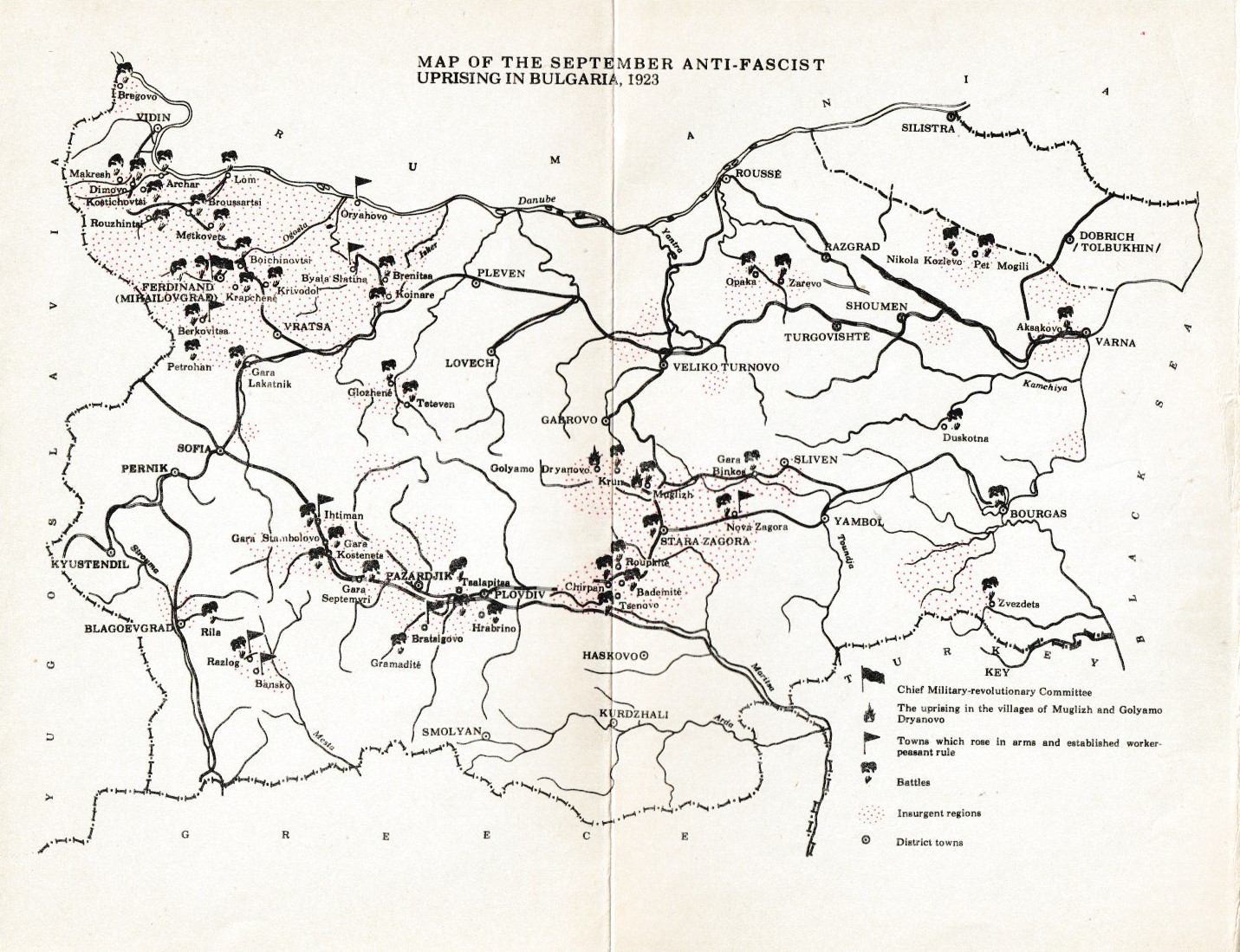
The September insurrection in 1923 in Bulgaria against the military Fascist dictatorship and for the Labour and Peasant Government was, in that period, the last heroic attempt of the proletariat to overcome the reaction, to maintain the proletarian positions which had been conquered and to keep the way open for the victory of the Balkan revolution. The September revolt of the Bulgarian workers and peasants was permeated with a Bolshevist spirit and was carried on under the banner of the October Revolution. In spite of the defeat, the insurrection will remain, in the eyes of the Bulgarian proletariat and of the proletariat of all the Balkan States, a bright ray thrown on the path of the revolutionary fight which will lead to a final victory.
For years the most terrible White Terror has been raging in the Balkan countries, and Fascism is making further progress. Its victims are innumerable. The bourgeoisie succeeded in shattering the organisations of the proletariat and the peasantry and in prohibiting and persecuting most severely the Communist Parties in Bulgaria, Yugoslavia and Roumania as legal parties. It succeeded in murdering or throwing into prison the most active proletarian cadres, in robbing the masses of workers and peasants completely of their political rights, and in exploiting the workers and peasants to the utmost. The revolutionary movement has for some time been driven back by the bourgeoisie, and the proletariat, as an important political factor, been pushed on one side.
The bourgeoisie of the Balkans could not, however, exterminate the ideas of the October Revolution, could not uproot the spirit of Bolshevism, nor destroy the unbounded love of the Balkan masses towards Soviet Russia.
On the contrary, the process of the Bolshevisation of the messes is steadily advancing, at the cost of colossal sacrifices and indescribable suffering. The proletarian masses and important sections of the poor peasantry have remained loyal to Communism.
In spite of everything, no proletarian groups have gone over to Social Democracy (this political agency of the bourgeoisie and of counter-revolution).
The Communist Parties of the Balkans, which have been so terribly persecuted, have been re-established as illegal organisations (with the exception of Greece, where the Party is still legal) and are, slowly but surely, beginning to gain strength and to consolidate.
On their way to Bolshevisation, the Communist Parties eliminated from their midst the liquidatory, petty bourgeois intelligentsia and the Social Democratic remnants (the group Sakarov-Manov in Bulgaria, the group Miloikovitch in Yugoslavia, Cristescu in Roumania and Puliopolus in Greece). The progressive Bolshevisation of the Communist Parties in the Balkans is further proved by a fact which should not be under-estimated that they all stand firmly on the side of the Communist Party of the Soviet Union against the Trotzkyist Opposition, against the Menshevist position and against the activity of the group of Trotzky and Zinoviev which is aiming at a split, and by the fact that this group has no adherents among the Parties in the Balkans.
As a federation of all the peoples of the former Tsarist Russia, the Soviet Union is a shining example before the eyes of the Balkan peoples. In the Balkans, just as in Russia, the very complicated national question can only be solved, the territorial feuds only be settled, the imperialist pressure overcome and real peace among the Balkan peoples be ensured by the creation of a federation of the Balkan peoples after their liberation from capitalism. That is the reason why the Balkan proletariat, in common with the peasants and with the oppressed nations, is carrying on its fight for the Balkan Federation, for the Federation of the Balkan Workers’ and Peasants’ Republics. As this Balkan federation is only possible by the removal of the bourgeois monarchist Fascist regime which prevails in the Balkans and by a decisive fight against imperialism, the only right way towards this end is the way of Bolshevism, the way of the October Revolution, a revolution of the workers and peasants under the lead of the proletariat.
International Press Correspondence, widely known as”Inprecorr” was published by the Executive Committee of the Communist International (ECCI) regularly in German and English, occasionally in many other languages, beginning in 1921 and lasting in English until 1938. Inprecorr’s role was to supply translated articles to the English-speaking press of the International from the Comintern’s different sections, as well as news and statements from the ECCI. Many ‘Daily Worker’ and ‘Communist’ articles originated in Inprecorr, and it also published articles by American comrades for use in other countries. It was published at least weekly, and often thrice weekly. Inprecorr is an invaluable English-language source on the history of the Communist International and its sections.
PDF of issue: https://www.marxists.org/history/international/comintern/inprecor/1927/v07n68-dec-01-1927-inprecor-op.pdf

