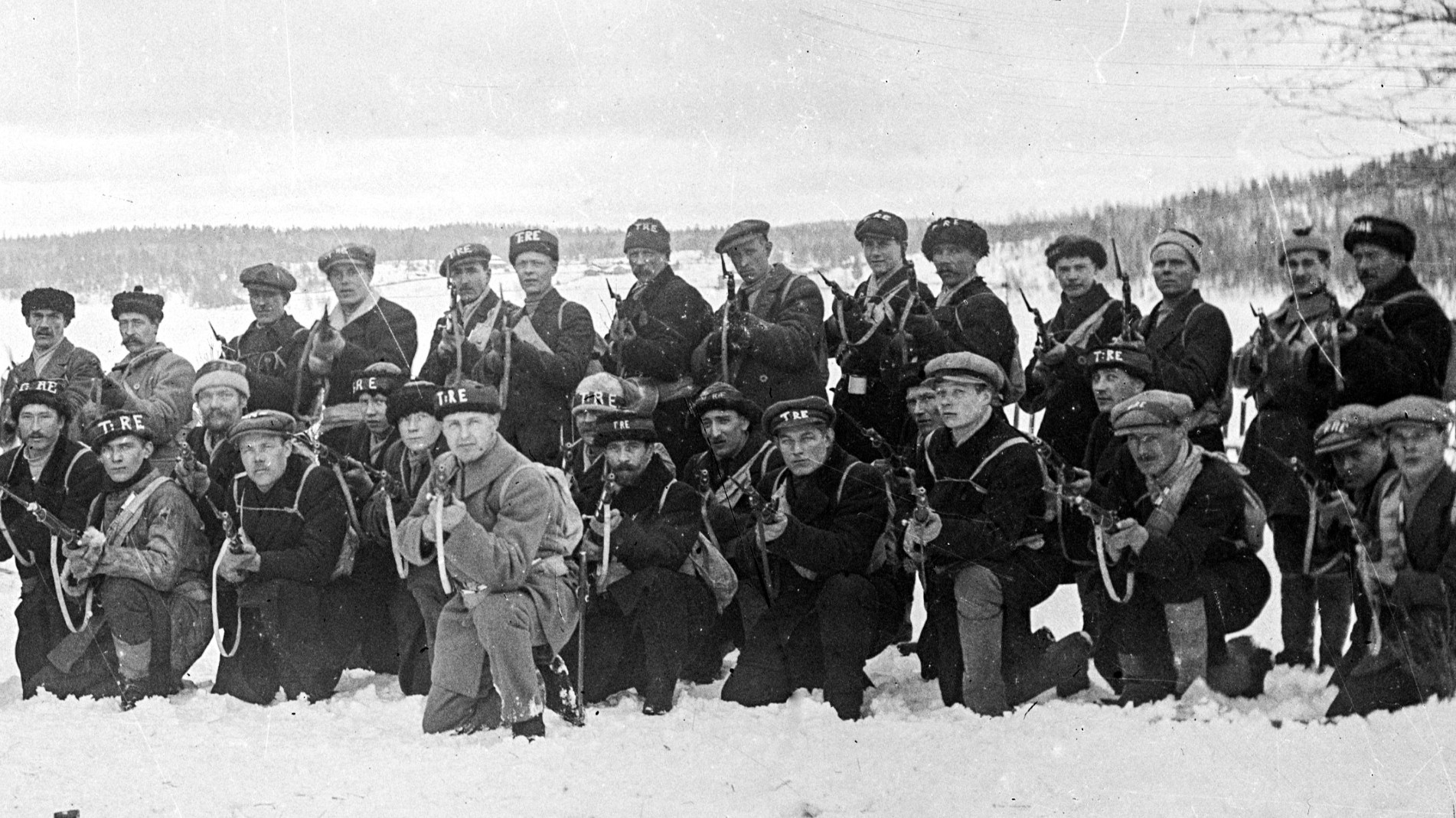
A brief but brutal civil war in the former Czarist Duchy of Finland saw Red Guards, mainly in the southern cities, fall to the White Finns with a German assist in 1918. Here, a Red combatant looks back at mistakes made.
‘Some Lessons of the Finnish Civil War’ by A Red Guardist from The Daily Worker Magazine. Vol. 3 No. 46. March 6, 1926.
THE lessons of the class war in Finland, in 1918 January to May–have not yet been made sufficiently available for the comrades of other countries. There is a pamphlet of Comrade O.W. Kusinen, “The Finnish Revolution, A Self-Criticism,” which is available in English, but is very little known in this country. In Finnish there are many publications on the question from both sides which give interesting material about conditions before and during this armed struggle of the classes, where the proletariat was compelled to take up arms without being prepared for it and in which it made some of the same mistakes as were made in the Paris Commune.
In “White Finland” there is published in six large volumes a history of “The Finnish War of Liberation”–so these allies of the German call their murderous warfare against the toilers of their own country. From this the following lessons can be drawn:
1. The preparations of the whites. As early as 1917, a military commission was appointed, whose first task was to investigate the geographical terrain, and especially to seek a basis for operation. They selected the coast of the Gulf of Bothnia in middle-western Finland. The reasons were: The population is of conservative middle peasantry, where a strong sentiment had been aroused against the Reds and the Russian soldiers. In this region there was a big railway center with roads running to the north, east and south, and west to the future white capital, Vasa. From this point it was possible to have connections with the western countries over the sea and north of the gulf. The whites had already made arrangements to get financial help, arms and supplies from Germany (officially) and from Sweden (unofficially). As is known, the Germans sent troops to Red Finland to the rear of the Reds, which decided the outcome of the civil war.
The lesson: In the sense of military preparations and foreign connections, the whites were well prepared; the reds had neglected these matters.
2. A plan to isolate the Russian military by surprise, was worked out. As the war with Germany was still pending, there were small Russian detachments scattered thru Finland, and the revolutionary soldiers were friendly towards the Finnish Reds, the workers and poor peasants. The whites organized besieging rings of armed “white” organizations around every unit and even succeeded in isolating them from each other, and from the Finnish Red Guards. The preparations of the latter to frustrate these plans were too late, as a result of the lack of an intelligence service.
3. Preparations to clean out Reds from the hinterland. There were big industrial centers in north Finland, saw-mills and lumber works, and a rebellious, poor peasantry. To capture the southern part of East Bothina would give the whites an opportunity to strike a blow against these Reds and to make their own rear safe. The whites succeeded in carrying out this plan. They were met by hard fighting on the side of the industrial workers and rural scouts, but succeeded in crushing them.
4. The military leadership. There were a number of former officers among the Finnish bourgeoisie. Some of them had been officers in the Finnish army, dissolved by czarism in 1901, and some had been officers in the czarist army. Then the whites had made arrangements to get staff and non-commissioned officers from Sweden and Germany. Then they had over two thousand “Jegers”–bourgeois youths, students and even peasants and workers, who had gone to Germany during the war in order to get military training. Most of them had honest intentions of preparing themselves for a fight against czarism in order to liberate Finland. They were regarded as adventurers by a big part of the Finnish bourgeoisie, which lined up with czarism for their profits in producing war supplies. But when power in Russia passed into the hands of the workers and peasants, the big bourgeoisie managed to get those patriots to fight the Finnish toilers under the cover of “ousting the Russians.” But hundreds of these boys did not let themselves be fooled by this trickery and were held in Germany either as prisoners or as war-workers. The Reds were very poorly prepared as regards military leadership.
5. The general staff. The military committee of the whites was replaced by a centralized staff under the leadership of General Gustav Mannerheim, a foreign count, registered among the Finnish nobility, but wholly Russianized as a general in the czarist army. He was secretly appointed by the Finnish government, January 16, to be commanding general of the white forces. He organized a staff of trained officers, each head of his department. The Red Staff was not at first composed of capable military leaders and was not centralized.
6. The headquarters of the staff. For this the city of Vasa was selected, as the capital Helsingfors in the south was considered likely to fall into the hands of the reds. This calculation was correct and the whites had an effective center from the very beginning. Later the white staff was removed to the railroad center, Seinajork.
7. Accuracy in details. As Mannerheim, disguised as a traveling salesman, was on his way from Helsingfors to Vasa, he was almost arrested in Tammerfors, the industrial center of Finland, where the Reds were especially strong. The Russian soldiers, who inspected the passports, suspected him of being an officer and demanded him to come to the station for questioning. The “white” history tells us: “Mannerheim began to dress himself (it was in a sleeper) when a young man (“white”) dressed as a railway employe, passing, explained to the soldier that the passport was all right and that they did not have the right to bother the travelers.” The soldiers dropped the case, and the whites had their leader.–The Reds were not careful in details.
8. The connections. The first task of the white staff was to organize connections with the white guard centers all over the country. They had eleven secret district centers. Messages to the staff came under the address of the Vasa City Administration. The whites also had the support of the telegraph operators. The quartermaster was in charge of all means of communication. The intelligence service and the communication of the Reds were very poorly organized.
9. The supply of weapons. The white staff had the available weapons already registered and took energetic steps to hasten the sending of guns and ammunition from Sweden and Germany. They bought also weapons from the Russian officers and speculating soldiers. The surprised Russian military units were compelled to surrender their supplies. The Reds were very slow in arming themselves. The rank and file, alarmed by the secret preparations of the whites, demanded weapons, but the leaders were not energetic enuf in supplying them.
10. The first alarms. The members of the White Guards were alarmed with exaggerated messages concerning some smaller fights in southern Finland and alleged sending of troops to the north. The “White” staff regarded these small occurrences as signs of threatening war, and was correct. The Reds did not fully understand this.
11. Threats and bluffs. The Whites circulated rumors among the Russian soldiers about the strength of the whites, and organized peasant parades to make an impression on them. In this way they gained time and succeeded in disheartening a part of the to some extent demoralized Russian soldiers. They also made earnest efforts to derail the trains and made other preparations for actual fighting. The preparations of the Reds were not so systematic.
12. The relations between the leaders and the rank and file. When the white guards were alarmed and mobilized, they wanted to go into action at once. It was difficult for the officers to hold them back. When they received from the staff a command to wait for action, they revolted. Such a lack of discipline could in some instances be useful for the whites. For instance, little groups of whites defended a railroad station south of the only connecting road to the east. Their position was so dangerous that they received a command from Mannerheim to retreat, but did not obey. So they saved the connections to the east. But soon the whites got their staff officers organized and military discipline established. This was important for them because the peasants were not willing to go far from their own localities. They intended only to get the Russian soldiers out and after that wanted to return home. But this was not the intention of the leaders, and the members of the white guards were told that they were soldiers in an army and had to go where they were commanded.
The Reds had to face the same problem. The red guards were voluntary local organizations with elected officers. They were used to discussing at length whether or not they should attack, to obeying a command or not, as they pleased. After a time this was overcome. When the Red guardists saw that their appointed officer was not capable in practice, they asked for a new officer from the staff. But there were not many such officers to be obtained. Some groups of industrial workers, who had been trained in sport organizations, could supply comrades capable of military leadership. But this process of creating officers while the war was going on was slow, and time did not wait. The necessity for discipline also developed with experience. But this process also was too slow. One little anecdote will illustrate the awakening of this consciousness. Long after the civil war, when one of the red guardists was released from the prison camp of the whites, he told his comrades: “Now I will keep my place in the firing-line.” That means that the trouble in fighting was that so many left the firing-line, and now he understood that this was the key to all fighting. The problem of developing men (and women) who are trained to keep their places and uphold their authority is the most vital in a questions of struggle. It is especially necessary when there is a need for a retreat. The men who take up arms are willing to advance, but retreat disheartens them and destroys discipline. It was for this reason that Lenin emphasized the double necessity of discipline during a retreat.
13. The concentration of troops. As told above, the rank and file in a civil war are willing to fight for their homes, but do not fully understand the necessity of fighting elsewhere. But in war, of course, there are places of more and less importance, and forces must be concentrated to hold the important places. This was clear for the white military leaders. And they had made preparations to concentrate the troops where they were needed and to provide them with the necessary supplies. This was not so apparent to the Reds. Of course it was done, but not so systematically as was the case with the whites, as the concentration and distribution of the troop was delayed. This was in many cases the main reason for defeat.
14. The critical moment. The decision to begin is the most vital problem in all action. This should not be hastened, but neither should it be delayed beyond the right moment. On February 25, some members of the whites were demanding immediate action. Others hesitated. They pointed out that there was no artillery to speak of, and the supply of machine-guns was insufficient. Even guns and ammunition were lacking. But Mannerheim decided for action. His reasons were:
“If the sending of troops to the north, aimed at by the marines and the Reds, could be carried out, the rise of the ‘white’ people, insufficiently armed, would suffer a serious drawback. It might be frustrated entirely…Hesitation was no longer possible.” The Russian revolution had convinced Mannerheim “that where power has passed into the hands of the revolutionists, no further upheaval was possible…Now the question was: victory or destruction.”
So the Finnish civil war started. This is called by the whites “The War of Liberation,” because it liberated the exploited classes of Finland for a time from the power of the workers and peasants. The white historians maintain, of course, that it was a liberation from Russia. But the simple fact that the Soviet government had already recognized the full independence of Finland and that the Russian military was withdrawing from Finland, illustrates the falsity of this statement. The peasants in the white guards were surprised when all of their prisoners were Finnish workers and their fellow-peasants and net Russians against whom they were supposed be fighting. But by that time they were already under the iron discipline of the officers’ machine and they had to obey orders.
The industrial south of Finland was organized as a Peoples’ Republic and defended by Red guards of workers and small peasants, now organized into a Red army. On January 28 the Red torch in the tower of the Workers’ Hall in Helsingfors called the Reds together. So the decision of the Red leadership came some days later than the decision of the whites. The many laxities in preparation have been mentioned above. Other defects and mistakes were in the main as follows:
1. No system of soviets was organized. That means that the great masses of the workers and peasants were not drawn into the state organizations. Already in 1917, representative bodies of workers had been organized in localities. They are a poor substitute for the Soviets, because they were established by only the organized workers (unions, workers’ federations, sport organizations, etc.)
The district committees of the Social-Democratic Party and the unions were organized as district centers. The government, called “The Trustees (Commissars) of the People,” were organized by the central committees of the party and the unions. A General Council of Workers consisting of representatives of the party, the unions, the Red guards, and the Helsingfors local centers was organized and functioned as a revolutionary parliament. Although these organizations included the active part of the working people and were really mass organizations, the basis for a revolutionary power was too narrow. The non-partisan masses, which sympathized with the Reds and helped them with all their means, did not feel the new power as entirely their own. This was a big mistake.
2. The masses of petty and middle peasants were neglected. The dissatisfied tenant farmers and even independent peasants registered in the Red army and fought bravely in south Finland. Also in the far north. But during the period of reparation the peasants of middle Finland were neglected. They were religious and patriotic and the Reds did not understand how to approach them. So they could be misled by the whites. There were plenty of signs of dissatisfaction with their conditions. The taxes were heavy, also the mortgages. Hunger for land was general. And there were huge areas of land owned by lumber companies which could have been confiscated, or the benefit of the small peasants. There was some understanding of this problem in the Social-democratic Party but its revolutionary importance was not brought out and not developed into clear slogans, a general feature of the socialist parties, even the most radical, such as the Finnish Social-Democratic Party.
3. Lack of initiative. As told above, the Reds were late in all their preparations and actions. This had its basis in the fact that the Social-democratic party was not conscious of the inevitability of the revolution and the civil war. It as forced on them. Already in November, 1917, the power in the whole country was in the hands of the Reds. But the party gave it up. At the end of January the party had to face a situation where the power in middle Finland was in the hands of the whites, who had used their time well. They recognized the necessity of fighting when the Red leaders still hoped the civil war could be avoided and the necessary reforms obtained in a parliamentary way. (The Finnish Social-democrats had almost half of the legislation in their hands and hoped for a coalition with leftwing peasants, but were unable to establish it.) So the lack of understanding and initiative on the military and political field proved fatal to the Reds.
4. The institution which was in Russia called the Extraordinary Commission (Teheka) was not organized. There were of course some organs to watch for and fight the whites in Red Finland, but they were not centralized and did not have the proper political leadership. The result was a lack of consistency in their work. In many places they were too lenient towards the whites and in other places some cases of arbitrariness occurred. The revolutionary power must be firm but consistent. This can be obtained only under leadership of responsible, politically trained persons. In Red Finland the whites appeared in establishing fortifications and partisan troops and in this way tied up the Red forces and delayed their sending troops to the north. And in Helsingfors, as they afterwards boasted, they succeeded in organizing conspirative troops and buying arms from the Russian officers and demoralized soldiers. The bourgeois women were especially used in transporting arms and supplies. Thus they abused the chivalry of the Reds towards the fair sex. The intelligence service of the whites was also comparatively well organized. At the beginning of the civil war they controlled a telegraph line running directly from Helsingfors to the “white” headquarters. When this was discovered they used the cable to Reval and sent the message through Stockholm. Messengers from the white staff in Helsingfors went to the frontiers to the side of the whites, under several pretenses (girls who “wanted to visit their sick mothers,” etc.) The naivete and leniency of the Reds were astounding. (Compare this with the alarming stories about the “cruelties” of the Reds.)
5. The main defect was of course the lack of a Communist party. The Social-democratic Party, which was forced by circumstances to take up the defense of the working class, was not prepared for the attack. The activity of the party during the revolution illustrates this also. The central committee did not function as the leading body in the fight. The party leaders were of course in the government, but they did not hold central committee meetings. And more than that: the central committee was changed, the leading comrades replaced by less capable comrades. There was no party discipline to speak of. The propaganda and agitation work as not systematized. The government depended wholly on the voluntary loyalty of individual comrades and the revolutionary inspiration of the masses. The strong backbone, which was felt in the Russian revolution, was lacking.”
As the Finnish revolution as a whole was a costly experience of how a revolution should not be conducted, so it illustrates, in a negative way, how absolutely necessary it is to have a conscious revolutionary, a Communist Party in leadership. The nearly 15,000 murdered in the white terror, the 15,000 starved in the prison-camps of the whites, where 100,000 working men, women and children were tortured, was the price paid for these experiences. Not to speak of the international significance of Finland being white and not, Red during the past eight years. The revolutionary workers of other countries ought to learn of this experience.
The Saturday Supplement, later changed to a Sunday Supplement, of the Daily Worker was a place for longer articles with debate, international focus, literature, and documents presented. The Daily Worker began in 1924 and was published in New York City by the Communist Party US and its predecessor organizations. Among the most long-lasting and important left publications in US history, it had a circulation of 35,000 at its peak. The Daily Worker came from The Ohio Socialist, published by the Left Wing-dominated Socialist Party of Ohio in Cleveland from 1917 to November 1919, when it became became The Toiler, paper of the Communist Labor Party. In December 1921 the above-ground Workers Party of America merged the Toiler with the paper Workers Council to found The Worker, which became The Daily Worker beginning January 13, 1924.
PDF of full issue: https://www.marxists.org/history/usa/pubs/dailyworker/1926/1926-ny/v03-n046-supplement-mar-06-1926-DW-LOC.pdf
 Revolution's Newsstand