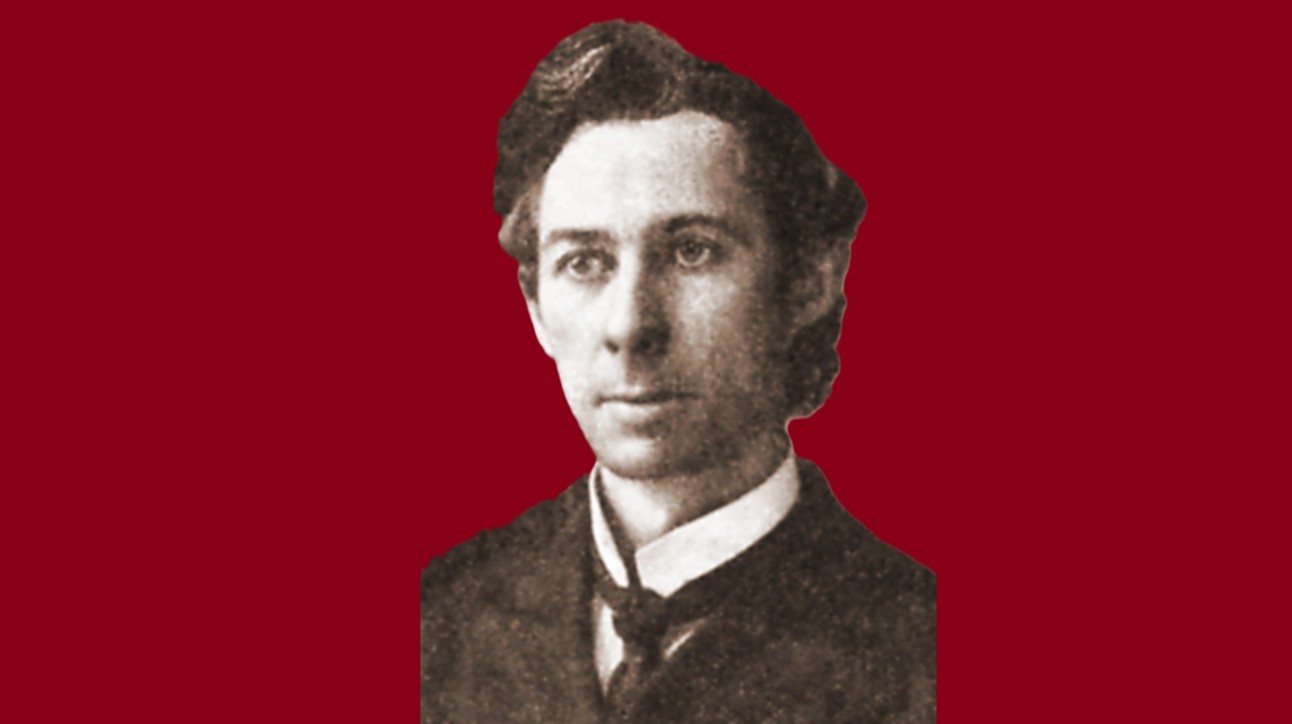
Fox, who came of age politically during the Haymaket Affair and became a leading syndicalists voice, tells of his political journey to Communism and contrasts it with Emma Goldman’s.
‘From Anarchism to Communism’ by Jay Fox from Workers Monthly. Vol. 4 No. 4. February, 1925.
(Editor’s Note. Jay Fox was the principal proletarian leader of the anarchist movement in America for the past 30 years. Emma Goldman represented the petty bourgeois wing, and in recent years devoted herself merely to lecturing upon sex, the drama and such subjects. Jay Fox joined the Knights of Labor in 1886 and went through the big stock yards strike of that year in Chicago. The Haymarket “riot” of 1886 made him a revolutionist. He was a militant worker in the Blacksmiths and the American Railway Union. He edited numerous anarchist publications and was arrested in 1901 in connection with the assassination of McKinley. In recent years he took an active part in the I.W.W., the Syndicalist League of North America, the T.U.E.L., and the Farmer-Labor Party. He joined the Workers Party in 1924.)
THE continued attacks by Emma Goldman upon the Russian Revolution impel me to review my own evolution prior to and since that eventful day in 1917 when the workers and peasants of Russia made the first serious rend in the armor of capitalism. At the age of sixteen I became a student of the militant revolutionists that gave up their lives for the cause at Chicago in 1887, Parsons, Spies, Fisher, Engel and Lingg. From these courageous comrades I imbibed the teachings of Anarchist Communism and since their crucifixion on the cross of gold have been a follower of that social philosophy.
The Chicago Anarchist Martyrs had split off from the Socialists, upon seeing the impossibility of the pacifist tactics of capturing the capitalist system with the capitalist ballot. They eschewed politics entirely, contending it was a waste of energy, and concentrated their whole attention on the economic field. They believed in revolutionizing the unions through which they hoped to destroy capitalism by revolutionary means.
Saw a Weakness in Anarchism.
As time went on and my practical experience broadened I began to see the weak points in the Anarchist propaganda. Spontaneous revolution arising out of some big strike would no doubt upturn the system; in fact, I saw no other feasible way to do it. But once the workers got control of industry, how was the revolution going to protect itself against the counter-revolution that from without and within would set upon it? Surely an army of defense would have to be organized. Without such a defense the workers would be slaughtered and the remnants driven back to slavery. I felt it would be harder to hold than to make the revolution. To make revolution is a matter of days; to hold it a question of months and perhaps years. In such a condition, to depend upon spontaneous defense would be foolish. My experience as a trade unionist had taught me that men must have organization and leadership or they rapidly fall back upon individual defense and are quickly routed by organized and disciplined opponents. Organized defense would constitute a revolutionary government and Anarchists were opposed to any kind of government. Really, I felt we would have to modify our principles in this regard, and I found that those comrades who had trade union experience were inclined to agree with me. I had studied the history of the Paris Commune and learned how it went down to defeat with the slaughter of 20,000 brave defenders through lack of proper organization. The Communards spent their time holding elections and parliamentary debates while the Versailles troops were marching on Paris.
Watched the Bolshevik Tactics.
For many years this flaw in my social philosophy tormented me. Thus, it may be easily conjectured with what intense interest I watched developments in Russia. I saw that the Bolsheviki immediately set up a revolutionary government and assumed leadership of the revolution. They knew what the revolution meant in order to be a workers’ revolution. They left nothing to chance. They organized the Red Army and sent it forth to smash the hordes of the counter-revolution; and the Red Army must remain as a necessary defense of the revolution so long as white armies are camped across the border ready to destroy the Workers’ Republic and hand the 160,000,000 of liberated workers back to the slavery and tyranny of capitalism.
For the first time in the history of the world a group of workers came into their own. They drove the parasites from their palaces. They ejected the masters from the mills and factories and the landlords from the land. They cast the yoke of capitalism from their necks and the capitalists of the world, with true class instinct, clamored for the suppression of the “Red Russian madmen”; and the capitalist governments sprang to the assistance of the counter-revolution with men, money and munitions. But at every point of attack they were met and routed by the Red Army of the revolution.
Upheld Conduct of Revolution.
With the coming of this epoch-making revolution and its terrific struggle for existence, I learned that my early doubtings were well-founded, that no revolution could live without a powerful organization of defense. A study of the Russian revolution has been of infinite value to me as a revolutionist, and far from joining the reactionaries in the counter-revolution, because some Anarchists were imprisoned, I raised my feeble voice in its behalf. I felt it would be a criminal betrayal of the revolution to attack the Bolsheviki because they were not conducting the revolution according to my pet theory. And then I did not know that if I and my comrades were at the helm we should not find our theories unworkable and be compelled to modify them in order to cope with the situations arising out of the conflict. I am sure we would not sacrifice the revolution on the altar of unworkable theory. That the Bolsheviki had put over the revolution and were heroically defending it, I accounted sufficient to merit my applause all I could contribute from this distance.
Saw Great Movement Coming.
I knew that the greatest event in history was taking place, that the age long dream of the social revolution was in process of being realized, and whether or not the Bolsheviki would be able to put their full program of Communism into effect, the revolution would have a tremendous effect upon the world. Revolutionists everywhere would be enthused and heartened by this wonderful achievement out of which a great new movement must arise that will sweep over the world like a prairie fire. With such a movement I would surely ally myself, for I knew it would be based upon the practical knowledge gained in the Russian struggle. Sentimentally I was drawn to the old movement, but as a practical revolutionist I knew my place was in the new one. I use the word “practical” advisedly. It is the duty of revolutionists to draw upon all the knowledge available in the preparation of their plans for propaganda and for the final struggle. Old movements crystallize around time-honored dogma and refuse to modify their tactics in the face of new experience.
The Communist International.
The new movement came fresh from the blood-soaked soil of new Russia, a vigorous young giant destined to convert the world to the ideal of Communism. The Communist International is the ripe fruit of the revolution, having all the experience and prestige of that great accomplishment behind it. Thus it is the most practical of all movements for the emancipation of labor. It is rallying the workers of all nations to its folds. It raises the cry: “All Power to the Workers,” and it has a most efficient program for the fulfillment of that aim. It emphasizes the fact that the source of all power is economic and roots itself in the workers’ and farmers’ unions. But is not a one-way organization. It insists that since political power is reflected economic power, it cannot be isolated and ignored.
Under capitalism, political power is the watchdog of the exploiters. It keeps the despoiled workers from consuming the wealth they create; it entangles the toilers in a network of law and kills those who rebel; it suppresses strikes and all forms of discontent; without it capitalism could not exist; it is part and parcel of imperial industrial capitalism, and as such cannot be ignored by the workers seeking to overthrow the system. The Communist Party, however, is not deluded with the social-democratic idea that this power can be captured at the ballot box. On the contrary, they keep constantly before the workers the fact that the final overthrow of capitalism must take the form of a revolution. Communist action on the parliamentary field is a tactic to weaken the enemy; a means of propaganda; a method for counteracting the capitalist propaganda so widely distributed at election time.
United Front and Union Tactics.
Finding the workers’ organizations divided while the mas ter class is an international unit, the Communists propose the very practical and sensible idea of a united front. Why not all workers’ organizations get together and agree upon a line of action wherein they can go forward in one solid phalanx to meet the united front of imperial capitalism? The Communists are ready to jump in and take part in any line of attack that will lead towards the goal of a workers’ world.
Workers are not always convinced by mere words. They have been lied to too often. They like the fellow worker who will reinforce his words with action, who will jump in and help in the daily struggle against the boss. To such a one they will be in a mood to listen when he suggests ways and means to abolish permanently the system of which the boss is a necessary part. Thus the Communists have adopted another very sensible tactic, that of joining and taking an active part in the trade unions with the view to imbue them with the revolutionary ideal. The trade unions are the most important of all existing economic organizations, in fact, the only ones that can carry over into the new industrial society.
Therefore, the necessity for the Communists to educate the membership and wrest the unions from the leadership of the capitalist henchmen who now largely control them.
Dictatorship a Necessary Protection.
The building of a workers’ society is decidedly a workers’ job. And having made the plans and cleared the ground, who should run the job? Instinctively the answer comes: “The workers.” Here, then, we have the “terrible” Dictatorship of the Proletariat. During reconstruction the ex-capitalists and parasites should not be given a chance to sabotage the work. Let them help if they will, but this is our job. We have suffered for centuries to get to it and we are not taking any chances. The Dictatorship is right. No power to the parasites.
The Soviet System of representation is much more representative than bourgeois “democracy,” now becoming so popular amongst the imperialists of the world. And of the Workers’ State, so absolutely necessary during the period of transition from capitalism to Communism, I have no fear that it will imbed itself and become permanent. The State cannot permanently operate industry. It can only function as the tool of the masters of industry; and its duty is to defend the possessors of wealth from the dispossessed. When society will be readjusted on a Communist basis and all will be possessors, when there will be no economic classes in society, then the state will be discarded, its function will be gone. And if Anarchists and other radicals who echo the capitalist slogan: “Down with the Dictatorship of the Proletariat,” will but study the evolution of the Russian revolution, they must agree that the Dictatorship is a most essential tactic.
Emma Goldman: Traitor.
But, unfortunately, many prominent revolutionists are blinded by the prejudice of party. Their party is not conducting the revolution so they are against it. They seem to think more of their group and its theories than of the social revolution. They damn the Bolsheviki with more venom than do the bourgeoisie. And it grieves me to learn that Emma Goldman and other prominent Anarchists are among the worst enemies of the revolution. How they can reconcile this outrageous conduct with their revolutionary pretentions is beyond me. Up until the revolution their records as rebels were good. But as soon as the revolution got under way they went over to the Mensheviks and capitalists, outstripping them in counter-revolutionary ruthlessness. While claiming to be revolutionists they attack the revolution. Such inconsistency has no parallel in revolutionary history.
That they would not agree in detail with the conduct of the revolution is but natural. There was much that I wished might have been different. But how could I tell if it were possible to have things different than they were? Since the revolution was an entirely new experiment, at best I could only theorize about the methods for putting it over. And since I never took part in a social revolution and cannot know anything about the practical details for conducting one, to set myself up as a critic and assailant of the Russian revolution would be the act of a jackass, with apologies to the ass, who most likely would know better.
When in Russia, Emma Goldman was ignored by the Bolsheviki. That is something she can never forgive. We in America who know her have no misgivings as to that. As writer has well said: “She found the Bolsheviki past masters in the art of deflating exalted egos.” She is reported to be anxious to return to America. She would not have been deported had she begun her attack on Russia while here. Morgan’s government would gladly have kept her to propagate the Wall Street stuff. As it is, the capitalist press is giving its front pages to her drivel cabled from England, and the brass check editors are commending her highly. “For once in her life,” they echo, “Emma Goldman is right.”
A Revolutionary Scab.
In her youth Emma Goldman was an agitator for the revolution. As she grew older she toned down and shifted to a discussion of ethical subjects and literature. She knew nothing about economics and wisely never attempted to discuss the subject; and her vague abstractions about freedom which she called anarchy would never hurt anybody. She never took an active part in the workers’ struggles and thus had no standing in the labor movement. And now she has lost what standing she may have had in the revolutionary movement by her traitorous attacks on the Soviet Republic. Emma Goldman will be written down in Labor history as a revolutionary scab.
However, the vaporings of a few renegades won’t hurt the Russian revolution. The Soviets have faced the world united front of capitalism for seven years and have grow strong in the fight. The Russian revolution stands out as the greatest achievement in all history. Revolutions have occurred before. The overthrow of governments is a common event. But never before have the workers of any country taken complete possession of its institutions and settled down to the task of making them over according to their ideals and their needs. That is the supreme event.
Long live the Soviet Republics and the men and women who created them! They have blazed the way. They have shown us how.
Long live the Communist International, the hope of the the world revolution! It leads us on to proletarian victory.
The Workers Monthly began publishing in 1924 as a merger of the ‘Liberator’, the Trade Union Educational League magazine ‘Labor Herald’, and Friends of Soviet Russia’s monthly ‘Soviet Russia Pictorial’ as an explicitly Party publication. In 1927 Workers Monthly ceased and the Communist Party began publishing The Communist as its theoretical magazine. Editors included Earl Browder and Max Bedacht as the magazine continued the Liberator’s use of graphics and art.
PDF of full issue: https://www.marxists.org/history/usa/culture/pubs/wm/1925/v4n04-feb-1925.pdf

