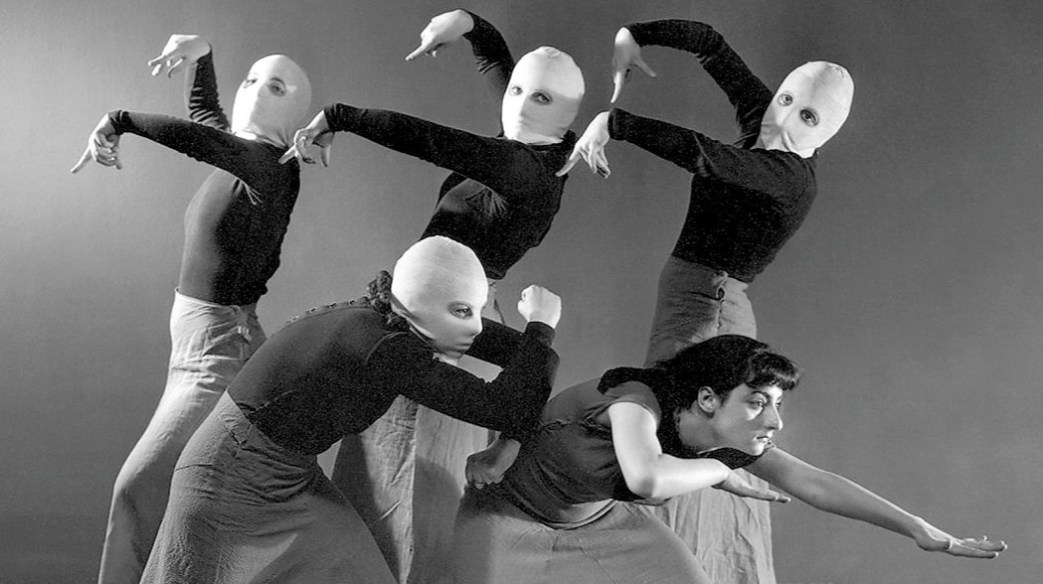
In reviewing the Workers’ Dance League’s 1934 competition, Eisenberg sees, with exceptions, the new revolutionary dance too much about, and not enough of, what it seeks to represent in the art form.
‘Diagnoses of the Dance’ by Emanuel Eisenberg from New Theatre. Vol. 1 No. 8. July-August, 1934.
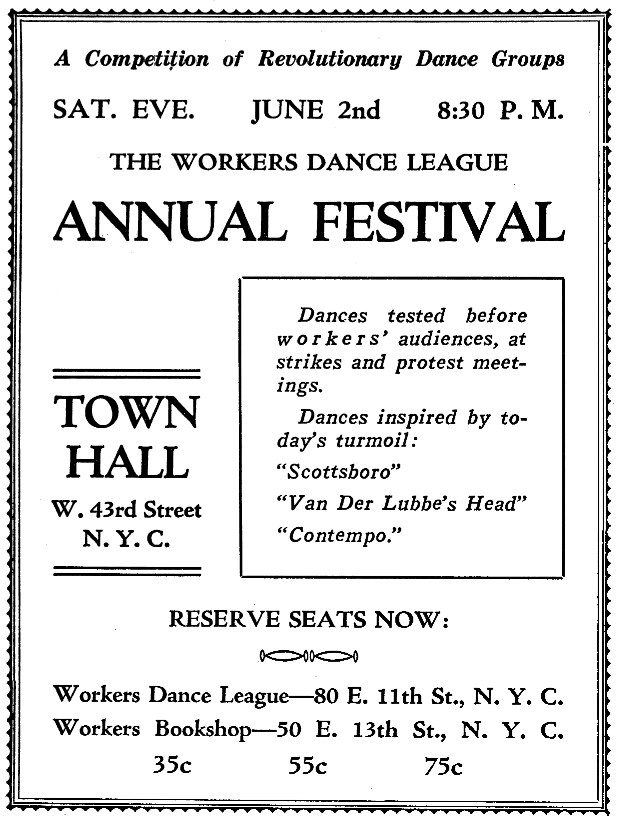
REVOLUTIONARY art is obviously not art which either announces, or depicts soberly in advance, the revolution; the completely automatic recording machine can do that just as well, and bourgeois artists are as slick at the game as any, if only because it is picturesque, dramatic and exciting. True revolutionary art demands an authentic and informed revolutionary point of view–and if I seem to labor a sheerly verbal truism, I plead as justification the occasion of their second annual Festival and Competition which the Workers’ Dance League gave in Town Hall on Saturday night, June 2, before a large and distressingly (but understandably) unenthusiastic audience of comrades and sympathizers.
Since none of the dance groups is more than two years old and most of them of far more recent origin, one is constantly and reasonably cautioned not to “expect too much.” The inevitable retort to that–at least from this highly concerned commentator–is that nobody expects anything from anybody: If a body of young workers is interested in preparing a theatrical presentation, either as dance or drama, and they need many months of rehearsal and experimentation and thinking through, it is doubtful if anyone would want them to perform before they feel ready. But once they reach the point of entering a public national competition and offering themselves as professional entertainers before large audiences, the natural and simple reaction is to evaluate them from the highest possible standards. And by these the evening of June 2 was a distinct and disheartening failure.
It would be manifestly unfair to maintain as a blanket indictment that the dances given were not out of or towards the revolution but around and about it; yet this is so close to the truth that the temptation to make a sweeping generalization is very strong. Out of twelve conceptions only the Van der Lubbe’s Head of the New Dance Group, the Comintern of the Red Dancers, and the Pioneer March of the Junior Red Dancers did not follow the pattern of the evening.
This pattern, broadly speaking, was along the following lines: Six or ten young women, clothed in long and wholly unrepresentative black dresses, would be discovered lying black dresses, would be discovered lying around the stage in various states of collapse. Soon, to the rhythm of dreary and monotonous music, they would begin to sway in attitudes of misery, despair and defeat. The wondering observer in every case was brought to the choiceless, if tired, realization that this must be the proletariat in the grip of oppression: not because that was one of the many decisions it was possible to come to, but because the program gave titles indicating both theme and contents–and the groups performing were known to have a revolutionary intent.
The swaying would continue for a couple of minutes in the rhythm of utter resignation…and then, a vision. Uprising. Revolt. Sometimes it came in the form of a light flooding suddenly from the wings of the balcony; sometimes in the form of sheer music intensity; sometimes as a dynamic figure in red, running passionately among the startled tragedians; once it was in the incredible person of a soapbox orator who moved both hands and mouth in an appallingly inept realistic parody. And always the group would respond with victory: hope had arisen, strength had come, freedom was won, the revolution had arrived. There was never any basis for the introduction of the new motif. Deadly swaying and intolerable oppression had gone on long enough, so a revivifier entered the scene and turned it from grave to gay. No problem of method. No transition. Break from your chains and go forth to the open world.
NOW this theme, considered purely as a theme, is certainly not a contemptible one: so much the opposite, in fact, that indignation and outrage arise precisely because a shockingly inane treatment makes it seem something that should possibly never be attempted by anybody. Yet, even in the recital under discussion, two groups managed to make something of it. But the Scottsboro of the Red Dancers and the Uprising of the New Dance Group were so weighted down and overshadowed by the rest of the evening that their nearness to dramatic truth and contextual convincingness was as nothing to the audience.
To depict oppression and persecution it is not enough to have young women teetering jerkily as burden-bearers. The nature of the burden cries for clarification; the origin of the attack must be vividly implied; the physical and moral effect (and not the hollow postures of resignation) demand to be communicated. For what possible value can it have to those not yet class-conscious and those not yet stirred to significant action to be shown a pageant of blank mourners having a very sad and distinctly unanimated time? What should be shown seems so glaringly plain that I hesitate to venture into literalism for fear of blundering into absurdity. Still, here are some suggestions of the specific aspects created by oppression and persecution in the world of work: terrified cringing; hypocritical lip-service; tubercular sweat-shop deformity; exhausting and etiolating field-labor; the twisted emaciation of overwork and underpay and undernourishment; the sheer jitters of uncertainty, humiliation, unpredictability, un-self-confidence. On the basis of such physical features and their cognates the dancer can proceed to choreographic symbols as broad and abstract as he pleases. So long as there is no departure from something intrinsic in our daily lives; so long as a serious and appreciable recognition can take place in the audience; so long as the picture made is instructive and dynamic and exciting and not a cross-section of post-oppressional phenomena given for their own drab sake.
A parallel criterion applies to the depiction of the arrival of the revolution. The revolution is not a bright white light nor suddenly violent music nor a street-corner orator nor even an active girl in a red dress. These are poetic simplifications which can be useful, in spite of their acute banality, as references to a known thing, as stenographic reminders of an undergone experience or a well understood concept. But, while it is valuable to tell your audience that mass congregation, mass rebellion and mass usurpation of power should be the immediate steps consequent to oppression and persecution, this is a ridiculously and fantastically inadequate configuration of the mere outlines of the revolution. Far from touching the revolution itself, far from seizing it and fixing it and projecting its innermost meaning, it offers a wholly useless sentimentalization of freedom or liberation or any “idealistic” vision anyone wants to put into it.
Constructively, then: how shall the revolution be choreographically conveyed? There must be symbols richer, truer and fuller than music, a color or a light. And there are. The revolution should be presented as a whole way of life rather than as a liberating vision from almost anything; it should be seen as a struggle, an upheaval, a reconstruction, a tremendous project. And, clearly, it is imperative to define the fighters as the proletariat–because, again, anyone might seem to be struggling for anything, with no intimation of the worthiness of the cause. We have, then, dancers who are definitely workers straining under the specific burdens and oppressions which workers know and which the audience will recognize as conditions surrounding their own existences (always as dance, of course always as meaningful movement). The burden grows beyond bearing and they strain forward to protest–or one of them, more alert than the others, brings an awareness of the possibilities of rebellion. When they rise, it must be unmistakably against someone, not merely out of the depths. When they mass together, it must be in a representative demanding body, not merely as an electrified group that is aspiring somewhere or other. And when they march into the revolution, it cannot be as a vaguely joyous aggregation surging toward the nondescript freedom of unrestricted territory, but as workers proceeding to a higher work, as builders, as executors of a large scheme, as informed and responsible sharers in the possession and the cultivation of the earth. Anything else is dreary bourgeois emotionalism and involves no more than an audacious superimposition of neo-revolutionary gestures on a decayed, juiceless and deceptively earnest body.
BUT all this lengthy talk is no more than preface to the full contents of the revolutionary dance. The theme of revolt against exploitation is a sound and important one; but surely it is only one and is far from meriting the misrepresentation of being almost the only idea which an evening of eight competitive workers’ groups will offer a hungry dance audience. What are further themes? As initial answer I point to the three dances of the evening at Town Hall–and a half-good fourth dance–which ventured into other paths than the easy ideational road of abuse-awakening-amalgamation-revolution. Pioneer March, done by the Junior Red Dancers, children from about five to eight, was lame and “cute,” but at least it had the quality of sheer community animation and cooperative joy. Comintern, one of the Red Dancers’ offerings, lacked color and vibration, but it, too, gave a stirring sense of the strength of organization in numbers and the cleanness of willing coordinated action. Van der Lubbe’s Head, the New Dance Group’s prize-winning dance, set its face in the highly laudable direction of current events and the blindingly vivid depiction not only of their literal actional values but of their political origin and their eventual significance. Contempo, the half-good dance, given by the Rebel Dancers of Newark, opened with a striking if completely naive and undeveloped motion picture of many different kinds of workers performing their various functions…and then went on to a tragedy-depression pattern. But its opening had at least revealed a fourth direction.
Group vitality, group power, dramatizations and analyses of political events, conversion of workers’ movements into designs of dancing; here, surely, are tendencies worth studying and cultivating and elaborating to the highest degree. They are just as much qualities of the drama as they are of the dance, it is true, but this is scarcely anything that militates against the employment of them for choreographic values.
And then, where is comedy, the happy depiction of small absurdities in the struggle toward revolution? Where is folk-legend (the Negro, the Indian, and the European races from which so many of us are so recently derived)? Where is folk-dancing? And where is satire, the ruthless exposure of bureaucracy, hypocrisy, pretension, affectation, benevolent despotism, disguised fascism, impotent socialism, fake and opportunistic “workers’ ” parties? Where is the heightened realistic visualization of what we demand of life and what we would like our world to do? The coming to class-consciousness, the observation of the specific evils around us, evictions, strikes, demonstrations, the training and reconditioning of children, the changing of “human nature,” the despair and futility of the church in the face of world crisis, the unabating pleasures of the rich, the mockery of legal procedure, the imprisonment of distributors of “insurrectional” literature, chauvinism, armaments, commercial ballyhoo, international relations, the mingled loathing and fear of Russia, the increase in naval and air fleets…all this could and should be authentic and exciting material for the revolutionary dance.
Any true projection of the countless motifs demands thorough familiarity with the life and demands of the worker, clear-headed grasp of the phenomena of the world directly around us, and an unwavering vision of the urgency of hastening–and the methods of producing–the revolution. Such a point of view can and must be developed by all of the groups that took part in the competition. For the most part they have’ a high degree of technique with the exception of the appallingly ungifted, untrained and inert New Duncan Group. All seem able to think. When they come to understand the emotional bourgeois origin of most of their otherwise admirable training, when they acquire a new body style that is directly related to the literal physical functions and the general psychological background of the workers of the world, and when they become completely documented on the decay of capitalism and the necessity for communism, then the revolutionary dance movement will begin to take on meaning.
The New Masses was the continuation of Workers Monthly which began publishing in 1924 as a merger of the ‘Liberator’, the Trade Union Educational League magazine ‘Labor Herald’, and Friends of Soviet Russia’s monthly ‘Soviet Russia Pictorial’ as an explicitly Communist Party publication, but drawing in a wide range of contributors and sympathizers. In 1927 Workers Monthly ceased and The New Masses began. A major left cultural magazine of the late 1920s and early 1940s, the early editors of The New Masses included Hugo Gellert, John F. Sloan, Max Eastman, Mike Gold, and Joseph Freeman. Writers included William Carlos Williams, Theodore Dreiser, John Dos Passos, Upton Sinclair, Richard Wright, Ralph Ellison, Dorothy Parker, Dorothy Day, John Breecher, Langston Hughes, Eugene O’Neill, Rex Stout and Ernest Hemingway. Artists included Hugo Gellert, Stuart Davis, Boardman Robinson, Wanda Gag, William Gropper and Otto Soglow. Over time, the New Masses became narrower politically and the articles more commentary than comment. However, particularly in it first years, New Masses was the epitome of the era’s finest revolutionary cultural and artistic traditions.
PDF of full issue: https://www.marxists.org/history/usa/pubs/workers-theatre/v1n08-jul-aug-1934-New-Theatre-NYPL-mfilm.pdf

