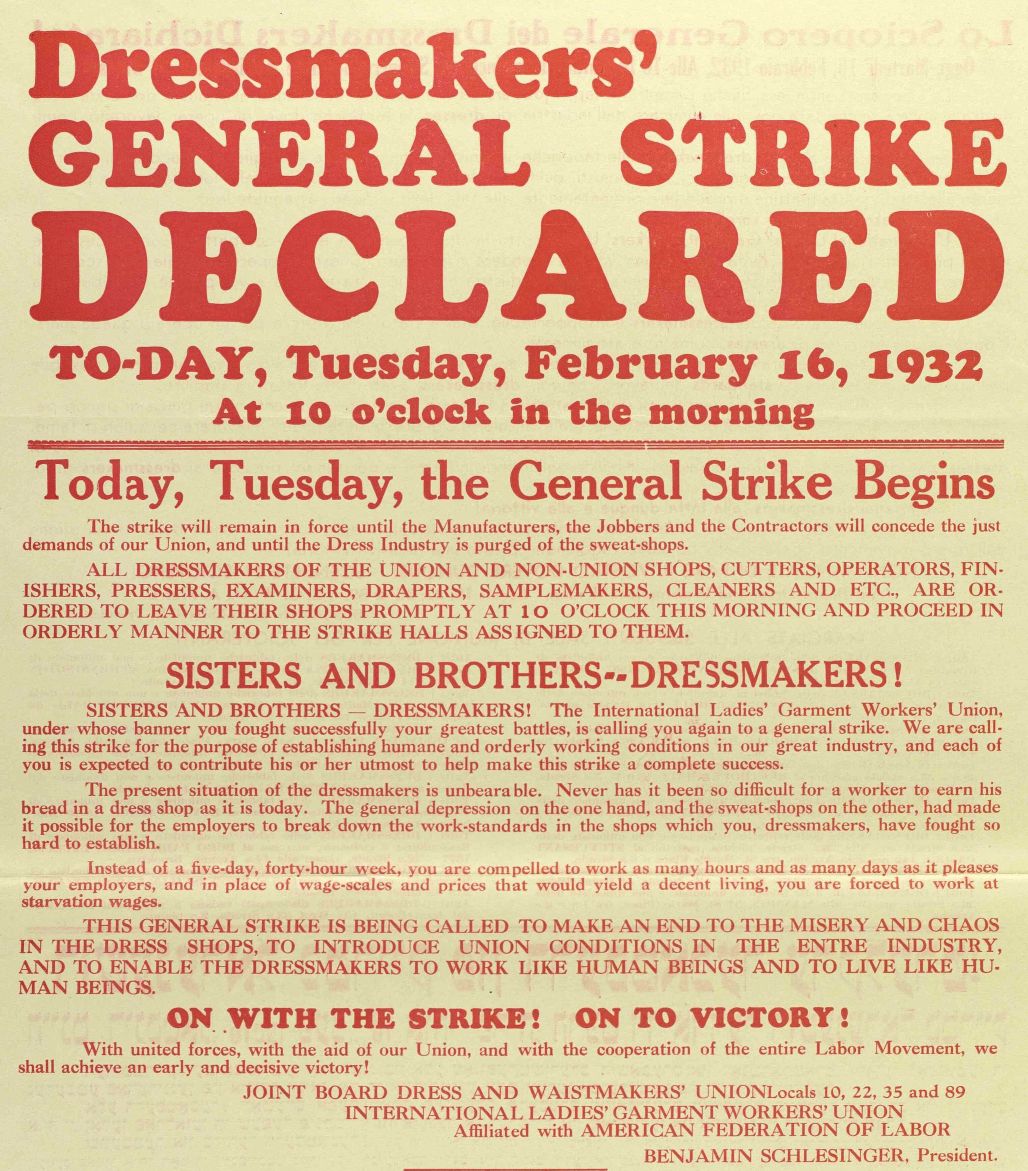
A progressive unionist evaluates 1932’s general dressmakers strike involving tens of thousands of New York City I.G.W.U. members.
‘The Dress Strike’ by Anna Kula from Labor Age. Vol. 21 No. 3. March, 1932.
COMPLETE chaos reigned in the dress industry prior to the present strike. Union conditions were not enforced. Very few dressmakers received the union scale of wages. The manufacturers were in a position to cut wages and worsen conditions at their own sweet will. To a large extent this was due to the failure on the part of the International to defend vigorously the conditions of the workers against the onslaughts of the manufacturers. Unionism became a meaningless word in the industry. Conditions became so bad that a revolt was inevitable.
During the past year dissatisfaction within the International Ladies Garment Workers Union had crystallized chiefly in three important local unions, namely, Locals 1, 9 and 22. A group of progressives, consisting largely of Anarchists, managed to make deep inroads in the administration of these three locals. It was the aim of this group to re-establish union conditions in the industry through more militant struggle than had characterized the present administration of the International. It was this progressive group in Dressmakers Local 22 which carried the chief burden of the Jimmie Higgins work during the present strike and which was its driving force.
The struggle was opened with a rousing mass meeting at Mecca Temple on Thursday, February 4, in which 12,000 dressmakers packed the hall to the rafters. This meeting gave its unanimous endorsement to the strike call, in the spirit of a determined war to wipe out the sweat shop and sweat shop conditions. The strike call was issued by the International on Monday, February 15, and on Tuesday morning at 10 A.M. dressmakers swept in a huge mass from the shops. It is estimated that from 15,000 to 20,000 responded to the strike call within a few days. Not in years has there been such eagerness for the struggle among the needleworkers. The registration clerks were swamped by the rush of the workers to join the International. In spite of the wholesale arrests and ruthless brutality of the police, the picket demonstrations reached such proportions that the garment district was tied up for hours at a time. When a shop came down, it brought down a host of other workers in sympathy. The workers showed a splendid spirit of self-sacrifice and militancy.
Meanwhile conference after conference with the employers was broken up. The employers demanded 10 per cent reorganization, additional wage cuts, no payment for holidays, Saturday work, no extra pay for overtime; demands which would have meant the complete surrender of union conditions in the industry. The militancy and sweep of the struggle forced the manufacturers to enter into negotiations almost immediately in order to arrive at a settlement. Here it must be said that the International officials, by too early talk of a settlement, tended to weaken the militancy of the strike and the picket lines before the strike had been consolidated to its maximum strength. It is conservatively estimated that another 10,000 could have been brought out on strike if the earlier momentum had been maintained. In fact, after the first big demonstration, estimated as including from 10,000 to 15,000 workers, the officials of the International did not encourage further demonstrations of this character, and seemed inclined to discourage such displays of militancy.
On Friday, February 25, the Affiliated Dress Manufacturers settled with the International, and the agreement was later approved at the meeting of shop chairmen and the membership. According to this agreement, the demand for Io per cent reorganization was partially rejected. At the end of the season, should employers seek to reduce their number of employees, and should permission be granted by the Joint Board, then workers will be permitted to draw lots as to who should remain, which is an acceptance of the principle of reorganization.
Although the agreement is said to include a guarantee of $1.10 minimum an hour, the enforcement of this rate will depend largely upon the future activity, alertness and determination of the union officials in protecting the workers’ wage scales.
The waiting period for setting prices on garments is cut down from five days to two days, which is a definite gain.
The union reserves the right to protest against Saturday work, but if the impartial chairman agrees to allow it, extra compensation is to be paid.
No mention is made of overtime.
In general, the gains involved in this agreement are highly problematical, depending largely upon the union’s ability to enforce its demands through effective action after the agreement is signed. The fact that the union has gained enormously in members might help in this direction, if the workers are not too greatly disappointed at the failure to make more substantial gains and a more watertight settlement. A settlement with the contractors and the jobbers is expected momentarily.
With the spectacular showing made at times in the strike, with its ability to exploit left elements for this purpose, including the Anarchists, the progressives and the Communists (Majority Group), the conservative International officialdom may have rehabilitated itself somewhat in the eyes of the membership and, what is more important for them, raised the income of the union through the increase in dues payments from the membership. To what extent the standing of these officials will remain, depends largely upon what will happen in the shops after the agreement is signed, to what extent the union will show itself able to withstand the post-strike attack of the manufacturers upon the standards of the workers, and to what extent they are able to hold and educate the new, young militant elements to the principles of honest, fighting unionism.
The Communists (Majority Group) have succeeded in taking the lead in criticizing the attitude and policies of the conservative officialdom, and, thereby, have won a certain support from the workers. This is partly due also to the hanging back of the progressives and the Anarchists who perhaps from motives of fear or passivity have displayed little initiative in this direction.
This is a most unfortunate development. The so-called Majority Group is still carrying on active negotiations toward unity with the official Communist Party, and the attitude of this group toward the I.L.G.W.U. and the Industrial Union, towards which it still casts frequent and friendly glances, makes them an unreliable and uncertain factor. What is needed is the crystallization of a genuine militant progressive trade union group within the International and with no tendencies toward or relationships with the so-called “Industrial Union.”
As far as the Communist Industrial Union is concerned, at no time in its entire history was its total lack of influence and prestige shown so markedly as in this strike. In fact, where they did succeed in pulling down a shop, the workers registered with the International.
Manifestly the future belongs to the progressives, provided they organize and speak out.
At this moment, while the workers are waiting for the three day period, during which prices are to be set, they are witnessing, with much demoralization and discouragement, the fact that the cutters of Local 10 are working furiously turning out work, which there is a strong possibility will be sent to out-of-town non-union shops. The fact that Local 10 is permitted to do this by the International constitutes a blow to the workers and threatens to destroy the possible gains of the strike. The progressives who did the bulk of the work in the strike and who were responsible for its early militancy have been left in the lurch by the International to face the disheartened and disgusted dressmakers.
Labor Age was a left-labor monthly magazine with origins in Socialist Review, journal of the Intercollegiate Socialist Society. Published by the Labor Publication Society from 1921-1933 aligned with the League for Industrial Democracy of left-wing trade unionists across industries. During 1929-33 the magazine was affiliated with the Conference for Progressive Labor Action (CPLA) led by A. J. Muste. James Maurer, Harry W. Laidler, and Louis Budenz were also writers. The orientation of the magazine was industrial unionism, planning, nationalization, and was illustrated with photos and cartoons. With its stress on worker education, social unionism and rank and file activism, it is one of the essential journals of the radical US labor socialist movement of its time.
PDF of full issue: https://www.marxists.org/history/usa/pubs/laborage/v21n03-mar-1932-labor-age.pdf

