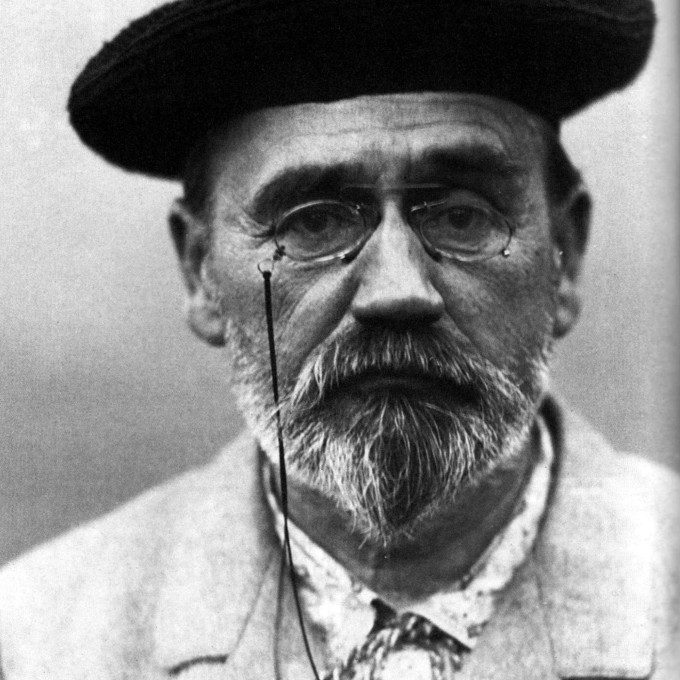
Reading Zola’s Germinal as a teenager was a life-defining experience for me, as it has been for many thousands like me. Images and passages remain alive decades later and are evoked often by daily life. Paul Friedländer pays tribute on the 30th anniversary of the French master’s death.
‘Emile Zola’ by Paul Friedländer from International Press Correspondence. Vol. 12 No. 43. September 29, 1932.
(On the Thirtieth Anniversary of his Death.)
In the night of September 28. 1902, the great writer Emile Zola died at the age of 63. His life was cut short just when he was working on a new series of social novels, in which there should ripen the fruit of his development into a critic and accuser of bourgeois society, into a champion of Socialism.
Zola, who was born in Paris on April 2, 1840, after a carefree childhood spent in the South of France, had to fight hard for years for his profession and his bread. When he was 25 years old, he decided to devote his life to a great literary work: to write the epos of the bourgeois society of his time. He carried out his plan with tenacious energy. The sensational success of his novels brought him also material security, so that he could devote himself wholly to this work. After the conclusion of a 20-volume series of novels, the “Rougon-Marcquart”, he came to be regarded as the representative epic writer of bourgeois France.
It was the Dreyfus case which made him from an artist into a fighter, from an observer into an accuser. His famous Open Letter to the President of the French Republic, “J’accuse”, had the effect of a bombshell. It was an indictment of the French Republic and of its military and judicial apparatus. Zola was aware of the tremendous effect his letter would have. He himself declared at the conclusion of his indictment: “The act which I accomplish is a revolutionary means in order to accelerate the explosion of Truth and Justice”. The effect of his action was enormous. There set in an unsurpassed incitement against Zola and his fellow-champions. He was sentenced to imprisonment and had to go into exile. Then the Supreme Court, which could no longer withstand the exposures and proofs, cancelled the verdict against Zola. Zola himself, who during his earlier creative period refrained from any statement of political views and, together with the so-called naturalist school, had condemned the political writer, now became a conscious critic of society: He drew the consequences from his already completed work, in which were described the conditions of bourgeois society. Death prevented him from completing his second great work.
In his recently published book on Emile Zola, Henri Barbusse sets himself the task of examining the life work of Zola in regard to his importance for our time and making clear to the present generation: “the plain appeal which Zola’s life speaks”.
Zola’s life synchronised with the flourishing period of the capitalist social order. He was witness to the “joie de vie” and orgies of the prosperous bourgeoisie, and he saw at the same time how there was germinating in its womb the seeds of its disintegration. Zola came to realise bourgeois society not from the social classes and their struggle, but from the individual, from the family and their fate. Thus he lacked the key to the historical meaning of the time in which he lived and which he portrayed. Nevertheless he was able to produce in rich colours and in epic breadth a colossal work dealing with the life and fate of a family, which rounded off into a picture of society.
The epoch-making, in fact in many respects revolutionary, importance of Zola’s novels arises, as we can so rightly recognise today, less out of the form than out of the content. The substance, that was that enthralling and stirring “enquiry”, in the form of a novel, into the natural and social history of a family in the second Empire, a family which branched off into all classes and strata of society. Thus the great series of novels became a rousing document that discovered the new land of social literature. The substance, therefore, gave the historical value to his work; it determined also the artistic presentation and not vice versa.
This statement that Zola’s breaking through the conventions of the novel resulted from the substance of his work, is most convincingly confirmed by the fact that precisely those novels of his dealing with the Rougon-Marequart family had a rousing, in fact sensational, effect, they tore aside the curtains from certain conditions in bourgeois society which up to then had remained hidden. It was the novel “L’assommoir” (Drink) which made Zola famous at one stroke. Zola’s success, however, was not a case of luck. It was much rather the merited success of a discoverer. In “L’assommoir” he discovered the working class, their environment, their life, their cares and sorrows. It is not of decisive importance that Zola only succeeded in penetrating the slum quarters and the haunts of drunkenness, and passed over the class conscious and fighting workers. It was not until much later that there dawned on him the problem of class society. Nevertheless, and this is the important thing, Zola’s description of the misery and collapse of the worker Coupeau and his wife Gervais had a stirring effect on broad masses and led them first to an understanding of the social struggles of the present.
Zola’s novel of the life of the miners, “Germinal”, was a further and bold advance into the social new land. Even if here also he went to work with painful reserve in order not to write as a moralist and politician but only as an epic writer, he could not do otherwise than lay his finger on the frightful social wounds and involuntarily–in describing the strike–wrote as a moralist, in fact as a socialist.
Zola reached the pinnacle of his fame with his novel “Nana”. On the day it appeared 55,000 copies were sold. This success also is not surprising. In scarcely any other work does Zola describe so drastically the rottenness and commencing disintegration of bourgeois circles as in this book. This novel had above all a disintegrating effect on the whole of bourgeois society and shook the self-confidence of the bourgeoisie, whilst it inspired its grave-diggers with courage.
Zola’s series of novels on the Rougeon-Marquart family and his later works, “Three cities”, “Lourdes”, “Rome” and “Paris”, already permeated with social criticism, are in spite of Zola’s lack of Marxist perception, a piece of historical materialism in the form of art. This perception came to Zola himself at the time when the fight against naturalism became the slogan of the French literary world, and when he was abandoned by his fellow-writers. “Fight against naturalism” was, of course, only a concealing slogan; behind it there was hidden reaction. The clinging to bourgeois society, the defence of the Church, barracks and exploitation, led to the fight against naturalism, behind which there was rightly scented, socialism and revolution. Zola did not give way here. The Dreyfus affair, in which the corrupt system of the bourgeois State produced a blossom of a special kind, converted Zola into a socialist and fighter.
At the end of his life Zola had advanced so far that he declared: “After a long portrayal of reality it is now necessary to work for the morrow.” In his novel “Work”, he shows the aim: the organised socialist society. He wanted, however, to point the way. He declared: “On the one side the Conservatives, the people of the past, on the other side the people of the future, the Revolutionaries.” He wished to throw in his lot with the revolutionaries. The book on which he was engaged when death took the pen from his fingers was to help to open a new period of the fight of the working people.
International Press Correspondence, widely known as”Inprecorr” was published by the Executive Committee of the Communist International (ECCI) regularly in German and English, occasionally in many other languages, beginning in 1921 and lasting in English until 1938. Inprecorr’s role was to supply translated articles to the English-speaking press of the International from the Comintern’s different sections, as well as news and statements from the ECCI. Many ‘Daily Worker’ and ‘Communist’ articles originated in Inprecorr, and it also published articles by American comrades for use in other countries. It was published at least weekly, and often thrice weekly. Inprecorr is an invaluable English-language source on the history of the Communist International and its sections.
PDF of full issue: https://www.marxists.org/history/international/comintern/inprecor/1932/v12n43-sep-29-1932-Inprecor-op.pdf

