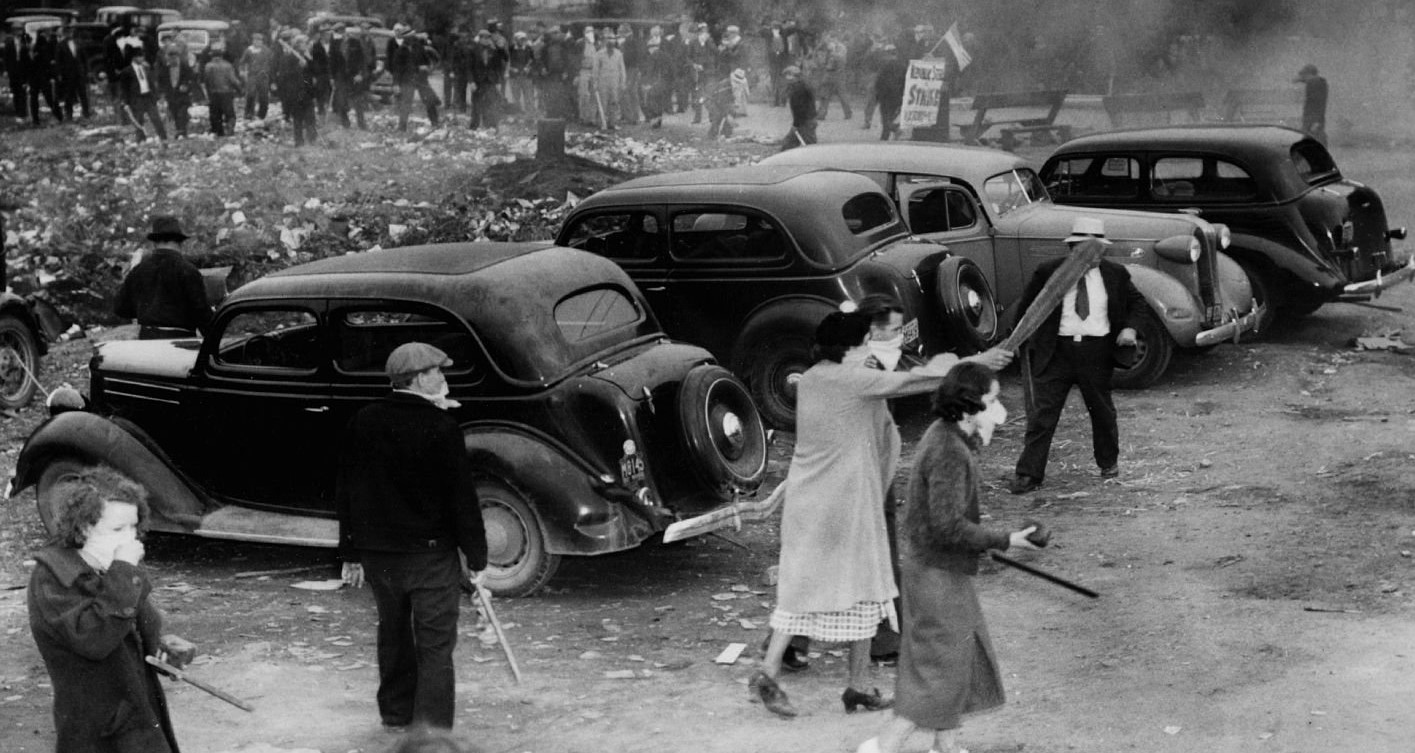
Women’s Auxiliaries were a feature of C.I.O. organizing among drives at male-dominated work-places, with the Steel Workers Organizing Committee among the strongest and most effective.
‘Organizing Steel Auxiliaries’ by Mineola Ingersoll from Woman Today. Vol. 1 No. 11. March, 1937.
Director Women’s Activities, Calumet Area, Steel Workers Organizing Committee
ALMOST DAILY the women’s auxiliaries in the Chicago steel region receive letters from Michigan, Pennsylvania, Arkansas and other States, asking how we organize the wives, daughters and sisters of steel workers. Notes, hastily written in Croatian, Polish or English, indicate that women everywhere are eagerly snatching a few minutes from their washing or cooking to find out how they can assist their menfolks in getting security and happiness.
In workers’ homes it is the women who manage to eke out for the family the bare existence that wages permit today, for they are chiefly responsible for solving the problems of feeding, clothing and educating the children, in the face of rising prices. In many instances it is the woman who decides whether or not the man will join the union. Not educated to the economic value of the union, the wife often says, “We cannot afford this dollar.” Many of our best volunteer organizers admit they kept their husbands out of the steel unions before they knew what it meant to be organized.
Our auxiliaries are being organized in the great drive of the Steel Workers’ Organizing Committee. We affiliated with the Amalgamated Association of Iron, Steel and Tin Workers, which is becoming the industrial union in steel.
How do we go about organizing the women? The men’s local must take an interest in this work. After passing resolutions to form auxiliaries to their particular locals, committees of men are appointed to assist the women. Union members are urged to tell their wives and daughters of the importance of this work, also when and where the auxiliary meets.
IN THE BEGINNING small groups may meet in homes, but it is better for the organizing committee to select some neutral place, a centrally located hall. At first there may be fear or dislike of the union hall. If only a few women respond, the auxiliary should be immediately organized. Many times one woman may belong to a large organization, social or civic, that can be committed to support the union.
Under the Steel Workers’ Organizing Committee, both the union and the auxiliary must organize without regard to race, color, creed or nationality. Those same steel barons who exploit the Mexican, Polish and Negro worker exploit alike the native born American workers. Real collective bargaining and all its benefits will come only through one powerful, industrial union.
At the second meeting at least temporary officers should be elected to permit the organization to function. The first officers may be: President, Vice-President, Recording Secretary, Treasurer, Financial Secretary (these two may be combined). Also a social chairman and a reporter.
Charters are secured through the local union, if proper blanks are filled out and submitted. Any woman over sixteen years of age and of good moral character is eligible for membership in the steel auxiliaries. No initiation fees or dues are required for membership. Eligibility, dues, initiation, etc., vary according to the rules of each particular union or auxiliary.
Two meetings a month, on alternate weeks, prove best in most cases, with one a business meeting, the other social. Occasionally joint meetings and joint socials of union and auxiliary are held, helping to build up attendance and further good relationship between both organizations.
The business meeting deals with matters of interest to the welfare of the union and auxiliary. It is the auxiliary’s first duty to aid the union in all possible ways. For instance, our most important point now is the organizing of the men into the union. By building the union, we build the auxiliary. We visit wives of steel workers, address other organizations, explaining what unions mean in terms of better homes, security and education.
ONE OF THE steel auxiliaries organized a conference of women’s organizations–trade unions, fraternal, civic, social and neighborhood groups, to acquaint them with the purpose of the drive and enlist their support. A friendly committee, representing various community organizations, was set up, meeting monthly to discuss ways and means of broadening the campaign.
Irregular shifts of their husbands’ work virtually tie the women to the kitchen. The company saves money by constantly changing the shifts. The women enlist public support of the men’s demands for better conditions. Sometimes it is impossible for mothers to leave their children for meetings. Auxiliaries may be able to secure teachers from the educational division of the W.P.A. for a nursery school. If not, certain members may be induced to supervise the children.
COMMITTEES must always be chosen to see that resolutions are carried out. The membership committee, perhaps under the vice-president, plans ways of getting new members and checks on attendance of old members. When committees report at business meetings, the whole membership shares the responsibility for the success of the work. The social chairman is assisted by a committee, likewise reporting to the meeting. The financial secretary keeps strict account of every penny going in and coming out, making monthly reports, with her books always ready for inspection. The reporter or publicity chairman sends news to the union paper and the local press.
When a sufficient number of auxiliaries within a given territory are organized, a council, made up of the principal officers of each local, may be set up to direct and coordinate general activities.
The American Federation of Women’s Auxiliaries of Labor estimates that approximately six billion dollars of union- earned money is spent annually by women members of union homes. Wives and relatives of union men should insist on the union label, patronizing those companies supporting labor’s demands.
Steel auxiliaries are in the fight against the increase in Chicago gas rates, a campaign being developed by a united conference of Chicago women’s organizations.
We women of steel are determined to become, as someone has said, a human dynamo, generating union spirit, helping our men build a strong and powerful union, the Amalgamated Association of Iron, Steel and Tin Workers, so that we, in the words of Mr. Van Bittner, may live the life we want to live and not the life the corporation wants us to live.
The Working Woman, ‘A Paper for Working Women, Farm Women, and Working-Class Housewives,’ was first published monthly by the Communist Party USA Central Committee Women’s Department from 1929 to 1935, continuing until 1937. It was the first official English-language paper of a Socialist or Communist Party specifically for women (there had been many independent such papers). At first a newspaper and very much an exponent of ‘Third Period’ politics, it played particular attention to Black women, long invisible in the left press. In addition, the magazine covered home-life, women’s health and women’s history, trade union and unemployment struggles, Party activities, as well poems and short stories. The newspaper became a magazine in 1933, and in late 1935 it was folded into The Woman Today which sought to compete with bourgeois women’s magazines in the Popular Front era. The Woman today published until 1937. During its run editors included Isobel Walker Soule, Elinor Curtis, and Margaret Cowl among others.
PDF of full issue: https://www.marxists.org/history/usa/pubs/wt/v1n11%20%2812%29-mar-1937-women-today.pdf

