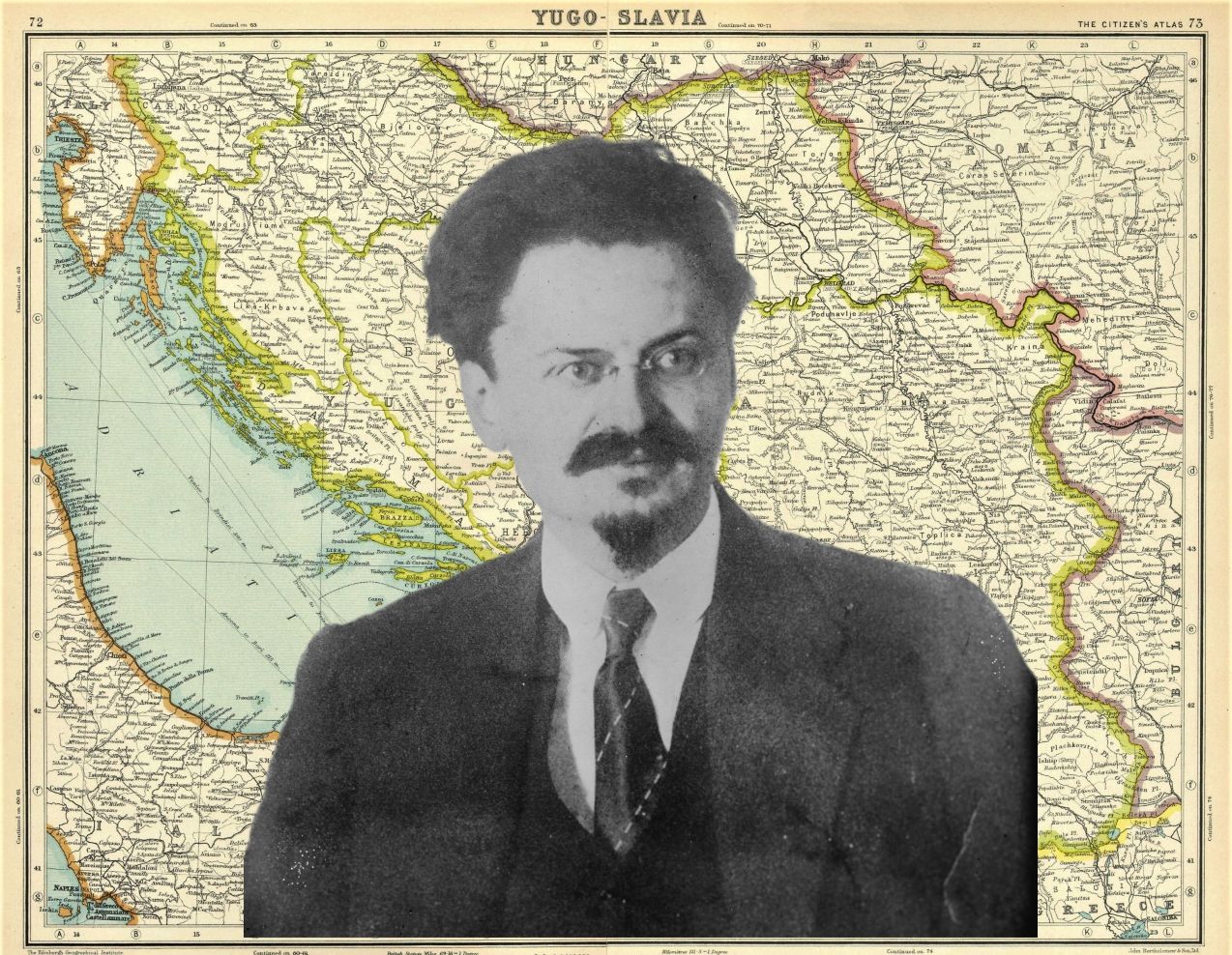
While en route to the Red Army front fighting Wrangel, Trotsky greets the newly-named Communist Party of Yugoslavia. Their conference in Vukovar in June, 1920 saw the Left win decisively, bringing the Yugoslav party firmly into the Third International. Eight years earlier, Trotsky had covered the Balkan Wars extensively as a journalist for a Russian newspaper. Based mostly in Sofia where he worked closely with Christian Rakovsky, a central figure in the Balkan workers’ movement who would be a founder of the Third International and become head of Soviet Ukraine.
‘Letter to Yugoslav Communists’ by Leon Trotsky from Truth (Duluth). Vol. 3 No 186. January 21, 1921.
Dear Comrades,
Comrade Milkitch has sent me copies of your letters and replies. On my way to the South front, where a decisive struggle will shortly take place against Wrangel, I had an opportunity to make a close study of your letters. Reading these letters recalled to my mind the atmosphere of the Yugo-Slavian, and more especially, of the Serbian Labour movement.
The Balkan war, they may say, served as an overture and introduction to the great world-slaughter. Socialists were tested then, for the first time, as to their loyalty to the socialist banner. The Serbian party suffered from internal differences and vacillation. But these differences were not given full play and, as far as I know, were more or less smoothed over on the conclusion of peace. It was obvious that Kantzlerovith was in favour of social-patriotism. The attitude displayed by Laptchevitch was one of firmness and resolution, and I was most grieved to learn that in the movement of today Laptchevitch represents not the future but the past. The bitter struggle cost us many friends. Some suffered actual death; others only perished morally.
Of those who fell in the struggle I call to mind first of all the image our friend Dmitri Tutzovitch. His loss is felt even today by the movement in Jugo-Slavia and the Balkans. This man was made of good material material. Firm, undaunted, capable and self-confident, Tutzovitch seemed created specially for the epoch upon which humanity has entered at his time. It is the greatest of misfortunes that he died before he could enter even the threshold of the new era.
Dushan Popovitch is another whose absence from amongst us we must regret. I am well aware that he was no stranger to social patriotic vacillations. But something tells me that this loyal warrior, this young and talented journalist, possessor of a strong and penetrating mind, would be with us on the side of revolution and of Communism.
But I am glad to find among the leaders of the communist movement of Yugo-Slavia a number of comrades, whose names I have known since 1912. I shall not mention any of these names, for that might put our comrades in danger from the Yugo-Slavian authorities.
I am not so well acquainted with the movement in the old Slavonic provinces of the Hapsburg Empire. But in order to form a clear conception of this movement, it is sufficient to know that the socialist organizations of these provinces used to reflect the general spirit of Austrian social democracy, i.e. the spirit of cowardly conformity with the will of the ruling classes, legality at all costs, reformist illusions, and chauvinist prejudices.
From the words of comrade Rakovsky I have become acquainted with the fact that the leaders of the socialist movement of Transylvania have introduced into the United Roumanian Socialist Party a spirit of the meanest sort of parliamentary opportunism. I gather from your letters that the old leaders of the Labour movement of Croatia, Slovakia, and Bosnia are imbued with the poison of social-patriotism. You are carrying on a decisive struggle against these traitors and, as is usually the case, the masses are on your side. The best witness to this is your last Congress at Voukovar. The Central Communist Party which numbers over 60,000 members represents a great power in Yugo-Slavia, where the bourgeois parties of the various provinces are in opposition to each other, and are weakened by internal conflicts. The Trade Union organization in Serbia was, prior to the war, under the influence of the Social-Democratic Party. Ot the present time, as far as we can judge from your letter, the Communist Party of South Slavonia is gaining and holding influence over the Trade Unions, which unite 150,000 working men and women. As far as can be inferred from this your movement seems to be pursuing correct revolutionary tactics.
During the Imperialist war, the cry for “Emancipation” for Serbia from the Austro-Hungarian yoke played an important part in the agitation carried on by Anglo-French Imperialism, that is to say, in the deception of the workers. As result of the war Serbia has grown larger. She has increased a territory at the expense of provinces that formerly belonged to Austro-Hungary and Bulgaria, thereby becoming Yugo-Slavia. But little Serbia was never in such servile dependance upon Austro-Hungary as Yugo-Slavia is now upon France and the Entente generally. Yugo-Slavia victorious is not less exhausted than her vanquished enemies. And it must be added that, had the economic revival of Europe been possible under the capitalist system, the development of Yugo-Slavia Bulgaria, Hungary and Austria would inevitably have led to a new and bloody encounter between these countries. Only a socialist revolution in the Balkans and in Central Europe can create conditions necessity for a peaceful revival of economic development among the labouring masses of Yugo-Slavia. Only a Balkan Soviet Federation, closely connected with the Federation of Central Europe, will give an opportunity to the various nationalities of this territory to combine their forces their forces in peaceful collaboration, instead of tearing each other to pieces.
The proletarian revolution is making rapid progress. It is at the present time in need of a strong, unanimous fighting labour organization. You are making every effort. Comrades, to create such an organization. In the name of the approaching Proletarian Revolution, I greet tree fraternal Communist Party of Yugo-Slavia,
L. TROTSKY.
October 10, 1920, Kharkoff.
Truth emerged from the The Duluth Labor Leader, a weekly English language publication of the Scandinavian local of the Socialist Party in Duluth, Minnesota and began on May Day, 1917 as a Left Wing alternative to the Duluth Labor World. The paper was aligned to both the SP and the I.W.W. leading to the paper being closed down in the first big anti-I.W.W. raids in September, 1917. The paper was reborn as Truth, with the Duluth Scandinavian Socialists joining the Communist Labor Party of America in 1919. Shortly after the editor, Jack Carney, was arrested and convicted of espionage in 1920. Truth continued to publish with a new editor J.O. Bentall until 1923 as an unofficial paper of the C.P.
PDF of full issue: https://www.mnhs.org/newspapers/lccn/sn89081142/1921-01-21/ed-1/seq-1
 Revolution's Newsstand