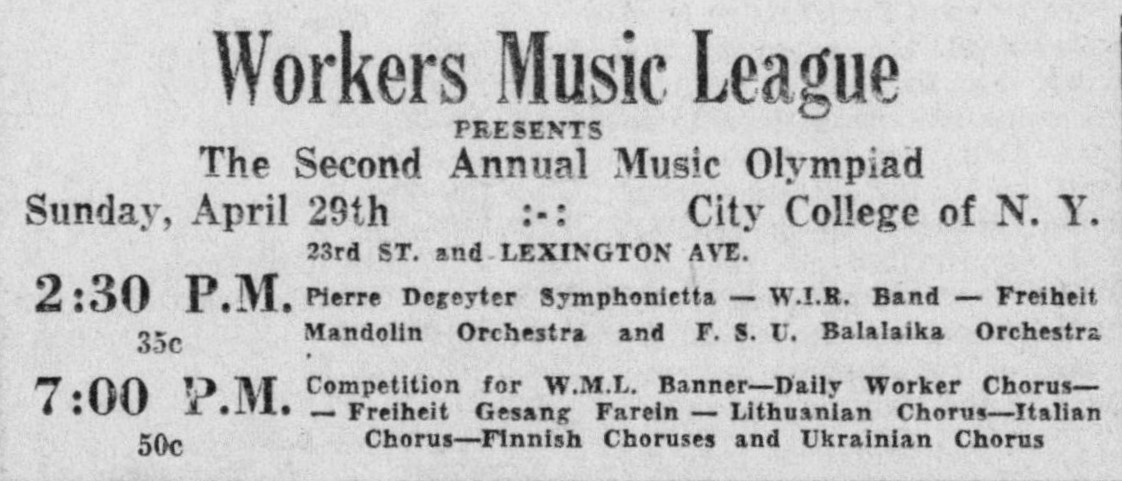
Larkin reviews recent publications of the Workers Music League.
‘Revolutionary Music’ by Margaret Larkin from New Masses. Vol. 8 No. 7. February, 1933.
The Worker Musician—Official organ of the Workers’ Music League, Volume 1, Number 1.
Red Song Book: edited by the Workers’ Music League, International Publishers. 15 Cents.
Music is the most abstract of the arts, and good musicians usually dig themselves a pit when they attempt expression of their ideas in another artistic medium—language.
This may be the only fault of the new magazine, “The Worker Musician.” The editors and authors are musicians, obviously not at home in words. They have valid and exciting things to say about music and its relation to the class struggle, but one must be a sympathetic and well informed reader to snatch them from these pages.
Evidently the editors themselves are not clear as to who their readers will be—a common failing in young magazines. The material of the magazine is specialized, seemingly intended for worker-musicians and for workers who are interested in music and have some knowledge of it. Yet the general style of most of the articles is elementary, not to say childish. The best sections are those which report musical news of the revolutionary movement—the column “On the International Music Front”; a vivid description of the singing masses at the Madison Square Garden campaign meeting; the story of Pierre Degeyter and the writing of The Internationale; the correspondence from worker choruses. The poorest bit is a “humorous” column called “The Lost Chord,” which details petty gossip of the bourgeois musical world in the “Better-watch-your-step,-Lem,” manner of the country weeklies.
The ambitious leading article, signed by the editorial board, is an attempt to contrast musical history in America and in Russia during the past fifteen years, and to relate it in each country to social and economic background. It contains some interesting facts and conclusions that succeed in impressing the reader in spite of bad writing, bad organization, and quite unnecessary over-politicalization. Surely the causes of the capitalist crisis might have been taken for granted in a discussion that needed only to refer to the fact in order to draw its conclusion, The discussion of musical gains in the Soviet Union should have included mention of the important work being done by the Russian composers for the cinema—that strong arm of proletarian culture.
The publication of a new revolutionary song with piano accompaniment is a valuable feature.
The magazine presents a most attractive physical appearance. Its publication is an indication of increasing strength on the cultural front and as such it should be welcomed.
Certain literary shortcomings are also evident in the League’s editing of the Red Song Book. A workers’ song book is always a cause for rejoicing, and this one is particularly valuable. It includes the melodies for all songs; many songs are arranged for part singing; it will be equally useful to individuals and to choruses. There are no piano accompaniments, but considering what their inclusion would have meant in costs, this lack may well be supplied in some supplementary fashion. Words and music are beautifully printed, and the booklet is substantial enough as to paper and binding to stand plenty of use.
The Red Song Book presents the old songs that every class conscious worker wants to know and introduces some new ones. Some of the new songs, such as Comintern and Stand Guard have been written by professional musicians and poets. These are much more stirring as to music than as to words. The lyrics are full of awkwardly expressed slogans strung together with careless regard for meter and no regard for poetic quality.
A half dozen songs that have arisen from mass struggle are the most significant contribution of the Red Song Book. These songs stem from native American folk song traditions, both musically and poetically. They are a direct and vigorous expression of the revolutionary spirit of large masses of American workers.
In introducing them, however, it would have been wise to preface them with more explanation of their origins, in order to make them comprehensible to foreign-born workers who are not accustomed to the idiom of the American folk song. People like to know something about the songs they sing, as the editors tacitly admit in labelling one song as Lenin’s favorite.
Workers confronted for the first time with the Miners’ Song would be interested in knowing that some proletarian poet (I suspect Aunt Molly Jackson) founded it on an old Southern folk song. And who wrote the Minders’ Flux and set it to the militant old tune, The Wearing of the Green? And why not a word about the martyred Ella May Wiggins, gifted poet of the Gastonia strike, who wrote the I.L.D. song and twenty more, and is immortalized in other ballads by other Southern workers? Would it not even add interest to the familiar Picket on the Picket Line to know that it was written for the young pioneers in the Passaic strike of 1926 and was swept into popularity by its witty words and catchy old American tune. The Soup Song of the Detroit unemployed is also founded on American traditions and is a fine example of the kind of song that workers like to sing.
The Workers’ Music League editors should be applauded for including these songs, and should not take too much to heart the condescending comment of the reviewer in their own magazine, on the “immaturity” and “arrested development” of the American folk melodies, which he attributes to the “exploitation of the coat barons.”
The New Masses was the continuation of Workers Monthly which began publishing in 1924 as a merger of the ‘Liberator’, the Trade Union Educational League magazine ‘Labor Herald’, and Friends of Soviet Russia’s monthly ‘Soviet Russia Pictorial’ as an explicitly Communist Party publication, but drawing in a wide range of contributors and sympathizers. In 1927 Workers Monthly ceased and The New Masses began. A major left cultural magazine of the late 1920s and early 1940s, the early editors of The New Masses included Hugo Gellert, John F. Sloan, Max Eastman, Mike Gold, and Joseph Freeman. Writers included William Carlos Williams, Theodore Dreiser, John Dos Passos, Upton Sinclair, Richard Wright, Ralph Ellison, Dorothy Parker, Dorothy Day, John Breecher, Langston Hughes, Eugene O’Neill, Rex Stout and Ernest Hemingway. Artists included Hugo Gellert, Stuart Davis, Boardman Robinson, Wanda Gag, William Gropper and Otto Soglow. Over time, the New Masses became narrower politically and the articles more commentary than comment. However, particularly in it first years, New Masses was the epitome of the era’s finest revolutionary cultural and artistic traditions.
PDF of full issue: https://www.marxists.org/history/usa/pubs/new-masses/1933/v08n07-feb-1933-New-Masses.pdf

