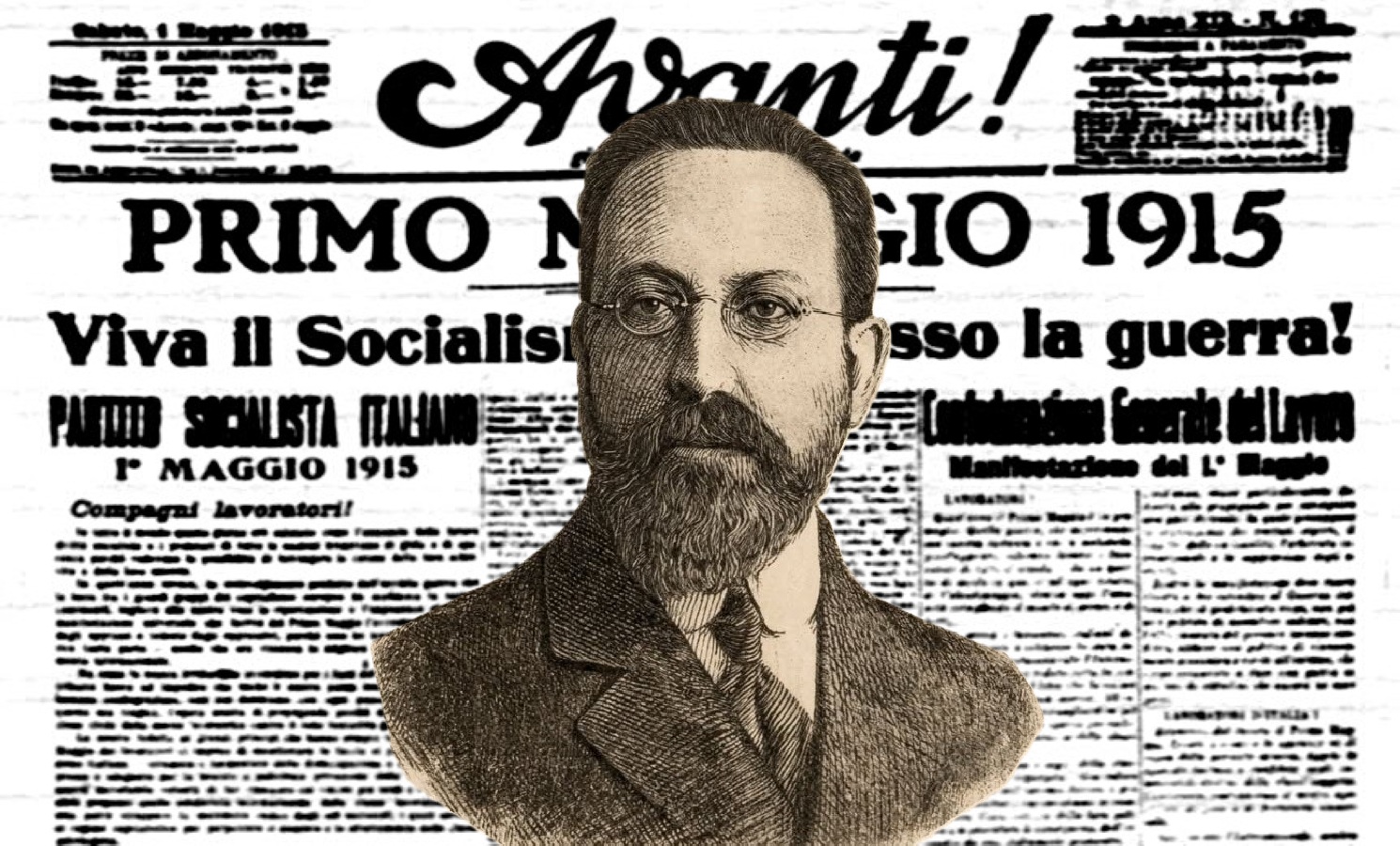
Togliatti pays tribute to the central figure of the Italian workers’ movement on his death. Long a leader of the Socialist movement in Italy, Giacinto Serrati was a Zimmerwaldist and attended the Second Comintern Congress in early 1920, serving on its Presidium and debating with Lenin. A ‘conciliator’, Serrati broke with the Comintern over the Twenty-One Points the following year, to rejoin in 1924. Along with activity in the Italy, Switzerland, and the International, Serrati during his early 1900s sojourn in the U.S. was instrumental in developing Italian Socialist organization here.
‘Giacinto Menotti Serrati’ by Ercoli (Palmiro Togliatti) from Communist International. Vol. 2 No. 23. September, 1926.
G.M. Serrati, leader of the Socialist Party of Italy during the war, died during May of this year. Serrati led the Socialist Party of Italy into the Communist International soon after the war. In 1921, however, his group left the International in the futile effort to “maintain unity” with the reactionary Right Wing of the old Socialist Party. In 1923 his group rejoined the Communist Party of Italy, taught by the bitter experience of Fascism that their past policy had been mistaken.
***
SERRATI was not a theorist of the Labour movement. This must be taken into consideration when analysing his personality. It should also be added that there were too few theorists in the Italian Labour movement when Serrati joined it, and that the absence of thorough theoretical knowledge and adequate training was one of the most characteristic traits of the leaders and representatives of the Party of which Serrati was one of the founders.
In all countries Marxist theory in its endeavour to gain widespread recognition and triumph had to overcome resistance—considerable resistance—on the part of the preceding forms and tendencies of the struggle of the working classes for their liberation. In Italy this resistance was stronger than anywhere else, and as a result the Labour movement was very backward in theoretical understanding and revolutionary ideology. The causes, however, of this phenomenon are self-evident. On the one hand our country lacked a factor which in other countries was the strongest force in the development of the Labour movement in the theoretical sphere: it lacked a proletariat which already, by its objective position, is receptive of class consciousness. On the other hand democratic tendencies which in many cases assumed a social character developed in the struggle for national independence. During the first decades of its development the Labour movement was, to a certain extent, bound up with the traditions of these tendencies, and these traditions prevented it from adopting wholeheartedly Marxist criticism and the revolutionary class struggle. When the Socialist Party was founded—and it is well known that Serrati was in its ranks from its very foundation—it lacked most of all a critical recognition of the aims of the Labour movement, of the aims and methods which must be pursued by the policy of the proletarian vanguard. Not one of the founders of the Party, not one of those who controlled it during three decades had made a complete study of the idea of Marxism. They thought of the Labour movement solely as the extreme Left-wing of the bourgeois democratic movement, and, therefore, their interpretation of the role of the Party was erroneous and narrow.
But if the Italian Socialist Party lacked theoretical clearness, it did not lack strong personalities with a fiery political temperament, a will to fight and passionate sympathy for the cause of the liberation of the workers. These gave the imprint of their personalities to the young Party, and by their devotion to the working class they were able to make up for, or at least to neutralise, the lack of ideological clearness. People such as Andrea Costa, Constantine Lazzari, Turatti and Prampolini, such as Serrati himself (although he was the youngest among them) had a decisive influence on the fate of the Socialist Party. It is true that they were not Marxists. Their language was even the language, in the main, which could very well be adopted by Left bourgeois radicals. None of them maybe had a clear notion of the cause, of the manner, of the concrete realisation of the Social-Revolution which they pictured before the eyes of the masses. But they went right into the masses. They addressed the ignorant toiling masses, the artisans, the very poor urban population, who for centuries had known nothing but oppression and poverty. To these masses they spoke of the coming day of liberation, of salvation from misery and of general well-being. They called upon the masses to assert themselves, to enter into the struggle in order to fashion their fate with their own hands, they imbued this propaganda with fiery enthusiasm, with the spirit of self-abnegation and self-sacrifice which could not help attracting the notice of the masses, and to which the masses were bound to respond by a steady devotion which has been tested and has not been found wanting. And that is not all. The first generation of working class leaders felt deeply the necessity to connect propaganda and agitation with action serving at least some of the immediate needs and requirements of the masses whom Socialist propaganda had brought into motion. Hence untiring work in connection with the organisation of the first “resistance unions” (leyne di resistenza) among industrial and agricultural workers, of mutual aid societies, and of co-operatives, clubs, etc.
More than once I have heard comrades belonging to the younger generations in the Labour movement speak somewhat commiseratingly and contentiously about the “evangelical” preaching of the initial stages of the movement. They spoke disparagingly of the work carried out during that stage in the simplest and seemingly least “revolutionary” form with the object of satisfying the most pressing needs of the workers. And there was indeed in both camps something extremely simple and extremely empirical which it is now very easy to criticise. But without this work in the initial period—and we must be reminded of this—we would not have in Italy a Labour movement of such revolutionary strength, we would not have a Party which for 30 years was recognised by the entire working class of Italy as its only Party, from which it expected leadership in the revolutionary struggle for liberation.
I think that it is impossible to conceive a clear idea of what Serrati meant for the Labour movement of our country unless one estimates at its right value what was done by the old generation to create a working class Party and to establish close contact between it and the exploited masses—unless one estimates at their right value the successes, the undoubted successes, which that old generation achieved in this sphere. Serrati, who was developing together with the old generation, although not in very close contact with its chief representatives, naturally ascribed enormous importance to this work and to these successes. It is possible that his mistake consisted in going a little too far in this direction. It prevented him recognising the right moment for breaking with part of our past in order to progress, in order to open up for the struggling working class the way of the immediate future. He was unable to solve the problem of connecting—at the proper historical moment and in the proper form—the heritage of the past with the demands of the future, the problem of connecting the old generation with the young. And it is not to be wondered at that the whole Labour movement has suffered from this failure of his. In fact, this was the problem over which all the Parties have laboured during many years and which, may be, has not yet been solved in all the Parties.
***
Nevertheless, Serrati was probably the man who more than anyone else was destined to direct and bring about this fusion of two generations of the Labour movement.
From the first, the older generation, he inherited very definite qualities. First of all, devotion to the working class a devotion which was more vocational and instinctive than conscious. He loved the toiling masses. He understood fully the most urgent needs of the workers and the need to satisfy them. These qualities were particularly prominent in him, because they were accompanied by a wonderful spirit, which to some seems to be the spirit of adventure, but which in reality was rebellion and mutiny against the social order in which he was compelled to live. There was inherent in him that restlessness which is an attribute of those who have emerged from bourgeois and petty bourgeois circles in order to devote their life to the proletariat, and who do not rest content until in their personal life they do not exceed the level of the most backward and unenviable workers. In this he differed from all the other leaders of the Socialist Party. He had severed irretrievably all connections with the class from which he had emerged. And to the working class with whom he was destined to struggle to the day of his death, he was tied with bonds as close as if they were physical. When an emigrant he devoted himself to the workers; with a light heart he took upon his shoulders the hardest of labour and dire poverty, he was a docker with the dockers, sailor with the sailors, he bent his back with the road makers, under the scorching rays of the tropical sun. It is with these extraordinary adventures of his life that no doubt are connected two peculiarities of his as a politician; his internationalism and his class irreconcilability.
Serrati’s internationalism was for a long time an exception in Italy. Our Socialists did only lip service to the International. In reality one had only to scratch them a little to discover good Italian nationalists and patriots. Let me remind you of Enrico Ferri, the recognised leader of the “Left” who after his sojourn in the countries where there are Italian emigrants delivered a speech in Parliament in which he declared that one’s country is above classes. Let me remind you of Modigliani, whose Internationalism consisted in sending every six months a picture postcard to the Executive of the International. But let me above all, remind you of Turatti, who at the moment of the defeat of the bourgeois State, when there was the possibility of a workers’ and soldiers’ rising, issued the slogan of national defence: “Our country is in peril.”
Serrati was an internationalist by instinct, by conviction and by experience. He spoke the same language to the masses of both hemispheres, for he sought everywhere first of all the same exploited masses and the same fundamental class problems. His life was a proof that the workers’ international can and must become a reality.
Even that which I have called his “irreconcilability” made him an exception almost alone among the representative and recognised leaders. Most of them were doomed through their very lack of clarity and ideological training to end in opportunism and treachery. Not having grasped that the Labour movement is an independent movement of the working class, their horizon was necessarily very narrow. For a long time it did not expand beyond the limits of Parliament. But in Parliament the representatives of the working class who had come to summon the exploited to rebel ended by becoming playthings in the hands of bourgeois politicians, having lost entirely their class spirit and class consciousness. Serrati has never been in Parliament, and what is more, he has not wanted to be there. Only once was he a candidate, on the Communist Party’s list in 1924. He was not an anti-Parliamentarian on principle. Nevertheless, it seems to me that he never endeavoured to explain from any general viewpoint the motives of this position of his. But I am prepared to say without hesitation that this was a symptom of that which separated him from the old generation, from everything which at a certain moment made the old generation unequal to its task and unworthy of itself, that which carried him, Serrati, into the foremost ranks of the Party, in front of the masses.
***
This moment occurred in the beginning of the war and during the war itself. He came out into the fray first of all, within the Left fraction of the Party. But here as almost at all times in Italy, it was a rather strange Left: side by side with an “Operariota” (representative of the croup of Labour) such as Lazzari stood a “Social Revolutionary” (socialrivoluzionario), or to be more precise a Blanquist such as Mussolini, and several others who subsequently proved themselves to be reformists and Social Patriots. For some time Serrati let them take first place, not out of modesty, I think, but because no man asserts himself until his hour has come. And his hour came just when at the beginning of the war it became necessary to induce the Socialist movement and its representatives to take a mighty step forward on the road to revolutionary struggle, on the road to the severance of all connection with the class enemy of the proletariat. Then Serrati took first place. Then his rebel spirit his uncompromising irreconcilability, his internationalism, ceased to be traits of some exceptional type, but became qualities essential for the salvation of the Labour movement from the peril of degeneration. Without Serrati—this one can say quite openly—the position of the Socialist Party during the war would not have been what it was. From the neutralist Lazzari position the Party would have rapidly evolved into the defensive and social patriotic position of Turrati. Serrati had no formula of his own. Nevertheless, he issued Lenin’s slogan demanding the conversion of the imperialist war into civil war. He did not go beyond negation, But his negation was such that it did not only leave no room for silent or open compromise, but opened the road to the positive re-establishment of the workers’ international after the collapse of August 4th. His negation placed him among the initiators of Zimmerwald, it led him to Kienthal and to his active solidarity with the Russian Revolution and the Third International.
There is no doubt whatever that Serrati was fully aware that the war was the most important period of his political life, the period when he was able to do more than ever before for the Labour movement. “The most glorious stage of my life”—so he wrote in an article which was interrupted by his death—”is certainly not the Leghorn Congress but the Turin Trial.” At this trial he declared before the military court which sentenced him to seven years’ imprisonment at the darkest stage of the war: “I always agree with all the Internationalists and I will remain faithful to the International.” And once more before the masses whose eyes were turned towards him, he openly took upon himself the defence of the Russian Revolution.
He could go a long way along the path which he pursued during the war. He went as far as the revision of the programme of the Party, and as far as the Bologna Congress. Then he came to a stop. If he had so wished, he could have become the head and the leader of the new generation of workers who demanded from the old Party something besides words and parliamentary maneuvers. In the battle which he waged in order to make the Socialist Party a real organisation of the revolutionary vanguard of the Italian proletariat, the masses, all the masses were with him. But when the right moment came he failed. The old and the new had not yet fused in him. At the decisive moment sentimentality, devotion to the old Party as a complete organisation, to its old representatives, its tradition, the whole of its tradition, gained the upper hand. This was the greatest mistake of his life, a “mistake”–we shall one more let Serrati speak for himself—“as a result of which I supported, by my capacities and my honour a movement which I imagined to be leading to revolutionary proletarian unity ana which, on the contrary, had within it everything except revolutionism.”
We are justified in saying that this was not an individual error. Behind Serrati there were broad, important sections of workers who still needed convincing, by facts, of the necessity of severance from the Party of the past. With Serrati, who was sincerity and straightforwardness personified, the contrast assumed dramatic forms. He was not only doing lip service to the revolution. When he spoke to the masses about revolution he was not acting as a demagogue. He saw in revolution hard struggle and difficult creative labour. The work of ideological clarification and in organisational policy for the revolution undertaken by the younger generation could not but appear to him essential, absolutely essential, although in order to achieve this aim we were compelled to go against the traditions with which he was so closely connected. Therefore it seems to me that the struggle which he carried on against us was a struggle within his own consciousness. He said quite openly at our recent Third Party Congress:
“Even in the most acute moments of our polemics and our struggle I was and felt spiritually nearer to you than to many of my then Party. No one will ever know of the mental suffering inflicted on me by this inconsistency. I believed that I was right and at the same time I committed the terrible mistake, the most serious mistake of my life.”
***
Others speculated on this mistake and Serrati became for a time a plaything in their hands—in the hands of D’Arragona, Baldesi, Modigliani, the agents of the bourgeoisie in the proletarian ranks. The darkest period of his life was when on the return from the Second World Congress he was unable to pillory the campaign of calumnies against Soviet Russia initiated by the reformists, when after the defeat of the movement for the seizure of the factories he was unable to find a slogan with the help of which he could have cut the ties which still connected the masses with the treacherous leaders and could have found a new outlet for their aspirations, when at the first Fascist attack he did not demonstrate against the reformists and their dastardly propaganda. It seemed then that Serrati’s role in the Labour movement was at an end. Then without him, against him, our Party, the Communist Party of Italy was formed. It was formed through the faith which the new generation of workers had in themselves, it was formed in a stormy outburst which caused much suffering to those who went with us full of faith in the future, a faith of which we are proud even now. Time proved, and that after a few months, that we were right; then Serrati came back to us and came back in such a manner that even now he is not appreciated according to his merits, and deserved the honour to be given immediately the place which he hoped to occupy in the first ranks.
We had fought against him openly, not counting the blows, and with the vehemence due to the cause for which we were fighting; his new rapprochement with us cost him dearly. He had to rise alone or almost alone against the Party in the foundation of which he had participated, against the “Avanti,” which under his editorship became a banner and weapon in glorious fights, he had to sever from himself part of his life. A man less devoted to the cause of the working class could not perhaps have taken this step.
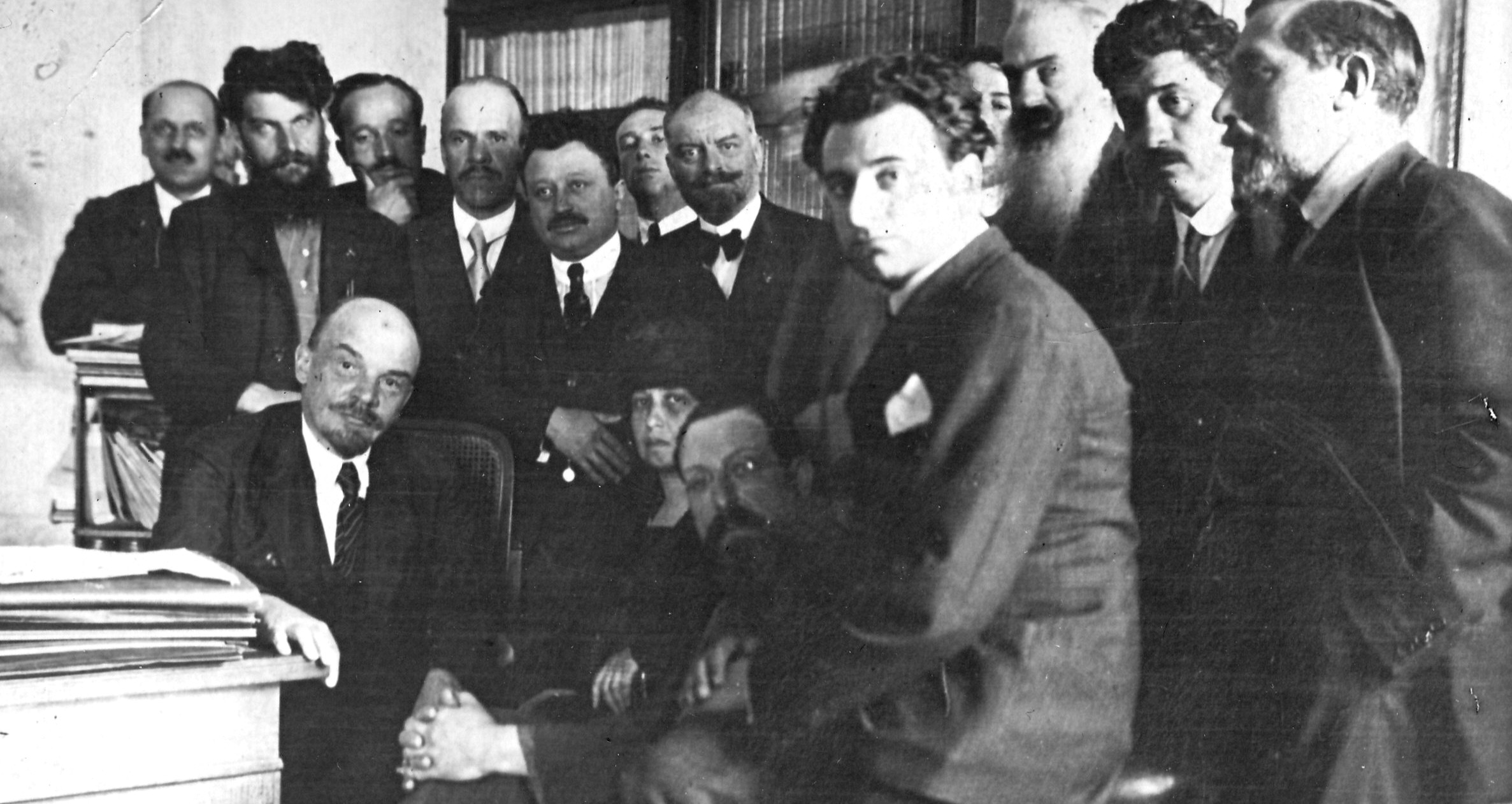
The words by which he condemned his past are clear and honest. But there is in them also the feeling of pride and dignity; they indicate to what extent this man was above the average:
“I have come back to you and I feel freer and more easy because I am conscious that I also form part of the Communist International. There is only one thing which I demand of you—that you should assign me the post of a true soldier of the proletarian revolution and I promise you to give myself heart and soul, to give my life to the liberation of the working class.”
Lately, in his entire work, in the posts assigned to him by the Party, he was able to overcome the greatest obstacles which might have separated him from us. He completed the fusion of the two generations, the most worthy symbol of which he certainly was.
He truly devoted his life to the cause in which he believed. We feel that in him we have lost one of our most prominent forces. But we also feel that he has taught us something and that we must follow in his footsteps.
E. ERCOLI.
The ECCI published the magazine ‘Communist International’ edited by Zinoviev and Karl Radek from 1919 until 1926 irregularly in German, French, Russian, and English. Restarting in 1927 until 1934. Unlike, Inprecorr, CI contained long-form articles by the leading figures of the International as well as proceedings, statements, and notices of the Comintern. No complete run of Communist International is available in English. Both were largely published outside of Soviet territory, with Communist International printed in London, to facilitate distribution and both were major contributors to the Communist press in the U.S. Communist International and Inprecorr are an invaluable English-language source on the history of the Communist International and its sections.
PDF of full issue: https://www.marxists.org/history/international/comintern/ci/new_series/v02-n23-1926-new-series-CI-riaz-orig.pdf

