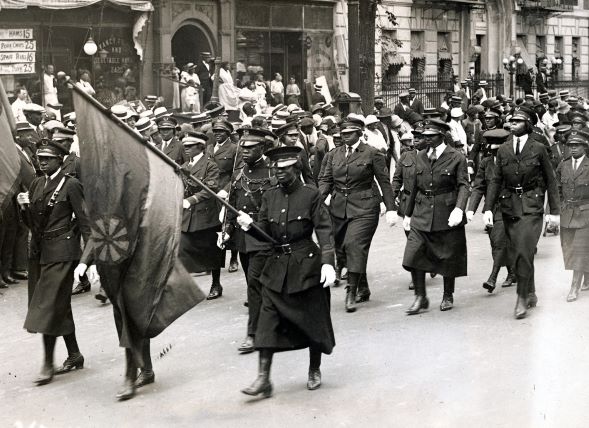
After Marcus Garvey was sent to federal prison in 1925 the Universal Negro Improvement Association, so dominant in Black politics for a decade, came to an impasse. Robert Minor, a leading white Communist voice for a central orientation of the U.S. party to Black workers in the 1920s, with an essay on the divisions and pressures faced by the U.N.I.A. in the mid-1920s.
‘Death or a Program!’ by Robert Minor from Workers Monthly. Vol. 5 No. 6. April, 1926.
THE Universal Negro Improvement Association, the largest of all Negro organizations, is in danger of going to pieces. A split is impending, if a split has not already occurred.
The Universal Negro Improvement Association.
A breaking up of this Negro association would be a calamity to the Negro people and to the working class as a whole. We say this not because the program or the leadership of the organization is of good quality, but because the Universal Negro Improvement Association is bigger than its leadership, and the deficiencies of its program are directly due to deficiencies of its leaders. The organization itself represents the first and largest experience of the Negro masses in self-organization. It is the largest organization that ever existed among the Negroes of the United States and the West Indies. It claims a large membership in Africa and it certainly has some followers among seafaring Negro workers in many parts of the world. It is composed very largely, if not almost entirely, of Negro workers and impoverished farmers, although there is a sprinkling of small business men. In any case the proletarian elements constitute the vast majority of the organization. Within its ranks are gathered the largest number of those energetic figures among working class Negroes who have arisen to activity in the period since the world war. We believe that the destruction of such an organization of the Negro masses, under the circumstances, would be a calamity.
And the destruction seems to be an imminent danger. It also appears on the surface to be the threatened result of a selfish quarrel among ambitious leaders.
The Garvey-Sherrill Feud.
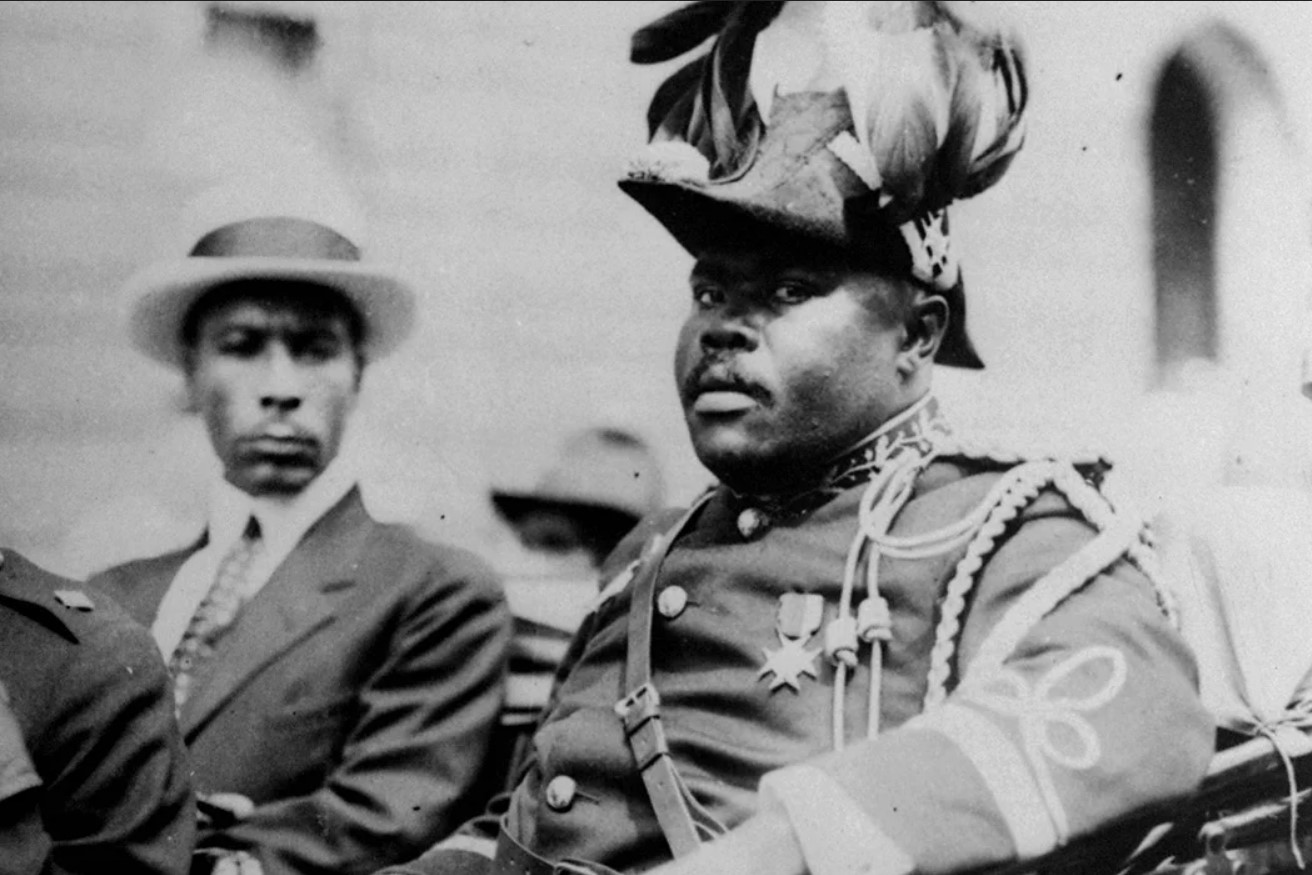
Marcus Garvey, the principal founder and the President-General of the association, is now in the federal penitentiary at Atlanta, Georgia, where he is kept, first, by the United States government, and secondly, directly by the action of Calvin Coolidge who a few weeks ago refused an application for his release. William L. Sherrill is now the acting President-General of the association, serving in the place of Garvey because of the latter’s imprisonment. Recently a quarrel broke out between Garvey and Sherrill, which finds expression in the present crisis. Garvey from his prison cell declares that Sherrill has been disloyal to him and to the organization. For the purpose of getting rid of Sherrill as the controlling head of the organization, Garvey has initiated a movement for a convention.
Garvey is supported by Joseph A. Craigen, Secretary of the Detroit Division, Fred A. Toote, President of the Philadelphia Division, William Ware, President of the Cincinnati Division, and Samuel A. Haynes, President of the Pittsburgh Division. These officers of four important divisions of the organization have signed the call for a convention to be held in Detroit during the latter half of March. Mr. Sherrill, as acting President-General, refuses to recognize the coming convention, and is probably supported by a large section of the organization, including many of the membership of the biggest cities, New York and Chicago.
The published utterances of both sides reveal no issue of principle–nothing more than a struggle for power among individuals, precipitated by Coolidge’s recent refusal of a commutation of Garvey’s sentence. The determination of the federal government to hold Carvey for some time and to deport him permanently at the end of his prison sentence has the effect of creating a scramble for his position which is assumed now to be permanently out of Garvey’s reach. Garvey accuses Sherrill of passive if not active acquiescence in keeping Garvey in prison, and of seeking to make use of Garvey’s imprisonment to get permanent control.
The Social Roots of the Threatened Disruption.
HOWEVER, it is an entirely false appearance from which one would judge that the present crisis is due solely to a quarrel among individuals. Anyone who has watched the affairs of this organization during the past several years ought to know that there are deep social causes for the threatened disruption. The Universal Negro Improvement Association has been. the victim of a leadership which turned it away from the struggles that were demanded of it. Therefore the organization, as expressed in its leadership, has during the past five years been steadily undermining its own reason for existence.
At the first substantial convention of the organization held in New York in 1920, it was apparent that the period of mass organization among Negroes of the working class (not merely organization of intellectuals) which had been made possible by the social changes of and following the world war, was beginning, and that it was crystallizing more largely in the U.N.I.A. than elsewhere. Also the rather primitive and unclear expression of working class character in the movement was exhibited by the program adopted in 1920. Among the complaints for which the convention demanded redress were:
“VII. We are discriminated against and denied an equal chance to earn wages for the support of our families, and in many instances are refused admission into labor unions, and nearly everywhere are paid smaller wages than white man.” (And)
“…2. That we believe in the supreme authority of our race in all things racial: that all things are created and given to man as a common possession: that there should be an equitable distribution and apportionment of all such things, and in consideration of the fact that as a race we are now deprived of those things that are morally and legally ours, we believe it right that all such things should be acquired and held by whatsoever means possible…
“7. We believe that any law or practice that tends to deprive any African of his land or the privileges of free citizenship within his country is unjust and Immoral, and no native should respect any such law or practice.
“…8. there should be no obligation on the part of the Negro to obey the levy of a tax by any law-making body from which he is excluded and denied representation on account of his race and color.
“9. We believe that any law especially directed against the Negro to his detriment and singling him out because of his race or color is unfair and immoral, and should not be respected.
“12. We believe that the Negro should adopt every means to protect himself against barbarous practices Inflicted upon him because of color.
“16. We believe all men should live in peace one with the other, but when races and nations provoke the ire of other races and nations by attempting to infringe upon their rights, war becomes inevitable, and the attempt in any way to free one’s self or protect one’s rights or heritage becomes justifiable.
“17. Whereas, the lynching, by burning, hanging or any other means, of human beings is a barbarous practice, and a shame and disgrace to civilization, we therefore declare any country guilty of such atrocities outside the pale of civilization…
“38. We demand complete control of our social institutions without Interference by any alien race or races…
“45. Be it further resolved that we as a race of people declare the League of Nations null and void as far as the Negro is concerned, in that it seeks to deprive Negroes of their liberty…
“47. We declare that no Negro shall engage himself in battle for any alien race without first obtaining the consent of the leader of the Negro people of the world, except in a matter of national self-defense.”
Effects of Bourgeois Pressure on the U.N.I.A.
But it is certain that fatal weaknesses were present in the organization, and that Garvey, although he was undoubtedly the chief builder of the organization, was also the chief one that carried into it the poison of opportunism. Upon any movement of a mass character which seeks to organize a large section of the exploited classes, there always begins to be exercised a tremendous pressure. The whole super-structure of capitalist society invariably rushes to its task of adjusting any mass movement in such a manner as to eradicate any tendencies incompatible with the capitalist social system. The effects of such pressure soon began to be apparent in the U.N.I.A., and especially in the trend of Garvey himself. Many incidents, especially occurring in the attempts to organize Negroes in the southern cities, brought out sharply the fact that the organization would be fought most bitterly on those issues which had to do with the demands of the Negro masses for organization in trade unions, for political rights, and especially those demands which struck out in the direction of the abolition of the general system of social inequality.
Under the pressure, Garvey began to give way. Difficulties were encountered by the organizers of the U.N.I.A. on the ground that the organization had “bolshevistic” qualities leading toward economic, political and social equality. Garvey met every difficulty by disclaiming the portions of his organization’s program which were under attack at the given moment. By a process of elimination, all demands which were offensive to the ruling class were dropped one by one, and the organization settled down to a policy of disclaiming any idea whatever of demanding any rights for the Negro people in the United States–the policy of declaring that the Universal Negro Improvement Association was not striving to attain any political or social rights of the Negro in America, but was trying only to construct an organization which would bring about the establishment of a “home for the Negro people in Africa.” From a negative protestation, the policy evolved into a positive declaration (voiced by Garvey and acquiesced in by his followers) that the Universal Negro Improvement Association recognized the United States as a “white man’s country,” and that it was therefore opposed to social equality in this country for the Negro.
Garvey issued a pamphlet (seemingly for private reading of wealthy white men to whom he sent it in the hope of securing gifts of money and not for circulation among the Negro membership), entitled, “Aims and Objects of Movement for Solution of Negro Problem Outlined.” In the pamphlet Garvey wrote:
“The white man of America has become the natural leader of the world. He, because of his exalted position, is called upon to help in all human efforts. From nations to individuals the appeal is made to him for aid in all things affecting humanity, so naturally, there can be no great mass movement or change without first acquainting the leader on whose sympathy and advice the world moves.” The pamphlet says further:
“To us, the white race has a right to peaceful possession and occupation of countries of its own, and in like manner the yellow and black races have their rights.”
Hitherto the other Negro movements in America, with the exception of the Tuskegee effort of Booker T. Washington, sought to teach the Negro. TO ASPIRE TO SOCIAL EQUALITY WITH THE WHITES, MEANING THEREBY THE RIGHT TO INTERMARRY AND FRATERNIZE IN EVERY SOCIAL WAY. THIS HAS BEEN THE SOURCE OF MUCH TROUBLE AND STILL SOME NEGRO ORGANIZATIONS CONTINUE TO PREACH THIS DANGEROUS RACE DESTROYING DOCTRINE added to a program of POLITICAL AGITATION AND AGGRESSION. The Universal Negro Improvement Association on the other hand, believes in, and teaches the pride and purity of race.”
“…The great white majority will never grant them (the Negro’s rights in America), and thus we march on to danger if we do not stop and adjust the matter.

“…Help him to return to his original home–Africa, and there give him the opportunity to climb from the lowest to the highest positions in a state of his own. If not, then the nation will have to hearken to the demand of the aggressive, ‘social equality’ organization, known as the National Association for the Advancement of Colored People, of which Dr. W.E.B. DuBois la leader, which declares vehemently for social and political equality, viz: NEGROES AND WHITES IN THE SAME HOTELS, HOMES, RESIDENTIAL DISTRICTS, PUBLIC AND PRIVATE PLACES, A NEGRO AS PRESIDENT, MEMBERS OF THE CABINET, GOVERNORS OF STATES, MAYORS OF CITIES, and leaders of society in the United States.
“Yet it is realized that all human beings have a limit to their humanity. The humanity of WHITE AMERICA, we realize, will seek SELF-PROTECTION AND SELF PRESERVATION, and that is why the THOUGHTFUL AND REASONABLE NEGRO SEES NO HOPE IN AMERICA for satisfying the AGGRESSIVE PROGRAM of the National Association for the Advancement of Colored People, but advances the REASONABLE PLAN OF THE UNIVERSAL NEGRO IMPROVEMENT ASSOCIATION, THAT OF CREATING IN AFRICA A NATION AND GOVERNMENT FOR THE NEGRO RACE.” (My emphasis).
All of the old program adopted in 1920 has disappeared from sight. Today if you ask for the program of the U.N.I.A., you are told, in the words of Garvey that “our one purpose, our one object, is the planting of the colors of the Red, the Black and the Green as the African standard that shall give to us a country, a nation of our own.”
Garvey had, according to his own statements, confined every hope and aim to this one thing. Inevitably this resulted in 1921 in narrowing the chief operation down to the sale of stock in a steamship company, the Black Star, reorganized after prosecution, under the new name of Black Cross Line, which was expected to open up resources with the help of American and other Negroes.
Anything that might destroy the illusion of a peaceful penetration into Africa would of course be a severe blow to the structure that Garvey had built.
Garveyite Illusions Blasted.
Along came events which destroyed the illusion.
Apparently Garvey did not operate this stock selling plan in a manner free from charlatanry, and the excuse that he had sold stock under false pretenses became the one under which he was finally sent to prison by the United States government, after a shamefully arbitrary trial with all the qualities of a political frame-up.
But that was not all that served to destroy the illusion. The after war unrest of the suppressed peoples of Africa–the early prelude to the present Morocco trouble, the Egyptian independence movement, etc., had given their alarm to the British, French, Belgian and Spanish governments, and these began taking measures to exclude Garvey’s organization and its publications from African colonies. This tended to confine operations to the “independent” republic of Liberia as distinguished from the outright possessions of imperialist powers. The Universal Negro Improvement Association concentrated on Liberia, and according to Garvey’s claim, the Liberian government gave a large concession to the Universal Negro Improvement Association (or a subsidiary) for the development of Liberia’s rubber and other resources. Upon the claim of the concession to develop the natural resources of Liberia, Garvey based his sole remaining hope.
But the illusion was still further to be exploded. The American ruling class does not let anything of value in the way of rubber lands lie around loose. A series of quick and very mysterious operations between Calvin Coolidge, Harvey Firestone, Solomon Porter Hood (a Negro tool of the Firestone Rubber Company appointed by Coolidge as American Minister to Liberia) took place in the summer of 1924 simultaneously with the final arrest and conviction of Garvey and his imprisonment in the federal penitentiary at Atlanta. Garvey went to prison at the same moment that the concessions be claimed in Liberia were given to the Firestone corporation. It may be that a shrewd prosecutor can show a perfect legal case against Garvey (perhaps a case equally as strong as the case against Mr. Mellon’s Aluminum Company), but we know that “perfect cases” are only incidental to the political purposes of prosecutions by the American capitalist government. Garvey was sent to prison because the American government thought that his imprisonment would be an effective blow at the Negro masses, to break up their organization (any Negro mass organization is considered dangerous per se, regardless of Utopian programs), and also perhaps because the imprisonment of Garvey incidentally relieved the Firestone deal of a petty annoyance.
But what has been the effect upon the internal affairs of the Universal Negro Improvement Association?
The effect has been to destroy the possibility of any further illusion of the magic acquisition of the continent of Africa by the “business” operations of an association of Negroes, while the war in Morocco, and the rapidly sharpening struggle against imperialism throughout Africa, helped to wash away the picture of benevolent British statesmen and American millionaires making a present of a continent larger than North America, ladened with untold gold, diamonds, rubber, and every imaginable wealth, to a group of helpless, down-trodden and exploited Negroes, out of pure love and Christian kindness.
The one center of the Garvey program had become incredible even to Garvey’s credulous followers.
THE single foundation stone upon which Garvey had built was thus destroyed. The Universal Negro Improvement Association could not be held together any longer on the basis of any belief in the Zionistic program. The Universal Negro Improvement Association, kicked off of the basis of the Liberia, illusion but still clinging to the exploded Zionism of Garvey, awakened by the imprisonment of Garvey whose powerful personality was a cohesive force, has inevitably drifted to the point of disruption.
The final refusal to release Garvey, under the circumstances, finally precipitated the crisis. It is known that Garvey will be deported (unless an effective protest is made) at the close of his prison term. The result is that throughout the organization the scramble to succeed him in control has come.
Garvey Adopts the Ku Klux Klan “Race Purity” Theory.
But while the controversy was boiling with all the appearance of being a mere quarrel of individual leaders without any fundamental issues involved, an incident occurred at Richmond, Va., which shows the true nature of the crisis the organization faces. It appears that the Richmond organization of the Universal Negro Improvement Association, having a membership of between 200 and 300, was called together for the purpose of hearing a lecture by three of the most reactionary, Negro-hating, propagandists of “white supremacy.” These were John Powell, Major Ernest Cox and Major Percy Hawse. It appears that one or more of these three men is involved in the effort to pass thru the Virginia state legislature a so-called “race integrity” law, forbidding intermarriage of Negroes with white people. The Ku Klux Klan bases its Negro-baiting theories upon an idiotic concept of “race purity.” Garvey has adopted this by attempting to make a supreme virtue of “race purity” for the Negro. This imaginary “race purity” (there is no such thing as an unmixed race) is supposed to be a basis upon which the Negro hater and the Negro can reach a common understanding, and on this theory the Negro masses are expected to sit and listen in a receptive mood to the propaganda of those who wish to make the Negro perpetually submit to race discrimination in the matter of segregation, discrimination, separate schools, and anti-intermarriage laws. But it appears that the membership of the Negro organization was not quite so idiotic as the Garvey leadership had assumed. A number of Negro workers arose in the meeting and objected vigorously to allowing the enemy propagandists to speak. The membership supported the objectors, and the three Negro baiters were driven out of the hall by the protest. The Richmond division faces a split, with the left wing clamoring for a repudiation of Garvey’s concession that “this is a white man’s country.”
The Revolt of the Left Wing.
We believe that this incident points to the real basis of the crisis of the Universal Negro Improvement Association. The new Negro–a healthy working class left wing in the organization–refuses any longer to submit to the servile anti-Negro program that Garvey has been adopting to thrust down their throats.
Another recent report is to the effect that Mrs. Garvey attempted to speak to the New York membership assembled at Liberty Hall and that the membership refused to permit her to speak. As Mrs. Garvey represents the point of view of President-General Garvey, the New York demonstration against her speaking probably indicates that the New York membership is at least partly aroused against the servile program. Of course, this, if true, is of tremendous significance. The metropolitan life of New York, which has within it a tremendous Negro segregated sub-city of more than a quarter of a million, has undoubtedly brought about the most conscious and active expression of the Negroes’ movement for freedom. We are perfectly justified in predicting that the way in which the New York membership ultimately lines up in this controversy will very nearly be decisive for the organization.
Wm. L. Sherrill, the Center of the Opposition.
In the meantime how about Mr. William L. Sherrill, the man who is the center of the anti-Garvey leadership? Mr. Sherrill is unquestionably a man of ability and one of the most powerful orators and powerful personalities in the country. In this respect he is the one prominent figure in the Universal Negro Improvement Association who has been considered to have ability comparable to that of Garvey. But Mr. Sherrill has been in the organization for a long time and never yet have we seen any signs that he is able now to rise to the occasion–to throw aside the philosophy of submission and to lead the left wing opposition. Mr. Sherrill has heretofore always submitted meekly to every debauching of the organization, as far as outside appearances indicate. He did not raise his voice against the disgraceful surrender to the Ku Klux Klan at the 1924 convention. We doubt very seriously if Mr. Sherrill is capable of taking a political stand and swinging the organization into the real struggle for the Negroes’ emancipation. Reports are to the effect that Sherrill represents an “American orientation” as against Garvey’s “back to Africa orientation.” But it seems that Mr. Sherill’s “orientation” is also a “business orientation.” This probably means that Sherrill’s program is only a dreary repetition of the old theory that the American Negroes can be liberated merely by increasing the number of Negro bankers and real estate men. Under this program the mass organization would quickly disintegrate.
The Hope of the U.N.I.A.
Probably it will not be thru the leadership of Sherrill or the leadership of any of the hitherto prominent men of the Universal Negro Improvement Association that the organization may be saved from disaster. The most hope lies in the fact that there has been generated in the organization in the past two or three years a very able corps of young men and women of working class character and undoubted sincerity. These young leaders are instinctively and potentially with any left wing that may be developing in either faction. Inevitably sooner or later there must be a revolt in such a mass organization of working class Negroes against the policy of submission. The left wing has hitherto been diverted into a sort of pseudo-anti-imperialism–a sort of a wordy objection to the conquest of Africa by the great imperialist powers without any tangible action to make the protest effective. In spite of the futility of a wordy program of talk against imperialism abroad while submitting to the most brutal persecution at home, the militant spirit aroused by the rebellions of Abd-el-Krim and the Egyptians has served to sift out among the Negro masses a very active and partly conscious element which now occupies many positions of local leadership in the association. Upon the rank and file of sincere Negro workers in the organization, and upon these more active spirits, the ultimate hope of saving and revitalizing the Universal Negro Improvement Association depends.
The key to the matter is the question of a program of militant struggle for the rights of the Negro here in the United States, in addition to an effective anti-imperialist world program.
It is a case of a program or death, for the Universal Negro Improvement Association.
The Workers Monthly began publishing in 1924 as a merger of the ‘Liberator’, the Trade Union Educational League magazine ‘Labor Herald’, and Friends of Soviet Russia’s monthly ‘Soviet Russia Pictorial’ as an explicitly Party publication. In 1927 Workers Monthly ceased and the Communist Party began publishing The Communist as its theoretical magazine. Editors included Earl Browder and Max Bedacht as the magazine continued the Liberator’s use of graphics and art.
PDF of full issue: https://www.marxists.org/history/usa/culture/pubs/wm/1926/v5n06-apr-1926-1B-WM.pdf
 Revolution's Newsstand