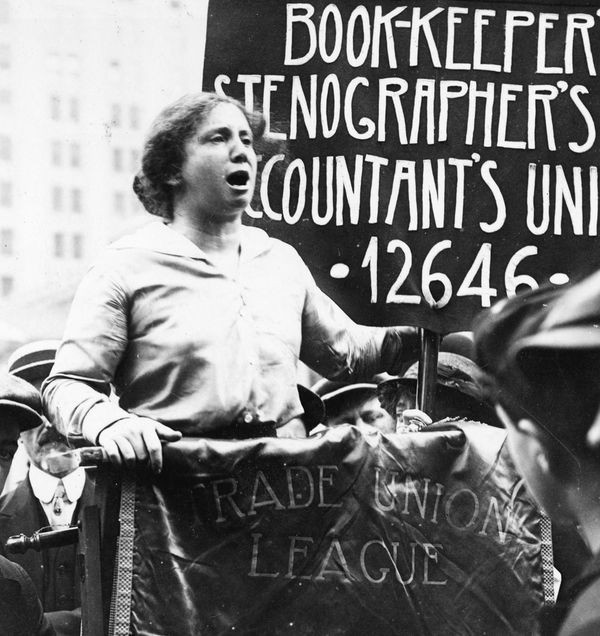
Hugely important in organizing the garment industry in the large Eastern cities, the New York branch of the N.W.T.U.L. reports on a year of work, with the main thrust of the work expanding from the base in the Yiddish-speaking communities into English-speaking shops.
‘Women’s Trade Union League Reports on Progress Made’ from The New York Call. Vol. 5 No. 136. May 15, 1912.
Annual Account of Stewardship Shows That the New York Branch of Organization to Aid Female Toilers Is Doing Effective Work.
In the annual report just issued by p the Women’s Trade Union League, of New York, that organization gives a detailed and exhaustive statement of its activities and progress.
The individual league membership has increased from 558 to 658 during the past year, while the membership through union affiliation is 54,767, of which 19,816 are women.
The league, finding that the organizing of American girls would add much to the stability of the organization, made a special effort in that direction, and found that the growing discontent among the workers made the organization of these workers especially possible.
The league hoped to make its contribution to the Jewish unions by bringing the American girls into the Jewish unions already formed. In attempting this it was found that it was difficult for Jewish unions to make the necessary adjustments in their organization. The policy left open was either to organize American branches, as in the case of the neckwear makers, or start organizations on the league’s own basis in the unorganized trades so that all nationalities could work together as in the case of the New York Hat Trimmers.
Need of Efficient Equipment.
The league realizes more than ever the necessity for efficient equipment. Th league needs and will need an increasing number of women regularly employed on the staff who are especially qualified for organization work. If the present discontent in met effectively, if the working women as well as men are to be given legitimate avenues through which they can express their will, the movement which represents them must be adequately manned. If cooperation is withheld and organization prevented or delayed, the discontent will express itself more rather than less in forms of violence.
The report gives a detailed account of its work among the various industries. Among the white goods workers it was successful in improving the hours and wages of 325 girls. Discrimination against union members was prevented, wages increased 50 cents to $2 per week, and shorter work days introduced.
The paper box makers’ strike, says the report, involved several thousand young girls and boys. The cause of the strike was the long hours of sixty or more per week and wages as low as $3 and not higher than $9. The strike was a spontaneous expression, without preparation or leadership. The league contributed the services of an organizer for five weeks, and a number of the members gave voluntary services in clerical and organizing work. The poverty of the strikers was a force too great to overcome, and the strike failed.
Lockout of Leather Workers.
In the lockout of 2,000 fancy leather workers, which lasted eight weeks the, league secured fair conditions and the signing of a number of contracts. Within a few weeks the manufacturers broke the contracts, giving as their reason, the refusal of other manufacturers to furnish them with needed materials because they had entered into agreements with the union. Petticoats having declined in fashion, the petticoat makers and the union have suffered. The league placed an organizer in the field, but found the declining trade a disastrous factor, against which organization was of no avail. The strike of Swiss embroidery workers, a strike for equal pay for the girls, was successful.
The league’s departure from its former methods of cooperation with the Jewish unions on their own lines was made in the early part of the year with the shirtwaist makers. It became evident, says the report, that the league’s energies were being misdirected in its efforts to introduce American methods into the Jewish union. The issue between the league and the union came to a head when the union determined on calling a second general strike in the trade. The league withdrew. Changes in style, want of work and other causes have rought havoc in the shirtwaist trade since the strike of 1909-10. The gains secured at that time have in a large number of shops been lost. In spite of the oppression of the workers, which is very real, the league realized that another general strike would not better conditions in the trade. The union later decided to postpone the calling of a second general strike and to build up its organization from within. This work, it is understood, is now going on.
Neckwear Makers Union.
The Neckwear Makers’ Union, continues the report, is the league’s best Illustration of the possibility of amalgamation of the Jewish and American workers in one union. The uptown or American neckwear workers were members of a union not of their own making. Their first opportunity for working out a wage scale and an agreement of their own with their employers came in October, the beginning of their second year.
A new agreement was worked out in connection with the East Side branch and a contract signed with the employers without a strike except in one shop, which lasted for three days. The agreement brought substantial gains in reduction of hours to fifty per week and increases in the scale of wages. The provision regarding the distribution of work on the basis of full time employment to all inside workers before work is given out to home workers is the first step toward the abolition of home work. Other minor improvements were also gained.
Hat Trimmers’ Union.
The Hat Trimmers unions of Newark and New York have made gains during the past year, says the report. The New York union, which was organized by the Newark union with the league’s cooperation, has held its American and Jewish girls together without a break, and has renewed its contracts this year with a substantial wage increase. The Newark union took up the matter of fire protection, and, without legislation, forced all the Newark hat manufacturers to make the changes which would insure the safety of the workers.
Special efforts will be made during the coming year in the organizations of the straw hat makers of New York and Brooklyn.
In October the league was given official representation in the United Textile Workers in New York City. Almost immediately after a strike was called in two mills manufacturing silk labels, one in Manhattan and the other In East New York. The strike followed the presentation by the three months’ old union of a price list asking for an increase in the scale of wages. The employer met the demand with the ultimatum that a cut in the original scale would be put into effect. At the end of ten days the employer signed a contract which gave the workers a fifty-four hour week, time and a half for overtime and an increase in the wages for week workers. Weavers who were peace workers received 25 cents per hour extra over and above what they made in their hours for overtime. The workers were only partially organized before the strike, yet they were able to secure the above conditions as well as a complete union shop.
The Laundry Strike.
During the laundry strike the league took active part in the struggle to improve the conditions of the workers who were subjected to the greatest disregard for the lives and the law. The strike brought organization into the trade. It unionized six laundries, fixed the minimum wages at $6 and regulated the hours of work with fifty-four hours as a maximum week’s work.
On the morning following the Triangle fire, a corps of league workers was visiting the families of the victims in the name of the Shritwaist Makers’ Union. Two of the league’s members served on a joint committee of relief composed of representatives from the union, the Jewish Daily Forward, the Workmen’s Circle and the league. This committee worked in cooperation with the Red Cross Society on the relief work, so that the committee could handle cases where the victims were union members.
Twenty thousand dollars was distributed and from sixty to seventy families cared for. The league also did extensive work in the collection of data for the investigation of the fire and in preventative methods in other factories. The report also gives extensive details regarding the work of the Label Committee, its Education Bureau, the work of its Legislative Committee and its district work.
A tribute is also paid to the late Carola Woerishoffer, its former treasurer, who joined the league during its days of obscurity, and who, through her untiring activity and continued contributions, helped much toward building up the league to its prevent valuable asset to the union movements of the East.
The league has its office at 43 East 23d street, and has as its officers: Mary E. Dreier, president: Leonora O Reilly and Rose Schneiderman, vice presidents: Mrs. Joseph H. Wise, treasurer: James P. Boyle, auditor: Melinda Scott, general organizer, and Helen Marot, secretary.
The New York Call was the first English-language Socialist daily paper in New York City and the second in the US after the Chicago Daily Socialist. The paper was the center of the Socialist Party and under the influence of Morris Hillquit, Charles Ervin, Julius Gerber, and William Butscher. The paper was opposed to World War One, and, unsurprising given the era’s fluidity, ambivalent on the Russian Revolution even after the expulsion of the SP’s Left Wing. The paper is an invaluable resource for information on the city’s workers movement and history and one of the most important papers in the history of US socialism. The paper ran from 1908 until 1923.
PDF of full issue: https://www.marxists.org/history/usa/pubs/the-new-york-call/1912/120515-newyorkcall-v05n136.pdf

