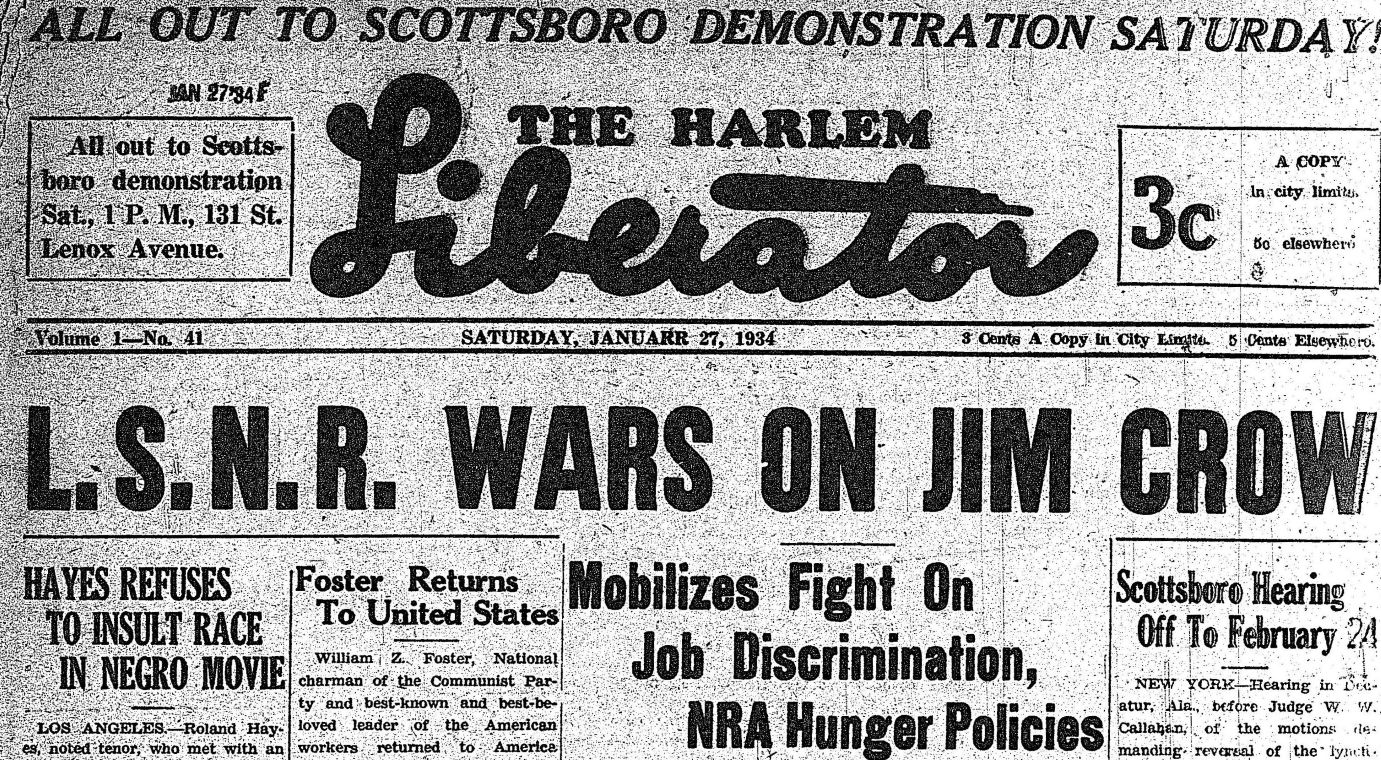
What had become painfully obvious through the German debacle; despite speaking for the working class, the Communist Party did not have the support of the working class majority. How to get that majority support was the proclaimed goal of 1933’s ‘Open Letter’ which saw the first moves away from the politics of the Third Period. Here, a comrade cites Party failures in San Francisco to raise concrete Black demands, alienating those workers from the Party and the need, if the Party’s claim to speak for all workers be true, to redress that with a new focus in their local work.
‘Must Root Out White Chauvinism to Carry Through Open Letter’ from Party Organizer (C.P.U.S.A. Internal Bulletin). Vol. 6 No. 11. November, 1933.
It is stated correctly in the reports of Comrade Browder and in other speeches made that we can record certain successes in the carrying through of the tasks that were set by the Open Letter. But at the same time, I want to state here that on one question, the question of work among the Negroes, I do not think we can say that real progress has been made in the application of the Open Letter and the resolutions of the Fourteenth Plenum.
One bright spot in our movement in regard to the Negro question is the work of District 17.
The discrimination against Negroes under the N.R.A. codes, that is, the exclusion of Negroes from industries where large numbers of Negroes have been occupied, the whole question of the cotton plowing under in the South, and the new lynch wave—in this situation the Party is lagging behind in the Negro work more than in any other work.
We Lag Behind in Negro Work
In the trade union work, we can also record no real advances so far as the Negro masses are concerned. In the recruitment into the trade unions, where we have made some progress, particularly steel and mining unions—this recruitment has not brought a sufficient proportion of Negro workers into the union.
At the same time we can say that the campaign against lynching, and the whole campaign of the Scottsboro case, has almost completely collapsed. This happens at a time when lynching is almost a daily occurrence and the struggle against it is one of the most urgent demands of the Negro people.
The failure to concretize, to develop local struggles, is the explanation for the collapse of the campaign against Scottsboro and lynchings. This is the reason why we are able to develop tremendous mass movements around dramatic moments in the Scottsboro campaign, such as after the Decatur trial, and then in a few weeks this movement collapses.
Where are we to look for the source of our weaknesses? In our failure to seek out and develop struggles around the specific demands of the workers, particularly in the shops, factories and neighborhood.
The Open Letter says the following in this connection:
“The Party can stand at the head of the national revolutionary struggle of the Negro masses against American imperialism and if it energetically carries through the decisions of the Fourteenth Plenum of the Central Committee on work among Negroes.”
What does the carrying through of these decisions mean? This means first of all that we direct our work to the organization of proletarian and semi-proletarian Negroes to bring them into the Party, the revolutionary trade unions, organizations of poor farmers. The Fourteenth Plenum says that the red trade unions must become the main channel for our work among Negroes. The Open Letter also elaborates this point and says:
“In all mass actions, strikes and unemployed struggles the Party must pay particular attention that in formulating practical demands, it takes into consideration and gives expression to the special forms of exploitation, oppression and denial of the rights of the employed and unemployed Negro masses.”
Failure to Raise Negro Demands Costly
Now, comrades, this has been stated often. It is not new. But it is quite clear that up to the present time we have not sufficiently understood this and it has not been seriously considered by the Party or the trade unions. And why is this? Why do we fail to raise the demands of the Negro masses, particularly in the revolutionary trade unions? We will find that behind this failure, which at times takes the form of resistance, is a social-democratic concept which still exists in our movement; namely: a tendency to regard the struggle for equal rights for Negroes not as a part of the general class struggle of the workers, but as something apart from and even detrimental to the class struggle—a failure to understand the relationship between the struggles for Negro rights, and the general class struggles of the working class, failure to understand that the Negroes in their struggle for equal rights are allies of the working class as emphasized very sharply in the Open Letter. Now this, comrades, is a form of expression of white chauvinism in our movement which is particularly prevalent in our revolutionary trade unions.
We have a most glaring example of this attitude in San Francisco in connection with the local election campaign there. Here we had the crassest capitulation before white chauvinism on the part of the District leadership. First of all they failed to put forward any Negroes on the local election ticket. But this is not all. The Negro question, as well as the question of the other national minorities in San Francisco, that is, the Japanese, Chinese and Filipinos, were not raised concretely but in a very abstract manner in the election program. On these questions the program had the sole demand, “unemployment relief without discrimination on account of nationality, creed or color.”
Now, comrades, this mistake of the comrades in San Francisco had very serious repercussions among the Negroes there. Immediately after we had noticed this omission, we received a protest circular that was gotten out by some non-Party white fellow. This circular had been distributed among various Negro organizations and called upon the workers of these organizations to send in their protest to the District Office of the C.P.
Behind this error it is quite clear that the comrades think that the importance of the Negro question and the other national questions there was to be measured solely on the basis of the numerical strength of the Negroes and other national groups in San Francisco, i.e., their numerical proportion in regard to the rest of the population. If considered on this basis we have to come to the conclusion that the Negro question is of small importance in San Francisco because there are only 21,000 out of a population of 750,000. It is quite clear that this sort of mechanical conception has nothing in common with the Bolshevik theory on the national question.
Building L.S.N.R. Immediate Task
In regard to the L.S.N.R. Our main emphasis, of course, is building up of the Party and the revolutionary trade unions, Unemployed Councils and poor farmers’ organizations among the Negro workers. However, in addition to these main forms, we must meet the need of the rapidly developing movement among the Negro masses, to provide the necessary forms for its fullest development by taking up the task of launching the League of Struggle for Negro Rights.
Editorial Note: Since this speech has been made, the L.S.N.R. has worked out a program, set up a national council and has launched a nation-wide campaign against lynching. Directives have been sent out by the C.C. for the campaign and the initial steps to be taken for the building of a mass movement for Negro rights. All Party members and especially functionaries should become acquainted with the policy, program and tactics of the L.S.N.R. by studying the new 5c pamphlet, Equality, LAND AND FREEDOM, containing the draft program and by-laws of the L.S.N.R., and by reading the special material in the Daily Worker on this question.
The Party Organizer was the internal bulletin of the Communist Party published by its Central Committee beginning in 1927. First published irregularly, than bi-monthly, and then monthly, the Organizer was primarily meant for the Party’s unit, district, and shop organizers. The Organizer offers a much different view of the CP than the Daily Worker, including a much higher proportion of women writers than almost any other CP publication. Its pages are often full of the mundane problems of Party organizing, complaints about resources, debates over policy and personalities, as well as official numbers and information on Party campaigns, locals, organizations, and periodicals making the Party Organizer an important resource for the study and understanding of the Party in its most important years.
PDF of full issue: https://www.marxists.org/history/usa/pubs/party-organizer/v06n11-nov-1933-Party%20Organizer.pdf

