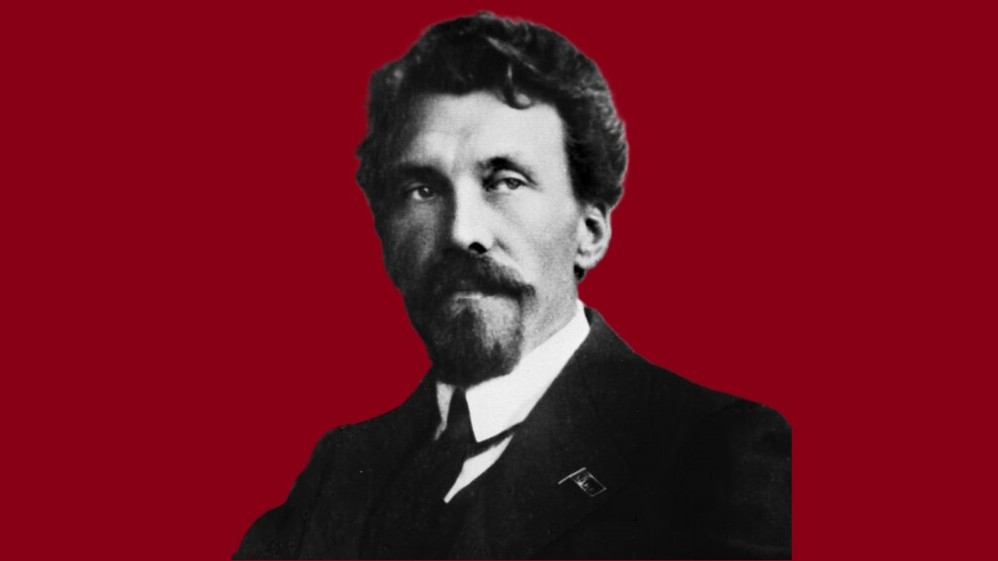
Rykov speaks to the crisis in the New Economic Policy transforming from a shortage of agricultural goods to a shortage of industrial products.
‘The Economic Situation and the Budget of the Soviet Union’ by Alexei Rykov from International Press Correspondence. Vol. 6 No. 33. April 22, 1926.
The most important Features of the Economic Situation in the Soviet Union.
(Extract from the Report at the Meeting of the Central Executive Council of the Soviet Union.)
When, under Lenin’s leadership, we carried out the transition to the New Economic Policy, the extent of the decline of our country was characterised by the following figures: Industrial production amounted to 18-20% and agricultural production amounted to 49% of the pre-war production. By comparing these two figures one could, at the first glance, arrive at the conclusion that agriculture was in a better position than industry.
Such a conclusion, however, would be extremely superficial, as it would leave out of account the fact that the bulk of the agricultural products is consumed by the peasants themselves, while almost the whole of the industrial products is sent in the market. At the beginning of the New Economic Policy agriculture sent such an insignificant portion of its products to the market that we experienced at the time an exceedingly severe food crisis. The development of our entire economy, including the development of industry, encountered before all in this period the difficulty presented by the weakness of agriculture. The workers had to have bread, the town population had to supplied with food, and industry with raw material. All this was only possible through the development of agriculture.
Hence, at that time agriculture was the weak point of our entire economy, the strengthening of which was the necessary pre-condition for the economic reconstruction and further development of the whole country.
The present economic situation differs greatly from the original stage of the New Economic Policy. Industry has attained about 95% and agriculture 91% of the pre-war standard. At the commencement of the New Economic Policy there existed hunger and food crisis. Today, there prevails hunger for industrial products. If one wished to express in a short formula the chief difference between the present economic situation and the situation at the beginning of the New Economic Policy, one could say: At that time agriculture was in a backward condition and as a result there prevailed throughout the whole country a severe food crisis; today it is industry that is in a backward condition, and as a consequence we are in the second year of shortage of goods.
Thus the importance and the role of agriculture and industry in the whole life of our Union has changed, although at the same time industry has developed at an exceedingly rapid rate. Last year it increased its production by 64%, and in the present year it will increase it by about 35%. The yearly increase in industrial production considerably exceeds the growth of agricultural production, nevertheless there prevails a shortage of goods.
Simultaneously with the growth of industry and agriculture and this is one of the symptoms of this general process of reconstruction our budget has grown considerably, and this year attains a balance of over four milliard roubles as against 2,28,148,000 roubles in the year 1923/24 and 2,905,070,000 roubles in the year 1924 25.
It must be borne in mind that we have achieved these results without any help whatever from outside. I believe that our State is the only one that has succeeded in overcoming the enormous devastation without foreign loans. I believe that our State also occupies a unique position in that it has proved capable of achieving economic successes such as other States have not been able to obtain even with the aid of foreign loans and the support of other States. Our economic successes have–and everyone must realise this–a tremendous political importance, as they prove that, in spite of all the attempts of our opponents to prove the inability of the working class and of the peasantry to organise economy without the factory owners and landlords, that the workers and peasants know how to build up the economic life of the country and to organise it better than was ever the case under the rule of the bourgeoisie and landlords and under the capitalist Order.
These successes which we have attained not only compel quantitative respect, but they imply at the same time a gigantic moral victory, as they prove the superiority of our Order compared with the bourgeois-capitalist Order.
As I have already said, in spite of the fact that we have attained 95% of the pre-war production in our industry and 91% in agriculture, there prevails a shortage of goods. Wherein lies the cause of this? If the proportion between the quantity of goods produced by agriculture and the quantity produced by industry has remained about the same, and the rate of development of industry even exceeds the growth of agriculture, then the chief cause, apparently, must be sought in another sphere.
The chief cause of the shortage of goods is the forced growth of effective demand.
There has been a great change in the budget of the peasant as compared with pre-war times. The nationalisation of the land, the freeing of the peasants from the burdens of purchase of land from and payment of rent to the land-owners, hand in hand with the advance of agriculture, alone increase the purchasing capacity of the peasants. The freeing of the peasants from a number of other liabilities which were part and parcel of the landlord regime increases at the same time the purchasing power of the village, and therefore the growth of agricultural production of the peasants involves a greater demand for industrial products Thanks to the considerable reduction of the agricultural income tax and the increase in the price of corn, and thanks to the generous granting of credits to our organs responsible for collecting grain, the purchasing power of the village has greatly increased this year.
The rapid growth of effective demand in the towns is due to various causes: the level of income of the urban population and the wages of the workers and employees have increased; along with this there is to be observed in recent times a certain retardation in the increase of the productivity of labour. In the increase in shortage of goods the rapid pace of the development of heavy industry and the inauguration of a comprehensive progamme of new buildings plays a considerable role. It must be remembered that the investment of capital does not mean the immediate inflow of new goods on to the market; on the other hand the demand for finished products is increased by this. If a new factory is built or a new pit is opened in the Donez basin, the work takes some years, and during this time the workers who are engaged in the new construction require bread and finished products. Therefore, the industrial investment of capital which finally leads to the abolition of the shortage of goods, increase the demand so long as the new factory is not set going.
All these facts which I have mentioned have greatly increased the growth of the effective demand in town and country, and this demand our industry was unable to satisfy, in spite of the fact that increased its production by 64% in the past year.
These are the causes of that shortage of goods which we feel so keenly in the present year and which existed in a weaker form in the past. I do not wish to create the illusion that this shortage of goods can be abolished in the near future. The elements of natural economy still play a very great role in the economic system of our country. Even today, a considerable portion of the peasant undertakings satisfy their own requirements. The element of natural economy is gradually decaying and will decay the more rapidly, the more speedily industry is restored, its products cheapened and its connection with agriculture consolidated. This decay of the elements of national economy will still further increase the demand for industrial products.
That is not dangerous. The rapid pace of the transference of agriculture on to the basis of goods economy will stimulate the development of our industry, promote technical progress and improve its organisation. Only such an increase of the shortage of goods would be dangerous which constituted a hindrance to the development of economy itself.
The general economic difficulties, which are a result of the shortage of goods, have been rendered more acute by some “miscalculations” and by some mistakes in carrying out the most important economic plans.
As a result of theses difficulties we had to adapt our export and import plan, the plan of our capital investments etc. to the means at the disposal of our State. But even according to this reduced plan, industry will increase its production this year by 35 to 40%.
We must now devote our chief attention to that danger which threatens us from the side of a too great increase of retail prices. A number of supplementary measures are at present being worked cut which are intended, in the course of the Summer, to increase the quantity of goods in circulation and to reduce prices. A further means towards the reduction of retail prices must be the improvement of the apparatus of our State and co-operative trading and the reduction of their overhead charges.
Whither and how shall our economy further develop after the removal of these difficulties?
In discussing the budget question one often encounters the following view: our agricultural population is much larger than the industrial, and therefore the budget must provide more for agriculture. Such a way of putting the matter is incorrect. We must do everything possible in order to secure the growth of our entire national economy. At the beginning of our New Economic Policy agriculture was the weak point, and we did our utmost in order to raise it. At the present time the weak point is industry, as it not only cannot satisfy the personal, but also the productive requirements of the agricultural population. Therefore, the further development of agriculture depends, to a very great extent, upon industry.
Our most important task, therefore, is the industrializing of the country. Of course, that does not mean that only industry is to be developed and agriculture shall remain stationary. It must also develop, and we must provide it with considerable help in the near future. But in this joint advance of agriculture and industry the latter must develop at a pace which will secure the overcoming of the shortage of goods and create the basis for industrialising the country.
The greatest difficulty consists in the fact that the development of industry, which has almost completely worn out the plant and equipment left over from the old time, requires great investments of capital. From where are we to obtain these means? The general pre-requisites for accumulation have been created by the October Revolution, which did away with the landowners and capitalists, cancelled the debts and concentrated industry, transport, the banks etc. in the hands of the proletarian State. This renders possible an accumulation and a productive employment of our means.
In the expenditure of our accumulated means we must take into consideration two factors: first a strict planned-economic discipline is necessary. Our practice hitherto in this respect leaves very much to be desired. Secondly the greatest thrift must be observed from top to bottom.
These are, in main outline, the most important features of our economic situation, which must form the main point in the discussion of our Budget.
International Press Correspondence, widely known as”Inprecorr” was published by the Executive Committee of the Communist International (ECCI) regularly in German and English, occasionally in many other languages, beginning in 1921 and lasting in English until 1938. Inprecorr’s role was to supply translated articles to the English-speaking press of the International from the Comintern’s different sections, as well as news and statements from the ECCI. Many ‘Daily Worker’ and ‘Communist’ articles originated in Inprecorr, and it also published articles by American comrades for use in other countries. It was published at least weekly, and often thrice weekly. Inprecorr is an invaluable English-language source on the history of the Communist International and its sections.
PDF of full issue: https://www.marxists.org/history/international/comintern/inprecor/1926/v06n33-apr-22-1926-Inprecor.pdf
 Revolution's Newsstand