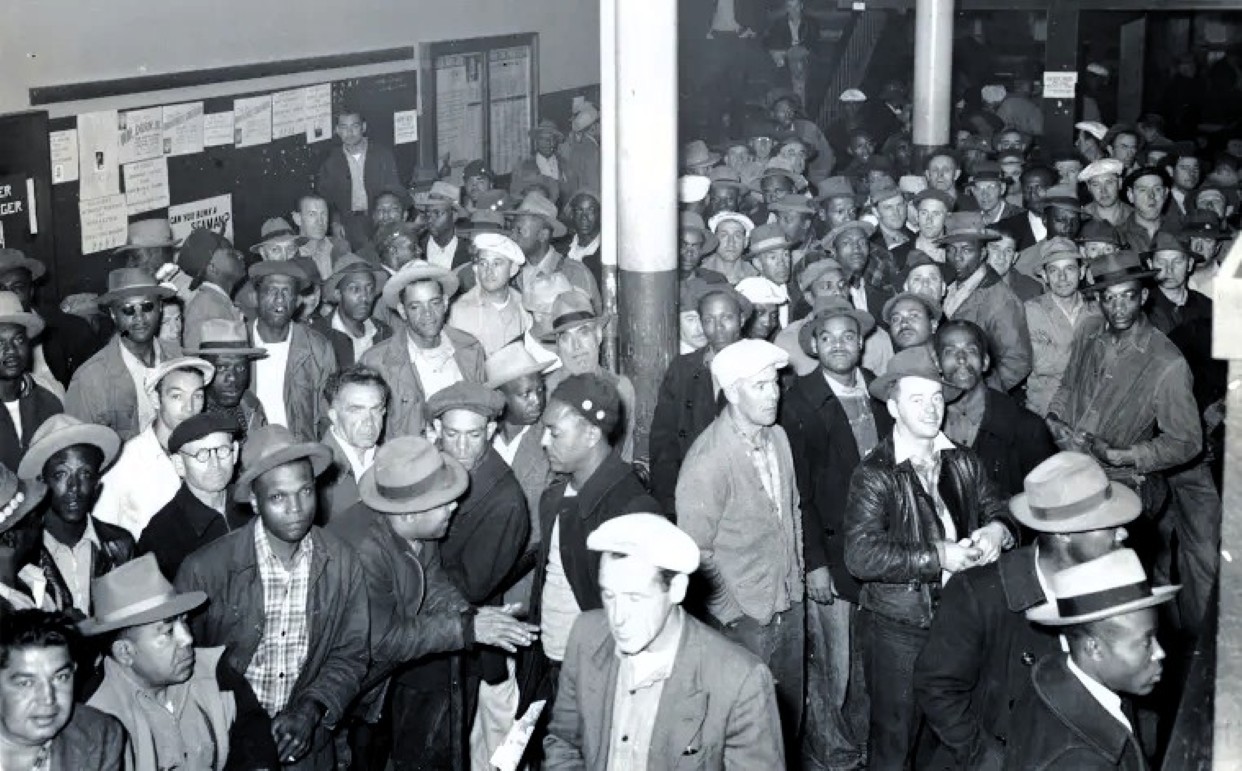
Young on why the worker-controlled hiring hall was the central demand of 1934’s West Coast general maritime strike.
‘Hiring Halls Central Issue in Coast Strike’ by Marguerite Young from The Daily Worker. Vol. 11 No. 172. July 19, 1934.
True Democracy Replaced Corruption of Old Halls–Workers’ Control of Halls Eliminated Blacklist
THE big guns of shipowner propaganda are trained today against worker control of hiring halls, the central issue in the great general strike on the Pacific Coast. The cold facts about what occurs when this demand is enforced are available. They were established a couple of months ago in Baltimore, where seamen set up their own employment agency and controlled 85 per cent of the shipping jobs along that port’s 16-mile waterfront.
Most of the fink halls and shipping sharks closed up shop, and those that remained open were deserted.
Blacklists came to be only a bitter memory.
Discrimination against Negroes and other oppressed races was ruled out.
Wages and work conditions so improved that one striking crew refused to go back to a “lousy scow” even after being offered more pay. And (Secretary of Labor Frances Perkins and President Joseph P. Ryan of the International Longshoremen’s Association, please note!) the “merit system” disappeared, but ship’s engineers confessed that to obtain efficient crews they had to go to the worker-controlled hiring hall. Finally, true democracy replaced the corruption of old, so that not one single case of discrimination could be produced.
Graft Eliminated
These are some of the things I found out about worker control of marine hiring halls when I saw the seamen’s agency in operation, despite the bitterest opposition of shipowners, during last May. Daily for two weeks I watched the Centralized Shipping Bureau, as the agency was called, distribute jobs free of charge, free of graft, in Baltimore. For seamen of every trade union affiliation I heard the story of this job agency’s efficiency and of the tremendous benefits it brought to the waterfront. Seamen coming from and going to ports scattered from coast to coast told this story.
How they must have laughed when they read what Secretary Perkins said last week! She declared there was “no precedent” for joint control of hiring halls by workers, owners and government representatives. Asked to comment upon the “precedent” for worker control established in Baltimore, Miss Perkins, instead of answering, prattled about the evils (even she admitted them) of boss-controlled hiring halls, such as “the appearance of—er–er crimps.” Finally, in reply to more questioning, she came out with her reaction to worker control. Only it wasn’t her reaction; it was President Ryan’s. She said, “I have it on such excellent authority as Mr. Ryan that sometimes worker control does allow corruption and crimps to creep in.”
Then the general strike broke. The capitalist press, which had avoided reference to the hiring hall issue as much as possible, now pounced upon it, explaining that worker control was something “new,” something “untried,” something which Wall Street banker Eugene Meyer’s Washington Post, on July 17, declared, “may, in extortionate hands, leave the employer completely at the mercy of his men.” The Post frankly advocated that the government take charge of hiring halls, asserting, “A proper and natural function of the state is organization of the labor market.” Smell the fascism!
The simple truth is that shipowners dread to give up control of hiring halls even more than to recognize unions because control of hiring is the time-honored mechanism by which they have carried out their anti-union policy. “For years seamen have been the prey of all sorts of parasites–bootleggers, merchants, tailors, prostitutes, barbers and whatnots, who board the ships the moment they dock,” Harry Alexander, former I.W.W., who became chairman of the Baltimore seamen’s job agency committee and later joined the Marine Workers Industrial Union, told me. “But of all the vultures, the shipping agent is the most ruthless. He doesn’t have to board the ship because he knows that without worker control of hiring the seaman will have to go to the shipping shark for a job.
“Shipowners gave these shipping agents power to dictate who gets what job for the very simple reason that the agents are willing tools of the bosses. It is they who enforce the blacklist. They follow it religiously, discriminating against all men marked for militancy, sometimes for union activity, sometimes for simply voicing an individual protest against intolerable conditions.
“The crimps get a fat rake-off from the shipowners, but naturally that doesn’t satisfy them, so they take more out of the seamen, with the approval of the bosses. Most of the finks have rooming houses where they charge the seamen first class prices for third class service, such as three to five dollars a week to sleep three to six in a room.
“Many of them take an outright tribute for a job. When the seaman doesn’t have to slip the shark money, he has to buy the shipping agent’s rotten gin or his lousy food–at prices including the graft against which the seaman dare not complain because it means his job.”
Baltimore had its full quota of such shipping agents until last January. There was “Standard Oil Pete,” who ran a restaurant, bar and lodging house, and recruited for that anti-union giant corporation. The Young Men’s Christian Association’s “Anchorage” Mission House did its share of shipping, particularly by providing crews to scab, and sometimes made this a requirement of the seaman’s receiving unemployment relief, which was being paid for by the federal government. There were dozens of smaller agents.
In January, Baltimore seamen, united in a powerful campaign for unemployment relief, won worker control of the distribution of federal relief. Their drive for this through relentless exposure of grafting Y.M.C.A. control and thru complete worker organization on the waterfront was victorious.
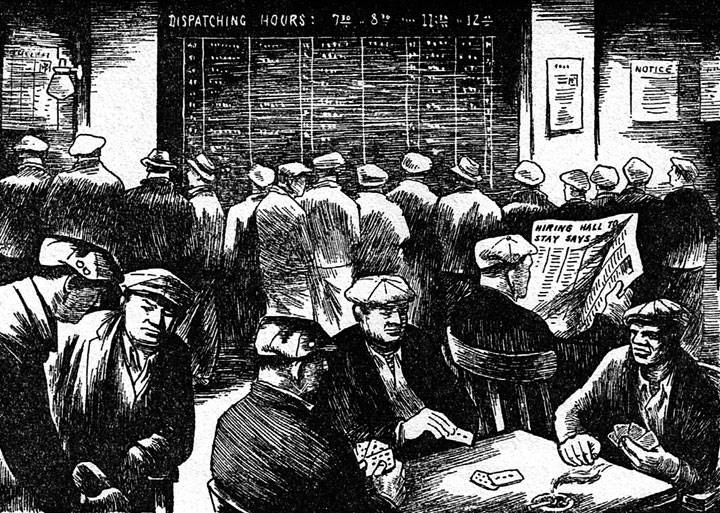
Very soon after this they set up the Centralized Shipping Bureau. In mass meeting they elected a committee of ten seamen off the floor–seamen belonging to the M.W.I.U., the International Seamen’s Union (A. F. of L.), the Wobblies, and the unorganized. This committee was placed in charge of the Centralized Shipping Bureau. It opened in a seamen’s recreation hall which was provided by the government and run by the seamen’s relief organization on the waterfront.
Any seaman “on the beach” could register at the Centralized Shipping Bureau. He must register for a specific job however, and must show discharges establishing his previous performance of that job. He received a registration number according to the order in which he registered. This figure was marked in the Bureau records and on the registration cards. When ships came in, they called the Centralized Shipping Bureau and listed jobs open in their crews. The Bureau listed these jobs on a bulletin board and, after waiting for the seamen to gather in the hall, called off the jobs and the low numbers registered for them. The seaman with the low-number registration got the job.
No Discrimination
This, the rotary system, automatically ruled out discrimination. The blacklist no longer existed. The low number got the job whether its holder had participated in union or strike activity, whether he was white, Negro, Hawaiian, Porto Rican or a member of any other minority racial group.
The Centralized Shipping Bureau held regular meetings, where rules and regulations were adopted, petty grievances threshed out, and the whole operation of the project subjected to criticism and comment by all the men registered. It was an immediate success. During the first week of operation 85 men shipped out. Seamen rallied to it as one man. And at the same time they began to fight more unitedly for improvement of conditions on their ships. Assured that they would get a job when their number came up, these oilers, firemen, cooks, coat passers, bargemen and lightermer refused to accept low wages and unsanitary conditions without protest. Job actions and strikes increased–and were increasingly victorious.
Soon the shipowners, realizing what a powerful weapon they were being deprived of, began a concerted campaign to smash the Centralized Shipping Bureau. Standard Oil boycotted the Centralized Shipping Bureau from the beginning, packing men in buses from New York to ship out of Baltimore, and finally spending thousands to ship from an island ninety miles away instead of from the port of Baltimore. The seamen, almost to a man, replied by boycotting the fink agencies. Shippers who could not afford Standard Oil’s expensive methods of opposition had to take their crews through the Centralized Shipping Bureau. Finally the ship-owners decided to try other methods. They got help from the Federal government and from some A. F. of L. officials.
Rank and File Support Officers of the I.S.U., who never had expressed approval of the Centralized Shipping Bureau, now raised false charges of “discrimination” against it. A committee of seamen elected in a Centralized Shipping Bureau meeting went to Johnny Bley, secretary of the I.S.U. local, and confronted him. He admitted that the IS.U. officialdom was acting as “runner” for Standard Oil and said there were “rumors” that the Bureau wouldn’t give I.S.U. men the same chance that it gave M.W.I.U. members. “You started those rumors!” one of the seamen told Bley, “and you can have your book back!”
“And mine,” said another of the Centralized Shipping Bureau delegation. “And mine,” said a third.
All three of them happened to be members of the I.S.U., and had seen how democratically the Centralized Shipping Bureau operated! Finally, the shipowners appealed to State and Federal government officials to withdraw relief to smash worker-control of this in order (so they thought) to scatter the seamen and break up the Centralized Shipping Bureau. Later, Federal officials in Washington informed me that worker-control of relief was being withdrawn, following bitter protests against it by A. F. of L. officials and shipowners, who came to Washington personally to tell the government what to do. These government sources told me that all of the complainers said that “the worst thing” about the Baltimore situation was the Centralized Shipping Bureau. That’s what they were after.
After a long, heroic struggle, the Baltimore seamen did lose worker-control of relief. And the shipowners again are boycotting the Centralized Shipping Bureau.
Three hundred seamen in Baltimore are still registered today in the Centralized Shipping Bureau, however, and are redoubling their drive to force the shipowners to hire through the worker-controlled hall. In recent weeks strikes have occurred–on the demand of recognition of the Centralized Shipping Bureau. In one of these, that of the S.S. West Eldara, I.L.A. longshoremen dropped their hooks and knocked off in sympathy. President Ox of the IL.A. local next day ordered the men back to work. Many refused to go. Although the longshoremen had not participated in the Centralized Shipping Bureau, they knew the significance of worker-control of hiring halls and were willing to fight for it. Today there is a strong sentiment among them for a strike in support of the Pacific Coast and for worker-control of their own hiring hall.
The Daily Worker began in 1924 and was published in New York City by the Communist Party US and its predecessor organizations. Among the most long-lasting and important left publications in US history, it had a circulation of 35,000 at its peak. The Daily Worker came from The Ohio Socialist, published by the Left Wing-dominated Socialist Party of Ohio in Cleveland from 1917 to November 1919, when it became became The Toiler, paper of the Communist Labor Party. In December 1921 the above-ground Workers Party of America merged the Toiler with the paper Workers Council to found The Worker, which became The Daily Worker beginning January 13, 1924.
PDF of full issue: https://www.marxists.org/history/usa/pubs/dailyworker/1934/v11-n172-jul-19-1934-DW-LOC.pdf

