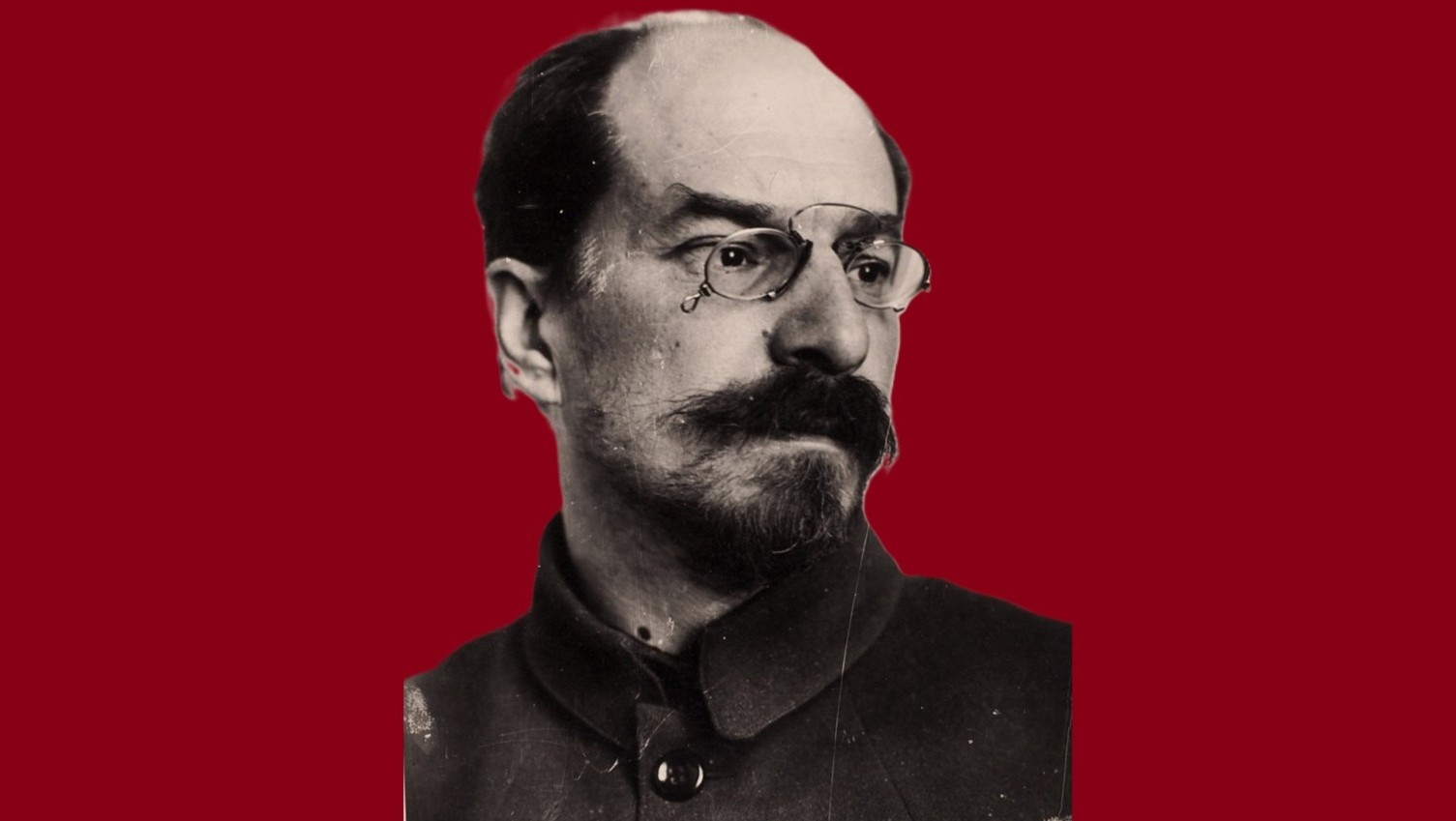
Among the very first actions of the Soviets, the day after taking power, was to establish a system of universal and comprehensive education with Anatoly Lunacharsky, a Marxist intellectual, erudite and with an expansive, educated, and sophisticated appreciation of society’s arts, particularly its literature. He would be Commissar of Education from its founding until 1929. A unique figure among the Bolsheviks, Lunacharsky’s impact on the new Soviet culture was incalculable, though he had little political authority within the Party, never serving on its leadership bodies. Ambitious, incredibly learned, and visionary, Lunacharsky’s transformation of education was among the Revolution’s great achievements. Born in Czarist Poland in 1875, he joined the Marxist movement at 15, travelling to Zurich for studies, meeting fellow exiles Rosa Luxemburg and Leo Joegchies, joining the newly-formed R.S.D.L.P. in 1898. Returning to Russia in 1899, several arrests and internal exiles followed. Released and returned to Kiev, he occupied the place of ‘conciliator’ during the 1903 split between Mensheviks and Bolsheviks, though soon threw in the Lenin, and relocated to Zurich where he would edit, Vperyod, the first exclusively Bolshevik newspaper. Returning to Russia in 1905 to participate in the Revolution, editing Novaya Zhizn in Moscow until his arrest, and the potential of a permanent exile or execution. Skedaddling, he first made it Finland, then to Germany where he participated in the Socialist International’s Stuttgart. A 1908 split among exiled Bolsheviks led Lunacharsky to side with a leading rival for the Bolshevik leadership, Alexander Bogdanov (also his brother-in-law) in his dispute with Lenin, beginning a new paper, Vpered, emphasizing the role of intellectuals and cultural activity, focusing on education while at the same time issuing maximalist slogans. This is Lunacharsky’s ‘god-building period in which he wrote ‘Religion and Socialism,’ advocating a kind of spiritual-secular ‘god’ of a liberated future—free humanity. While often dismissed by our more Orthodox friends, these writings are a trove of stimulating ideas and imaginings of material possibilities beyond today’s mortal limits. Exile it Italy, near Maxim Gorki, and later in Paris and Switzerland during the war he co-edited Nashe Slovo with Trotsky, Lulius Martov, and Antonov-Ovseenko. Steeling back to Petrograd after the opening of the 1917 Revolution, Lunacharsky was a member of the Mezhraiontsy (Inter-District Group) which published Vperyod and included figures like Trotsky, Joffe, Dmitry Manuilsky, Moisei Uritsky, Lev Karakhan, Volodarsky. In July, the Mezhraiontsy merged and folded completely not the Bolsheviks, with several of their members taking senior roles in the fused Party. Arrested with Trotsky after the July days, both were released in September 1917. On the first evening of Soviet Power, October 26, 1917, Lunacharsky was voted to lead the revolution’s transformation of education as Commissar of Education; a monumental and central tasks of Socialist Reconstruction. With his extraordinarily wide range of enthusiastic interests; physical arts, music, theater, cinema, literature, architecture, Lunacharsky’s imprint on the cultural achievements of the first decade of the Soviet Union are unparalleled.
‘The Death of Comrade Lunacharsky: A Brief Appreciation’ by Moissaye J. Olgin from The Daily Worker Vol. 10 No. 2. January 8 1924.
PHILOSOPHER, poet, playwright, critic, essayist, art connoisseur, historian of literature, leader of the theatre, educator–Lunacharksy always remained himself, because there was an essential unity to all the manifold expressions of his richly endowed and highly cultivated personality. Lunacharsky was first of all and above all a social dreamer. Not a dreamer who, to use Lenin’s quotation from Belinsky, “flies off at a tangent in a direction to which no natural progress of events will ever proceed,” but a dreamer “whose dream runs ahead of the natural progress.” “Of this kind of dreaming there is unfortunately too little in our movement,” said Lenin in 1902 (Works, Vol. IV, Book II, p. 241). Lunacharksy was one of the few old Bolsheviks who possessed the ability and the courage to see social visions and to embody them in writing which varied in form but remained uniform in spirit (of all the Old Bolshevik Guard, Lenin was by far the greatest seer of visions, but he embodied them in social organizations and in writings helping build those organizations).
Lunacharsky concerned himself mainly with what is known in Marxian terminology as the “superstructure,” the cultural aspects of society removed from, but determined by, the productive forces. As a historical materialist he made it his life’s work to explain cultural phenomena and their succession by the material economic basis of society and its changes; as a fighter for a socialist system he was keenly and overwhelmingly interested in the emergence of a new proletarian culture; as a poet he saw the new man under the new social system, a free individual, broadminded, broad-visioned, sensitive, noble, and creative. It was perhaps this longing for the higher creative personality that formed the pivotal point of all his wideranged work. “In pain and tortures, in the grimaces of a depraved ape, in the corruption of a fallen angel, man creates the link that is not yet in nature,” says Thomas Campanella in a play of Lunacharsky’s by the same name. “He is a crooked and filthy bridge between the gigantic greatness of the abyss and the splendor of infinity beyond space. In him the spirit strives to embodiment, and the flesh, to become spirit.” What Campanella said about the spirit generally, Lunacharsky translated into the spirit of the class struggle.
His particular work in the rank of the Bolsheviks was to win over to the revolution the intellectuals primarily interested in things cultural. Himself an intellectual of the highest order, he could not be dismissed by the intellectuals like many another revolutionist on the ground of “disregard for cultural values.” He knew cultural values only too well, and he was too respected even among the bourgeoisie for his learning and talent. There was even a legend current among intellectuals that he was less of a Bolshevik and more of a “culturist” interested in literature and art “generally.” The truth of the matter is that there was a division of labor among the Bolsheviks ever since the turn of the century. While Lenin was building the Communist Party and mapping out the plan for the social revolution, men like Lunacharsky were proving that “the proletariat is essentially a culture class,” that “the proletariat itself, its organization, its program, its future is the result of a highly developed economic mechanism built up by capitalism,” and that “in the very same way as socialist production is the outcome of capitalist production, though improved and modified, so also socialist culture is a freshly blossoming beautiful branch of the great tree of general human culture,” because “the proletariat, representing the majority of the city population, strives everywhere and irresistibly to knowledge and beauty.” (Cultural Tasks of the Working Class.)
When the November revolution elevated the proletariat to the position of the ruling class, there was no one better fitted to fill the role of People’s Commissar of Education than Lunacharsky. He became a kind of liaison officer between the dictatorship of the proletariat and the bourgeois intellectuals whose services were needed for the new State. Because he used persuasion rather than coercion, he became known as a “good Bolshevik,” i.e., a man far less severe than the other leaders. Because he had had his days of error in connection with “God-seeking” and “God-building” (his well-known treatise on Religion and Socialism whose conceptions Lenin characterized, in a letter to Gorky, Feb. 25, 1908, as “an attempt at teaching the workers ‘religious atheism’ and ‘deification’ of the highest human potentialities”) he was looked upon by the bourgeoisie the world over as “not quite” as “intolerable” as the rest of the “dictators.”
In reality, Lunacharsky’s road was a straight one. He fought for the Marxian conception of history all his life and with weapons of varying calibre. As head of the Soviet educational department, he succeeded in establishing the new school and organizing first the cooperation of the oldtime intelligentsia with the new system, then the training for higher cultural work, men and women from among the masses of workers and peasants. As an artist, a beauty lover, he encouraged the artists to produce under the new system and encouraged the masses to enjoy art values and to move to the front their own creative individuals. As a specialist in European art, he encouraged a rapprochement of the Soviet artists with the artists of the western world.
He was a revolutionist and a Marxist, and to him both were especially valuable as touching upon the mainsprings of human emotion and human behavior. Many of his critical treatises were devoted to the Tragedy (his famous tract on Hamlet, Faust, and Versunkene Glocke); many of his essays dealt with the morals of the revolution and the morality of the future society. Throughout he remained humane, deeply convinced and convincing as only sincerity can be. His brilliance accompanied him as naturally as the timbre accompanies a man’s voice.
A cultural fighter of the first rank has died. His work lives in the cultural activity of a great country building a new system.
The New Masses was the continuation of Workers Monthly which began publishing in 1924 as a merger of the ‘Liberator’, the Trade Union Educational League magazine ‘Labor Herald’, and Friends of Soviet Russia’s monthly ‘Soviet Russia Pictorial’ as an explicitly Communist Party publication, but drawing in a wide range of contributors and sympathizers. In 1927 Workers Monthly ceased and The New Masses began. A major left cultural magazine of the late 1920s and early 1940s, the early editors of The New Masses included Hugo Gellert, John F. Sloan, Max Eastman, Mike Gold, and Joseph Freeman. Writers included William Carlos Williams, Theodore Dreiser, John Dos Passos, Upton Sinclair, Richard Wright, Ralph Ellison, Dorothy Parker, Dorothy Day, John Breecher, Langston Hughes, Eugene O’Neill, Rex Stout and Ernest Hemingway. Artists included Hugo Gellert, Stuart Davis, Boardman Robinson, Wanda Gag, William Gropper and Otto Soglow. Over time, the New Masses became narrower politically and the articles more commentary than comment. However, particularly in it first years, New Masses was the epitome of the era’s finest revolutionary cultural and artistic traditions.
PDF of full issue: https://www.marxists.org/history/usa/pubs/new-masses/1934/v10n02-jan-09-1934-NM.pdf
 Revolution's Newsstand