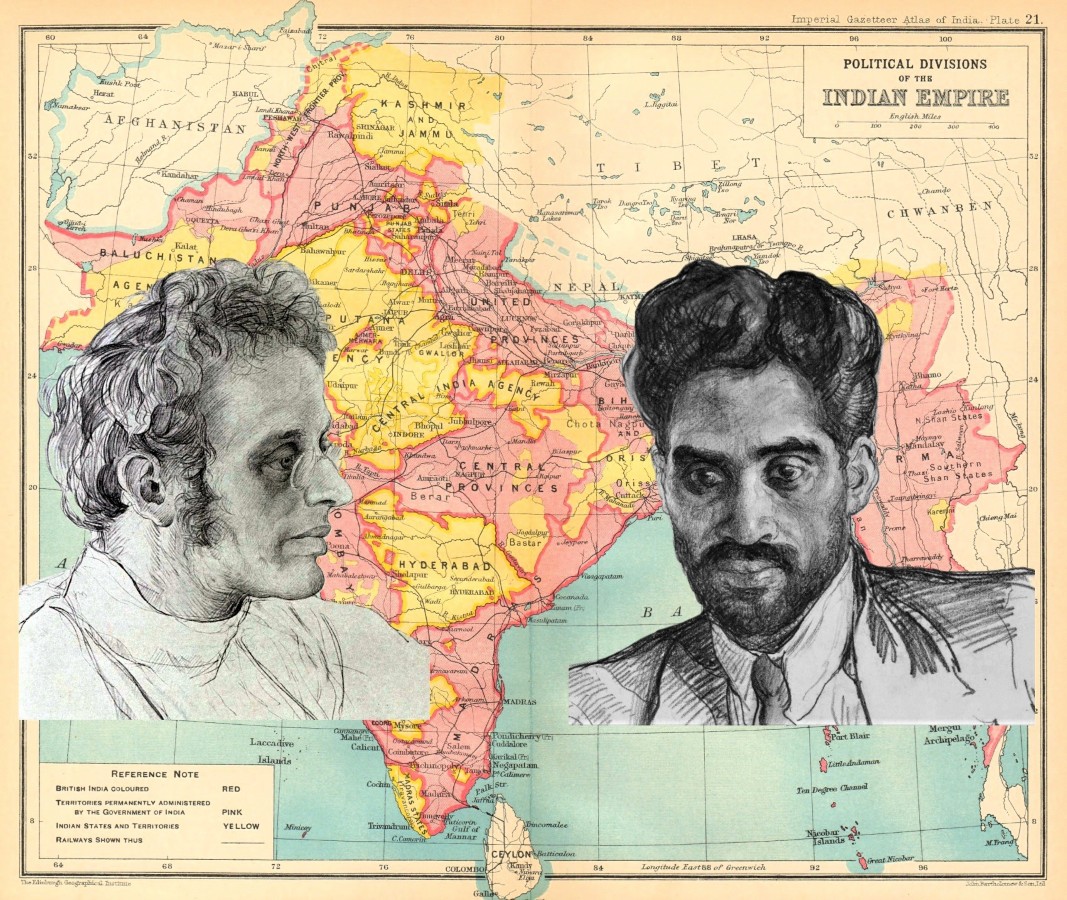
A major piece from Radek criticizing M.N. Roy’s position on the prospects of revolution in India.
‘Problems of the Indian Revolution’ by Karl Radek from International Press Correspondence. Vol. 10 Nos. 28, 29, 30 & 31. June 12, 19, 26 and July 3, 1930.
I. Indian Capitalism and English Imperialism.
The events taking place in India are replete with the profoundest contradictions. The conflict between British imperialism and the national reformist Indian bourgeoisie, which strives towards a compromise with imperialism and fears the revolutionary struggle of the workers and peasants as the devil fears holy water, has created a situation which can and must be utilized in the interests of revolution.
On this point, and with respect to the whole standpoint of the so-called third period, the VI World Congress of the Comintern foresaw the raising of a large number of questions which have now been pressed into the foreground by the course of events. Therefore there can be nothing more absurd and shameless than the following assertions, made by Roy in his attempts to find his way back to the “national” camp:
“The VI World Congress of the Comintern”–writes Roy “declared that, with the exception of the workers and peasants, everyone in India is a counter-revolutionary. It forgot that India is a colonial country, and that in India the political relations of the classes cannot be the same as in the independent capitalist countries.”
Before we refer to what was said by the VI Congress, it is worthwhile to point out the statements made in 1926 by Roy in his book: “The Future of Indian Policy“:
“What are the chief demands of the nationalist bourgeoisie? They culminate in three points: The industrialisation of the country, financial autonomy, and protective tariffs. All these demands have been met, for the reason that British capitalism has sought to overcome the post-war crisis by rebuilding the foundation of the Empire. Experience has shown that the economic programme of nationalism can be realised even when the imperialists do not carry out the abrupt political reforms demanded by the petty bourgeoisie. In other words, the big bourgeoisie has come to the conclusion that its economic development is possible within the confines of imperialist policy.” (Page 33. The emphasis is mine. The quotation is retranslated from the German. K.R.)
Roy has not stood alone in his assertion respecting the fulfillment of the demands of the capitalist bourgeoisie of India by British imperialism, or the fundamental possibility of the needs of the capitalist development of India being satisfied by British imperialism. This idea has formed the spring of a series of trends, sometimes repeating the fairy tale of British imperialism, and sometimes combining the hopes of the capitalist bourgeoisie of India with the hopes of those young and inexperienced Indian Communists who have thought to leap over a whole stage of the development of the revolutionary movement of India. Comrade Narayan, for instance, stated at the VI Congress of the Comintern:
“We find that to the same degree as the hindrance in the way to the capitalist development of India has been removed by British Imperialism, the bourgeoisie is sliding more and more towards co-operation and one group after the other is capitulating to imperialism.” (The emphasis is mine. K.R.)
The widest sanction was lent to these views of the Indian Communists by some of the English delegates at the VI World Congress, who exaggerated the extent of the industrialisation of India, and maintained that imperialist English policy had undergone a fundamental change. This standpoint was expressed concisely and graphically by Comrade Arnot, who declared:
“In the era of finance capital, export of capital develops more and more bursts into the colonies, and has inevitable reactions there. The inevitable process of the growth of industry is no longer retarded, or rather the balance between the tendency towards retarding and the tendency towards accelerating, becomes increasingly more and more towards acceleration.” (The emphasis is mine. K.R.)
Comrade Arnot even entertained the idea of a “state plan” of the English bourgeoisie, furthering an uninterrupted industrial development in India.
As opposed to this standpoint, the Comintern unfolds a very different picture, both in Comrade Kuusinen’s report and in the theses passed by the VI Congress. It need not be said that it has not occurred to anyone to deny the facts of the industrial development of India since the war, or of the existence of partial concessions on the part of the English imperialists towards the Indian industrial bourgeoisie, in order to gain a compromise. But the Comintern has not contented itself with merely summing up the facts; it has raised the general question: Can English imperialism remove the obstacles in the way of the capitalist development of India? This question is of enormous political significance. It is clear that if the interests of English imperialism are compatible with the undisturbed development of capitalism in India, the result would be that India is not on the eve of a period of the democratic revolution, and that all contradictions between English imperialism and the capitalist development of India I could be solved by reformist methods. Not, as Trotzky believes, because the desertion of the national bourgeoisie exhausts in itself the period of democratic revolution. On the contrary, as a rule the bourgeoisie deserts the national movement at the point when the masses of the workers and peasants shake off the bourgeois tutelage and tackle the accomplishment of their revolutionary tasks on plebian methods, that is, the point at which the bourgeois revolution, after a preliminary period of general national opposition, enters the decisive phase. The point at which the bourgeoisie abandons the democratic revolution cannot signify the conclusion of that revolution, for the simple reason that the bourgeoisie has never been the revolutionary driving power, despite the fact that the social content of the revolution has been the emancipation of capitalist development from the fetters of feudalism.
In China and India the industrial bourgeoisie could never supply the driving power of revolution, for this revolution is taking place at a time when the proletariat has already been victorious in the Soviet Union, and the approaching thunder of the socialist revolution may already be heard in the West. But if we deny the industrial bourgeoisie the role of the motive power of revolution, if we are aware of the treacherous part played by the bourgeoisie in the past and expect its further treachery in the future, then we cannot be misled into supposing that the removal of the obstacles in the way of India’s industrial development is compatible with the rule of imperialism. For, if we adopt the standpoint of the compatibility of the rule of imperialism in India with the removal of the obstacles to capitalist development, then it is clear that this development will undermine and wash away the last remnants of feudalism, will raze down a path for the advance of capitalist development into agriculture, and will thereby suck up at the same time the proletarised elements of the village. This means that the perspective of democratic revolution vanishes, and is replaced by a reformist perspective.
The Congress of the Comintern denied the reality of such a reformist perspective, the sole actual object of the contention although the Indian and English comrades failed to see the forest because of the trees, and believed that the contention was concerned with such trivialities as lack of comprehension of the role played by capital export, or the non-recognition of the fact of a certain advance in the industrialisation of India.
From the standpoint of the Congress the central idea was this: that no change in the policy of English imperialism can lead to the liquidation of that residue of feudalism which forms the chief obstacle to the development of Indian capitalism.
50 per cent of the land is in the hands of feudal landowners and princes, 30 per cent in the hands of the English imperialists. This enormous burden upon the shoulders of the masses of the people, making India to that land of poverty which it is, where the income per head is only 20 roubles yearly as compared with the 60 to 70 of the Japanese peasant, cannot be removed by a wise decision from above, but solely by the agrarian revolution.
The voluntary renunciation of the French, on 4th August 1789, of their feudal tribute, is a historical legend. Even the Girondists would not and could not free the French peasantry, and the bloody revolution of the Jacobins was required in order that the peasantry might liquidate feudalism and become the owners of the land. English imperialism, in defending the feudal yoke in India, defends not only its immediate revenues, but at the same time the class upon which it leans chiefly for support in India. It is not merely a question of the 8 millions whose interests are directly bound up with feudal exploitation, but of the whole pertaining system: the system of the native princes, the system of religious influence upon the masses, all part and parcel of the residue of feudalism.
This in itself would suffice to enable us to say that there is no reformist way of removing the obstacles to the capitalist development of India, which is impossible without the creation of home markets. There is however another leading argument against this reformist perspective. During the period of imperialism the export of goods is not succeeded by the export of capital, but supplemented. The financial capital of the great cities, which holds the industries in its hand, and exports objects of universal use, especially textile goods, has developed at the same time the heavy industries requiring growing markets. This coincides with the needs of financial capital, which seeks for its accumulations of wealth a higher rate of interest than is customary in the great cities. This results in the simultaneous export of articles of general use and of the products of heavy industry, offering to the colonial country the possibility of creating its own light industry–which limits the sale of the goods of the great cities–and of creating the foundations of the beginning of the development of a colonial heavy industry.
In this manner the new colonial policy–differing, as the colonial policy of monopolist capitalism, of financial capitalism, of imperialism, from the old colonial policy of the era of free competition, with its preponderance of light industry over heavy–does not merely sweep aside the old policy, but merges into and becomes one with it. Hence it is childish schematism to suppose that the colonial policy of financial capital consists of energetic support of the industrial development of the colonies. Birmingham has not swallowed up Lancashire. The offices in the City, the counting houses of the five great English banks, which decide on the economic policy of imperialism, do not forget to consider the interests of English industry in general and of the textile industry in particular. Financial capital is not simply bank capital, a thing apart from industry, and simply calculating on a standard rate of interest.
Every step taken by British economic policy in India is the subject of conflict among various groups of British capitalists. Therefore the so-called support of the Industrial development of India encounters tremendous obstacles. The struggle rages not merely between the Indian bourgeoisie and British capitalism, but at the same time between different groups of English capitalists. The result is that the industrial development of India–except during the war–is proceeding very slowly. Today the British bourgeoisie, under the pressure of its war requirements and its fear of revolution, is making concessions to the national Indian bourgeoisie, with the intention of withdrawing them again tomorrow. It suffices to point out that the British bourgeoisie, after making concessions in the tariff question and raising the duties in order to safeguard the industrial development of India, afterwards raised the rate of exchange of the rupee after the defeat of the first wave of revolution in 1919 to 1921, thereby creating a special premium for the furtherance of British export to India. These developments of the economic policy of British imperialism are full of inconsistencies, pursue a zig-zag line, and give to delays and obstacles at every step. It is a struggle between the meds of capitalist development in India and the interests of British imperialism. The destructive influence of British imperialism upon Indian economics, evidenced in the increasing Impoverishment of the Indian village, and in the ceaseless addition to the army of the superfluous of dozens of millions of pauperised peasants, who find no place in industry, is developing more rapidly than the process of the industrialisation of India.
***
In as far as this latter process is going on, it does not signify the emancipation of India from paying tribute to English imperialism, but the growth of its dependence and the increase of this tribute, with the sole difference that the trading profit is superseded by the industrial profit. The loans given by European capitalists to the United States of America during the capitalist youth of that country did not enslave America, but accelerated its independent development into the greatest capitalist power, for the proportion of these loans to the national income of the young capitalist country, with its enormous and growing home markets, was inconsiderable. Had English capitalism not suffered as it has indubitably done since the war, and had the extent of the English export of capital to India been in accordance with those fantastic imaginings and expectations which represent one of the bases of reformist perspectives with regard to India, then this would have meant the growth of India’s independence of England, and not its weakening. In view of the existing interweaving of the interests of English imperialism and Indian feudalism, it would signify the strengthening of that whole Asiatic-feudal-imperialist system which is throttling India, and not the weakening of this system.
Finally, it must not be forgotten for a moment that Indian policy is not made by some abstract class of historical tendencies and subordinates itself to historical necessities, but by a living English bourgeoisie in whose policy the gentlemen of the “Indian Office”, and the Colonial military and civil bureaucracy, elements entirely at one with the ruling strata of the English bourgeoisie, play a much greater role than all the MacDonalds, even were we to assume that it has been proved–and we have no reason to do this–that these last are extremely anxious to improve the situation of the Indian people. The Colonial bureaucrats and officers are fighting not only for their high salaries, not only for those 200 million roubles of savings which they send year for year to England. In their struggle against the policy of concessions they can refer to such facts as that for instance, that whilst Japan expends about 300 million roubles yearly (figures from 1926) for its fleet and army, India spends 600 million roubles annually for its direct and indirect “defence”, 50 % of the total Indian state expenditure is for the immediate purposes To this must be added the expenditure of a concealed military character, such as the payment of state debts and the building of railways, so that military expenditure, In the opinion of the English financial experts, amounts to 70% of the Indian budget. Thus write the German reformists Schrader and Furtwängler in their book “Das werktätige Indien” (Working India), (Berlin, 1929, p. 80). India pays not only for its chains, but to a considerable extent for the defence of British interests in the East. India signifies the basis of English imperialism in the East, and English imperialism will protect this basis to the utmost of its power.
***
All the promises made by the English government, where these go beyond the extension of local self-administration, or of the increased participation of the leaders of the Indian bourgeoisie in the administration of India, are pure swindle. The solution of Dominion Status for India, that is, the placing of India in the same position as Canada, Australia, and South America, is simply Utopian. The Conservative die-hards who admit this speak the truth, and the Liberals and the Labour Party people who maintain the contrary are either fools or hypocrites. The position of the English dominions is that of practically Independent small countries in which chiefly English capital has built up the economy, in which the bourgeoisie is mainly English, and whose essential character is that of an extension of the British Empire. Where they have not been able to protect themselves (for instance Australia against Japan) they have agreed to certain restrictions of their independence with respect to their foreign policy, and have granted certain privileges to English imperialism, which has however not interfered in any way in their internal affairs nor lived at their expense. In proportion as the Australian and Canadian bourgeoisie have developed their own industries, they have resisted the attempts of English imperialism to find a means of escape from its economic difficulties at their expense. It was these attempts to league the Dominions more closely with the Motherland which shipwrecked Joe Chamberlain’s policy, and which will shipwreck the policy of Beaverbrook and Mond, who are striving to renew Chamberlain’s effort in the present acuter stage of the crisis of British imperialism. The Dominions, under the influence of the growth of the world power of the United States, have turned to the money market of New York, and in 1921 they helped the United States to force England to abandon the alliance with Japan. The Dominions have developed towards complete independence. Dominion Status for India would signify first of all an onset against the unbearable war burdens now crushing it, and a struggle for the replacement of English bureaucracy by Indian. Gandhi himself found himself obliged, in his ultimatum to the Viceroy, to demand Inter alia a 50% reduction of the war expenditure and of the salaries of the higher English bureaucracy, and this although Gandhi is notoriously of the opinion that the interests of the Indian bourgeoisie render the maintenance of the connection with England necessary. The weakening of the rule of British imperialism in India would signify such a weakening of feudal imperialist positions in India that the next day would raise the question, if not immediately of the liquidation, at least of the bridling of the whole regime of feudal imperialist exploitation, the question of the transference of the bureaucratic administration of India, scantly covered with the figleaf of legislative institutions participated in by representatives of 3% of the population, at least into the hands of bourgeois democracy. India as Dominion would signify that English imperialism makes the Indian people a present of nine tenths of the independence of India. It is possible to complete Independence by fighting for it, but it is not possible to be given the half or nine tenths of Independence as a present.
This being the actual position, a fresh outbreak of opposition against English Imperialism was Inevitable, even on the part of the national reformist bourgeoisie of India, which strangled the revolution of 1922, and is ready to betray another hundred revolutions. That Indian bourgeoisie which betrayed the revolution of 1922, and broke off the struggle in its fear of that revolution, expects concessions from English imperialism: but it has not even been permitted to take part in the Simon Commission for the investigation of the situation in India. This is tantamount to telling it that it is the object, and not the subject, of English policy. It has not been allowed to secure a majority for the Indian National Congress representing the interests of the Indian bourgeoisie, in the conference of the “Round Table” which is to be assembled to confer on the question of India’s new constitution. It has been told: English Imperialism is not going to alter its social basis in India; it has complete faith only in the feudal lords, the princes, the compradore bourgeoisie. And finally, after MacDonald had commanded the Viceroy. Lord Irwin, on 31st October 1929, to dangle before the eyes of the Indian bourgeoisie the Fata Morgana of Dominion Status, he was obliged to declare in Parliament, when pressed against the wall by the Conservatives, that there is no change impending in English policy in India. The prophecy contained in the resolution of the Comintern has proved true in every respect:
“The independence of the country in relation to imperialism, being to the advantage of the whole colonial people corresponds also to the interests of the national bourgeoisie, but is in irreconcilable contradiction to the whole nature of the imperialist system. Various native capitalists, it is true, are by their immediate interests to the great extent bound by numerous threads to imperialist capital. Imperialism is able directly to bribe a considerable portion of them (it may be even a greater portion than heretofore) and to create a definite Compradore position, a position of intermediary trader, sub-exploiter or observer over the enslaved population.
But the position of slave owner, of monopolist supreme exploiter, imperialism reserves for itself alone.
Independent rule, a future of ‘free’ people–this imperialism will never voluntarily yield to the national bourgeoisie in this respect, the contradiction of interests between the national bourgeoisie of the colonial country and imperialism is objectively of a radical character. In this respect, imperialism demands capitulation on the part of the national bourgeoisie.
The native bourgeoisie, as the weaker side, again and again capitulates to imperialism. Its capitulation, however, is not final as long as the danger of class revolution on the part of the masses has not become immediate, acute and menacing.”
This is how history actually puts the question to the Indian bourgeoisie–capitulation or struggle. It has not been able to capitulate immediately, not only because this would have signified the complete renunciation of the defence of its capitalist interests, but because it would have signified the loss of the leadership over the petty bourgeoisie of the cities and over the peasantry, and a direct surrender of the hegemony to the proletariat.
In our next article we shall deal with the inner class relationships in India, which are impetuously breaking down the confines of the national reformist struggle against imperialism. In this question too the resolution of the VI World Congress foresaw all the difficulties facing the Indian communists, and laid down the correct tactical line to be adopted.
***
II. The National-Reformist and National-Revolutionary Camps in India.
During the first mass wave of the Indian revolution, in 1919 to 1922 the class division of forces was as follows: English imperialism was supported by the princes, the feudal landlords, the comprador bourgeoisie, the usurers, and the strata of the intellectuals belonging to these. In opposition to these were the industrial bourgeoisie, the handicrafts, the small tradespeople, the intellectuals belonging to these strata, the masses of the workers and peasants. The struggle carried on under the leadership of the nationalists, and especially of Gandhi, who advanced at that time for the first time into the arena of all India, was not a struggle for independence, but for the participation of the Indian bourgeoisie in the administration of the state, for its equal rights in competition with Englishmen for positions in the administration. In the sphere of economics, the movement was carried on under the slogan of a return to the past, to a primitive economy of commodities (Gandhi’s propaganda for home weaving), but in reality the movement took the form of a struggle for the conditions under which Indian native industries were developed. Socially, Gandhi’s adherents advanced exceedingly indecisive demands for the improvement of the situation of the workers and peasants. They founded trade unions, in order to meet the growing demand for organisation among the masses, but attempted to impart to these unions the character of educational and philanthropic institutions, and to play the part of intermediary between the capitalists and the workers. When the masses of the workers and peasants began to refuse obedience, and to intensify the struggle against both English imperialism and against the Indian capitalists and landlords, the Gandhi party ceased its campaign, substantiating this step in very precise class terminology. In the resolution passed at Bardoli (January 1922) it confirmed its rejection of revolutionary force, and stated in so many words that the nationalist movement did not aim at destroying feudal exploitation, but at coming to a peaceful understanding with the feudal landowners in the question of lessening the burdens imposed on the peasantry.
Has the position thus adopted by national reformism changed in the period since the cessation of the struggle in 1922? No, as regards English imperialism it has not changed. The national reformists, who advanced in 1927 the slogan of independence, exchanged this in 1928 for the constitution proposed by the older Nehru, which retains India’s dependence on England, and returned in 1929 once more to the slogan of independence. This change of slogans makes it apparent that for national reformism the slogan of independence is merely a trump in the struggle to gain concessions from English imperialism. And we see that Gandhi, after the slogan of in- dependence had been accepted at the Congress at Lahore (“Young India”, 30ah January), supported, in the 14 conditions for the cessation of the struggle and the participation of the national reformists in the “Round Table Conference”, among the political demands only the 50% reduction of the army and a like reduction of the salaries of the higher officials, the amnesty for political prisoners (with the exception of the terrorists), the cessation of political persecution, and the permission to carry weapons in self-defense.
Is there any change in the national reformist attitude toward the questions of the workers and peasants?
The growth of the peasant movement has forced national reformism to accord it more attention; whining articles appear in the press, describing the sorry situation of the peasantry; Gandhi’s 14 demands include one for the 50 % reduction of grounds rents, but as a rule the national reformists do not go beyond the reformist demands for the alleviation of the position of the peasants. They regard the growing labour movement with ever increasing disapproval, at times take sides openly with the employers, and even support the measures taken by imperialism for the repression of the proletariat. The demands formulated in the programme of the younger Nehru, which demand “as far as possible” both the abolition of feudalism (compensation to be given) and the nationalisation of big industry accompanied by the eight-hour day, are as characteristic of the real policy of the national reformists as Skobelyev’s demand for a 100% confiscation of profits for the Menshevists and for the S.R. in the February revolution of 1917. With respect to fighting methods, the national reformists continue to oppose any revolutionary mass action, although Gandhi now speaks of passive-aggressive tactics. In his letter to Lord Irwin, the viceroy of India, a few days before the beginning of the salt campaign, Gandhi openly exposed his counter-revolutionary attitude:
“We all know” he declared, “that the influence of the party of violence is growing, even though at the moment it appears to be badly organised and insignificant. Its aims are the same as mine, but I am profoundly convinced that it is not in a position to bring help to the silent millions. I am more than ever filled with the consciousness that only the entire renunciation of the use of violence can overcome the organised force of the English government. My experience, limited as it is, has shown that the renunciation of the use of violence can be a great and active power. I am prepared to lead this power, both against the power of the British government and against the unorganized forces of the party of violence. To fold our hands would be tantamount to abandoning the field to these two powers.“
We need not enter into Gandhi’s declaration that his aims are identical with those of the “party of violence”, for we do not know of what “party of violence” he speaks. What is important in his declaration is his announcement, at the commencement of a fresh wave of revolutionary movement, of a fight on two fronts. We see that the fundamental political principles of national reformism have not changed since the day of betrayal at Bardoli. Every Indian communist must keep fresh in his memory the resolution of Bardoli, and Gandhi’s declaration, based on the class situation of the industrial bourgeoisie and the well-to-do strata of the petty bourgeoisie. These are striving to lessen imperialist exploitation and the imperia- list yoke, but they do not forget for a moment that they are living on the crater of the profoundest discontent of the workers and the pauperised peasant masses. When the earnest revolutionary struggle of the workers and peasants begins, the national reformists will inevitably stand on the other side of the barricade, and not between imperialism and revolution. “You cannot quarrel with a communist any more than you can quarrel with a mad dog; therefore the Chinese government has resolved to exterminate them by thousands of executions” these words of the Indian industrialist Victor Sassun, an adherent of imperialism, will be the programmatic slogan of the national reformists when the class war is in full swing. To have even the slightest doubt of this, after what we have seen in China, and to fail to prepare ourselves and the masses for this inevitable change of front on the part of the national reformists, would mean a frivolous and criminal abandonment to defeat of the workers and peasants. The struggle against the national reformists, the struggle against Gandhism, is no less important a prerequisite for the victory of the Indian revolution than the struggle against English imperialism.
***
Why have the national reformists, whose class position impels them towards a compromise with English imperialism, and who fear the revolutionary movement of the workers and peasants, nevertheless adopted some fighting measures? We answered this question partly in our previous article, which pointed out that the antagonisms between the interests of English imperialism and those of young Indian capitalism do not allow English imperialism to satisfy the needs of the capitalist development of India. This forces the Indian industrial bourgeoisie into an opposition which intensifies, during certain phases, into attempts at fighting. At the present juncture such a necessity for active struggle has been brought about by the differentiation in the camp of the nationalists.
The working class, which followed the national reformists blindly in the period between 1919 and 1922, began to separate from them in the years from 1926 and 1927, and to withdraw from their influence. It began to remove the agents of the national reformats from the leading positions in the trade unions; during the enormous strike wave, which rushed far beyond the highest tide-mark of the strikes of the previous period, the working class began to form as class, for these strikes were not purely economic disputes, they were conflicts in which the working class began for the first time to feel itself as a separate power, and to oppose not only English imperialism, but the so-called Indian society. The workers who have refused the intermediation of the “holy man” Gandhi, the workers who have rejected the aid of the “sympathisers”, for the reason that this aid was only intended for a part of the workers–the Mohammedare–the workers who have now been carrying on the struggle for months, are no longer the same mass which blindly followed the national reformists. It was not for nothing that the reformists pushed forward in the trade union movement, their “very Leftist leader, the younger Nehru, who decked himself with revolutionary feathers in order to gain control of the movement. It suffices to read the speech held by the younger Nehru at the Conference of the Trade Union Central in Nagpur, in order to grasp the enormous political importance of the Indian strikes of the last three years. Jawaharlal Nehru was obliged not only to declare himself in favour of complete separation from England, but to proclaim that the working class did not need an independence in which the rule of the English was replaced by the rule of the Indian capitalists. The aim of the revolutionary movement can only be socialism, and this can only be realised by the seizure of power by the working class. Therefore he, Nehru, was an enemy of the II International, the lackey of the bourgeoisie. And therefore he was filled with enthusiastic at the rise of the Soviet Union But…as he is not agreed with the methods of the Comintern, he begged for a postponement of the affiliation to the Pan-Pacific Trade Union Secretariat! Nothing more.
Jawaharlal Nehru, the son of Motilal Nehru, the actual leader of the national-reformist camp, came forward with Gandhi’s blessing at the Trade Union Congress as a so-called “oppositional communist,” one who is merely dissatisfied with the “regime”. This fact in itself shows the enormous influence exercised by the strike wave on the petty bourgeoisie might have been expected that after such a speech Jawaharlal Nehru would have been expelled by the national reformists as deserter to the revolutionary camp. Gandhi, who proposed his candidature as president of the National Congress, substantiated his proposal as follows:
“No-one can surpass him in his love for his country: he is brave and passionate, and at this moment these qualities are very essential. But, although passionate and resolute in the struggle, still he possesses the reason of a statesman. An adherent of discipline, he has proved in deeds his capability to submit to decisions with which ho is not in agreement. He is modest and practical enough not to rush to extremes, in his hands the nation is perfectly secure.”
Did Gandhi alter his attitude towards Jawaharlal Nehr after his almost communist speech? Not in the least! An young Nehru, the “almost-communist”, was elected president of the Indian National Congress, to the end that with his aid and through his intermediation the workers and the democratic petty bourgeoisie might be restrained from independent action.
Gandhi’s words on the growing influence of the “party of violence” are to be attributed to the fact that the example given by the struggles of the working class has awakened the democratic revolutionary tendencies of the petty-bourgeoisie. Externally, this is chiefly manifested in the radicalization the Youth League, which promotes the revolutionary mass struggle against imperialism, and in the activisation of the terrorist movement. This we have learnt om the newspaper reports on the proceeding of the Congress at Lahore, where Gandhi was at times threatened with the loss of the majority. There can be no doubt that not one hundredth part of the facts have come to our ears which signalise the beginning concentration of a national-revolutionary camp, and its opposition to the national-reformist camp.
The national reformists, through their spokesman Gandhi, tell the plain truth when they declare that it would mean the abandonment of the field to the national-revolutionary movement and to English Imperialism, were they to abstain from action in this situation. In other words: they would lose the leadership of the movement. The transition of the national reformists to fighting methods is not caused solely by the impossibility of coming to an understanding with English imperialism, but as much by the fear of losing influence over the petty bourgeois and proletarian masses now urging on the real fight. It need not be said that the national reformists, in taking up the struggle against English imperialism, had hoped that the English would be intimidated by the mass movement, and would make concessions before the struggle for the bourgeoisie could become dangerous. At the same time they took measures to prevent the revolutionary struggle from getting beyond their control.
***
When Gandhi began the salt campaign, he probably let himself be guided by the hope that he would thereby chiefly arouse the village, which suffers more than the city from the burden of the salt tax. It was to be a means of pressure upon the government. But at the same time it was to side-track the peasants from the struggle against the landowners. Gandhi intended to lead the national movement into the desert, pilgrimaging from Ahadabad to the sea. But before the news of his campaign had reached the villages of mighty India, all the cities had risen.
It is the city workers who suffer a hundred times more, for the foremen demand a month’s wages from them for engaging them. They suffer a hundred times more through the system of arbitrary fines which robs them of the greater part of their wages, quite apart from the many other burdens imposed on the Indian proletariat. But the working masses and the democratic petty bourgeoisie urge on the struggle, and they realise that the salt campaign is an utterance of disobedience to the English laws, and that it represents that brick in the decaying structure of English Imperialism whose removal may run a fissure from the top to the bottom of the building. The magnificent mass movement, the demonstrations, simple but taken part in by millions, converted the salt campaign into an important revolutionary fact, quite contrary to the intentions of the national reformists. A glance at the English press suffices to observe in its howls the alarm which has seized upon the English bourgeoisie. The difference between the reactionary “Morning Post” and the Liberal “Manchester Guardian”, which represents the best traditions of English radicalism, is only one of tone. What is that article in the “Manchester Guardian” worth which defends Gandhi’s arrest, which maintains that for such a holy ascetic prison is no punishment, and that it is excellent for his health to be removed from the scene of political excitement? Garwin, the representative of common sense among the Conservatives, who stood out against the die-hards during the Chinese revolution, and who is opposed to the rupture of relations with the Soviet Union, writes about Gandhi:
“In words the apostle of the renunciation of violence, he is however at the same time in actual practice the organiser of anarchy, an apostle of hate and a forerunner of bloodshed.”
(Observer. 4th May 1930. Retranslated from the Russian.)
The press of that “Labour” government which realises the wishes of English imperialism writes essentially the same. The common class interests of the English bourgeoisie appear to be touched on a very sore spot when the “Left” Brailsford comes forward with a despicable article in which he proves that what is going on in India is not imperialist robbery, but an antique tragedy. Both heroes–imperialism and the Indian people–are therefore fighting for English sacred rights: The people of India are striving for their independence, but England cannot simply thrust aside its responsibility in India, which would become the scene of great inner struggles after the withdrawal of the British army.
All the comic papers in world are publishing one and the same caricature which has sprung spontaneously into being with regard to the salt campaign: Gandhi strews salt on the tail of the British lion, but the lion roars, and it can be seen that its whole body is covered with sores; a handful of salt is enough to make the majestic animal roar and rear. It would be the greatest possible error to fail to grasp the objectively revolutionary importance of the situation created in India by the whole of the previous struggles of the working class, and by the policy of English imperialism, merely because the helm of the movement is outwardly in the hands of the national reformists. Had the counter-revolutionary trend of Gandhi and his intentions gained the upper hand of the objectively revolutionary importance of the movement, and had the really revolutionary elements therefore turned their backs on the movement, then they would have done the national reformists the greatest service. The masses of the workers and petty bourgeoisie, formally the followers of the national reformists, have been shown by facts to have imparted a revolutionary character to a movement which was initiated as a purely reformist one, and to have exceeded the limits drawn for the movement by the national reformists.
For those same masses who demonstrate today with a handful of salt, will tomorrow attack the salt stores and take up the fight against the soldiers of English imperialism. Under the influence of the revolutionary movement of the proletariat and of the city petty bourgeoisie, a peasant movement is beginning to develop, and the Indian army is he ginning to crumble. The movement is beginning to get beyond the control of the national reformists. The national-revolutionary camp must place itself at its head. Such a camp will inevitably be formed. Every necessary social element exists. The history of the movement from 1919 till 1921 has not failed to leave its traces among the masses. The fact alone that Motilal Nehru and Gandhi have been forced to hide their policy behind Jawaharlal Nehru, the president of the Independence League, whose pseudo-radicalism has made him popular, proves in itself that even the leaders of the national reformists take into account the distrust of the masses, that is, their political experience. Every treacherous step taken by the national reformists adds to the political experience of the masses, and accelerates the separation of the national-revolutionary elements from the national reformists.
This situation sets the working class of India great tasks. It must create a proletarian mass party, it must conquer the hegemony over the peasantry and the city petty bourgeoisie. It can attain this aim by combining the social struggle of these strata with the political struggle for liberation from the yoke of English imperialism. The Indian communists are faced with the questions of an agrarian program, of the attitude to be adopted to the slogan of dominion status, the questions the methods of revolutionary struggle, which they, aided by the experience gained in the Russian and Chinese revolutions, but taking fully into account the conditions in India, must solve. These solutions can have nothing in common with the Menshevist confusion of Roy.
International Press Correspondence, widely known as”Inprecorr” was published by the Executive Committee of the Communist International (ECCI) regularly in German and English, occasionally in many other languages, beginning in 1921 and lasting in English until 1938. Inprecorr’s role was to supply translated articles to the English-speaking press of the International from the Comintern’s different sections, as well as news and statements from the ECCI. Many ‘Daily Worker’ and ‘Communist’ articles originated in Inprecorr, and it also published articles by American comrades for use in other countries. It was published at least weekly, and often thrice weekly. Inprecorr is an invaluable English-language source on the history of the Communist International and its sections.
 Revolution's Newsstand