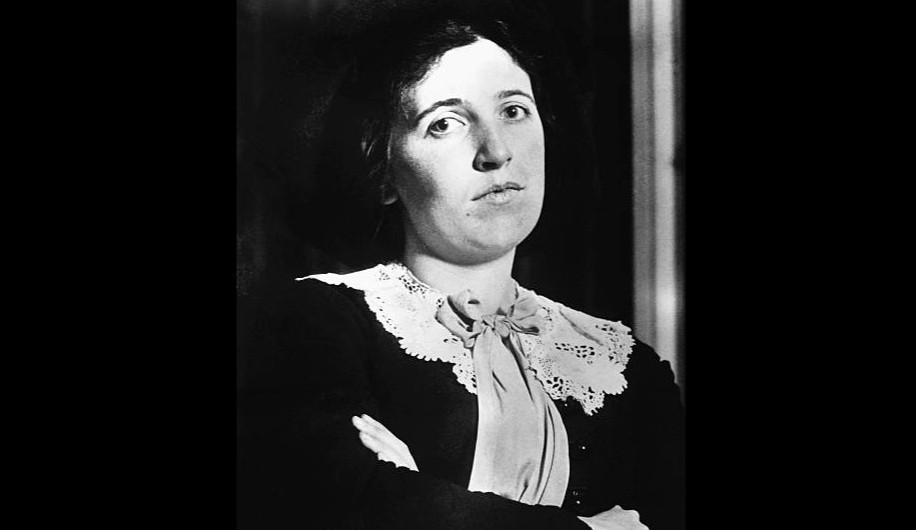
A nineteen year old, and pregnant, Elizabeth Gurley Flynn is arrested in the Spokane Free Speech fight and jailed with women charged with prostitution in an article where she famously accuses the police of hiring out the imprisoned women in a brothel of their own. This issue of the Worker would be confiscated by the Spokane police as a result of the ‘scurrilous’ charge.
‘Story of My Arrest and Imprisonment’ by Elizabeth Gurley Flynn from Industrial Worker. Vol. 1 No. 39. December 15, 1909.
On Tuesday, November 30, at about 8 o’clock, I was walking toward the I.W.W. hall. As I reached the corner of Stevens and Front Avenue, I was accosted by Officer Bill Shannon with the demand: “Are you Miss Flynn?” I replied. “Yes,” whereupon he grunted, “Well, we want you.” I asked, “Have you a warrant?” “Naw, we haven’t,” he rejoined, when the other officer stepped up and remarked, “There is one tin he station.” I accompanied them to the a police station, where I was booked and a warrant read for criminal conspiracy. I was then taken to the chief’s office, where Prosecuting Attorney Pugh put me through the “third degree.” Mr. Moore, attorney for the I.W.W. came to the door and asked for the chief, demanding to see me, but they unceremoniously slammed the door in his face. The chief said: “Let him wait until we get through.” At that time there were present besides the chief and prosecuting attorney, Commissioner Tuerke, a stenographer and several other officials unknown to me. I refused to answer the prosecuting attorney when he fired the first question, saying “I don’t know who you are.” Indignantly the chief introduced us with necessary formality. “This is the prosecuting attorney, Mr. Pugh; Miss Flynn, the I.W.W. organizer.” They were all extremely courteous, probably due to the information conveyed to them over the phone that my physical condition was such that it would be dangerous to be otherwise. But the ordeal of a rapid firing of questioning is not as easy as it looks from the outside. Every trick known to a shyster lawyer resorted to. Every appeal made to the honesty, sincerity and truthfulness of the average citizen, that the questioners presumably had no respect for themselves. Frankly, the only mistake I made was to talk at all; but what I “forgot,” “refused to answer,” “didn’t remember” and “couldn’t recall” would fill a book. A man they would have put in a sweat box and broken his physique and spirit, and eventually got him so faint and sick that he wouldn’t know what he was saying.
The idea of the third degree is evident–namely, to trap you into attempting to prove yourself innocent, into forgetting that it is up to them to prove you guilty. Some of the cross-questions were entirely humorous. For instance, Mr. Pugh remarked: “You know it’s useless denying what is an apparent fact, easily proven by scores of witnesses.” To which retorted, “Well, why do you ask me so many questions about an apparent fact?” The chief of police was anxious to know if Katherine Flynn, who signed the Irish Socialist communication, happened to be any relation of mine. Irish on both sides of this fight annoys the chief in face of his assertion that we are all Foreigners.
With an assumption of innocence, Pugh asked: “Who are the executive committee and who handles the finances?” The first I didn’t know, the second I refused to answer. He asked, “Do you know?” and I answered, “Of course I know.” And he asked. “You refuse to answer?” I said, “I certainly do.” He asked “Did you say so and so in your speeches?” to which I replied, “I talked so much I don’t know what I say.” They all gave him the laugh, and he asked if that statement wouldn’t probably, if published, injure my reputation as a speaker. Anxious he was for me to maintain my standard as an agitator, indeed! Finally he said, with a very smooth preliminary about not caring to prosecute a woman, that I might go if I would state that I had no connection with the free speech fight, was not in sympathy with the tactics of the I.W.W. and had not induced men to go to jail. I refused to either deny or affirm, declined to be tried and found guilty or adjudged innocent in the chief’s office, and that settled me.
I was allowed to see Mr. Moore and Mr. Rogers in the chief’s office, after which I was taken to the county jail in the patrol wagon. The morning “Spokesman-Review” had a story that I had requested to be taken across the river in a hack. The idea never occurred to me, and if it had I would have known better than to lay myself open to being refused. The “Review” lied, as usual.
I was placed in a cell with two other women, poor miserable specimens of the victims of society. One woman is being held on a charge that her husband put her in a disorderly house. The other is serving 90 days for robbing a man in a disorderly resort in Spokane. Never before had I come in contact with women of that type, and they were interesting. Also, I was glad to be with them, for in a jail one is always safer with others than alone. One of the worst features of being locked up is a terrible feeling of insecurity, of being at the mercy of men you do not trust a moment, day or night, unable to defend yourself or call for help. These miserable outcasts of society did everything in their power to make me comfortable. One gave me the spread and pillow cover from her own bed when she saw my disgust at the dirty gray blankets. I could not eat the heavy, soggy foul, stews, etc., nor drink the terrible stuff called coffee; but the girls gave me fruit that had been sent into them. They moderate their language, apologize for their profanity and pathetically try to conform to some of the standards of decency when they see that you are “digerent.” They have been so accustomed to being ill-used and brow-beaten they rather expect it, yet become indignant when it is done to another. In the morning they gave me soap and clean towels, that I might not have to use the common soap or dirty jail towels. The jailers are on terms of disgusting familiarity with these women, probably because the latter cannot help themselves or don’t care. Imprisonment does not seem to have any horror for them. Content to sleep and eat, they are as happy inside of jail as out. They are unconscious of their degradation and solicit no sympathy. Perhaps they shouldn’t be conscious, for society is to blame and not they.
I was put in with them at about 11 o’clock, yet the lights were burning bright and they showed no sign of retiring. Three little iron beds were the furnishings of our sleeping facilities, so I threw my cloak over me and tried to sleep, The younger girl still remained up. Though she turned the light down that I might rest. Several times she went to and fro, asking if she disturbed me. Finally the jailer came, opened the cell door and took her out. She remained a long time, and when she returned I gathered from the whispered conversation with the older one, the following: That he had taken her down to see a man on the floor below, a sweetheart, she called him to me afterward. She went again and remained a long time, and, whispering, told the other woman on her return that “Bert” (I judged to be the jailer) would have brought “Jack” up but for this woman, indicating me. “They don’t trust her,” she said. Perhaps I am justifying her suspicion in writing this. But the whole performance bore the earmarks to me of a putrid state of morals inside the county jail of Spokane. Taking a woman prisoner out of her cell at the dead hours of night several times to visit sweethearts looked to me as if she were practicing her profession inside of jail as well as out! And what particular interest did this man “Bert,” so intimately designated by his first name, have in the matter? It would bear investigation. Readers may well imagine the horrible night of restlessness I put in.
Early in the morning a man by the name of Bigelow, jailer, I presume, came into the cell with breakfast. Instead of leaving it in the ante-room of the cell and going about his business he marched straight into the room where we were all still in bed. He laid his cold hand on my cheek and I awoke with a start. My anger blazed up and I said, “Take your hand off me; I didn’t come here to be insulted.” He murmured some inarticulate excuse. “Of course not,” or words to that effect, and got out.
It certainly is a shame and disgrace to this city that a woman can be arrested because of union difficulties, bonds placed so high that immediate release is impossible, thrown into a county jail, where sights and sounds, horrible, immoral and absolutely different from her ordinary, decent mode of life can be forced upon her. Her privacy invaded while trying to steal some sleep by a brute of a man in a jail that hasn’t attained the ordinary standard of civilization that requires a matron for the care of women prisoners. This all for law and order. “O Liberty, what crimes are committed in thy name!”
ELIZABETH GURLEY FLYNN.
The Industrial Union Bulletin, and the Industrial Worker were newspapers published by the Industrial Workers of the World (IWW) from 1907 until 1913. First printed in Joliet, Illinois, IUB incorporated The Voice of Labor, the newspaper of the American Labor Union which had joined the IWW, and another IWW affiliate, International Metal Worker.The Trautmann-DeLeon faction issued its weekly from March 1907. Soon after, De Leon would be expelled and Trautmann would continue IUB until March 1909. It was edited by A. S. Edwards. 1909, production moved to Spokane, Washington and became The Industrial Worker, “the voice of revolutionary industrial unionism.”
PDF of full issue: https://www.marxists.org/history/usa/pubs/industrialworker/iw/v1n39-dec-15-1909-IW.pdf

