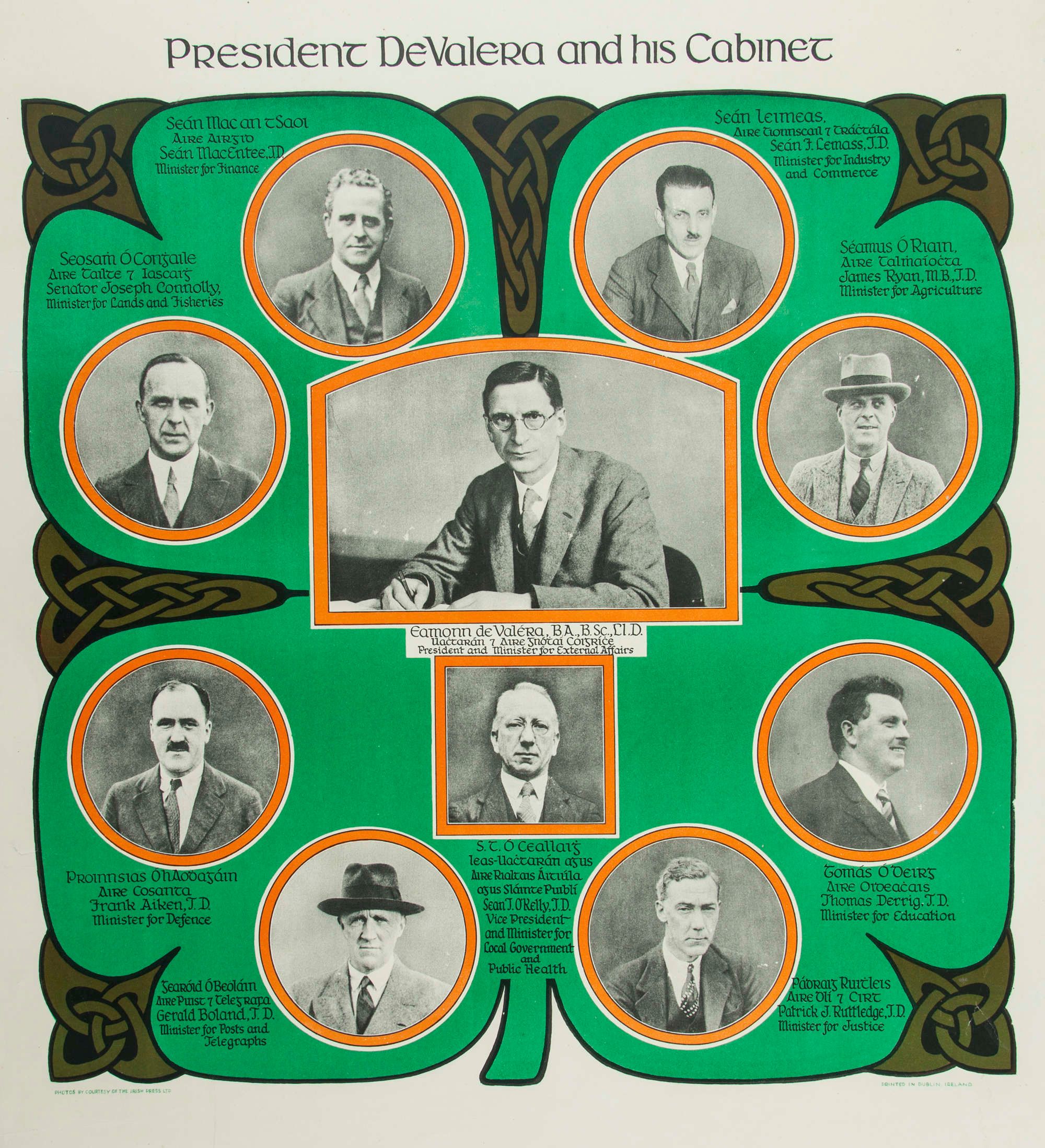
Echoes of Ireland’s Civil War ten years later. After its first unstable, minority government was dissolved in late, 1932, Fianna Fail under Éamon de Valera increased its vote, forming a majority government with the Labour Party and beginning decades of dominance in Irish politics. There are several ‘Tom Bells’ in the English-speaking Communist world, I believe this to be a Canadian-born comrade trained in Moscow and sent to Ireland as a Comintern representative.
‘The Results of the Elections in the Irish Free State and the Tasks of the Irish Communists’ by Tom Bell from Communist International. Vol. 10 No. 8. May 1, 1933.
THE Irish Free State elections have resulted in Fianna Fail (De Valera’s Party) getting 71 seats, a majority of one over all the other parties combined; the Labour Party eight seats, an increase of one seat, while the opposition parties received 68 (Cumann na nGaedheal 48, decrease of eight; Centre Party 11, and Independents nine). De Valera’s government, supported by the Labour Party, has a majority of 16 over the combined opposition in the Parliament. The extent of the gains of De Valera can be seen from the number of first preference votes received (the voting is by proportional representation):
1933–1932
Fianna Fail 689,458–566,325
Cumann na nGaedheal 417,467–449,779
Centres Party 126,795–34,989
Independents 68,892–124,513
Labour Party 7,222–98, 263
The Fianna Fail vote increased by 123,133 and the Cumann na nGaedheal decreased by 32,812, while the combined opposition vote increased by about ten thousand. The total Labour Party vote decreased because of fewer candidates being nominated: 30 candidates in February last year, and 13 this year; the votes for the successful candidates slightly increased. Had the elections been held on the English system, instead of under proportional representation, De Valera would have gained a substantial majority instead of only five of an increase in spite of the greatly increased vote.
The significance of the De Valera vote is the great increase in first preferences, the increase in votes in Dublin and Cork, that he was able to secure further thousands of workers and small farmers and the petty bourgeoisie as his supporters. The huge vote for De Valera is an expression of the further development of the militant mood of the masses against British imperialism, of their willingness to struggle for the independence and unity of the country and against the British imperialist agents in the country as expressed in the Cosgrave opposition, and for their social demands. De Valera received this huge vote because his party appeared to be the party leading the struggle against British imperialism, the party offering the workers and poor farmers a way out of the crisis, the party which fights the forces of imperialism and finance-capital within the country.
The masses saw in the combination of the Cumann na nGaedheal, Centre Party and Independents, led by Cosgrave, a concentration of the imperialist-capitalist exploiting farmer elements in the country, the same class grouping which had broken the national revolutionary war against imperialism in 1921, had waged civil war, shot the leaders of the Irish Republican Army, ruled the Free State by coercion acts and police terror, and led the capitalist offensive against the mass of the workers and farmers. During the ten years’ rule of the Free State by the Cosgrave government the masses had bitter experience of the rule of the pro-British groups of capitalists, rentiers and capitalist farmers.
De Valera, on the other hand, with his programme promising the establishment of a free, united, and economically independent country cutting land annuity payments in half and promising distribution of land at the expense of the estate and cattle ranch holders, industrialising the country and supplying employment to the unemployed and raising the standard of living of the masses, appeared as the only alternative to the open pro-imperialist finance-capital camp of Cosgrave. De Valera posed as the representative of the Irish people against British imperialism and its agents within the country.
The election is evidence of the reaction of the Irish masses to the policy of British imperialism during the past year. British imperialism rejected even the modest demands of De Valera for a revision of the Anglo-Irish treaty: the abolition of the oath of allegiance, and the retention of the land annuity payments was met by an economic blockade of the Free State by means of prohibitive tariffs against Irish imports into Britain; an attempt to force complete capitulation to British imperialism. The imperialist press continuously predicted the economic collapse of Ireland. At the same time the imperialist allies within the country received every encouragement from British imperialism. Every statement and action of the Cosgrave opposition for submission to the terms of the treaty, the formation of the armed bands of Cosgrave supporters by the Army Comrades’ Association, and the attempt to organize a united “National Party” in opposition to Fianna Fail—the organisation and consolidation of the whole pro-imperialist camp—was supported by British imperialism.
Even the Labour Party was able to make gains in this election because it posed as being against British imperialism, and because of its support of the De Valera government against the Cosgrave opposition. The “Irish Press” cynically expressed this editorially when it pointed out that the Labour Party had gained by receiving republican second preference votes, and that “hitherto the party did not attract republican second preferences because the treaty hung around Labour’s neck as around Cumann na nGaedheal’s like a dead albatross.” The Labour Party strengthened its position in spite of the fact that it has betrayed every important national and social struggle of the Irish masses and had played an open pro-imperialist role in the establishment of the Free State, because it now appears to be against British imperialism, kept its too thoroughly compromised leaders in the background, and had the blessing of Fianna Fail in the elections, and was preferable to Cosgrave candidates.
De Valera’s election manoeuvre of a speedy election prevented the consolidation of the Cosgrave opposition into a single party and took them at a disadvantage. The moment of the election also favoured De Valera because the result of the British tariff boycott on Irish agricultural imports is a fall in prices of foodstuffs in the Free State, the government bounties on exports have prevented the farmers feeling the full effect of the British tariffs against them, while the protective tariffs on manufactured imports have not yet raised prices more than the fall in prices of foodstuff’s. Increased expenditure in relief and public works has aided the unemployed (as compared with their situation under Cosgrave), which came about as a result of the mass pressure of the unemployed on the government, which was especially effective after the great struggles of the Belfast unemployed last October.
This situation and the demagogic statements of De Valera about a “new social system,” reorganising the country on the basis of “Christian communism instead of pagan capitalism,” the promises regarding land annuities and land distribution to the farmers, help to cloak the social reactionary policy of De Valera, but does not stop the growing resistance of the workers to the capitalist offensive. This is shown by the growing activity of the unemployed, the stubborn strike of the Kilkenny miners for better conditions, and the resistance of the railwaymen, teachers and civil servants to wage cuts. The strike of railwaymen against a ten per cent. wage cut was only prevented prior to the elections by a government subsidy to the companies which postponed the question until April. On the eve of the election there was also a postponement in government “economies” at the expense of the wages of the civil servants.
De Valera’s programme is a definite programme of the Irish national bourgeoisie which fights British imperialism to secure its own class interests. He issued very moderate manifestoes during the campaign, calling for a majority Fianna Fail government which would be in a position to carry through a policy abolishing the oath of allegiance, retention of the land annuities, reorganising the senate, establishment and protection of manufacturing industries, preservation of the home market for the farmers, encouragement of wheat growing, economy in administration, preservation of the Irish language which he said “are still the immediate objective, leading ultimately to a reasonably self-contained and self-sufficing, free and Irish Ireland.”
De Valera, in applying such a programme, comes into conflict with British imperialism, because the tribute exacted from Ireland is an obstacle preventing its application. At the same time, to win the support of the Irish masses for his programme he appears before the masses with the most radical republican phrases, promising a free, united and independent Ireland based upon a “new social system” which will abolish the poverty, misery and exploitation under which they suffer. De Valera’s struggle against British imperialism is strictly limited to furthering the interests of Irish capitalism. Therefore, it pays no attention to the social needs of the masses, although such reforms are carried through as are compatible with the interests of Irish capitalism, e.g., halving the land annuity payments, and cannot organise and lead a consistent revolutionary struggle for independence because that would clash with the interests of the Irish bourgeoisie.
Fianna Fail constitutes a barrier to the development of the revolutionary advance of the masses; it is a social prop for Irish capitalism among the masses, limiting the anti-imperialist advance of the masses to the national-reformist aim of gaining concessions from British imperialism for Irish capitalism, while putting forward the aim of a united and independent Ireland in words, to achieve which it does not organise a revolutionary struggle. Its social-reactionary programme is shown by its phrases about the betterment of the conditions of the masses by making the country independent economically by industrialisation, wheat-growing instead of cattle-raising–“Christian communism instead of pagan capitalism”–which in practice means developing the internal market by means of protective tariffs, bounties, etc., for the capitalists, and ignoring of the social demands of the workers and the capitalist offensive against the wages and conditions of the employed workers and unemployed.
The I.R.A. supported Fianna Fail with reservations, criticising its weakness in the national struggle and demanding “public ownership” of industry and reaffirming the struggle for an Irish republic. This programme is a step forward over the previous position of the I.R.A. which was formulated as “Either De Valera or Cosgrave,” i.e., binding the revolutionary republicans to the support of De Valera. But the issue of an independent Party of the workers and small farmers leading the revolutionary struggle against British imperialism and for the Irish Workers’ and Farmers’ Republic was not raised by them. The further development of the struggle in Ireland will make it clear to the revolutionary republicans in the I.R.A. that if they are not to be the tail-end of De Valera’s national-reformist capitalist party they must base their actions on the slogan: Neither De Valera nor Cosgrave–for the interests of the workers and small farmers, for the independence and unity of the country in a Workers’ and Farmers’ Republic.
The Revolutionary Workers’ Groups, carrying on the struggle for the formation of the Communist Party of Ireland, in the election correctly directed its main fire against the pro-imperialist Cosgrave camp, criticised the national-reformist and social reactionary capitalist programme of De Valera, and called for a revolutionary mass struggle for the independence and unity of the country and the establishment of a Workers’ and Farmers’ Republic. The reactionary election laws of the Free State require a deposit of one hundred pounds for each candidate, and the R.W.G. was prevented from going on the ballot because they were late in making this deposit, which was difficult to raise, and, of course, the government bureaucrats were only too glad to keep the R.W.G. off the ballot. The R.W.G. during the last period has been the centre of attack for all the reactionary forces in the country, and the Catholic church was especially active in the anti-communist campaign. Wherever the groups had been successful in leading the workers in their struggles for better conditions the church took a leading part in the organisation of the attack on the workers and the revolutionary leadership, as, for example, among the Kilkenny miners where the church has excommunicated all workers who join the militant miners’ union which had successfully forced better conditions for the workers. In other places revolutionary workers have been blacklisted, and in Cork the church openly organised hooligan attacks against unemployed meetings organised by the groups. Nevertheless, the R.W.G. entered the elections independently of all other parties as part of the campaign for the formation of the C.P.I., to place before the workers and small farmers the necessity for the formation of such a party to lead the
struggle for the Workers’ and Farmers’ Republic. The R.W.G. put forward a programme of revolutionary struggle against British imperialism to mobilise the masses of workers and farmers for the struggle for national independence:
(1) Annulment of the Treaty as a first step to the establishment of an independent Republic for all Ireland.
(2) Neither tribute nor arbitration on the tribute; immediate use of the money in the Suspense Account to relieve unemployment and the poor farmers.
(3) Measures of national defence against the British attack, such as punishment up to and including confiscation of poverty, and imprisonment of all who assist the imperialist enemy against Ireland.
(4) Disbandment of the C.I.D. and suppression of the White Army.
(5) Work or maintenance for all unemployed workers. Money to be provided by increased taxation on incomes over £500 per year.
(6) Reduced rents on all workers’ dwellings. No rents on slum houses.
(7) Release of all political prisoners; legality for the I.R.A. and all revolutionary organisations.
(8) Release of small farmers and low quality land from all annuities, and ranchers and big farmers to be compelled to pay in full, the money to be used to relieve unemployment.
(9) All burdens of the economic war to be placed on the shoulders of the rich.
The R.W.G. correctly exposes the national reformist policy and programme of Fianna Fail, but did not sufficiently expose the social reactionary character of its policy and programme and put forward a programme of demands of the workers against the capitalist offensive on their wages and working conditions. Besides unemployment the workers and agricultural labourers are suffering from wage cuts, rationalisation and worsened working conditions. This was shown during the past year in the attacks on the railway workers, etc., and the general wage-cutting offensive of the employers in which the Fianna Fail joined, by the “economies” at the expense of the wages of civil servants and teachers. There is growing resistance on the part of the workers to this offensive (railwaymen) and in some cases the workers fight stubborn battles for better conditions (Kilkenny miners). The weakness of the R.W.G. election programme is that it does not form a sufficient basis upon which could be built up a militant united front of the workers fighting against the capitalist offensive on their standard of living. At the same time such counter-demands of the workers based upon their immediate needs is the most effective exposure of the demagogic talk about a “new economic system” carried on by De Valera. Leadership of the everyday struggles of the workers, both employed and unemployed, is the paramount task of the R.W.G., because only in this way can the C.P.I. become rooted in the factories, among the unemployed, and in the trade unions. In this lack of emphasis on the social reactionary programme of De Valera there is shown a certain tendency to follow in the wake of Fianna Fail.
The return of the De Valera government with such an increased vote will result in the sharpening of the Anglo-Irish conflict. The British press sees this and advises against doing anything that may sharpen the situation. The Sunday Times wrote: “During the election both press and politicians in this country honourably avoided any suggestion of interference, and at this critical moment that avoidance must scrupulously be maintained…In any other manner the flames of passion must be uselessly and dangerously fanned.” This cautious note is sounded because the defeat of the British imperialist agents and the return of De Valera “on an extreme national policy” (Daily Telegraph) at a moment of sharpening relations with the United States makes it necessary. But the Daily Telegraph puts the issue plainly: “…if it is sought to change either the existing economic or political relationships Great Britain will demand to have her say, and she can say it with power.”
British imperialism is not so much alarmed about the return of De Valera as it is about the anti-imperialist upsurge of the masses behind him. The London Times writes that “Mr. De Valera owes his position to a traditional hatred of England.” The Daily Telegraph depicts the Irish masses as “Credulous and ignorant voters with nothing to lose and everything to gain.” The Sunday Times says: “The methods are not those of communism, but the spirit is little different…the election has been a crude contest between the ‘haves’ and the ‘have-nots’ and the poverty of the country is reflected by the result…All who have anything at stake regard the future with anxiety.” A special correspondent of the Manchester Guardian gives his estimation as “roughly speaking, the poor and the thriftless expect profit from a De Valera régime…the forces of economic discontent and extreme nationalism which Mr. De Valera has summoned to his aid will not allow him to stand still or draw back.”
The upsurge of the masses of workers and farmers who support De Valera because his demagogic phrases appear to give an answer to their national and social needs in the crux of the present situation. De Valera’s national-reformist capitalist policy cannot help but disappoint and disillusion the masses. The only way to develop the advance of the masses is by supplying a revolutionary alternative to Fianna Fail, and that alternative is the Communist Party of Ireland. Fianna Fail can be exposed by the development of the struggle of the masses around the slogans of complete independence and unity of the country from British imperialism, and defence of the workers’ standard of living against the capitalist offensive, social insurance for the unemployed workers and agricultural labourers; wage increases and lower hours, better housing and social insurance for the agricultural labourers; abolition of debt payments and land distribution to the small and landless farmers; for a Workers’ and Farmers’ Republic.
Along with the sharpening conflict with British imperialism there goes on a sharpening of the internal class relations. The employed and unemployed workers are showing greater resistance to the capitalist offensive and militant struggles of the workers are growing. The strike of the Belfast railwaymen against wage reductions, supported by the dockers and busmen, the stubborn fight of the Kilkenny miners against the reactionary capitalist, church and trade union bureaucrat combination, the growing struggles of the unemployed following the splendid example of the Belfast street battles last October, are all evidence of the rising tide of proletarian militancy. The Irish Communists have the task of welding these militant struggles together. The formation of the Communist Party of Ireland will be the first great step forward to the solution of these tasks by organising together the revolutionary elements of the workers and small farmers. Under the leadership of the Communist Party the Irish working class must take over leadership of the rising anti-imperialist mass struggle, unite the forces of the workers and small farmers in a revolutionary struggle for the unity and independence of the country, for the interests of the workers and farmers, for a Workers’ and Farmers’ Republic.
PDF of full issue: https://www.marxists.org/history/international/comintern/ci/vol-10/v10-n08-may-01-1933-CI-grn-riaz-OC.pdf

