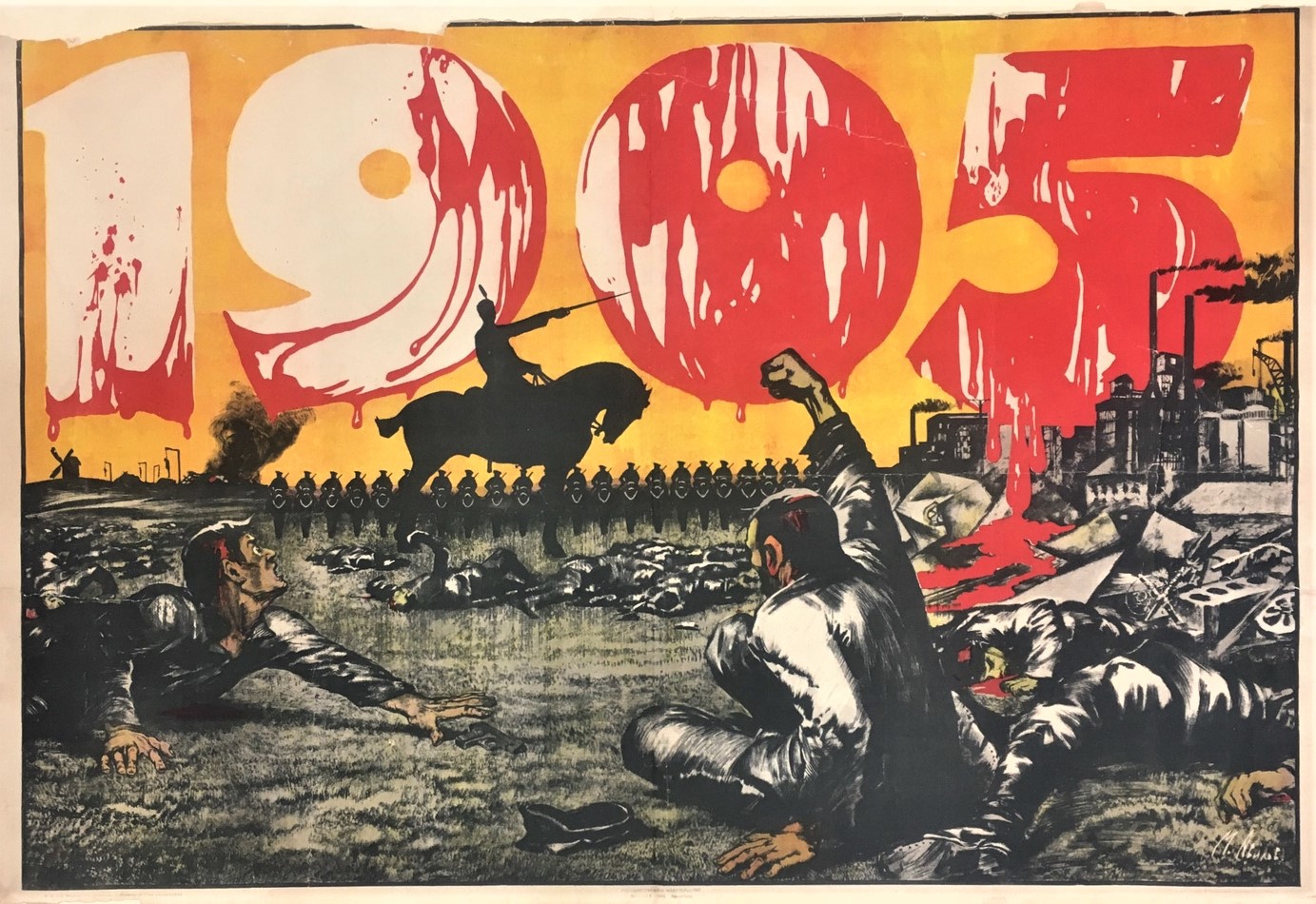
Words meant to stagger and shame those reading them, this stunning Social Democratic leaflet addressed to soldiers in the Tsar’s army from a revolutionary sailor during the 1905 Revolution.
‘To a Soldier’ from The Worker (New York). Vol. 15 No. 30. October 21, 1905.
A Document of Russian Socialist Propaganda.
What a Social Democratic Sailor Says to a Soldier of the Tsar Who Has Helped to Break Workingmen’s Strikes and “Maintain Order.”
According to Russian law every male subject is obliged to serve in the army from the age of twenty-one to that of twenty-five. Failure to appear for service is severely punished.
The following is a translation from “Iskra” of a letter written by a Socialist sailor of Russia to a soldier who has served in the breaking-up of workingmen’s strikes and meetings, and it may well be read by American as well as by Russian soldiers:
Soldier, listen: For four long years’ you are torn away from your kinsmen, from those who are dear to your heart, who have nursed and cared for you. For four long years you are torn away from your native village, from your native fields and meadow and wood and river. For four long years, soldier, you are at the mercy, at the arbitrary will, of your commanders. For four long years you are confined to the Tsar’s dirty and stifling barracks, where your every move is watched by your superiors. For four long years you are given over to slavery. For four long years, soldier, you are a slave, without liberty or rights.
If you do not turn exactly according to the regulations, you are mercilessly punished. If in your leisure time you venture to take a walk without asking permission, what awaits you? A broken nose and then, arrest. If, soldier, feeling lonesome for your kin, you dare to go to see them at your will, what awaits you, you defender of the country? Prison. If you fail to salute or if you salute not just according to the regulations, what awaits you? A broken jaw and then, arrest. If, faithful servant of the Tsar, provoked by the intolerable torments to which you are constantly subjected by your superiors, you once lose patience and by word or deed avenge yourself or resist abuse, what awaits you? The galley or the bullet. If rotten food is given you and you refuse to eat it, what awaits you? Prison. If you refuse to go to the front to kill people, if it is abhorrent to you, if your conscience forbids you to kill, what awaits you? To be shot will be your penalty.
No, Soldier, for four long years everything that is honest and human in you is systematically crushed out, and at the end you are transformed into an obedient slave, an obedient brute, ready at any time, at the command of a cruel officer to shoot even your own mother who nursed, and reared you. Soldier, look at yourself for once. Are you a human being? Consider what the Tsar’s service makes of you. When you departed for the service, soldier, you left an old mother, a hut that you called home, a horse, a garden, a bit of ground, perhaps a bride. When you came back from the Tsar’s service–but will you yet come back? It is more likely that you will lose your life in some land unknown to you, some country you do not care for, as hundreds of thousands of your comrades have perished in far-off Manchuria; or you may perish in the mines of cold Siberia: or you may die in one of the Tsar’s lazarettos. But if you come back from the Tsar’s service, will you find things at home as you left them, soldier? That old mother of yours will grow yet older from grief for you; her chest will grow more hollow, the wrinkles in her face will grow deeper, her cough will grow worse. And will you find her at all? Very likely she has long since from sorrow and great want, found peace under the sod. Your hut is deserted, soldier. The walls are sagging, it is blackened, the roof is full of holes: the wind whirls away the straw that covered it and howls through the empty room; the rain drips in, perhaps on your old mother’s body. Your horse has been sold at auction for the unpaid rent. Your little garden and piece of farmland are overgrown with weeds. There is nobody to care for them. Your bride, even, has been taken away by some village capitalist bloodsucker or some griping landlord. He has money; he can do what he will. You see, soldier, what the Tsar’s service means. And you, soldier, still obey your Tsar and his officers, and at their first command like a ferocious beast you attack the defenseless workingmen and peasants, who are as poor and unfortunate as yourself, when they come out on the street to fight for their own freedom and for yours: when they demand for themselves and for you a human existence: when they declare that the Tsar and all the various officials should no longer feed on their blood and yours; when they protest against the murder of poor creatures like yourself. Jews and Armenians; when they, your brothers, the workingmen and peasants, demand everywhere the abolition of rents and taxes, demand that the Tsar and the other official thieves be done away with, that all men be equal, that there be no more war.
But you, soldier, like a wild beast, spring upon those brothers of yours. those unarmed men, wishing only happiness for you and for all the poor; you shoot, stab, beat, slash, making no distinction of sex or age: you strike down women and old men and children and all. You do this because all that was human in you has been beaten out of you in the service, because you have been brutalized, because the priests and the officers have pounded it into your head that you ought to kill people at command, in the name of the silly oath you have given to the accursed Tsar.
Soldier, think! Think how many you have already killed of the poor and unfortunate, how many you have made wretched, how many widows and orphans there are on account of you.
Soldier, come with me to any Russian city. Here at the outskirts of the city stands a wretched hovel. Let us go in. Do not fear. Enter. You will see your own work. Look, soldier, here is the family of a workingman whom you recently killed. Do you see this woman, famished, and worn out by grief and inhuman toll? She is not dressed in silk as your masters’ wives are. She is dressed in rags. This is the wife of that workingman you shot. On her lips you do not see the self-contented smile you can see on the faces of your masters’ wives. In the features of this workingman’s wife you see the imprint of sorrow and of endless want. Her lips are closely shut; there are wrinkles around them. She has suffered much. You see that. And here, soldier, look! See these unkempt, lean, half-naked, sickly little ones. These are the children of the honest workingman you shot. Look! They are frightened. They huddle closer to their mother. On your uniform they see their father’s blood. Look! The very baby points at you with his tiny finger and his bloodless lips whispers something. Do you hear? Listen, soldier, listen what the little one says.
Do you hear, soldier? He lisps: “Murderer, murderer! Why did you kill my father? He was no enemy of yours. He wished well to you and all the poor. Why did you take away our only support? We are dying of hunger, we have not eaten for many days Murderer, murderer! Why did you kill our father? Why?”
What is the matter with you, soldier? Can you not listen to the just and true words of the little one? You do not wish to hear. But the little one is right. You are a murderer.
You wish to run away, soldier–to run away from the truth the little one has spoken. In vain, soldier, do you run. All over Russia, no matter where you go, you will hear that cry: “Murderer, murderer!” Everywhere you will see this sight.
Halt soldier: Do not run away. There is yet time for you to expiate the crimes you have committed.
I will tell you how to wipe them out. Listen closely.
When you are again sent to kill defenseless workingmen and peasants, when your officers order you to shoot them down–shoot those officers and go over to the workingmen and say to them: “I am with you, comrades. I am for you, for freedom, for brotherhood, for equality and truth.” And strike, together with them, strike down the enemies of liberty, the commanders, the governors, the dukes. Strike down the Tsar. Strike down the parasites, the hangmen, the infamous stranglers.
And you will then see how thankful the workingmen will be to you. You will see with what sincere joy they will put their calloused hands in yours. Their wives and children will gather joyfully around you and thank you as a brother of the great family of workingmen, as a liberator.
Listen, soldier! I am speaking to you as a friend. I pity you. Only by joining the people can you redeem yourself for the wrongs you have done them. Otherwise, nowhere will you find rest. Everywhere–in the city, in the barracks, in the field, in your village–everywhere you will be pursued by the cry of that little one: “Murderer, murderer:”
Soldier, cry out with the people–Down with the Tsar! Down with the dukes, the masters, the capitalists!
Long live the Social Democratic Party! Hurrah for free Russia! Hurrah for the republic! Hurrah for the toiling masses! Hurrah for Socialism!
The Worker, and its predecessor The People, emerged from the 1899 split in the Socialist Labor Party of America led by Henry Slobodin and Morris Hillquit, who published their own edition of the SLP’s paper in Springfield, Massachusetts. Their ‘The People’ had the same banner, format, and numbering as their rival De Leon’s. The new group emerged as the Social Democratic Party and with a Chicago group of the same name these two Social Democratic Parties would become the Socialist Party of America at a 1901 conference. That same year the paper’s name was changed from The People to The Worker with publishing moved to New York City. The Worker continued as a weekly until December 1908 when it was folded into the socialist daily, The New York Call.
PDF of full issue: https://www.marxists.org/history/usa/pubs/the-people-the-worker/051021-worker-v15n30.pdf

