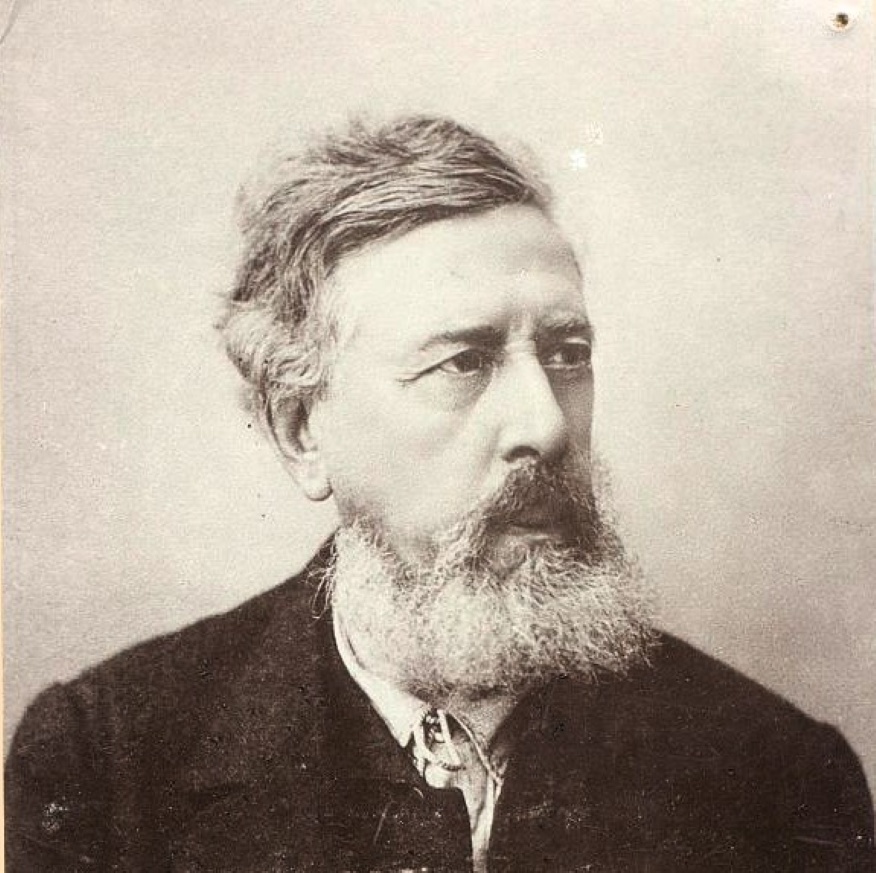
A classic of our movement from Wilhelm Liebknecht attacking the former Socialist Alexandre Millerand entering the French government as Minister of Commerce in 1899. These selections come from the larger pamphlet ‘No Compromise– No Political Trading,’ and were first published in English just months before Liebknecht’s August 7, 1900 death. A work that entered the canon of revolutionary Marxism as soon as it was printed and has been read since, but was particularly important as a text for activists in the years before the Bolshevik Revolution. For them, this work was a constant reference and source of quotes guiding the guardrails of independent working class politics; Socialism. Famously published in whole by the Charles H. Kerr Cooperative in a number of editions.
‘A Socialist Who Enters a Capitalist Government Ceases To Be a Socialist’ by Wilhelm Liebknecht from The People. Vol. 10 No. 21. August 18, 1900.
MILLERAND: TRAITOR TO LABOR.
THERE CAN BE NO ALLIANCE WITH THE ENEMY
Socialists Can Enter Into No Compromise With Capitalist Parties–The Class Straggle Character of Socialism Must Be Preserved–The Strength of Socialism Rests in the Fact That Socialists Are Leading That Class Struggle, That the Laboring Class Is Oppressed by the Capitalist Class, and That Within Capitalist Society Effectual Reforms Are Impossible.
[Some months ago, the capitalists who run the Republic of France got into trouble over the celebrated Dreyfus case. Frenchmen were greatly wrought over the peculiar capitalist way in which Dreyfus was railroaded to prison. For a time there seemed to be danger of a popular uprising of the people. The situation was an appropriate time for the royalists and they proceeded to agitate against the Republic and in favor of returning to the rule of a king. At this juncture, the capitalists who desired to perpetuate the Republic tried to throw a sop to the French Socialists by appointing Millerand (who up to that time had been regarded as one of the leaders of the French Socialist movement) to a position in the Cabinet–he was made Minister of Commerce. To the surprise of the French Socialists and to the disgust of Socialists all over the rest of the world, Millerand accepted the position and thus became part of the capitalist government of France. The French Socialists immediately took action, and the Parti Ouvrier Franenis, the Socialist Labor Party of France, at once declared Millerand to be a traitor to the cause of labor. This declaration was concurred in by the great majority of the French Socialists. While the discussion was at its height, Liebknecht expressed himself very forcibly on the matter. Later he embodied his opinions in n pamphlet entitled “No Compromise, No Political Trading.” It is from this pamphlet that the article which follows is taken. It is doubly interesting now that Millerand, an outcast from the International Socialist Movement, has done the bidding of his capitalist superiors. There is a great shipping strike on at Havre, the largest seaport of France. For a number of days, several of the ocean liners have been tied up for lack of men to coal them; and behold Millerand, true to his traitorous nature, has detailed sailors from the French men-of-war anchored at Havre to coal the ships that were hung up–thus doing all that any capitalist could do to break the strike.]
With a Socialist party there should be compromise. The danger of compromises in giving up, keeping in the background or forgetting the class struggle basis, for this is the source of the modern labor movement. It is necessary here to distinguish sharply, and not be misled by catchwords; in short, we must have an emancipation from phrases, as I said decades ago, with reference to the phraseology of anarchism, which poses as revolutionary, but in fact is only small bore reaction–merely a late-arrived caricature of the bourgeois ideal of freedom and a theatrical masquerade of commercial free competition.
Socialism and Ethics.
Pity for poverty, enthusiasm for equality and freedom, recognition of social injustice and a desire to remove it, is not socialism. Condemnation of wealth and respect for poverty, such as we find in Christianity and other religions, is not socialism. The communism of early times, as it was before the existence of private property, and as it has at all times and among all peoples been the elusive dream of some enthusiasts, is not socialism. The forcible equalization advocated by the followers of Baboeuf, the so-called equalitarians, is not socialism.
In all these appearances there is lacking the real foundation of capitalist society with its class antagonisms. Modern socialism is the child of capitalist society and its class antagonisms. Without these it could not be. Socialism and ethics are two separate things. This fact must be kept in mind.
Whoever conceives of socialism in the sense of a sentimental philanthropic striving after human equality, with no idea of the existence of capitalist society, is no socialist in the sense of the class struggle, without which modern socialism is unthinkable. To be sure Bernstein is nominally for the class struggle–in the same manner as the Hessian peasant is for “the Republic and the Grand Duke.” Whoever has come to a full consciousness of the nature of capitalist society and the foundation of modern socialism, knows also that a socialist movement that leaves the basis of the class struggle may be anything else, but it is not socialism.
This foundation of the class struggle, which Marx–and this is his immortal service–has given to the modern labor movement, is the main point of attack in the battle which the bourgeois political economy is waging with socialism. The political economists deny the class struggle and would make of the labor movement only a part of the bourgeois party movements, and the Social Democracy only a division of the bourgeois democracy. The bourgeois political economy and politics direct all their exertions against the class character of the modern labor movement. If it were possible to create a breach in this bulwark, in this citadel of the Social Democracy, then the Social Democracy is conquered, and the proletariat thrown back under the dominion of capitalistic society. However small such a breach may be in the beginning, the enemy has the power to widen it and the certainty of final victory. And the enemy is most dangerous when he comes as a friend to the fortress, when he slinks in under the cover of friendship, and is recognized as a friend and comrade.
No Alliances with Other Political Parties is Possible.
The enemy who comes to us with open visor we face with a smile; to set our foot upon his neck is mere play for us. The stupidly brutal acts of violence of police politicians, the outrages of anti-socialist laws, the anti-revolution laws, penitentiary bills–these only arouse feelings of pitying contempt; the enemy, however, that reaches out the hand to us for a political alliance; and intrudes himself upon us as a friend and brother–him and him alone have we to fear.
Our fortress can withstand every assault–it can not be stormed nor taken from us by siege–it can only fall when we ourselves open the doors to the enemy and take him into our ranks as a fellow comrade. Growing out of the class struggle, our party rests upon the class struggle as a condition of its existence. Through and with that struggle the party is unconquerable; without it the party is lost, for it will have lost the source of its strength. Whoever fails to understand this or thinks that the class struggle is a dead issue, or that class antagonisms are gradually being effaced, stands upon the basis of bourgeois philosophy.
The Sources of Strength Are Rooted in Combat.
We may not do as other parties because we are not like the others. We are-and this cannot be too often repeated–separated from all other parties by an insurmountable barrier, a barrier that any individual can easily surmount: but once on the other side of it, and he is no Socialist.
We are different from the others: “we are other than the others.” What, for the others are necessities and conditions of life, are death to us. What is it that has made of us in Germany, the pivotal Party, which according to the significant testimony of Caprivi and the teaching of daily experience makes us the axle around which governmental polities turns? Most assuredly not our representatives in the Reichstag. We might have three times as many representatives, and the allied bourgeois parties would have nothing to fear from us. No, it is the avalanche-like increase of on supporters that gradually, with the certainty of a natural law, or more correctly of a natural force, grows from tens of thousands to hundreds of thousands, and from hundreds of thousands to millions, and is daily increasing, bidding defiance to our opponents and driving them into impotent race. And this avalanche-like increase has come, and is coming as a consequence of our opposition to the struggle with all other parties.
All who are weary and heavy laden; all who suffer under injustice; all who suffer from the outrages of the existing bourgeois society; all who have in them the feeling of the worth of humanity, look to us, turn hopefully to us, as the only party that can bring rescue and deliverance. And if we, the opponents of this unjust world of violence, suddenly reach out the hand of brotherhood to it, conclude alliances with its representatives, invite our comrades to go hand in hand with the enemy whose misdeeds have driven the masses into our camp, what confusion must result in their minds! How can the masses longer believe on us? If the men of the clerical party, of the progressive party, and the other boodle parties are our comrades, wherefore then the struggle against capitalist society, whose representatives and champions all of these are? What reason have we, then, for existence? It must be that for the hundreds and thousands, for the millions that have sought salvation under our banner, it was all a colossal mistake for them to come to us. If we are not different from the others, then we are not the right ones–the Savior is yet to come; and the Social Democracy was a false Messiah, no better than the other false ones!
Just in this fact lies our strength, that we are not like the others, and that we are not only not like the others, and that we are not simply different from the others, but that we are their deadly enemy, who have sworn to storm and demolish the Bastile of Capitalism, whose defenders all those others are. Therefore we are only strong when we are alone.
Millerand: The Traitor to Labor.
Now I come to Millerand and his entrance into the French Ministry, thus becoming a part of the capitalist government of France.
The internationality of Socialism is a fact that is daily becoming more evident and more significant. We Socialists are one nation to ourselves–one and the same international nation in the lands of the earth. And the capitalists with their agents, instruments and dupes are likewise an international nation, so that we can truthfully say, there are today only two great nations in all lands that battle with each other in the great class struggle, which is the new revolution a class struggle on one side of which stands the proletariat, representing Socialism, and on the other the bourgeoisie, representing capitalism.
While the bourgeois world of capitalism continues and the bourgeoisie rules, so long are all States necessarily class States, and all, governments class governments, serving the purposes and interests of the ruling class, and destined to lead the class struggle for the bourgeoisie against the proletariat–for capitalism against Socialism, for our enemies and against us. From the standpoint of the class struggle which is the foundation of militant Socialism, that is a truth which has been raised by the logic of thought and of facts beyond the possibility of doubt. A Socialist who goes into a bourgeois government either goes over to the enemy or else puts himself in the power of the enemy. In any case the Socialist who becomes a member of a bourgeois government separates himself from us, the militant Socialists. He may claim to be a Socialist but he is no longer such. He may be convinced of his own sincerity, but in that case he has not comprehended the nature of the class struggle–does not understand that the class struggle is the basis of Socialism.
A Socialist In a Capitalist Government Becomes a Nonentity or a Traitor.
In these days, under the rule of capitalism, a government, even if it is full of philanthropy and animated by the best of intentions, it can do nothing of real value to our cause. One must keep free from illusions. Decades ago, I said: “If the way to hell is paved with good intentions, the way to defeat is paved with illusions.” In the present society, a non-capitalist government is an impossibility. The unfortunate Socialist who casts in his lot with such a government if he will not betray his class only condemns himself to impotency. The English bourgeoisie offers the best example of weakening the opposition by permitting them to participate in the government. It has become the traditional policy of all parties in England that the most radical member of the opposition who is naive enough to be taken in should be given a place in the government. This man serves as a shield to the government and disarms his friends who cannot shoot at him–just as in battle one may not shoot at the hostages that the enemy has placed in front of itself.
That is my answer concerning the question the entrance of a Socialist into a bourgeois government.
The Kind of “Unity” Socialists Want.
Now I come to another important question, that of “unity,” of “agreement.”
The answer is dictated to me by the interests and principles of the party, I am for the unity of the party–for the national and international unity of the party. But it must be a unity of Socialism and Socialists. The unity with opponents–with people who have other aims and other interests–is no Socialist unity. We must strive for unity at any price and with all sacrifices. But while we are uniting and organizing, we must rid ourselves of all foreign and antagonistic elements. What would one say of a general who in the enemy’s country sought to fill the ranks of his army with recruits from the ranks of the enemy? Would that not be the height of foolishness? Very well, to take into our army which is an army for the class struggle and the class war-opponents, soldiers with aims and interests entirely opposite to our own–that would be madness, that would be suicide.
On the ground of the class struggle we are invincible; of we leave it we are lost, because we are no longer Socialists. The strength and power of Socialism rests in the fact that we are leading a class struggle; that the laboring class is exploited and oppressed by the capitalist clam, and that within capitalist society effectual reforms, which will put an end to class government and class exploitation, are impossible. We cannot traffic in our principles, we can make no compromise, no agreement with the ruling system. We must break with the ruling system and fight it to a finish. It must fall that Socialism may rise, and we certainly cannot expect from the ruling class that it will give to itself and its domination the death blow. The International Workingmen’s Association accordingly preached that “the emancipation of the laboring class must be the work of the laborers themselves.”
Undoubtedly there are bourgeois, who from a feeling of justice and humanity place themselves upon the side of the laborers and Socialists, but these are only the exceptions; the mass of the bourgeoisie has class consciousness, a consciousness of being the ruling and exploiting class. Indeed, the mass of the bourgeoisie, just because they are ruling class, have a much sharper and stronger class consciousness than the proletariat.
Long live the France of the Socialists and the laborers! Long live international Socialism!
The Class Struggle Must Be Held Aloft.
We Socialists dare not be like the other parties, all of whom, are equally guilty of the injustices of the present system and equally responsible for them. Every one who suffers under these injustices looks to us for deliverance. Every one of us has had these victims of society after failing to get justice from the courts, from the government, from the Emperor himself, and from all the other parties, come to us as the last and only one that can help them. They do not know our scientific program: they do not know what capital and capitalism mean; but they have the belief, the feeling, that we are a party that can help when all other parties fail. This belief is for us an inexhaustible source of power. It was a similar faith of despair that spread more and more in the decaying Roman empire and slowly undermined the heathen world until it finally collapsed. We give up this inexhaustible source of power if we ally ourselves with other parties and drive suffering humanity from us by saying: “We are not essentially different from the others.” Once the boundary line of the class struggle is wiped away and we have started upon the inclined plane of compromise, there is no stopping. Then we can only go down and down until there is nothing deeper.
The Catch-word “Revolution.”
The catchword “revolution” is certainly very ridiculous. Ridiculous it certainly is–and no one has expressed this more clearly than myself–to drop the words “revolution” and “revolutionary” out of the month at every opportunity. It can become as mechanical a song as saying one’s bends. But ridiculous, as it is to boast of belonging to the party and to express one’s views at every opportunity when there is no necessity for it, still such exaggerations do not justify us in throwing away the good with the bad, and declaring that to emphasize the revolutionary character of our party is under all circumstances, ridiculous. To emphasize it is a very serious and a very necessary thing. It is serious, because membership in a Socialist Party means a struggle, a political struggle with grievous persecution and a private struggle for existence, a struggle that for the majority is far more difficult and heavy than the political, struggle. And it is necessary, because the courage for this two-fold struggle is created only by the consciousness that the injustice of society by which the great majority of mankind are today oppressed, corrupted and crippled, can only be abolished through a revolutionary movement, that is, a movement that shall completely exterminate capitalism with every fiber of its roots.
I know that it has here and there become the fashion to laugh at the warning about sliding down inclined planes. They refer us to the fable of the sheep and the wolf. The comparison limps, however, and finally turns against the laughter. The wolf was actually there and at last broke into the fold. And in our case, it is also no imaginary danger from which we are warned. And at all events the interests of the party are at least as carefully guarded by the warners, as by the scorners. Heretofore distrust was counted as a democratic virtue, and over-confidence as a Democratic vice. Here and there are found persons who would reverse this maxim.
Bluecher’s Motto.
The proletariat stands politically as well as socially in the most abrupt contradiction to the present class State. It must fight it on all fields and upon every question, both of domestic and of foreign policy. To be sure it is not always easy to decide rightly. Where the interests are not clearly visible, the feelings may be easily deceived. Fortunately we have at the points where it is hardest to decide an infallible compass in the actions of our enemies. We shall never go wrong if we do what is opposed to the interest of our enemy. On the other hand, we shall almost never right if we do what our enemies applaud. Historical development is a continuous conflict, a conflict of interests, a conflict of races, conflict of classes. And if friendship does not count even in ordinary business, how much less so in such a conflict. Goodness, how much less so in such a conflict. Good-naturedness and sentimentality have no place in politics. They have never won a victory, but have brought numbered defeats, Bluecher’s motto, “Always follow the canon’s roar and throw yourself upon the enemy,” is the best rule also in political warfare.
What Frightens the Capitalist Class.
Just a word in this connection. The class instinct of the bourgeoisie is far better developed than that of the proletariat. The governing class naturally knows its interests better than the governed, who have so much less opportunity to become informed and are also sometimes intentionally, and sometimes not, systematically deceived and misled from recognition of their interests.
Do not say that it is the rough form in which Socialism is often set forth that frightens and embitters the bourgeoisie. That is absolutely false. It is not the form; it is the content which they detest: and the more harmless the form so much the more dangerous do the contents appear to the gentlemen of the bourgeoisie. The fineness of the form makes no difference to them. That is clear from the manner in which they fight out their quarrels among themselves.
Socialism must remain for itself, must seek for and generate its power within itself. Every power outside of ourselves on which we seek to lean is for us only weakness. In the consciousness of our strength, in the faith in the world-conquering mission of Socialism lies the of our extraordinary, almost miraculous success.
Islam was unconquerable so long ago as it trusted in itself alone and saw an enemy in every non-Mohammedan. From the moment when Islam entered upon the path of compromise and united with the non-Mohammedan, the so-called civilized powers, its conquering power was gone. With Islam it could not have been otherwise. It was not the true world-redeeming faith. Socialism, however, is this, and Socialism cannot conquer nor redeem the world if it ceases to believe upon itself alone.
Therefore, we will not turn from the old tactics, nor from the old program. Ever advancing with science and economic development, we are what we were and we will remain what we are.
New York Labor News Company was the publishing house of the Socialist Labor Party and their paper The People. The People was the official paper of the Socialist Labor Party of America (SLP), established in New York City in 1891 as a weekly. The New York SLP, and The People, were dominated Daniel De Leon and his supporters, the dominant ideological leader of the SLP from the 1890s until the time of his death. The People became a daily in 1900. It’s first editor was the French socialist Lucien Sanial who was quickly replaced by De Leon who held the position until his death in 1914. Morris Hillquit and Henry Slobodin, future leaders of the Socialist Party of America were writers before their split from the SLP in 1899. For a while there were two SLPs and two Peoples, requiring a legal case to determine ownership. Eventual the anti-De Leonist produced what would become the New York Call and became the Social Democratic, later Socialist, Party. The De Leonist The People continued publishing until 2008.
PDF of full issue: https://www.marxists.org/history/usa/pubs/the-people-slp/000818-weeklypeople-v10n21.pdf
 Revolution's Newsstand
> A Socialist In a Capitalist Government Becomes a Nonentity or a Traitor
While Millerand was branded a traitor to the socialist movement, he was responsible for some historic wins on behalf of the French working class as part of the capitalist government including:
Liebknecht’s critique didn’t age well because it didn’t allow for the possibility of contradiction and ambiguity, namely that Millerand could both be a ‘traitor to socialism’ while advancing working-class interests inside a hostile institution.
LikeLike