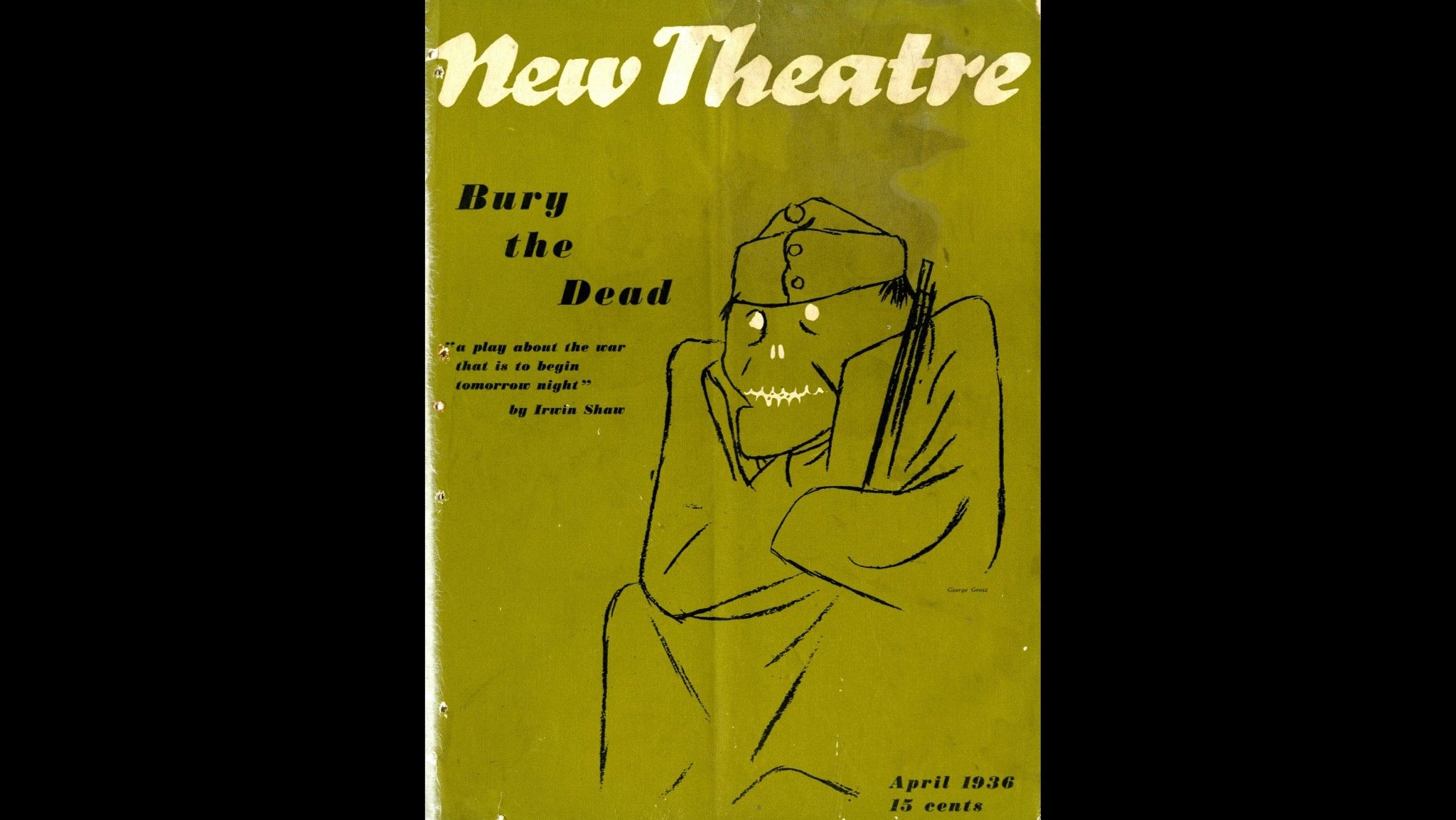
A review of the one-act anti-war play written by Irvin Shaw and first performed by the New Theatre League.
‘Bury the Dead’ by Stanley Burnshaw from New Masses. Vol. 19 No. 4. April 21, 1936.
Bury the Dead, by Irwin Shaw. Complete text in April issue of New Theatre Magazine, 15c; in book form, published by Random House, $1.00. A regular production is announced beginning April 18 at the Ethel Barrymore Theater.
Mankind Is Standing Up
AN EVENING in the “second year of the war that is to begin tomorrow night”: a detail of soldiers digging a common grave for six corpses. It is the usual procedure; the frazzled gravediggers sputter with bitterness; vary the chore by smashing a rat—“fine pedigreed animal fed only on the choicest young men of the United States”; proffer it to the Sergeant as a token of their regard; wait for the chaplains to perform the last rites. But while priest and rabbi dribble prayers the corpses rise, one by one. The soldiers sigh in terror till suddenly the dead men speak. Their words have a terrible tenderness:
“Don’t bury us…don’t go away…Stay with us. We want to hear the sound of men talking. Don’t be afraid of us. We’re not really different from you. Are you afraid of six dead men, you who’ve lived with the dead?… Are we different from you? An ounce or so of lead in our hearts, and none in yours. A small difference between us. Tomorrow or the next day the lead will be yours, too. Talk as equals…”
When the General learns that six corpses are standing in their graves refusing to be buried, he reacts with usual obtuseness. But his informant was not tipsy; the army doctor cannot report cases of coma. Indeed the six have been dead forty-eight hours. Frantic attempts to seal up the news fail. A New York editor has to forbid his reporter to spring “the biggest story of all time…Lloyds are giving 3-to-1 they won’t go down.”
It is an emergency requiring the best army brains. But despite the lovely arguments of three assorted Generals, the corpses are unmoved. When the Captain comes to defeat them with philosophy, they answer simply:
“They sold us for 25 yards of bloody mud. A life for four yards of bloody mud. Gold is cheaper, and rare jewels, pearls and rubies…a man can die happy and be contentedly buried only when he dies for himself or for a cause that is his own…We have been dispossessed by force, but we are reclaiming our home. It is time that mankind claimed its home—this earth—its home.”
The war-makers have one last hope. “Get out their women…Women are always conservative. It’s a conservative notion…allowing yourself to be buried when you’re dead.” But nobody can predict the outcome of conversations with the dead. As the six women approach their men, six various lives gradually unfold in the soft, burning talk of the dead to the wife, mother, sweetheart, sister. The purpose of this return to earth, the pain, bitterness, hope, the unsatisfied hunger, beat valiantly and desperately through the cry of the one who was first to stand up:
“I got heaven in my two hands to give men…They only know what they want—I know how they can get it….I’m going to the living now.”
And the last of the women calls with the dead: “Tell ’em all to stand up!…There’s plenty for live men to stand up for.”
The thought spreads everywhere, the vision breaks through the confusion of a world repeating: “You can’t bury soldiers any more.” “Mankind is standing up and climbing. out of its grave.” When the Church finally commands them to lie down in the name of God, the dead quietly walk from the grave in the direction of men. “The dead have arisen. Now let the living rise, singing!”’
During the two performances (March 14, 15) of this play, Bury the Dead, the audiences listened breathlessly through every scene, for every word. At the final curtain the house seemed to shake with the cheering. And it was deserved. The actors of the Let Freedom Ring company had given robust performances, under the sensitive, sturdy direction of Worthington Minor and Walter Hart. The author, Irwin Shaw, had contributed to the anti-war movement its most moving one-act drama. But this was something more than precise embodiment of a protest. Bury the Dead provided two satisfactions for which people have been hungering: poetry and passion.
Shaw does not write razor-keen lines, nor does he build up blocks of action that pound like a trip-hammer on the tranquility of the listener. Some of the power flows from the interaction of separate speeches with the accumulating emotion. In the opening, for example, the individual lines of the grave-diggers, loaded with irony, suddenly charge with new intensities as segments of action add to the whole. But the basic power of the play grows out of its essential strangeness—a true, alluring strangeness through which emerges a mood of hope and terror. From the everyday world of literal fact the play rises to a new plane from where the common events of existence are illuminated in terms of the logic governing that plane. Which is to say, Bury the Dead is all one figure of speech. Now, the use of such a composite poetic image is justified only if it enables the writer to define more precisely and to intensify, to illuminate. Released from the limitations of literalness, Bury the Dead concentrates its emotional overtones, enlarges the range of the thought (by quickening the brains of dead soldiers and reconstructing their lives) and projects into a coming time action which is strangely logical and immediate.
It is not simply a matter of making dead soldiers rise. Hans Chlumberg used the same device in Miracle at Verdun (produced 1931, Theater Guild): When the French and German soldiers march out of a mass grave, Europe’s governments are panicky: what if the thirteen million war dead return? Impossible! Calamity! Problem! They held an international conference based on the slogan “Down with the Resurrected.” But the soldiers returning to the world after eighteen years see chiefly one thing: madness of war preparation, the same flamboyant, poisonous, social stupidity everywhere; they return to their grave of their own will. It is a play drenched in bitterness, glistening with contempt for the living. While fiercely antiwar, its strength is withered by its hopelessness. The lines crinkle under the heat of cynicism, for there is insufficient human faith to impel affirmation. The lines of Bury the Dead, however, ring with an inevitability of triumph. “The dead have arisen. Now let the living rise, singing.” Shaw remakes the Chlumberg device of despair into a passionate song of hope.
This work by a 24-year-old writer comes at a time when writing on the whole seems lacking in freedom and fire. All sorts of hot energies are wasted in an open season of attacks on criticism, leaving cooler, blander stuff for creative works. Obviously this is no explanation, but merely the report of a fact—and possibly a fact of negligible importance since nobody can take seriously a graph of literary productivity for a given calendar-interval. And yet, even taking a longer view, it is impossible not to notice an absence of literary passion beside the warmth, expansiveness, sentiment and histrionics which exist in abundance. “Men do not fight, nor die in cold blood for a cause; they fight because they are filled with faith and wonder,” Michael Gold commented in 1933. A great deal has been accomplished since then; yet the statement would be equally relevant today; it could still explain, among other things, why a passionate one-act play like Bury the Dead has become a major event in the development of Left drama.
The New Masses was the continuation of Workers Monthly which began publishing in 1924 as a merger of the ‘Liberator’, the Trade Union Educational League magazine ‘Labor Herald’, and Friends of Soviet Russia’s monthly ‘Soviet Russia Pictorial’ as an explicitly Communist Party publication, but drawing in a wide range of contributors and sympathizers. In 1927 Workers Monthly ceased and The New Masses began. A major left cultural magazine of the late 1920s to early 1940s, the early editors of The New Masses included Hugo Gellert, John F. Sloan, Max Eastman, Mike Gold, and Joseph Freeman. Writers included William Carlos Williams, Theodore Dreiser, John Dos Passos, Upton Sinclair, Richard Wright, Ralph Ellison, Dorothy Parker, Dorothy Day, John Breecher, Langston Hughes, Eugene O’Neill, Rex Stout and Ernest Hemingway, Artists included Hugo Gellert, Stuart Davis, Boardman Robinson, Wanda Gag, William Gropper and Otto Soglow. Over time, the New Masses became narrower politically and more journalistic in its tone.
PDF of full issue: https://www.marxists.org/history/usa/pubs/new-masses/1936/v19n04-apr-21-1936-NM.pdf
 Revolution's Newsstand